#483) Film Portrait (1972)

#483) Film Portrait (1972)

OR “A Movie-able Feast”

Directed & Written by Jerome Hill

Class of 2003 

The Plot: After a lifetime of documentary and experimental films, Jerome Hill turns the camera on himself to examine his life in the aptly titled “Film Portrait”. Hill covers his childhood in Minnesota, his early films in Europe, and his later, more renowned documentaries, as well as the techniques he learned for and applied to all of them. Hill’s meditation on his past and present (as well as hypothetical futures) came at just the right time, as Hill passed away shortly after completing “Film Portrait”.

Why It Matters: The NFR gives a brief rundown on the film, and a link to the Jerome Foundation, which features “Film Portrait” (and Jerome’s other works) in its entirety. It should be pointed out, however, that the NFR erroneously lists the film’s release year as 1970.

But Does It Really?: Jerome Hill isn’t well-known to modern audiences, but his films are an important link between the experimental filmmakers that inspired him, and the ones whom Hill inspired. “Film Portrait” is a thoughtful, entertaining memoir, never becoming too reverential or self-important, and is filled with the kind of experimentation Hill was known for. “Film Portrait” earns its spot on the NFR as representation of Jerome Hill’s artistry.

Shout Outs: I’m pretty sure “Intolerance” is among the silent films featured in Hill’s montage about the early days of cinema.

Everybody Gets One: A plethora of biographical information on Jerome Hill can be found within this film (obviously), as well as in this authorized essay by Mary Ann Caws. To summarize: Hill was born in Saint Paul, Minnesota, and was an avid film lover from day one. Before becoming a filmmaker, he studied music at Yale, and painting at the British Academy in Rome (both of these disciplines would find their way into his films). He started making experimental films in the 1930s, and even got a few of them distributed by Warner Bros. After serving in various Army film units during WWII, Hill made a documentary short about painter Grandma Moses, earning his first Oscar nomination. Hill’s filmography was supplemented by his musical compositions, paintings, and photography.

Wow, That’s Dated: Mainly the art of making films with actual film. The final sequence of Jerome editing “Film Portrait” on an old-school flatbed looks like a complex nightmare. Then again, watching him examine his past on Final Cut Pro wouldn’t pack the same punch.

Seriously, Oscars?: Although “Film Portrait” played Cannes (and other festivals) in 1972, it appears that the film didn’t have an Oscar eligible run until 1973. No posthumous nomination for Jerome Hill, but “Film Portrait” does feature footage of Hill’s 1957 Oscar win for “Albert Schweitzer”. For the record: 1973’s Best Documentary winner was Kieth Merrill’s “The Great American Cowboy”.

Other notes 

  • Right out the gate, Hill’s passing is causing problems for this movie. Much of the first 10 minutes is Hill theorizing how he will die, played out in various comic scenarios, including a ski accident and being eaten by a giant fish. It’d be more fun without the foresight.
  • Hill grew up in the 1900s-1910s, so every photo in this movie looks like the ending of “The Shining“.
  • The first section of the film is Hill looking back fondly on where his fascination with movies comes from. His father was a photographer, and the Hill’s were among the first families to own a movie camera. Surprisingly for the 1910s, the Hill family is well documented in what could be considered the earliest known home movies.
  • Many of Hill’s recreations of his childhood include one of his favorite experimental tricks: painting directly onto the film negative. The amazing part is that, in order to get the colors right, Hill had to paint the complimentary colors on the negative. For example: painting red on the negative would make the color appear green on the positive print.
  • I appreciate Hill’s use of footage by Georges Méliès and the Lumière Brothers. Since these important filmmakers were French (and based in France), their monumental work is ineligible for the NFR, so including them here is a nice workaround.
  • So much cutting and manipulating of family photos; if only Photoshop had been a thing in the ’70s.
  • The bulk of the movie is Jerome discussing and showcasing the experimental movies he and his friends made in Europe in the late ’20s and early ’30s, utilizing such then-revolutionary techniques as film reversal. All good stuff, but there’s a point where it feels like padding. Almost like Jerome’s goal was to include as much of this footage as possible.
  • Hill’s 1932 film “La Cartomancienne”[roughly translated: “The Fortune Teller”] briefly turns into yet another “staring at water” movie. I’m beginning to see why the NFR picked “Film Portrait”.
  • Shoutout to legendary “Nanook of the North” filmmaker Robert J. Flaherty, whose films inspired Jerome to start making documentaries.
  • One of Hill’s later in life attempts at a narrative film includes the dark comedy “Open the Door and See All the People”. After an hour of avant-garde footage, I was not expecting this movie to have a pie fight.
  • My main takeaway from this movie is a quote from Jerome towards the end: “Through cinema, time in annihilated”. Hill recognizes film as a form of time travel, where the past is always the present. This is visualized in the final shot; a modern (c. 1970) recreation of the Lumière Brothers’ “Arrival of a Train at La Ciotat”, filmed at the same station from the same angle.
  • Ultimately, I don’t know enough about Jerome’s timeline to conclusively determine whether or not he knew he was dying while making “Film Portrait”. I suspect he did, as the final film is an in-depth assessment of his work. And if he didn’t, Hill was 67 when he made the movie, making a thorough self-reflection unsurprising.

Legacy 

  • Jerome Hill died of cancer in November 1972, just four weeks after attending a screening of “Film Portrait” at the Museum of Modern Art.
  • In 1964, Hill founded the Avon Foundation, with a mission to support young artists in both New York and his native Minnesota. After Hill’s passing, the foundation was renamed the Jerome Foundation, and is still going strong, providing a wealth of information on Hill, including his papers and films.
  • Among the filmmakers inspired by Jerome Hill’s experimental work were future NFR inductees Stan Brakhage and Jonas Mekas. Mekas was also responsible for finishing Hill’s uncompleted documentary on Carl Jung, which became the 1991 short “Carl G. Jung or Lapis Philosophorum”.

#482) Melody Ranch (1940)

#482) Melody Ranch (1940)

OR “Local Cowboy Makes Good”

Directed by Joseph Stanley

Written by Jack Moffitt & F. Hugh Hebert & Bradford Ropes & Betty Burbridge

Class of 2002 

No trailer, but here’s a clip.

Shoutout to streaming service Tubi, which thanks to a partnership with Gene Autry Entertainment, offered this elusive film online for free.

The Plot: Gene Autry plays a successful country music radio and recording star not unlike himself. When his hometown of Torpedo invites him to return for their Frontier Days Celebration, Autry accepts and takes his radio show with him, including sidekick Corny Courtney (Jimmy Durante) and new leading lady Julie Shelton (Ann Miller). Once in Torpedo, Autry runs into trouble with the Wildhack Brothers (Barton MacLane, Joe Sawyer, and Horace McMahon), who threaten to wreck havoc on the town. There’s action, romance, comedy, and plenty of songs in this offering from America’s Singing Cowboy.

Why It Matters: The NFR gives a rundown of the film and Gene Autry, attributing his success to his “playful humility and popular Western-tinged songs”.

But Does It Really?: While Gene Autry is (as he was then) primarily associated with his songs rather than his movies, having one of his films on the list is a testament to his popularity, and “Melody Ranch” is a perfect encapsulation of the all-in-good-fun type of movies Autry specialized in. It’s nowhere near an untouchable classic, but “Melody Ranch” has a welcomed spot in the NFR.

Shout Outs: Corny, upon being held at gunpoint: “What is this, ‘The Great Train Robbery‘?”

Everybody Gets One: Orvon “Gene” Autry got his start singing and playing guitar at local dances in southern Oklahoma. In 1929, he signed with Columbia Records, and after spending most of the ’30s as a mildly successful radio and recording star, had his breakthrough in 1939 with his re-written rendition of Ray Whitley’s “Back in the Saddle Again“. The song was a hit, and became Autry’s signature song for the rest of his career.

Wow, That’s Dated: Your first clue is that Autry is presented here as a radio star. Other than that, it’s smooth sailing…until the scene where Gene and Julie play Brave and Squaw. It’s brief, but incredibly cringe-inducing.

Title Track: In addition to being the name of Gene Autry’s real life radio program (which premiered the same year as the movie), the song “(Stake Your Claim on) Melody Ranch” bookends the film.

Seriously, Oscars?: No nominations for “Melody Ranch”, though Gene Autry would receive an Oscar nod the next year for composing (along with Fred Rose) the song “Be Honest with Me” in his film “Ridin’ on a Rainbow”.

Other notes 

  • Autry had already made dozens of films for Republic Pictures by 1940, but “Melody Ranch” was given a bigger budget in an attempt to make Autry a bigger movie star.
  • This is also the only NFR appearance for film and TV comedian Jimmy Durante (but not if I have anything to say about it). By 1940, Durante had been a star of vaudeville and radio, and was just starting to get decent parts in the movies. Aided by his raspy delivery and trademark schnozzola, Durante is still laugh-out-loud funny in this movie.
  • This is one of seven films George “Gabby” Hayes made with Gene Autry, and he is everything the later impressions of him would claim to be. The “Blazing Saddles” team did their homework.
  • Gene Autry is not the best actor, but he never claims to be and is clearly not taking himself seriously, which adds to this film’s overall fun. Be on the lookout for moments where Gene almost breaks while genuinely amused by his co-stars’ comic antics, just like Jerry on “Seinfeld”.
  • “Melody Ranch” would make a good double feature with fellow NFR entry “Under Western Stars” starring Autry’s movie cowboy rival Roy Rogers. Both films have our stars essentially playing themselves and applying their homespun personas to local politics.
  • During this viewing I realized that both Durante and Autry are associated with Christmas standards: Durante has “Frosty the Snowman“, and Autry has “Here Comes Santa Claus” (which he wrote!).
  • We hired Ann Miller and damn it, we’re gonna make her show off her legs and tap dance! I don’t think the number comes across on radio, but it’s fun to watch.
  • After beating up Gene, the Wildhack Brothers sing their own version of “Back in the Saddle” called “Go Back to the City”. Very meta, though if you’re not familiar with the original song the scene can be confusing.
  • Wow, Gene Autry was doing training montages 35 years before “Rocky“. How I long for a bluegrass cover of “Gonna Fly Now”.
  • Yes, the romantic subplot between Gene and Julie is by-the-numbers and a bit dull, but the “Call of the Canyon” sequence gave me an opportunity to stretch a bit without missing anything. Thanks, movie!
  • Shoutout to Barbara Jo Allen as local school teacher Veronica Whipple. Here, Allen plays a variation of her radio character, the perpetually oblivious Vera Vague (she’s even parenthetically credited as Vera in the opening credits). Everyone’s good in this movie, but Allen steals the show. Fun Fact: Allen would go on to voice Fauna (the green fairy) in Disney’s “Sleeping Beauty“.
  • A celebrity running for public office? What a ridiculous notion…
  • That being said, the political subplot really takes over during the third act. Wasn’t Ann Miller in this movie?
  • The action scene on the trolly loses something whenever we switch to the wide-shots with an obvious model. It made me start humming the “Neighborhood of Make Believe” music.
  • Even back in the ’40s there was voter oppression? Man, we really suck at keeping that under control. Quick, someone get Richard Kiley!

Legacy 

  • Although “Melody Ranch” did not elevate Gene Autry’s movie star status, he continued to make popular western musicals throughout the 1940s. In fact, Autry was successful in practically every showbiz endeavor he attempted: movies, records, radio, television, live performance, to say nothing of his shrewd investments in real estate and TV/radio affiliates.
  • Further proof of his success: Gene Autry is the only person to receive five stars on the Hollywood Walk of Fame, one for each of the five eligible categories.
  • As his film career was winding down in the early ’50s, Gene Autry purchased the Monogram Movie Ranch, renaming it Melody Ranch after this movie. The ranch has been a go-to filming spot for many a TV and movie western, and most recently doubled for the infamous Spahn Ranch in “Once Upon a Time in Hollywood”.

Listen to This: There’s NO Gene Autry on the National Recording Registry? That’s it, I’m filling out the form…

#481) Abbott and Costello Meet Frankenstein (1948)

#481) Abbott and Costello Meet Frankenstein (1948)

OR “Monster Mashup”

Directed by Charles T. Barton

Written by Robert Lees & Frederic I. Rinaldo & John Grant

Class of 2001

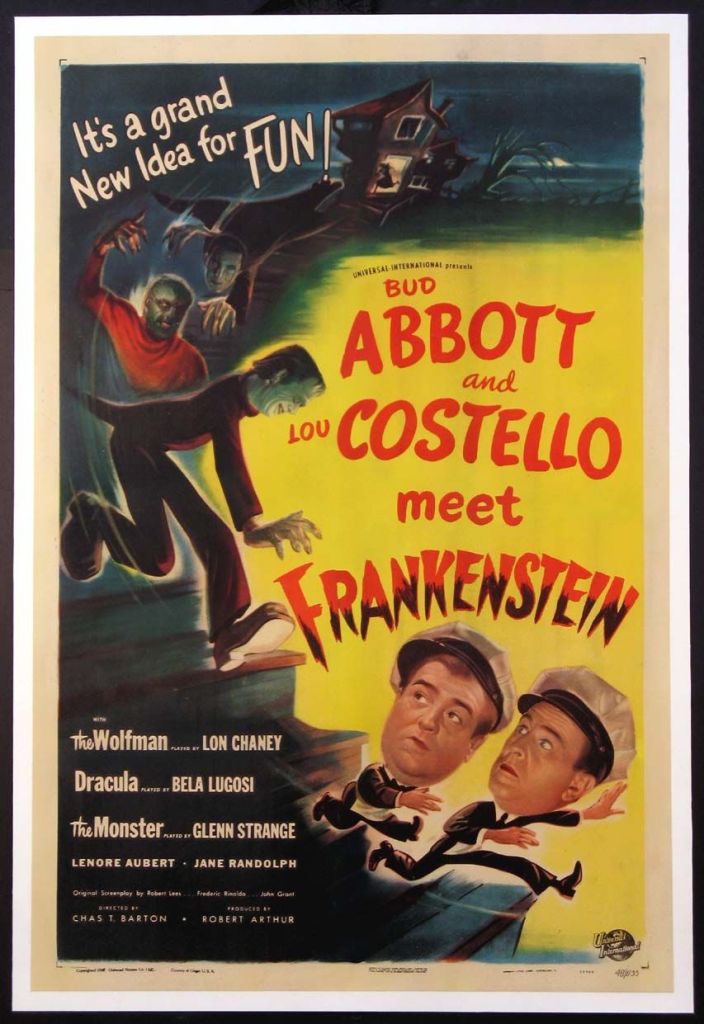
The Plot: Baggage clerks Chick Young and Wilbur Grey (Bud Abbott & Lou Costello) are assigned to deliver two large crates to “McDougal’s House of Horrors”. They soon discover that the crates include the bodies of Count Dracula and Frankenstein’s Monster (Bela Lugosi & Glenn Strange), with the Count planning to revive the monster by putting Wilbur’s brain into its body. The boys are aided by Wilbur’s girlfriend Sandra (Lenore Aubert), insurance investigator Joan (Jane Randolph), and Lawrence Talbot (Lon Chaney Jr.), who turns into the Wolf Man whenever there’s a full moon. But all this is just a backdrop to watch a legendary comedy duo mug their way through some of Universal’s most iconic franchises.

Why It Matters: The NFR gives a plot recap, and states that Lugosi, Chaney and Strange “all play their roles perfectly straight” as foils for Abbott and Costello. There’s a more appreciative essay by Abbott & Costello expert Ron Palumbo.

But Does It Really?: While not in the same league as movie comedy teams The Marx Brothers and Laurel & Hardy, Abbott & Costello’s iconic filmography and pitch-perfect timing are more than deserving of NFR recognition. I suspect the appearance of the Universal monsters gives this A&C outing the edge over their other well-known films “Buck Privates” and “The Naughty Nineties”. “Nineties” has their “Who’s on First” routine, but “Meet Frankenstein” is the overall better film, and is a welcome addition to the NFR.

Shout Outs: Well, obviously “Frankenstein” and “Dracula“, though it should be noted that this film takes its depiction of these monsters from 1944’s “The House of Frankenstein”, not the original classics.

Everybody Gets One: In 1935, vaudeville performer Lou Costello needed a last minute replacement when his comedy partner fell ill. William “Bud” Abbott filled in, and the two officially became a comedy duo the next year. In 1938, Abbott & Costello made their radio debut on “The Kate Smith Hour”, and their successful appearance led to more radio, stage, and eventually film work. Under contract with Universal, the pair became two of the most successful movie stars of the 1940s. By the time “Meet Frankenstein” came about, the duo’s star power was fading, and the team had endured a few personal rifts between them. Pairing the boys with the declining Universal Monsters characters was a last ditch cash grab for Universal, and was one of their cheapest productions that year.

Wow, That’s Dated: In addition to the massive cultural appropriation happening at the masquerade ball, we get the lost attraction of wax museums, and a shoutout to the Lucky Strike slogan.

Title Track: The film was originally titled “The Brain of Frankenstein”, but Abbott and Costello’s names were added to prevent people from expecting another horror film. It should also be noted that this film always refers to the creature as “Frankenstein’s Monster“, meaning the Frankenstein of the title is presumably the doctor, who does not appear at any point in this film.

Other notes 

  • If this is your first viewing of Abbott & Costello, their dynamic might seem a little off-putting; Abbott’s exasperated straight man constantly berating Costello’s energetic man-child. The team had made 21 movies together prior to this, their stage personas firmly established over the previous decade. Like “Road to Morocco“, this NFR entry assumes you know who these two are and what their deal is.
  • Although he played many vampires throughout his career, this was Bela Lugosi’s only official film appearance as Count Dracula following the 1931 original. This was also Lugosi’s last major studio film before resorting to television and the films of Ed Wood.
  • Here’s a weird one: Boris Karloff refused to reprise his role of Frankenstein’s Monster for this movie, but agreed to do publicity for it as long as he didn’t have to see the final film. The role ultimately went to Universal’s other Frankenstein Monster Glenn Strange, and publicity photos of Karloff promoting the film still exist.
  • Lon Chaney Jr. had played Lawrence Talbot, aka The Wolf Man, in four previous Universal films. He is…not much of an actor without that makeup.
  • [Insert Mandatory “Werewolves of London” Reference Here]
  • Shoutout to the Universal effects team for their impressive work transforming Dracula into a bat. Bela Lugosi fades into animation of Dracula turning into a bat, which fades to a live-action model bat on strings. A relic by modern standards, but still cool to watch.
  • Chick and Wilbur live together? Chick is Wilbur’s boss, how does that make any sense?
  • Costello gets to chew the scenery (and excels at it), but Abbott also scores with the handful of punch lines he gets throughout the film.
  • Ah yes, the exhilarating life of an insurance investigator. Romance! Intrigue! Danger!
  • Everyone in this movie follows the Comedy Rule of Peripheral Vision: You can only see things when it’s funny.
  • I am willing to forgive this movie’s “Full Moon” rule about werewolves if they would acknowledge it also works during the moon’s Gibbous phases. Speaking of, The Wolf Man kinda looks like Tim Allen, complete with grunting noises!
  • Why does everyone keep calling Wilbur a “kid”: He’s 42!
  • While pleading with Frankenstein’s Monster, Wilbur repeatedly calls him “Frankie”. That’s what we should be calling the monster!
  • Frankie throws one of the leading ladies through a glass window? You wouldn’t see Karloff do that.
  • The finale ramps up the funny, and I found myself laughing out loud quite a bit. No spoilers, but the movie ends with a big laugh from a surprise cameo. Take that, Nick Fury!

Legacy 

  • “Abbott and Costello Meet Frankenstein” was a surprise smash for Universal, and rejuvenated the comedy team’s sagging career. Universal had the duo “Meet” several of their other properties, including “The Mummy”, “The Invisible Man”, and at last, “The Killer, Boris Karloff”.
  • In addition to their films, Abbott & Costello found continued success in radio, as well as the new medium of television. The duo ended their partnership in 1957, with several factors contributing (overexposure, Lou’s ongoing health issues, the rise of Lewis & Martin). After Costello’s death in 1959, Abbott attempted to revive the act with Candy Candido, but as Abbott later put it, “No one could ever live up to Lou.”

Listen to This: Abbott & Costello had been honing their “Who’s on First?” routine since their vaudeville days, and the bit became their most famous sketch. The earliest surviving recording of “Who’s on First?” comes from a 1938 radio appearance, which made the National Recording Registry’s inaugural class of 2002. A&C expert Ron Palumbo is back with a detailed essay on the history of the routine.

#480) Let’s All Go to the Lobby (1957)

#480) Let’s All Go to the Lobby (1957)

OR “Snacks Haven”

Directed by Dave Fleischer

Song Lyrics by Jack Tillar

Class of 2000 

The Plot: You’re at the movies circa the late ’50s-early ’60s and you still have some time to kill before the main feature. What do you do? Well, these four singing concessions have a great idea: Let’s all go to the lobby and get ourselves a treat! Why these four are encouraging you to eat their own kind I don’t know, but how about that song!

Why It Matters: The NFR calls it “probably the best known ‘snipe’ or theatrical movie trailer ever produced”. There’s also an essay by animation expert Thad Komorowski.

But Does It Really?: “Let’s All Go to the Lobby” is not the first (or in the NFR’s case, 300th) American film that comes to mind when you think “preservation-worthy”, but once it does, it’s an obvious choice. “Lobby” doesn’t so much represent the movies as it does the movie-going experience. Seeing this film immediately brings to mind images of the popcorn and hot dogs in a classic movie palace lobby, and settling in for your feature presentation. Part of preserving art is preserving how that art was viewed, and “Let’s All Go to the Lobby” equals (and in some cases surpasses) the cultural importance of its fellow NFR entries.

Every Chicago-Based Company Gets One: Very little is known about the production of “Lobby” (even the 1957 release date is debatable), but we do know it was made by Chicago’s Filmack Trailer Company. Founded in 1919 by Irving Mack, Filmack specializes in making “snipes”: the short scenes that play before a movie, such as courtesy slides or commercials for the theater. Although Filmack faced some tough times when theaters started converting to digital projectors, the company is still going over 100 years later! That being said, their website is in desperate need of an update. It might as well be on GeoCities.

Title Track: No incredible masterstrokes of genius here; as composer Jack Tillar recalled years later, “I [wrote the song] in about five minutes”. The reason that jingle is so catchy is because you already know it: it’s “For He’s a Jolly Good Fellow” (or “The Bear Went Over the Mountain”, if you prefer).

Other notes 

  • “Let’s All Go to the Lobby” was one of a series of shorts commissioned by Filmack to advertise a theater’s concession stand (the film’s official title is “Technicolor Refreshment Trailer No. 1”).
  • As best we can tell, “Lobby” was directed by Dave Fleischer, who directed many of the Betty Boop and Popeye cartoons of the 1930s. After resigning from Fleischer Studios in 1941, Dave worked at various other studios’ animation departments, and found himself moonlighting at Filmack in the early 1950s, where he made “Lobby”. Fleischer ended his career as a “Technical Specialist” at Universal.
  • I have a bone to pick with the Komorowski essay. At one point Thad mentions that after writing this film’s song, Jack Tillar went on to “a brilliant career that earned him an Oscar, an Emmy, and a Grammy”. I cannot find a single other source that could confirm any of these wins. Sure, information regarding local or regional Emmys can be hard to find, but it’s a lot trickier to fake an Oscar or Grammy win. What’s your source, Komorowski?
  • There’s a dispute over what exactly the concession on the far left is. Some (including the NFR) say it’s chewing gum, other say it’s a candy bar. The concession’s label is mostly incomprehensible, but it could easily read “Candy Bar” if you want it to. Whatever that giant box contains, it is clearly the group’s leader.
  • I couldn’t find definitive information about how much movie theater concessions cost in 1957, but according to this article, you have always been overpaying for movie popcorn. (Appropriately enough, the article begins with a GIF of a scene from “Lobby”!)
  • Can you imagine this playing during the intermission of some prestige roadshow picture like “Lawrence of Arabia” or “2001“? It would definitely “break the spell” of those movies.

Legacy 

  • Filmack estimates that over 80% of all movie theaters have shown “Let’s All Go to the Lobby” at one time or another over the last 60 years.
  • Given its catchy song and cheap animation, “Let’s All Go to the Lobby” is easy to reference and parody. Geico made an updated version a few years back, there was a recent quarantine-specific remake about going to your kitchen, and yes, even a classic “Simpsons” had Mr. Burns warble the tune.
  • Snipes are still commonplace in the movie-going experience (provided the movie-going experience resumes at some point). Everything from trailers to Maria Menounos to the M&M’s telling you to silence your phone are part of this film’s cultural lineage.
  • For the record: my favorite movie snacks are Red Vines and Reese’s Pieces. And if I’m going with another person, I’m willing to split a large thing of popcorn. My movie beverage of choice is Dr. Pepper, but the key is to use the bathroom before sitting in a room for 2 1/2 hours.

Further Viewing: Filmack’s other famous snipe – “Variety Show” – is a ten-minute intermission countdown featuring all the wonderful food you can buy at the concession stand! You may recognize the somewhat suggestive “hot dog jumping into a bun” sequence from its appearance in “Grease“.

#479) Night of the Living Dead (1968)

#479) Night of the Living Dead (1968)

OR “Brains Supreme”

Directed by George Romero

Written by Romero & John Russo

Class of 1999

Thanks to my friend Ryan for sharing his zombie knowledge with me. Go check out his art!

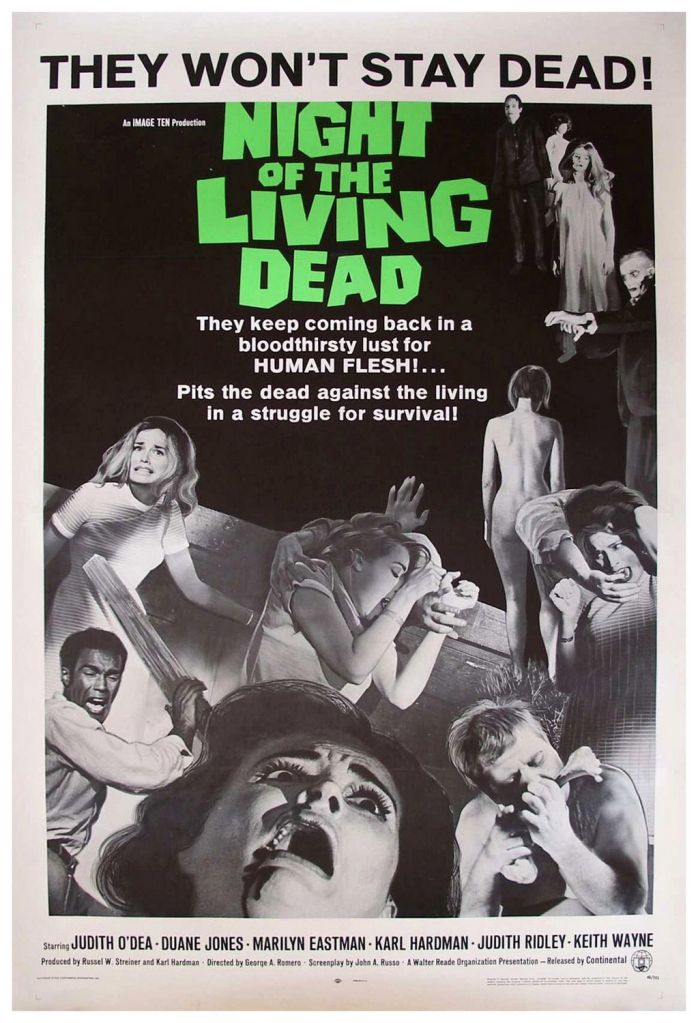
The Plot: While visiting their father’s grave, siblings Barbra and Johnny (Judith O’Dea and Russell Streiner) are attacked by a stranger. Barbra escapes, and takes refuge in a seemingly abandoned house. Also hiding there is Ben (Duane Jones), recently attacked by people who, like Barbra’s assailant, feast on human flesh. Ben and Barbra discover another group (Karl Hardman, Marilyn Eastman, Keith Wayne, Judith Ridley, and Kyra Schon) hiding in the cellar, and together they try to fight off these “ghouls” – revealed to be the recently deceased, returning to life to eat the living. And from this little movie from Pittsburgh stems one of the most successful horror genres of all time.

Why It Matters: The NFR praises the film for “usher[ing] in an entire entertainment industry – the zombie film.” The write-up goes on to praise the film’s “tight editing”, its “unapologetically matter-of-fact approach” to the gore, and its “sociopolitical commentary”. There’s also an essay by horror expert/former “Miami Vice” writer Jim Trombetta.

But Does It Really?: I’m not a horror movie person, but I respect “Night of the Living Dead” for its effective presentation and its contributions to popular culture. Like many a classic low budget fare, “Night” makes up for its lack of funds with plenty of creativity, with Romero and his team using inventive cinematography and practical effects to sell their vision. With an endless cycle of zombie movies still being made today, “Night of the Living Dead” has more than proven its legacy and impact on American films.

Everybody Gets One: A lifelong film fanatic, George Romero got his start making industrial films and TV commercials with his production company The Latent Image. Yearning to do something more creative, Romero, along with his partners John Russo and Russell Streiner, came up with the idea of a low-budget horror film about “flesh-eaters”. The team pitched the idea to producer Karl Hardman, and together they raised $114,000 for the film’s budget.

Wow, That’s Dated: Radio as a primary news source, and TVs with “rabbit ears”. Also, a zombie attack would play out very differently in the age of smart phones and cable news.

Title Track: Originally produced as “Night of the Flesh Eaters”, Romero et al were having difficulty finding a distributor who wouldn’t demand a neutering of the film’s carnage. The Walter Reade Organization agreed to distribute the film as is, on the condition the title be changed to “Night of the Living Dead”. While making a new title card for the opening, the film’s copyright notice was accidentally removed. Under copyright laws of the day, “Night” inadvertently fell into the public domain.

Other notes 

  • Everyone in this movie pulls double duty. Producer Karl Hardman played Harry Cooper, and also helped with the film’s makeup and still photography. In addition to playing Helen Cooper, Marilyn Eastman was the film’s makeup supervisor, and plays the zombie who eats a bug off a tree. Producer Russell Streiner also plays Johnny, and delivers the classic line “They’re coming to get you, Barbra.”
  • Also aiding in the film’s budget: the film’s main setting was an abandoned house set to be demolished, giving the filmmakers carte blanche to destroy it however they needed to.
  • The first zombie attack is exciting, although Barbra does trip over her own heels, proving once and for all that heels are the worst invention ever.
  • The role of Ben was not written to be African-American, but Romero cast Duane Jones because he gave the best audition. Although Ben’s racial background is never explicitly stated or addressed in the film, Duane Jones was able to change Ben’s dialogue and overall characterization to make him a more positive, intellectual depiction of an African-American.
  • Barbra’s near catatonic shock may be realistic, but it does make her one of the less active female leads of any major movie.
  • My god, stop the incessant cricket noises! This is worse than the zombies.
  • Romero was also the film’s cinematographer, and his unconventional camera work lends itself well to the film’s unfamiliar, off-putting presentation.
  • A national emergency with no government strategy? And everyone needs to stay inside? When did this movie become so prescient?
  • The good news about all these TV reports: this is all before the removal of the FCC fairness doctrine. You can actually trust the news!
  • There’s a lot of inertia with these characters standing around the house talking about possible escape plans, but the eventual attacks made me tense, so this movie is doing something right.
  • The dead are being reanimated because of nuclear radiation? When did the zombies become Godzilla?
  • Wow, kids are the worst. The scene of Karen killing Helen with a garden trowel is one of filmdom’s watershed moments in terms of gore, despite being incredibly tame by today’s standards.
  • After completing the final cut of the film, George Romero and John Russo immediately took the finished reels and drove to New York in the hopes of a screening. During their drive, the two heard the news of Martin Luther King’s assassination, giving their film’s ending – in which Ben is mistaken for a zombie and shot by the police – a level of unintentional social commentary that continues to stay with the film.
  • Let this be a reminder: Always cremate your dead.

Legacy 

  • “Night of the Living Dead” opened in October 1968, one of the last unrated films before the MPAA rating system took effect. Despite initial controversy over its graphic violence, the film was a hit, earning more than a 100 times its budget at the box office (though it was the distributors, not the filmmakers, who took in most of that profit). The film’s accidental public domain status helped the film find a cult following on television and home video long after its theatrical release.
  • After a dispute between George Romero and John Russo over the direction of the sequels, the two agreed to make their own sequel franchises, both dealing with the aftermath of the first film’s events. Romero’s “…of the Dead” series has had five entries, with first sequel “Dawn of the Dead” achieving a cult status on par with the original film. Russo’s “Return of the Living Dead” series also consists of five films, and is overall more heightened and less grounded in reality than its Romero counterparts.
  • There have been countless remakes of the original film, most notably Tom Savini’s 1990 version, which amps up the bloodshed and makes Barbra a more active protagonist. These remakes also come with their share of unofficial sequels, prequels, spin-offs and rip-offs. If only they had remembered the copyright notice.
  • George A. Romero’s son – George C. Romero – has written a prequel to his father’s original film called “Rise of the Living Dead”. There was a successful Indiegogo campaign in 2014, but the film has yet to be made.
  • “Night of the Living Dead” has not only been a major influence on the horror genre, but also helped usher in the zombie subgenre that’s still going strong 50 years later. Zombie movies aren’t really my thing, but I did enjoy “Shaun of the Dead”.