
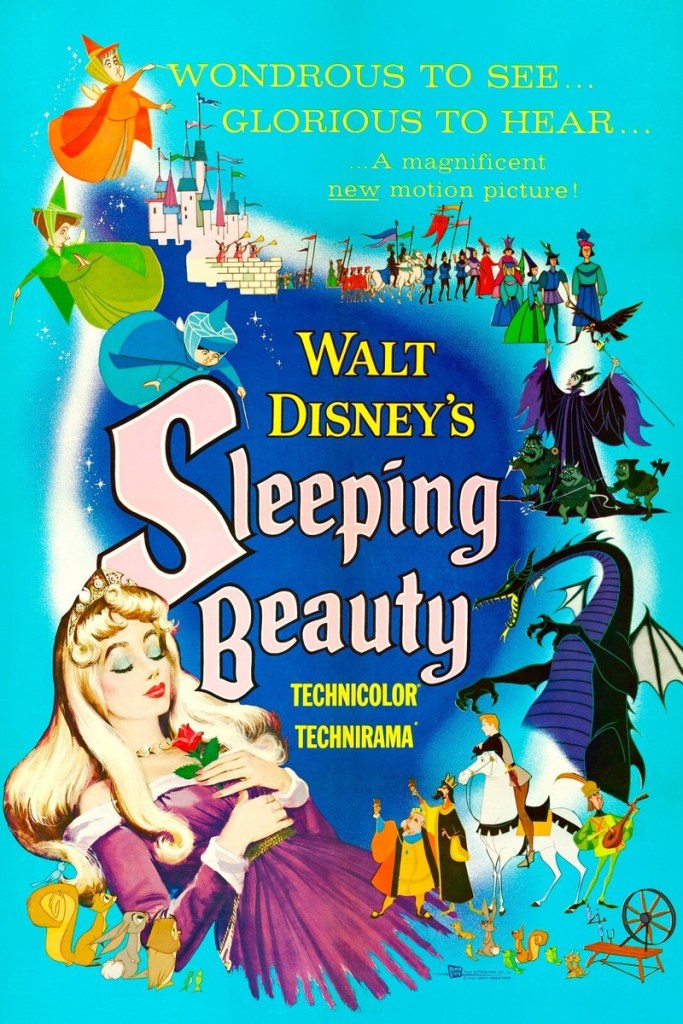
#809) Sleeping Beauty (1959)
OR “Three Fairies and a Little Lady”
Directed by Clyde Geronimi (supervising), Eric Larson, Wolfgang Reitherman, and Les Clark (sequence)
Written by Erdman Penner, Joe Rinaldi, Winston Hibler, Bill Peet, Ted Sears, Ralph Wright, and Milt Banta. Based on the fairy tale by Charles Perrault.
Class of 2019
The Plot: Once upon a time, the beautiful Princess Aurora (voiced by Mary Costa) is born, and her kingdom celebrates at her christening. The festivities are thwarted, however, by Maleficent (voiced by Eleanor Audley) an evil fairy who wasn’t invited. She curses the baby to die on her 16th birthday by pricking the spindle of a spinning wheel. Thankfully, the good fairies Flora, Fauna, and Merryweather, (voiced by Verna Felton, Barbara Jo Allen, and Barbara Luddy) change the spell so that she merely sleeps, to be awakened by true love’s first kiss. That’s about it plotwise, but please enjoy the stunningly beautiful animation as Walt Disney’s brand of storytelling reaches its pinnacle.
Why It Matters: The NFR praises the film’s “magnificent score” and “vivid images and charming details”, while also singling out Maleficent as “one of Disney’s most enduring villainesses”.
But Does It Really?: While not my personal favorite Disney animated film, “Sleeping Beauty” is, for my money, the most beautiful. The artistry on display is so good it distracts from the movie’s thin story and characters. But then again, “Sleeping Beauty” never pretends to be anything other than a wholesome, pure fairy tale, so there’s a lot I’m willing to forgive in the story department. Overall, the movie holds up well and still has enough enchanting moments to be considered among the best Disney films. While I never pushed to get “Sleeping Beauty” on the NFR, I’m glad it made the cut.
Seriously, Oscars?: “Sleeping Beauty” received a single Oscar nomination: Best Music (Scoring of a Musical Picture) for George Bruns’ adaptation of the Tchaikovsky ballet score. The film lost to another NFR entry: “Porgy and Bess”.
Other notes
- Walt Disney began plans for an animated adaptation of “Sleeping Beauty” in 1950, but production was delayed several times throughout the decade. The first draft was scrapped due to its similarities to “Snow White” and “Cinderella”, and then production was delayed in the mid-50s because Walt was unhappy with the animation (he was also focusing more on the construction of Disneyland as well as his slate of live-action movies and TV shows). “Sleeping Beauty” was originally scheduled for a 1955 release before being pushed back to 1957, then 1958, until finally being released in January 1959 at a final cost of over $6 million, the most expensive animated feature up to that point.
- Shoutout to Eyvind Earle, credited for the film’s “Color Styling”, who primarily served as the film’s art director. In an unprecedented move, Walt gave control of the film’s visual style to Earle, the first time a single animator was given that much authority over a Disney film. Earle’s mixture of pre-Renaissance, Medieval, and Gothic gives “Sleeping Beauty” its distinct aesthetic, filling every millimeter of the Technirama 70 widescreen with beautifully detailed backgrounds, helping it stand out among Disney’s other animated features.
- For what it’s worth, Princess Aurora is one of the few Disney heroines for which both of her birth parents are alive and stay alive for the whole movie. Granted she wasn’t raised by them and her mother doesn’t even have a name, but I’ll take what I can get.
- Ah, Maleficent. When it comes to Disney villains, you can’t do much better than a vengeful fairy who looks like the devil and sounds like Cinderella’s stepmother. Eleanor Audley is two for two with iconic Disney villains, and this is her masterwork, cackling and chewing the scenery in her limited screentime. Bonus shoutout to the legendary Marc Davis, supervising animator for both Maleficent and Aurora. Talk about range!
- Outside of Audley, I don’t have a lot to say about the voice cast. Mary Costa definitely has the pipes for Aurora, as does Bill Shirley as Prince Phillip. All three good fairies play well off each other, especially Luddy as stubborn Merryweather. And NFR buffs may recognize Marvin Miller as the narrator; he also narrated “Gerald McBoing-Boing” and voiced Robby the Robot in “Forbidden Planet”.
- In true Disney fashion, a little too much time is spent fleshing out the side characters rather than our protagonists. The fairies are fun and endearing, especially when they try to plan Aurora’s birthday, but most of the film’s screentime is devoted to them rather than Aurora. We don’t even see grown-up Aurora (or Briar Rose, her witness relocation name) until 18 minutes into the movie. It also doesn’t help that Aurora is, ya know, asleep for most of the third act.
- In a film filled with okay songs, “Once Upon a Dream” is the sole standout, serving as the film’s leitmotif (even being referenced as a minor plot point). It’s a charming sequence, although there’s an unintentional lol moment for me when the song ends and Prince Philip softly asks Aurora, “Who are you?”. These are the questions you ask before you start romantically singing at someone.
- I’m trying very hard not to poke holes in a fairy tale, but I have a few questions. First off, they ban all the spinning wheels in the kingdom, so what did they do for clothes for 16 years? And if the curse is lifted after sunset on Aurora’s 16th birthday, why would you bring her back to the castle before sunset? I know, I know, it’s a fairy tale, just let it be.
- I love the reaction shot of Maleficent as she watches her goons capture Prince Philip. It’s like Jane Greer watching the fight/getting secretly turned on in “Out of the Past”.
- That’s one heck of a finale. The score amps up with the action as Prince Philip escapes Maleficent’s dungeon, fights off her goons, and does battle with Maleficent as a fire-breathing dragon. You just wish it went on a bit longer.
- Perhaps the most interesting thing I learned in my research is that in the Perrault version, the prince doesn’t break the spell with a kiss, but rather by being “captivated by her beauty”. So they did have consent back then!
- Speaking of the original fairy tale, are we not doing the second part where Prince Philip’s mother is an ogress who wants to eat Aurora and their children? You know what, good call.
Legacy
- “Sleeping Beauty” premiered in 1959 to mixed reviews. While it did well at the box office, it failed to recoup its budget, resulting in Disney reporting a financial loss in 1960 for the first time in a decade. A subsequent re-release of “Sleeping Beauty” in 1970 finally landed the film in the black.
- Always quick to cross-promote one of his movies, Walt had the castle at Disneyland named after “Sleeping Beauty” (this is 1955 when the film was still due out in 1957). When production was pushed back, dioramas were added inside the castle telling the story of “Sleeping Beauty”, which are still there to this day. Disneyland Paris also has a Sleeping Beauty Castle, complete with its own dragon in the dungeon!
- Like so many other popular Disney franchises, the characters from “Sleeping Beauty” pop up in countless other Disney media, most notably Maleficent who typically serves as the leader of all Disney villains. Maleficent is prominently featured in the theme park show Fantasmic, though due to one viral incident her dragon form no longer breathes fire.
- Speaking of Maleficent, the mistress of all evil has gotten not one but two live-action remake/prequel/sequels starring Angelina Jolie. The first “Maleficent” hit when live-action Disney remakes were still a novelty, but unfortunately “Mistress of Evil” arrived just as we were all getting sick of those damn things.
- But the biggest influence “Sleeping Beauty” had was on Disney animation itself. The film’s financial loss led to layoffs at Walt Disney Productions, and Walt determined that future animation films had to be done much more cheaply. Starting with 1961’s “One Hundred and One Dalmatians”, the original drawings were Xeroxed directly onto animation cels (rather than being hand-painted), resulting in the “scratchy” animation style that defined the next era of Disney animation. It would take 30 years and another fairy tale – “The Little Mermaid” – before Disney animation hit its next zenith.
Further Viewing: “Grand Canyon”, the Oscar-winning short that preceded “Sleeping Beauty” in its original theatrical run. This is why there’s a Grand Canyon diorama at Disneyland!


3 thoughts on “#809) Sleeping Beauty (1959)”