#324) How the West Was Won (1962)

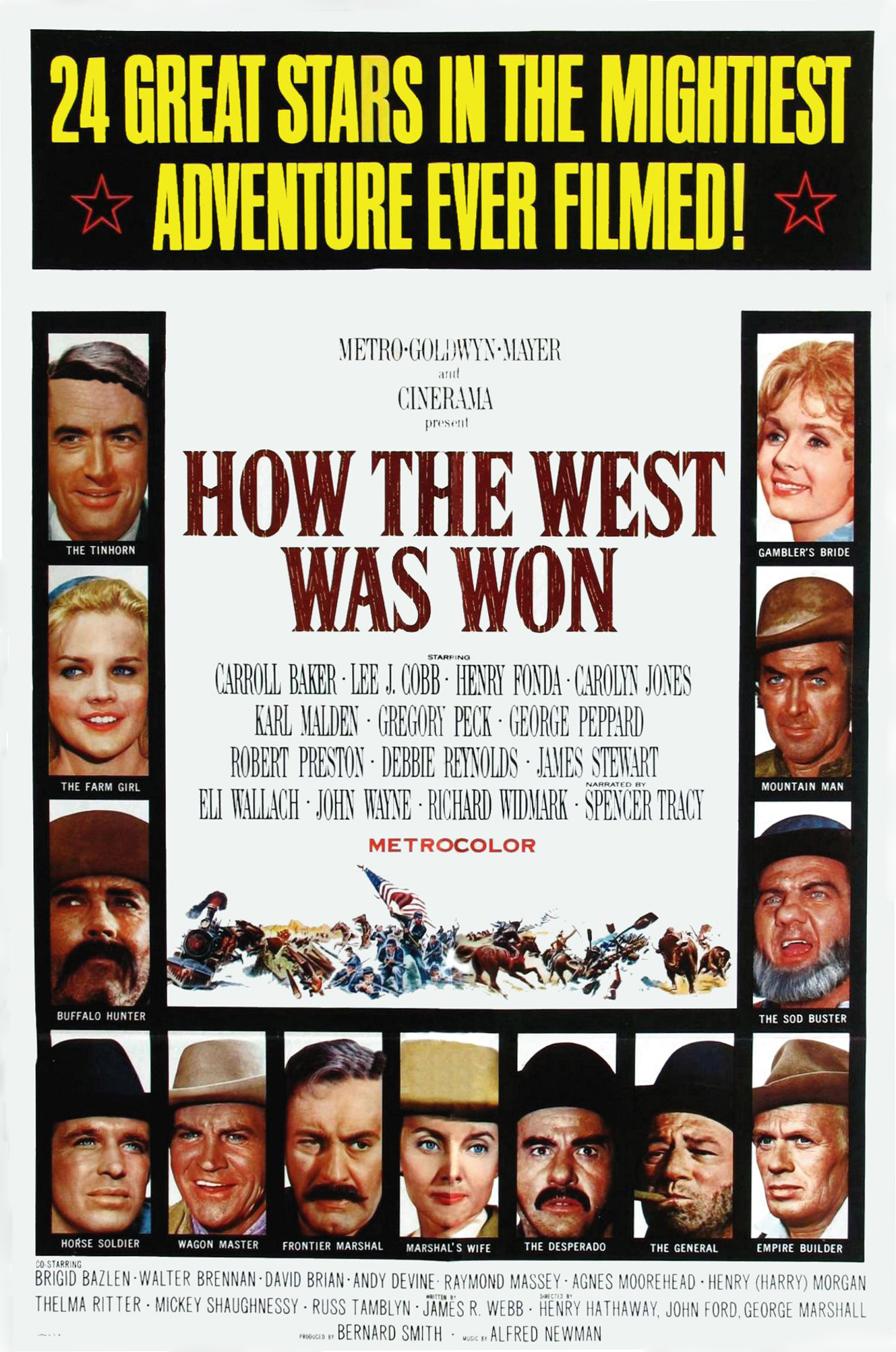
Poster_-_How_the_West_Was_Won

#324) How the West Was Won (1962)

OR “Frontierland: The Motion Picture”

Directed by John Ford (Part 3), Henry Hathaway (Parts 1, 2 & 5), and George Marshall (Part 4)

Written by James R. Webb. Based on LIFE Magazine series.

Class of 1997

The Plot: Narrated by Spencer Tracy and filmed in Cinerama, “How the West Was Won” spans 50 years of the Prescott/Rawlins family traveling and surviving in the American West. In 1839, the Prescott family travels along the Erie Canal to Illinois, with daughter Eve (Carroll Baker) falling for mountain man Linus Rawlins (James Stewart). In 1851, Eve’s sister Lily (Debbie Reynolds) travels across the plains to inherit a California gold mine. In 1861, Eve’s son Zeb (George Peppard) joins the Union Army, serving in the Battle of Shiloh. By 1868, Zeb is in the cavalry, trying to maintain peace between the Arapahos tribe and the impending Central Pacific Railroad. And finally, in 1889, Zeb, now a Sheriff, must protect his family from a bandit (Eli Wallach), and help bring order to the lawless West.

Why It Matters: The NFR calls the film a “sprawling epic” and declares Ford’s segment on the Civil War “probably the best of the film’s three parts”. First of all, the film is five parts. Second of all, no.

But Does It Really?: In an era of filmmaking filled with spectacles, “How the West Was Won” out-spectacles them all. While not without its shortcomings, the film’s expansive Cinerama photography and all-star cast help put it head-and-shoulders above other Westerns of the era. Definitely NFR-worthy, though I recommend watching this on the biggest screen you can find, preferably in the curved “Smilebox” format available on the Blu-Ray release.

Everybody Gets One: James R. Webb got his start at Republic Pictures in the ‘40s writing screenplays for the Roy Rogers westerns. He also wrote the screenplay to the original “Cape Fear”. Producer Bernard Smith was a literary editor and critic during the ‘30s. His few producing credits include this, “Elmer Gantry”, and John Ford’s final films.

Wow, That’s Dated: While there is some nuance to the film’s depiction of Native Americans, they are still secondary to the white settlers who take over their land. Also, thanks to some detailed background action, this film requires a BLACKFACE WARNING. In fact, anyone in this movie who isn’t a white male gets a raw deal overall.

Seriously, Oscars?: Oddly enough, “How the West Was Won” premiered in London in 1962, with American screenings starting in January 1963. At the 1964 Oscars, “West” received eight nominations, including Best Picture. The film won three awards: Editing, Sound, and Original Screenplay. Most egregious of its losses, Alfred Newman’s iconic score lost to Best Picture winner “Tom Jones”, and the film’s four cinematographers all lost to the equally epic “Cleopatra”.

Other notes

  • I know I’ve definitely heard this score before, but until this screening I couldn’t have told you it was from this movie.
  • Cinerama is impressive to watch during the action sequences, but doesn’t lend itself well to more intimate moments. For one thing, close-ups were technically impossible, so the best you can get is a medium shot with plenty of space on either side of the actor.
  • Karl Malden plays Carroll Baker’s father. If you’ve seen “Baby Doll” you understand how unintentionally creepy that is.
  • This movie has not one, but TWO readouts on the Michael Douglas Scale. There’s 23 years between James Stewart and Carroll Baker, and 16 between Gregory Peck and Debbie Reynolds. Oh Classic Hollywood, will you never learn?
  • The film’s first major action sequence is the Prescott’s raft navigating the rapids. If nothing else, Debbie Reynolds is unsinkable, I give her that.
  • It’s fun watching Gregory Peck play against type as a con artist. Also great seeing Robert Preston in the kind of rugged western role he specialized in before becoming a Broadway star.
  • Those are some impressive wagon train sequences. When does someone die of dysentery?
  • How much did years of playing the loveless sidekick damage Thelma Ritter’s self-esteem?
  • The Indian raid wins no points for its depiction of Native Americans, but is an impressive coordination of camerawork and stunts.
  • It turns out “Rosebud” was the name of Andy Devine’s horse. Mystery solved!
  • Despite being one of the film’s biggest stars, John Wayne only has one scene, playing General Sherman to Harry Morgan’s General Grant. Side note: Spencer Tracy was cast as Grant, but bowed out due to health. He became the film’s narrator, a role he is better suited for than original choice Bing Crosby.
  • When quoting Linus, George Peppard does his Jimmy Stewart impression. John Ford hated it, but since re-takes with Cinerama cameras were expensive, this take made the final cut.
  • Appropriate that Henry Fonda plays an old friend of James Stewart’s, since the two were close in real-life.
  • I assume this film utilized every buffalo in existence for the stampede sequence. Another very impressive scene to see on a big screen.
  • It took two hours but we finally get a shot of Monument Valley. No western is complete without a trip to the Arizona-Utah border.
  • Very odd seeing Debbie Reynolds and Carroll Baker in old age makeup. For what it’s worth, they both aged better in real life.
  • “The Outlaws” is the most character driven of the segments, but still packs a punch with its train shoot-out finale. I just feel bad for stuntman Bob Morgan, who was severely injured during the scene’s production.
  • The epilogue includes some beautiful shots of modern-day (1962) Los Angeles and San Francisco. Another point in favor of Cinerama being used for non-narrative travelogues.

Legacy

  • While “How the West Was Won” was successful in its day, studios were wary of doing more narrative films with expensive, cumbersome Cinerama cameras. Later Cinerama films – including “2001: A Space Odyssey” – were actually filmed in standard flat widescreen formats and projected on Cinerama’s curved screens.
  • “How the West Was Won” inspired the 1977 TV miniseries of the same name with Eva Marie Saint and James Arness. This spun-off into a weekly series that ran for two seasons on ABC.
  • It was a screening of “How the West Was Won” that convinced Sergio Leone to cast Eli Wallach as “The Ugly” in “The Good, the Bad and the Ugly”.
  • Most of the film’s legacy has been how many times the title is referenced throughout our culture. But it does give me a chance to reference the 1994 Olsen Twins movie “How the West Was Fun”!

#323) The Forgotten Frontier (1931)

image-w1280

#323) The Forgotten Frontier (1931)

OR “Call the Midwife”

Directed by Marvin Breckinridge

Class of 1996

The Plot: Photojournalist Marvin Breckinridge ventured into filmmaking to document the humanitarian work being done by her cousin Mary in Kentucky. Mary’s organization, the Frontier Nursing Service, provides nurses and midwives to the underserved Appalachian Mountains. In filmed recreations – some involving the actual patients – Mary and her team ride on horseback for miles to help the community, from delivering babies to inoculating children to tending bullet wounds.

Why It Matters: The NFR write-up has no superlatives, just a run-down of the film and its historical context (though one of the sentences is weirdly cut off mid-way through).

But Does It Really?: As always, I will give a film a pass for representing a filmmaker in the Registry and/or highlighting a community that rarely gets recognition. “The Final Frontier” is both, introducing me to the work of Marvin Breckinridge (and her generations of famous relatives) as well as showcasing an organization I’m embarrassed to say I had never heard of. Obviously medical technology has evolved over 90 years, but the Frontier Nursing Service’s rustic beginnings make for a fascinating historical document, and a welcome addition to the NFR. And as for the unsung heroes of the medical profession, lets give nurses three cheers…and significantly higher pay.

Everybody Gets One: Mary Breckinridge had gotten her nursing degree in 1910, but did not pursue a career until ten years later, following her divorce and the death of her two young children. While in Europe she saw the British midwife system in action, and founded the Frontier Nursing Service in 1925 upon her return to America. Mary’s cousin was also named Mary Breckinridge, but went by her middle name, Marvin, to help differentiate between the two. Marvin was an international photojournalist throughout the ‘30s, joining CBS News during WWII and becoming the only woman on the original “Murrow’s Boys” team.

Wow, That’s Dated: It’s a nursing service that relies on horses and river fording. You can pretty much date everything in this movie.

Other notes

  • You know who else is a cousin of Mary and Marvin’s? John Cabell Breckinridge Jr., better known as Bunny Breckinridge, the actor who played the Alien Ruler in “Plan 9 from Outer Space”. I wonder if that ever came up at Thanksgiving?
  • Despite the film’s title and its frequent reliance on horses, this is not a western.
  • There’s a lot of Kentucky/Appalachian terminology I had to look up as I went along. For starters, “fotched-on” is a variation of “fetched-on”, as in someone fetched from another part of the country to the Appalachians.
  • “Hey woman! My woman is a-needin’ you!” Not exactly the Bat-Signal, is it?
  • I know it’s a recreation, but the woman in labor is going for the Melanie Hamilton Award for Most Quiet Childbirth (2018’s winner: Emily Blunt in “A Quiet Place”!)
  • One of the assistant directors of the Frontier Nursing Service is identified as “Miss Peacock”. What happened to her depends on which room she is in, and with what object (and which ending you watch).
  • I like that all of the nurses wear ties and coats while on duty. Gender norms be damned!
  • Is the schoolteacher discouraging her students from getting inoculated? Ah man, even back then history had Jenny McCarthys.
  • There are several scenes where the nurses have to ford a river on horseback. You have to be really dedicated to want to do this line of work.
  • The man who delivers the orphaned babies is referred to as “a widow-man”. Did the term “widower” not exist yet?
  • Another Appalachian term: the “least’uns” is the youngest member of a family. I’m the least’uns of my family!
  • There’s a scene in which an angry man guns down his neighbor. Do you think either of these men were willing to recreate that moment?
  • I’m in amazement that not only does this group of volunteers take the gun victim 16 miles on foot to the nearest hospital, and not only does the surgeon travel 25 miles on horseback to operate on him, but that the victim survived long enough for any of this to happen, AND survived the operation. That’s sheer determination at that point.
  • The final shot is of Mary riding off to help another family, in this instance riding a horse in the middle of the night using a flare to guide the way, which seems terrifying. That is some true dedication to your work. Makes me question all of my life choices up to this point.

Legacy

  • Marvin Breckinridge became a philanthropist towards the end of her life, donating her photos and art to, among other places, the Library of Congress. She lived long enough to see “The Forgotten Frontier” make the National Film Registry.
  • Mary Breckinridge continued to direct the Frontier Nursing Service until her death in 1965. She was inducted into the National Women’s Hall of Fame in 1995, and received her own postage stamp in 1998.
  • The Frontier Nursing Service is still in operation in Kentucky, and was added to the National Register of Historic Places in 1991. You can learn more about them here.

#322) The Adventures of Robin Hood (1938)

adventures_of_robin_hood_ver5

#322) The Adventures of Robin Hood (1938)

OR “Sherwood Flynn and the First Crusade”

Directed by Michael Curtiz and William Keighley

Written by Norman Reilly Raine and Seton I. Miller. Based on the Robin Hood legends.

Class of 1995

The Plot: In the absence of his brother Richard I (Ian Hunter), Prince John (Claude Rains) takes over as King of England and raises taxes on all Saxons. The only man who stands in his way is Sir Robin of Locklsey (Errol Flynn), who rounds up a group of Merry Men to rob from the rich and you know the rest. Along the way, Robin woos Lady Marian Fitzwalter (Olivia de Havilland), fights the evil Sir Guy of Gisbourne (Basil Rathbone), and shows off his archery skills.

Why It Matters: The NFR calls the film “[d]ashing, athletic and witty” and “[o]ne of the most spectacular adventure films of all time”. The write-up goes on to praise Flynn, Rathbone, and their climactic swordfight.

But Does It Really?: There have been more exciting adventure films since 1938, but none of them would exist without this “Robin Hood”. This movie checks off all the boxes you want from a Robin Hood movie, and Flynn leads the film in its sheer entertainment value. “The Adventures of Robin Hood” holds up reasonably well after 80 years, and is worth a watch, as well as more than deserving of it NFR inclusion.

Everybody Gets One: Director William Keighley was originally assigned to “Robin Hood” but, while shooting on-location, was replaced with Michael Curtiz (Producer Hal Wallis felt Keighley’s action sequences lacked excitement). Despite Curtiz helming a majority of the final film, both men received the director credit. Composer Erich Wolfgang Korngold was a child prodigy in his native Austria, composing several operas and ballets. Fellow countryman Max Reinhardt convinced Korngold to come to Hollywood and score Reinhardt’s film of “A Midsummer Night’s Dream”. With the Nazis on the rise in Europe, Korngold stayed in America for the rest of his life.

Wow, That’s Dated: This was Warner Bros.’ first major production in the new process of three-strip Technicolor, hence why everyone in the movie wears such vibrant colors.

Seriously, Oscars?: One of the biggest hits of 1938, “The Adventures of Robin Hood” was nominated for four Oscars, including Best Picture. The film lost Best Picture to “You Can’t Take It With You”, but did win in its other three categories: Art Direction, Film Editing, and Original Score. The film’s win for Score was most noteworthy, as it was the first year the award went to the composer, rather than the head of the studio’s music department.

Other notes

  • With real life historical figures Richard I and Prince John, this movie is technically a sequel to “The Lion in Winter”.
  • Robin’s intro is very Classic Hollywood: A close-up as he rides in on horseback as the orchestra swells. It’s great.
  • Olivia de Havilland is British, but moved to California when she was three, so she’s giving us a very watered down English accent. Also, as of this writing, Olivia de Havilland is still alive!
  • Claude Rains is clearly having a blast in his performance. Prince John is one of the rare movie villains where you get to be undeniably ruthless, yet equally foppish and cowardly.
  • “You speak treason.” “Fluently.” Quick, someone invent the microphone so Robin can drop it.
  • Apparently King Richard took all of his good men with him; these guys are your standard dumb movie henchmen. They outnumber Robin 100 to 1, yet still attack him one at a time.
  • Alan Hale Sr. (yes, father of that Alan Hale) also played Little John in the 1922 silent “Robin Hood” with Douglas Fairbanks.
  • That is some impressive archery work going on here. Apparently each stunt man was paid extra to wear padding and get shot: $150 per arrow.
  • It needs to be pointed out that the Merry Men live a forest life not too different from the Ewoks.
  • Robin and Marian have one of those “he’s a jerk but she’s okay with it” relationships, but it’s slightly more organic and nuanced than in other movies so…yay?
  • The archery tournament is definitely a highlight. Of course archery is one of the world’s more Freudian sports. That helps.
  • Marian’s plan to secretly meet the Merry Men at the tavern involves her wearing the shiniest dress she owns. She might as well have worn a cowbell.
  • This was the third pairing of Errol Flynn and Olivia de Havilland, following “Captain Blood” and “The Charge of the Light Brigade”. No wonder they have such natural chemistry. According to de Havilland, she purposefully ruined take after take of their kissing scene to prolong the experience.
  • The final sword fight between Robin and Gisbourne does not disappoint. As best I can tell, both Flynn and Rathbone did their own fighting.
  • Richard the Lionheart: History’s finest deus ex machina.

Legacy

  • “The Adventures of Robin Hood” was the most expensive Warner Bros. film to date, and their biggest hit of the year. Talk of a sequel “Sir Robin of Locksley” began immediately, but fell through.
  • “Captain Blood” set up Errol Flynn as the swashbuckling action star, and “Robin Hood” sealed the deal.
  • This is the third movie Errol Flynn and Olivia de Havilland starred in together. They did six more, though none as popular as “Robin Hood”.
  • You can see the film’s influence in the similarly themed 1940 version of “The Mark of Zorro”, right down to the swordfight between the vigilante hero and Basil Rathbone.
  • Alan Hale Jr. would play Little John again in 1950’s “Rogues of Sherwood Forest”.
  • Since Looney Tunes and “Robin Hood” are both Warner Bros. properties, Bugs and company took several turns spoofing the film. 1949’s “Rabbit Hood” even goes as far to include actual clips from the movie!
  • There have been many, MANY, retellings of Robin Hood on film over the last 100 years. The later ones usually take a thing or two from the Errol Flynn version.
  • If anyone tells you that the anthropomorphic fox in the Disney “Robin Hood” is hot, do not invite them into your home.
  • “Robin Hood: Men in Tights” owes as much to the 1938 version as it does to “Robin Hood: Prince of Thieves”. I mean, could they have done it without Cary Elwes?
  • Apparently another attempt at updating Robin Hood came and went in 2018. It did not show up on my radar until it got nominated at the Razzies.

Listen to This: Erich Wolfgang Korngold’s score for “Robin Hood” premiered before the movie was released, on a Los Angeles radio program with Basil Rathbone narrating the story of the film. The NRR inducted this program in 2005, calling it “one of Korngold’s most respected dramatic scores”. There’s also an essay by Korngold expert Brendan G. Carroll.

#321) Meet Me in St. Louis (1944)

MV5BZWVmZmRlNWQtYzYyMy00ZDljLWE5MjgtNDE5MGVmYTQ5NDk0XkEyXkFqcGdeQXVyNjc1NTYyMjg@._V1_

#321) Meet Me in St. Louis (1944)

OR “Pride and Prejudice – The Musical!”

Directed by Vincente Minnelli

Written by Irving Brecher and Fred F. Finklehoffe. Based on the novel by Sally Benson. Original score by Hugh Martin and Ralph Blane.

Class of 1994

The Plot:  “Meet Me in St. Louis” is a year in the life of the Smith family at the turn-of-the-century, with the construction of the 1904 World’s Fair as a backdrop. Eldest daughters Rose (Lucille Bremer) and Esther (Judy Garland) are trying to find husbands, while younger daughters Agnes (Joan Carroll) and Tootie (Margaret O’Brien) are adorable/morbid. As the seasons progress, so do Esther and Rose’s respective budding romances, until the day Father (Leon Ames) announces that the family is moving to New York. How will they have themselves a merry little Christmas now?

Why It Matters: The NFR calls the film “charming” and praises Margaret O’Brien for having “the most memorable performance”. An essay by UCLA Film and TV curator Andrea Alsberg contextualizes the film and its production.

But Does It Really?: This one gets a “minor classic” designation from me. It’s good, but something’s missing. Part of that is the absence of the wartime environment the film was produced in (which the aforementioned Alsberg essay helps illuminate), and part is that the movie assumes you know the basic social etiquettes of the early 1900s. Despite this separation, there’s still a lot going for this film. Not every song is a classic, but the standouts are renowned for a reason. Plus you get a Judy performance more mature than her previous fare. “Meet Me in St. Louis” is still enjoyable, but one wonders if future generations will love it as much.

Everybody Gets One: The daughter of a circus performer and a dancer, Margaret O’Brien made her film debut at age four in “Babes on Broadway” (also starring Judy Garland). In her eight years at MGM, O’Brien made 20 pictures, and was known as one of MGM’s “Best Cryers”, a talent she displays in full-force throughout “St. Louis”.

Wow, That’s Dated: Shoutout to cinematographer George Folsey and the Technicolor process. The film’s vibrant color palette could only exist in the ‘40s.

Take a Shot: The song “Meet Me in St. Louis, Louis” was written in 1904 for the World’s Fair. It’s also the reason everyone pronounces the city’s name “Loo-ee” as opposed to the correct “Loo-iss”.

Seriously, Oscars?: One of the biggest hits of 1944, “Meet Me in St. Louis” was nominated for four Oscars, but went home empty-handed. Most egregious was “The Trolley Song” losing Best Song to “Swinging on a Star” from “Going My Way”. A great song to be sure, but come on! The Oscars did, however, present a Juvenile Award that year to Margaret O’Brien for her performance in several films, including “Meet Me in St. Louis”.

Other notes

  • The film’s turn-of-the-century setting seems quaint, but keep in mind it was only about 40 years before the film’s release. It would be the equivalent of setting a current film in the late ‘70s.
  • Agnes colorfully describes how she’ll kill the maid? Tootie buries her dolls at the local cemetery? Meet Me in the Child Psychology Ward.
  • This was the first movie where Judy not only got to play someone on the verge of adulthood, but also was allowed to be pretty. Is it any wonder she fell for Vincente Minnelli?
  • Nothing gets a party going like “Skip to My Lou”.
  • Kudos to Judy for not overpowering Margaret O’Brien during their duet. Now that’s a scene partner!
  • “The Trolly Song” is a delight, although I’ll argue it’s not properly built up. The last we saw John (Esther’s prospective steady), he was faux pas-ing all over the place, now we’re supposed to be happy he hopped on the trolley? Judy, of course, nails the song; the majority of which is in a single take.
  • Ah yes, back when Halloween was more trick than treat. Minnelli and Folsey perfectly capture Halloween night from a child’s perspective.
  • There’s a huge chunk of the movie that Esther is absent for. This must have been during one of Judy’s infamous delays in filming.
  • Mary Astor went from leading lady/Oscar winner to a thankless mom role in less than three years. Hollywood has never been kind to women.
  • This movie is the number one entry on my “Meet Me in St. Louis” list of kinda-Christmas movies.
  • The highlight of the film is Esther singing “Have Yourself a Merry Little Christmas”. Many have covered the song over the years, but no one will top Judy’s performance. With the actual context to help, Judy’s version highlights the song’s inherent sadness.
  • Wait, was Agnes in her bed the whole time Esther was singing and Tootie was crying? Wow, she can sleep through anything.
  • Highlights of the 1904 World’s Fair included the wireless telephone, the x-ray, and a competition of flying machines, which I think is where that stock footage is from. Sadly, no cigarette-smoking robots or Barney Google at this World’s Fair.

Legacy

  • “Meet Me in St. Louis” was MGM’s biggest hit in 1944, and immediate plans were made to turn the film into another “Andy Hardy”-esque franchise. A proposed sequel, “Meet Me in New York”, never materialized.
  • Several of the film’s songs have become standards, but the real breakout was “Have Yourself a Merry Little Christmas”, although the most common version is the one with the Sinatra-mandated altered lyrics.
  • Judy Garland and Vincente Minnelli met on the set of “St. Louis” and were married in 1945. They divorced in 1951, but not before collaborating on four other films and one child: Liza (with a Z).
  • There have been a few adaptations/remakes over the years. A 1959 TV movie starring Jane Powell and Patty Duke followed the film’s screenplay, while a 1966 pilot starring Shelley Fabares never got picked up.
  • Hugh Martin and Ralph Blane composed new songs for a stage version of the film that premiered at – where else – the St. Louis Muny in 1966. This version briefly played Broadway in 1989.
  • The making of “St. Louis” is covered in the TV biopic “Life with Judy Garland: Me and My Shadows”. Judy is played by the incomparable Judy Davis, while Vincente Minnelli is played by…Hugh Laurie?

#320) Chulas Fronteras (1976)

event-poster-10148621

#320) Chulas Fronteras (1976)

OR “Walk the Line”

Directed by Les Blank

Class of 1993

The Plot: Documentarian Les Blank uses his cross-section style of filmmaking (and his eclectic love of music) to highlight the norteño and conjunto music of Mexicans on both sides of the border. Highlights include the “Tex-Mex” (Texans of Mexican descent) community, how music helped aid the migrant farmers and their attempts to unionize, the racism towards Mexicans (and Mexican-Americans) from Texans, and the performers whose music has defined the political and cultural climate for generations of Mexicans.

Why It Matters: The NFR gives a brief overview and calls the film “complex” and “insightful”. There’s also an informative essay by film expert Dr. David Wilt.

But Does It Really?: If you read my post about Les Blank’s other NFR entry, “Garlic Is as Good as Ten Mothers”, you know that I’m not sure about Les having two films on the list. Having now seen both films, I still feel that way. If forced to make a “Sophie’s Choice” (which isn’t on the list yet, BTW), I’d keep “Chulas” and toss “Garlic”. No knock against “Garlic”, it’s just too similar to “Chulas” in terms of style and presentation. “Chulas” is spared thanks to its preservation of two similar cultures separated by an invisible line. And as always with Les Blank’s films, the movie has a great soundtrack. I’m glad Les Blank is represented on the National Film Registry, but one is enough, don’t you think?

Everybody Gets One: A quick word about Les Blank; an English lit major from Phillips Academy Andover (with an MFA in theater), Les got his start making industrial films he would later describe as “insipid”. Once he made enough money from the industrials, Blank founded Flower Films and was able to stay an independent filmmaker for the rest of his life. A meeting with Airhoolie Records founder Chris Strachwitz, led to Les documenting norteño performers (a favorite of Strachwitz’s) for “Chulas Fronteras”. Strachwitz serves as the film’s producer.

Wow, That’s Dated: The fashion, that’s your giveaway. Only in the ‘70s did we think that plaid pants looked good outside of a golf course.

Seriously, Oscars?: No Best Documentary nomination for “Chulas”. The winner for 1976 was fellow NFR entry “Harlan County U.S.A.”

Other notes

  • For the record, “Chulas Fronteras” roughly translates to “Beautiful Borders”. The film begins with a car being moved across the Rio Grande/Rio Bravo. And crossing the border was never that easy ever again.
  • I did not realize that accordions made it to Mexico because of German settlers in Texas in the late 1800s. Didn’t see that coming.
  • Tex-Mex performer Lydia Mendoza is highlighted in the film, as is her recording of “Mal Hombre” (translated here as “Cold-Hearted Man”). Pay attention to those lyrics; what an intense, socially advance song that is. She tells a man how horrible he is because he “treated me like all men who are like you treat women.” It’s a surprisingly frank song.
  • Another song featured is “Los Rinches De Texas” (“The Texas Rangers”) as performed by Dueto Reynosa. It’s a fun upbeat number, until you realize that it’s a song about Texas rangers beating up members of the United Farm Workers who were attempting to unionize. Then-Governor of Texas John Connally is mentioned in the song as “an evil ruler who hates the Mexican and scorns human pain.” That must have done wonders to his approval rating.
  • The song “El Corrido de César Chávez” is a hymn to the civil rights leader. Coincidentally, my hometown of Stockton, California gets a shoutout. Like many before and after, the people in the song are just passing through Stockton to get to Sacramento.
  • The montage in which the actual making of a record was shown fascinated me. No wonder those things are so easy to break.
  • Wow, a lot of these upbeat songs are about institutional racism. That one’s on us.
  • Most of the final part of the movie is devoted to Flaco Jiménez, legendary norteño performer and second-generation accordion player. We see his son learning to play near the end. Flaco is still with us, and still performing at the age of 80!
  • Cacti growing among the barbed wired fence on the border: if that’s not this movie’s theme in a nutshell I don’t know what is.
  • Despite the recurring theme of oppression highlighted in many of the featured songs, Blank does attempt to end the film on a positive note, with a performance of “Mexico Americano” by Los Pinguinos Del Norte. At the end of the day, you have to accept where you come from and embrace it.

Legacy/Further Viewing/Listening: Les Blank and Chris Strachwitz made another documentary about Tex-Mex music, 1979’s “Del mero corazón”. A soundtrack comprised of music from both films was released in the mid-90s.