#222) The Times of Harvey Milk (1984)

a086b25e71462ec5a938e1ef42d1627f

#222) The Times of Harvey Milk (1984)

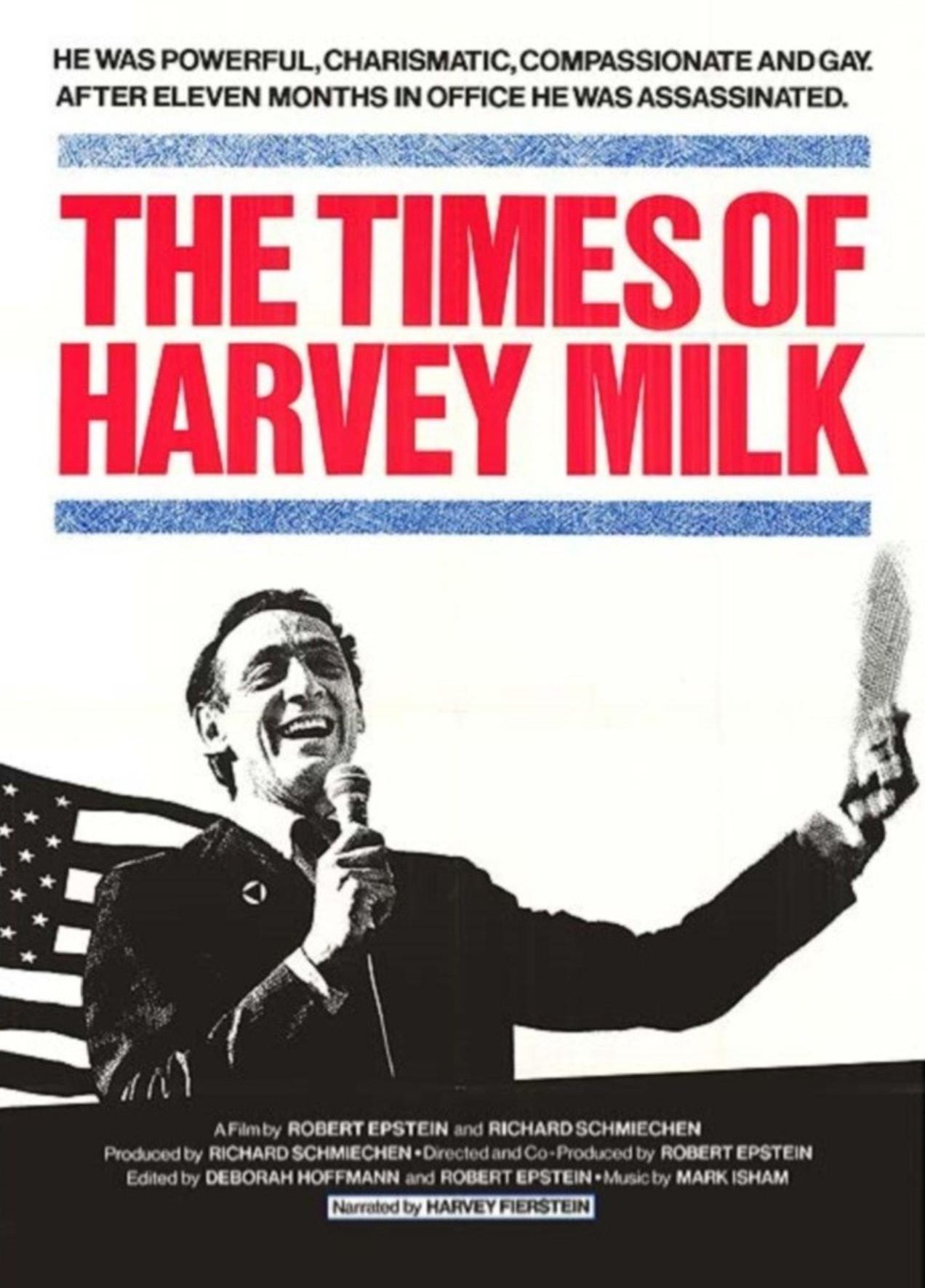
Directed by Rob Epstein

Class of 2012

Not so much a trailer as it is a snippet from the film, featuring “You Make Me Feel (Mighty Real)”.**

The Plot: Utilizing archival footage, local news coverage, and present day interviews with those who knew the man, “The Times of Harvey Milk” chronicles San Francisco’s “Mayor of Castro Street” and California’s first openly gay elected official. Among the topics covered are Milk’s landmark 1977 election to San Francisco’s Board of Supervisors, his stance against the 1978 Briggs Initiative (which would have prevented openly gay Californians from teaching), his tragic murder – alongside San Francisco Mayor George Moscone – by co-supervisor Dan White, and the impact his death had on California and the LGBT community. Narrated by Harvey Fierstein in what may be his least vocally intrusive performance.

Why It Matters: The NFR calls the film a “moving and incisive portrait” as well as “a historical document of a grassroots movement gaining political power through democratic means.”

But Does It Really?: “The Times of Harvey Milk” is being preserved for its standing as a compelling, engaging documentary, and as a time capsule of a specific pivotal moment in American history. Rob Epstein has solidified his place as a pioneering documentarian of gay Americans, and one of his films should be on the list. This film’s cultural significance is already very strong, and I suspect will just keep getting stronger.

Everybody Gets One: Everyone involved in this film, primarily director Rob Epstein (more on him in the “Legacy” section), and narrator Harvey Fierstein (though of his other films, I’m gonna guess the next entry will be… “Independence Day”?)

Seriously, Oscars?: At long last, I have covered an Oscar winning documentary. “The Times of Harvey Milk” is one of only five Best Documentary Oscar winners to make the Registry. Finally, Oscars!

Other notes

  • For weeks I’ve been erroneously calling this film “The Life and Times of Harvey Milk”, but I think it’s important to examine the crucial omission of “Life”. This film isn’t a Harvey Milk biography, but rather a focus on the era in which Harvey Milk came to prominence. There’s virtually nothing about Milk’s life before San Francisco, and his longtime partner Scott Smith only gets a passing reference. This film is about the world Milk came into, and how he changed it. This film is about the man, but more importantly it’s about a moment and a movement.
  • As previously stated, I don’t pick these films too far out in advance, but sometimes the timing is an unexpected bonus. Happy Pride Month, everyone!
  • There’s a brief mention in the narration of Harvey Milk’s time “producing on Broadway”. Turns out he was an associate producer on the 1971 musical “Inner City”, and was an assistant to director Tom O’Horgan for a little thing called “Jesus Christ Superstar”.
  • There’s a lot about Harvey Milk that separated him from other politicians. One of the things this film touches upon is his keen sense of what his district needed and how to get it done. You get a sense of someone tirelessly reaching as many people as he could, not only to help his district and its citizens, but also to help break down the stigma of homosexuality. He made sure you thought of Harvey Milk as a person first, with his orientation being secondary to his humanity.
  • It’s great to see the likes of Annie Kronenberg and Tom Ammiano discuss their time with Harvey Milk, but there are a few noticeable absences, primarily Scott Smith and Cleve Jones. And it seems like teamsters union leader Allan Baird gets a lot of screen time. A bit lopsided, don’t ya think?
  • As a resident of San Francisco, it’s great seeing what the city looked like 40 years ago. For starters, that Safeway is still there!
  • “The reason for all this merriment and gaiety – if you’ll pardon the pun…” Fuck you, Channel 5 Reporter John Lester.
  • Of course all-American white boy Dan White was frustrated on the Board of Supervisors. Between Milk, Ella Hill Hutch, Gordon Lau and Carol Ruth Silver, White was the Board’s “and Peggy”.
  • Milk’s sense of humor also differentiates him from other politicians. No one in politics has a sense of humor anymore. It’s why the White House Correspondents Dinner is always such a downer.
  • In another time or universe, Professor Sally Gearhart would be played by Olivia de Havilland. They have similar mannerisms and cadence. Side note: Gearhart taught at my alma mater SFSU. Go WeDon’tHaveASportsTeam!
  • “The Times of Harvey Milk” was released in 1984, in the midst of the AIDS epidemic. This documentary makes sure to point out that 1978 Ronald Reagan was publicly against the Briggs Initiative (and therefore presumably pro-gay rights), while 1984 Ronald Reagan was actively ignoring the thousands of Americans dying of AIDS during his presidency.
  • I know it’s coming (the film begins with Dianne Feinstein’s announcement of the murders) but Milk & Moscone’s deaths and the immediate aftermath are just heartbreaking.
  • Oh my God, Dan White was 32 when he shot Milk and Moscone. A straight, white 32-year-old man shot a gay peer and the mayor who opposed his return. Shit.
  • This film’s credits list hundreds of contributors who helped finance it. Very telling of not only the importance these people knew this film would have, but also how taboo it still was in 1984 to produce any gay-related film.

Legacy

  • Rob Epstein is still going, with career highlights that include “Common Threads: Stories from the Quilt” (which got him another Oscar), and “The Celluloid Closet”.
  • Many of the participants are still with us and still doing what they can for gay rights. Interestingly enough, teacher Tom Ammiano was elected to the San Francisco Board of Supervisors a decade after being interviewed for this film.
  • Dan White’s release from prison is mentioned in the film, and a year after the premiere, White committed suicide in his home in San Francisco. Epstein initially opposed adding this information to the movie’s epilogue, but eventually included it in some prints.

Further Viewing: If you want the Harvey Milk biopic, look no further than “Milk”. I saw it in 2008 at the Castro Theater, which was an experience unto itself.


**2019 Update: Rejoice, for “You Make Me Feel (Mighty Real)” by Sylvester has just been added to the National Recording Registry!

#221) The Kid (1921)

edited-3sheets-6

#221) The Kid (1921)

OR “Waif Waif…Don’t Tell Me!”

Directed & Written by Charlie Chaplin

Class of 2011

NOTE: As is the case with Chaplin’s “The Gold Rush”, there are a few versions of “The Kid” out there. For this post I watched a restored print that has been cut to best match Chaplin’s 1971 reissue of “The Kid”. That seems to be the one Chaplin wants you to see, so that’s what I’m going with.

The Plot: An unwed mother (Edna Purviance) abandons her newborn child with a note asking its finder to take care of the baby. The child is discovered by a tramp (Charlie Chaplin) who, after a few unsuccessful attempts at pawning off the baby, grows to love him, and takes him in, naming him John. Five years later, the mother is now a successful actress whose charity work coincidentally leads to her meeting her son (Jackie Coogan) without knowing who he is. The Tramp’s attempt to raise a child in the slums without the orphanage taking John away is mixed with Chaplin’s trademark blend of slapstick and pathos.

Why It Matters: The NFR praises Chaplin and calls the film “an artful melding of touching drama, social commentary and inventive comedy.” There’s also a very informative essay by Chaplin expert Jeffrey Vance.

But Does It Really?: “The Kid” is Charlie Chaplin’s first full-length film after six years of shorts, and that alone would be enough for film preservation. But it helps that “The Kid” is on its own merit a very funny and warm film. Chaplin, ever the perfectionist, has crafted a simple yet powerful story with expertly precise filmmaking. He also manages to get a performance out of child actor Jackie Coogan that is neither too sugary nor artificial. “The Kid” doesn’t get the attention some of Chaplin’s other titles get, but it deserves a place on the Registry, as well as on the Mt. Rushmore of Chaplin’s greatest accomplishments.

Everybody Gets One: The major player making his sole NFR appearance here is child actor Jackie Coogan. That adorable kid would grow up to play, and I swear this is true, Uncle Fester on “The Addams Family” TV series. Let that sink in the next time you watch this film.

Wow, That’s Dated: Gaslights instead of light bulbs. Light bulbs were around for purchase at the time, but they were still considered a sign of wealth.

Other notes

  • The opening intertitle describes the film as “A picture with a smile – and perhaps, a tear.” You could put that at the beginning of any Chaplin film.
  • As we watch an unwed mother carrying her baby away from a hospital, we fade to an image of Jesus carrying the cross. Real subtle, Charlie.
  • Carl Miller appears as “The Man” (suggested to be the father of “The Kid”) for one scene. His limited screentime wouldn’t bug me if he weren’t one of only four actors to actually get screen credit, over more prominently featured actors like Tom Wilson as the town’s only police officer.
  • Watching this film in HD brings out with great clarity the layers of makeup some actors have caked on.
  • The Tramp’s first line: “Awkward ass.” I’ve been called that before. Hell, I’ve been called that this week.
  • Yes, our lovable hero: a bum contemplating throwing a baby into an open sewer.
  • The Kid is the only major character who has a name (John). And the scene where the Tramp names him was the film’s first big laugh for me.
  • Ah man, now I want pancakes.
  • The Tramp invented the precursor to the Snuggie!
  • Ah, to be alive in the days when tough guys would wear bowler hats.
  • Surprise cameo by William McKinley as the country doctor.
  • I’m glad we as a society have veered away from the phrase “orphan asylum”.
  • Nice pre-“Vertigo” rooftop chase scene.
  • Did Mom bring her own wind machine to the police station?
  • And then we get to the Dreamland sequence. What the hell does that have to do with anything? Perhaps it’s a young filmmaker used to shorts adding another episode to his screenplay.
  • Side note: The “flirtatious angel” in Dreamland is played by Lita Grey. A few years later Ms. Grey would become the second Mrs. Charlie Chaplin. Not surprising considering that Chaplin’s first marriage to Mildred Harris was dissolving during the shoot.
  • Wait that’s it? The film just kind of ends.

Legacy

  • With the universal success of “The Kid”, Chaplin finished his contractually obligated two-reelers for First National and headed off to his own production company: United Artists. His next few features were more or less vehicles for this film’s leading lady, Edna Purviance, but he struck gold again with, appropriately enough, “The Gold Rush”.
  • Jackie Coogan became a successful child star, and then eventually played, because I can’t mention it enough, Uncle Fester on “The Addams Family” TV series.
  • “The Kid” has been remade twice…for some reason: once in 1986 as the Turkish film “Garip”, and again in 2015 by David Scott Heck, and appears to be a scene-for-scene update of the original.
  • Perhaps to avoid confusion with this film, a 2000 Disney film also titled “The Kid” was marketed as “Disney’s The Kid”. And then that movie disappeared so you don’t have to worry about it.
  • But for me, “The Kid” will always be my nickname for Chaplin’s fourth wife, Oona O’Neill. She was 18 when they wed in 1943; he was 54. We may have to rename the Michael Douglas Scale.

#220) The Pink Panther (1963)

pink9

#220) The Pink Panther (1963)

OR “I’m All Right Jacques”

Directed by Blake Edwards

Written by Edwards and Maurice Richlin

Class of 2010

The Plot: The Pink Panther is the world’s largest diamond, now controversially in the hands of Princess Dala of Lugash (Claudia Cardinale). While on holiday at a ski resort in Cortina, Italy, she is wooed by Englishman Sir Charles Lytton (David Niven), who is secretly notorious jewel thief “The Phantom”. Also mixed up in the attempted theft is Sir Charles’ highly Americanized nephew George (Robert Wagner), and the inspector assigned to the case, the very clumsy and very French Jacques Clouseau (Peter Sellers). Clouseau brings along his wife Simone (Capucine) who, unbeknownst to him, is The Phantom’s secret accomplice/lover. Come for the international intrigue, stay for the beginnings of Sellers and Blake Edwards’ beautiful/rocky friendship.

Why It Matters: The NFR calls it a “comic masterpiece” and praises Edwards, Sellers, and composer Henry Mancini.

But Does It Really?: I’ll argue that “A Shot in the Dark” is the funniest of the “Pink Panther” films, but it’s always fun to watch the first film in a franchise before it became formulaic. As a standalone ‘60s caper comedy it’s fun, but the real joy is watching Blake Edwards realize that Sellers is the MVP. Having Clouseau as a supporting character makes for a film that’s not a complete laugh-fest, but the physical comedy more than makes up for that, and at times is still laugh-out-loud funny. “The Pink Panther” led to a ripple effect that influenced film comedy for the next 20 years (to say nothing of what it did for Peter Sellers), and is one of the more fun entries on the NFR.

Everybody Gets One: Lead performers Capucine (who led a sadly tragic life) and Robert Wagner (who will always be Number Two).

Wow, That’s Dated: This film very much has that ‘60s jet-setting vibe to it. Throw in Italian star Claudia Cardinale and you’ve got yourself 1963!

Seriously, Oscars?: “The Pink Panther” snagged one nomination, but if you only get one, it should be for Henry Mancini’s score. Mancini lost to the Sherman Brothers’ song score for “Mary Poppins”. But you don’t need to feel too bad for Mancini; he had already won three of his four Oscars at that point.

Other notes

  • This film’s most famous piece of trivia was its original casting. Ava Gardner was tapped to play Simone, with Peter Ustinov as Clouseau. When Gardner’s demands could not be met, she left the film, and Ustinov soon followed suit. Sellers was an eleventh hour casting choice, and it was his idea to turn Clouseau from the clueless straight-man to the clueless comic relief. Edwards agreed, and revised the film accordingly.
  • No offense to Saul Bass, but this may be the best animated opening credits sequence ever. Great animation under the direction of David H. DePatie and Friz Freleng, and an iconic score by Henry Mancini. This may be the only movie with a credit for “tenor sax solos” (shoutout to Plas Johnson).
  • Claudia Cardinale: Because Sophia Loren costs how much?
  • Speaking of, Claudia Cardinale didn’t speak English, so her entire performance is dubbed by singer Gale Garnett; who was a few months away from her biggest hit: “We’ll Sing in the Sunshine”.
  • As Clouseau, Sellers is doing lowest common denominator physical schtick. But it’s so well choreographed and perfected, it works. It helps that Blake Edwards knows how to film physical comedy: Long uninterrupted takes, with everything you need in the frame (or comically coming into the frame).
  • There is a long stretch of this movie without Peter Sellers in it, and it is, unsurprisingly, not very funny. It doesn’t help that most of this time is Sir Charles trying to get Princess Dala to pass out from drinking while discussing antiquated gender politics. More pratfalls!
  • Shoutout to ‘60s singer Fran Jeffries performing “Meglio stasera (It Had Better Be Tonight)”. It’s essentially a music video wedged into the middle of this film, but it’s impressively shot and a lot of fun. Points deducted, however, for clapping on One and Three.
  • The centerpiece of the movie is the farce happening in the Clouseaus’ hotel room. Niven, Wagner, and Capucine don’t get the funniest lines, but they are very game for the physical comedy.
  • Blake Edwards loves his party scenes.
  • A few logistical questions about the Phantom. He always leaves a glove embroidered with a “P”. Does he have them custom made for each robbery? Or does he have a bunch made in advance? And is it always the same hand? Did his tailor have to sign an NDA?
  • “The Pink Panther” is in the vein of “The Thin Man” where the title of the franchise is a plot-point from the first film only (although the actual Pink Panther does pop up in some, but not all, of the sequels).
  • They are so clearly setting up the ending to be the first in a series of “Charles and George Lytton” films. What an interesting little “Sliding Doors” moment in film history.

Legacy

  • Peter Sellers’ Inspector Clouseau was so well received, Blake Edwards immediately started rewriting his next film, an adaptation of the stage play “A Shot in the Dark”, to incorporate Clouseau. It’s also the film that brought Herbert Lom’s Commissioner Dreyfus and Burt Kwouk’s Cato into the fold.
  • 1964 was the year that Peter Sellers went from British comedian to international superstar. “Dr. Strangelove” was released in January, “The Pink Panther” in March, and “A Shot in the Dark” in June. None of his other ‘60s films packed the same punch as these three, but it was enough to keep his momentum going.
  • Sellers aside, the film’s biggest breakout star was The Pink Panther himself. The title character appeared in a series of animated shorts throughout the ‘60s and ‘70s, which were eventually aired on television (along with new material) as “The Pink Panther Show”.
  • After being left for dead with 1968’s “Inspector Clouseau” (with Alan Arkin filling in for Sellers and with no involvement from Edwards at all), The Pink Panther franchise was resurrected with 1975’s “The Return of the Pink Panther”. Blake Edwards followed up with two more sequels with Sellers, one with outtake footage of Sellers following his death, and a final film that tried to create a new central character with Ted Wass’ Det. Clifton Sleigh. No takers.
  • I’ll clump the 1993 and 2006 reboots together, because who cares?
  • As for the Pink Panther diamond, I think Richard Burton bought it for Liz Taylor at some point.

#219) The Red Book (1994)

3123.D_1200_700

#219) The Red Book (1994)

OR “Collage Reading Skills”

Directed by Janie Geiser

Class of 2009

The Plot: Through the use of collages and stop-motion animation, “The Red Book” is an experimental film about a…red book and a…nude woman and a…house? I think?

Why It Matters: The NFR’s official write-up consists of an explanation of who Janie Geiser is, followed by Gesier’s description of the film. An essay by film scholar Dr. Holly Willis tries to clarify some of the film’s qualities, but just left me more confused.

But Does It Really?: The NFR has made it clear that “The Red Book” is on the list as a representation of Janie Geiser, and that’s good enough for me. The film is not my cup of tea, but hey, when I’m in the right mood “RocketMan” is a hilarious movie, so I don’t think Geiser’s losing any sleep over my opinion.

Everybody Gets One: After getting a degree in visual arts at University of Georgia, Jane Geiser got a part-time job at Atlanta’s Center for Puppetry Arts. In addition to puppetry, she started making short experimental films. Her puppetry earned her a Guggenheim fellowship in 1992, which lead to focusing more on her films. “The Red Book” is Jane Geiser’s first major film.

Wow, That’s Dated: I can’t put my finger on it, but the film has a ‘90s vibe to it. Like something I’d see on a scrambled cable channel late at night.

Seriously, Oscars?: As best I can figure, “The Red Book” didn’t hit theaters until 1996. Whether or not it was eligible for an Oscar I don’t know. Regardless, the winner for Best Animated Short in 1996 was a film called “Quest”.

Other notes

  • “The Red Book” is primarily in black & white, with splashes of red for emphasis. In other words, the same color scheme as “Schindler’s List”.
  • I was not expecting this film to have full frontal nudity (albeit animated).
  • The male figure featured throughout kinda looks like young Conan O’Brien.
  • What is it with experimental films and falling keys?
  • There are a few moments of Terry Gilliam-esque animation in this. Fortunately no animator suffered a fatal heart attack during production.
  • Hey, that’s a just a live-action clock being filmed! Flag on the play, 15-yard penalty.
  • Backwards singing: very David Lynch-ian.
  • I didn’t realize Guggenheim’s full name is John Simon Guggenheim. For a second I was worried that critic/misogynistic garbage John Simon was involved in this.

Legacy

  • Janie Geiser is still going, making films and puppetry. Her most recent film is 2013’s “Kriminalistik”. (PS: These videos are on her official Vimeo channel, because she’s too cool for YouTube).

#218) A Face in the Crowd (1957)

A_Face_in_the_Crowd-1

#218) A Face in the Crowd (1957)

OR “The Andy Griffith Show: Origins”

Directed by Elia Kazan

Written by Budd Schulberg. Based on his short story “Your Arkansas Traveler”.

Class of 2008

The Plot: While doing a profile on local prisoners for a radio program, Marcia Jeffries (Patricia Neal) meets Larry Rhodes (Andy Griffith) who, despite his drunken and uncouth demeanor, comes across as warm and personable over the airwaves. Dubbed “Lonesome” Rhodes by Marcia, he becomes the hit of Arkansas, even influencing a mayoral election with his opinions. This leads to a national television program, and instant fame. But is Lonesome Rhodes ready to be the voice of the masses? And with a presidential election looming, just how much influence should one person have?

Why It Matters: No major superlatives, but the NFR calls the film a “dark look at the corruptibility of sudden fame and power.”

But Does It Really?: Holy crap Kazan, you and Schulberg had your fingers on the fucking pulse! This film is about the seismic influence television’s “style over substance” M.O. can have on America, and Schulberg and Kazan absolutely nail it. Like “Network”, “A Face in the Crowd” is ahead of its time, and just keeps getting more and more accurate. Budd Schulberg has a lot to say and Elia Kazan knows exactly how to get that message across. Throw in a star-making turn by Andy Griffith and you’ve got a film that deserves a second viewing, especially right now.

Everybody Gets One: This is Andy Griffith’s film debut! He was a stand-up and a Broadway star when Hollywood came a-callin’. It’s a shame he never had another film role as impressive as this one (except of course for “Spy Hard”).

Wow, That’s Dated: This film is a pretty detailed look at how television operated in the ‘50s, mixed with frequent sexism and sporadic racism. On a less depressing note, there’s a “This is Your Life” parody and a look at pre-Power Point presentations (“Next chart, please.”)

Seriously, Oscars?: Reception was mixed on “A Face in the Crowd” upon its release and as a result, no Oscar love. Its only precursor attention was a DGA nomination for Kazan, losing to David Lean’s “Bridge on the River Kwai”.

Other notes

  • Larry Rhodes is allegedly based on a few similar TV personalities of the day, most notably Arthur Godfrey, with a dash of Tennessee Ernie Ford and Will Rogers (who gets name-dropped a few times).
  • It is lovely to see Andy Griffith succeed in a role outside his good-natured straight man Andy Taylor. For starters, we meet him in a local jail. HE’S the Otis!
  • Rhodes is essentially what Stanley Kowalski would be like if he could sing.
  • Kazan earns points for including African-Americans in several (albeit minor) roles throughout the film. It almost makes up for him ratting out all of his colleagues to HUAC. Almost.
  • Selling a mattress sucks, but at least Rhodes doesn’t have to hawk the Garden Weasel. PS: Is this how the Mattress Wars began?
  • Patricia Neal never gets the credit she deserves. In a film dominated by a very flashy central figure, Neal gives Marcia a wonderful, subtle character arc. For me, she’s the most tragic figure in all of this. All she wanted was to highlight real Americans; she got that and more than she bargained for.
  • Love that Vitajax montage. This movie predicted Viagra/advertising specifically to erectile dysfunction.
  • Shout-outs to the supporting cast. Walter Matthau is great in a performance that predates his typecasting as a “grumpy old man”, Anthony Franciosa is excellently despicable as Rhodes’ agent, and Kay Medford nails her one scene as something other than a Jewish stereotype.
  • To add to the realism, Kazan had several news and entertainment personalities cameo as themselves. Among them: Mike Wallace, Faye Emerson, Mitch Miller, Walter Winchell, and Burl Ives, no doubt a favor to his “East of Eden” director, Elia Kazan.
  • That’s Lee Remick in one hell of a film debut! Though I’m pretty sure that’s a double in some of the long shots of her baton twirling.
  • And then we get to Rhodes helping Senator Fuller with his campaign and we start getting such prescient lines as “people want capsule slogans”. It gets a bit eerie.  Well done, Schulberg.
  • Side Note: “A Face in the Crowd” was added to the Registry in December 2008, shortly after the presidential election of Barack Obama over John McCain. This is the election that gave us nationwide exposure to Sarah Palin, whose meteoric rise to fame is not without its similarities to this movie.
  • Shout-out to then-Vice President Richard Nixon, and Checkers too!
  • Blink and you’ll miss a young uncredited Rip Torn as “country boy” Barry Mills.

Legacy

  • “A Face in the Crowd” started getting reappraised in the years following its initial release. One of its key early champions was French auteur Francois Truffaut.
  • Matlock! Maaaaaaatloooooock!
  • Keith Olbermann occasionally refers to fellow pundit Glenn Beck as “Lonesome Rhodes”, a reference that certainly doesn’t help Olbermann shake off his smug liberal persona.
  • Timing is everything: When I picked this as my next film I was not expecting Kazan to be tangentially in the news again.

A Brief Editorial (With Spoilers): I don’t get on my political soapbox too often, but I felt I needed to address something connected to this film. Recently there have been comparisons made between Larry Rhodes and Donald Trump. There are similarities to be sure (both capitalize on mass media, both appeal to the blue-collar public, both antagonize the press, etc.), but the key difference is public and private persona. Rhodes was presenting a wholesome “aw shucks” southern boy to his public, while privately despising them. With Trump, what you see is what you get. When Rhodes is exposed, it’s a betrayal to his adoring public. When Trump brags about sexually assaulting women on the “Access Hollywood” bus, it should be shocking, but it’s not too much of a stretch for a man with Trump’s track record. The parallels are enough to revive interest in “A Face in the Crowd” (TCM played the film on Trump’s Inauguration Day), but it’s not a direct allegory, just a really painful reminder of what we’re willing to accept from our public figures.