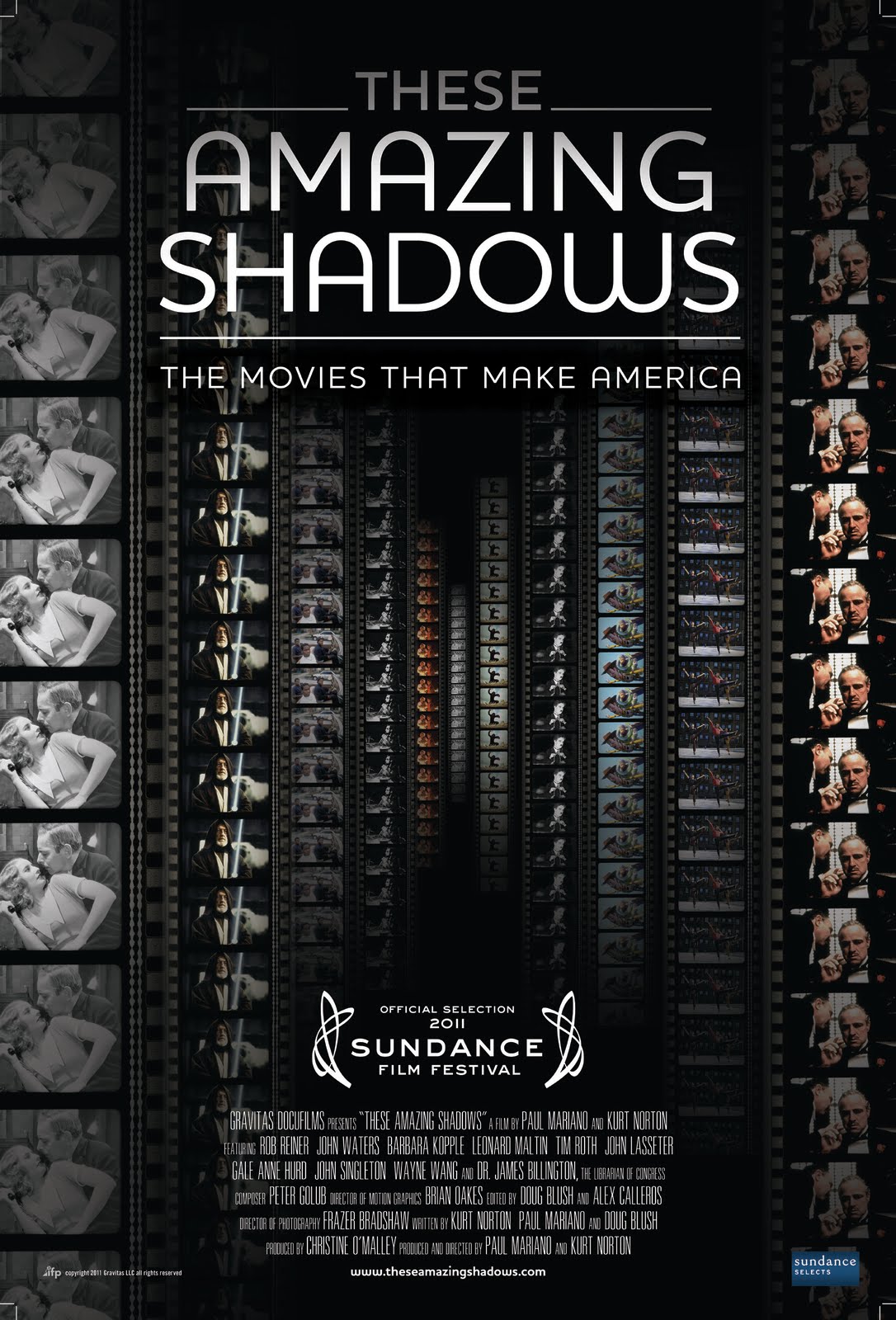
These Amazing Shadows (2011)

shadows

These Amazing Shadows (2011)

OR “National Film Registry: The Movie: The Motion Picture: Tokyo Drift”

Directed by Paul Mariano & Kurt Norton

Written by Mariano & Norton & Douglas Blush

Today marks the one-year anniversary of “The Horse’s Head”! To celebrate me writing about watching movies for a year, I watched a movie about all the movies that I have/will watch and write about.

Released back when the National Film Registry had a mere 575 films on the list, “These Amazing Shadows” is a standard talking-head documentary about the creation of the National Film Registry and its efforts to preserve American film. Interviews are conducted with a variety of subjects: from those who select the films, to those whose work is being preserved. Clips from the honored films are highlighted throughout. Covered topics include proper preservation, racial and cultural representation, the early success and later sidelining of women in the film industry, film as a historical document, and the overall power of the movies. Ultimately the best description of the NFR comes at the end, when it is compared to preserving family photos: This is what we want to show future generations. This is what was important to us.

While conventional in its approach, “These Amazing Shadows” is a rare glimpse into what it takes to become an NFR film. I applaud the filmmakers for making a movie about movies that doesn’t talk down to those who study film, nor alienates those who don’t. If you’re a film nut like me, you’ll get a lot out of this. Personally, “These Amazing Shadows” is a lovely opportunity for me to not only revisit the great films I’ve already watched for this blog, but also to get excited for the films I have yet to see (except you, “Birth of a Nation”). I look forward to the controversial/confusing inclusion of “These Amazing Shadows” on the National Film Registry in 2021.

Shout Outs: By my count there are 126 Registry titles featured in this film (35 of which I have already covered on this blog).

Title Track: NFR preservationist George Willeman utters the title about 17 minutes in. It seems a bit forced, but it works. I personally prefer one of their alternate titles, “To Protect and Preserve”. I wish I had come up with that.

Seriously, Emmys?: “These Amazing Shadows” premiered on PBS in December of 2011, and didn’t get a single Emmy nomination in 2012. Come on, TV Academy! How do you have 900 categories and still not nominate something? What about “Best Adapted Writing for a Nonfiction Unstructured Special Class Program (Non-Prosthetic)”?

Other notes

  • Ted Turner was an asshole for colorizing these films in the first place (even arrogantly referring to them as “my movies”), but without him we wouldn’t have a government-funded film preservation agency. So thank/fuck you, Ted Turner.
  • Of the first 25 films, “The Learning Tree” always gets the shaft. Its only appearance in this film is its poster during the end credits. Come on NFR; you picked it, show some support!
  • Do you think it gets awkward in the meeting room when one of cinematographer/board member Caleb Deschanel’s films comes up for consideration? At the time of filming, only one of his movies (“The Black Stallion”) had made the cut. And how often do you think Leonard Maltin tries to get “Gremlins 2” inducted?
  • Why is Tim Roth being interviewed? “Pulp Fiction” wasn’t on the list yet.
  • “Very often history proves [The Oscars] wrong.” In the case of Best Picture winners (the point this part of the film is trying to make), that’s not true. So far, about 60% of all eligible Best Picture winners have made the cut. Not an exceptional record, but not a rarity either.
  • Hey, don’t knock “Thriller”. It’s awesome!
  • At some point I would love to visit the Library of Congress Packard Campus in Culpeper, Virginia. It may be my personal Mecca.
  • Don’t burn rare film nitrate to prove your point! We can take your word for it!
  • Shout-out to “The Greatest” the 1977 Muhammad Ali film that’s playing at the same theater as “Star Wars”. Coincidentally, both films feature James Earl Jones.
  • The film is quick to switch over to the original unaltered “Star Wars” when the situation dictates (to the point where the dip in quality is noticeable), but manages to overlook using a shot from the “E.T.” Special Edition. The added cape effect is the giveaway. Don’t think I didn’t notice.
  • At face value, having George Takai as a talking head in this film is a bit random. But then you hear him talk about his own experience in a Japanese internment camp and you realize how important it is to not only preserve that footage (“Topaz”) but also to hear about the experience from those who were there.
  • It’s nice to put a face to some of the people whose names I recognize as NFR essay authors.
  • Rob Reiner insists that “The Princess Bride” should be on the list. Give it five more years, Meathead.
  • Filmmaker Barry Jenkins only had a handful of shorts to his credit at the time of this film, but not only is he interviewed, he’s on the National Film Preservation Board. I’m sure we can expect “Moonlight” to make the cut in 2026.
  • Rights clearance to “Apocalypse Now”? Check. Rights clearance to “The End” by The Doors? Well…
  • Debbie Reynolds is only in this film for a hot second, but it’s enough to make me miss her and appreciate how much she did for the preservation of classic movies throughout her life. And now I have something completely unrelated in my eye…

Thanks for joining me for the first year of “The Horse’s Head”. There’s plenty more to come. As always, Happy Viewing!


Tony

#156) Popeye the Sailor Meets Sindbad the Sailor (1936)

MV5BOWZiNmU0ZTgtODJlZC00MWExLTk5NjctNTVmNGMyM2VkYmNkXkEyXkFqcGdeQXVyMDMxMjQwMw@@._V1_SY1000_CR0,0,761,1000_AL_

#156) Popeye the Sailor Meets Sindbad the Sailor (1936)

OR “Hey World, I Yam What I Yam!”

Directed by Dave Fleischer

Class of 2004

The Plot: Three times the length of an average “Popeye” short (and the first in color), Popeye the Sailor (voiced by Jack Mercer) finds himself in an epic showdown with the legendary Sindbad the Sailor (as “played” by Bluto, voiced by Gus Wickie). Sindbad kidnaps Olive Oyl (voiced by Mae Questel), and Popeye must save her. But first he has to get through Sindbad’s island, filled with wild animals and monsters and very realistic set pieces. Good thing he always carries a can of spinach.

Why It Matters: The NFR mentions Popeye’s popularity in the ‘30s, “matched only by Mickey Mouse”, and then calls this short a “classic” and praises the sets. And that’s about it.

But Does It Really?: If you’re going to have only one “Popeye” short on the Registry, this is a good choice. It has all the conventions you want (Bluto kidnaps Olive, Popeye eats his spinach, Wimpy is Wimpy), plus the animation is an impressive undertaking of scope and presentation. Its inclusion is a no-brainer for me. The whole short is, well, strong to the finish.

Shout Outs: Sindbad states that Boola would “frighten King Kong”, an ape that definitely didn’t exist in the 17th Century. Speaking of, what’s the time frame on this one? Did Popeye time travel to the Abbasid Caliphate? Or is Bluto just claiming to be Sindbad in an Emperor Norton-type scenario?

Everybody Gets One: While not his only NFR appearance, it should be noted that Jack Mercer was the official voice of Popeye from 1935 to his retirement in 1980. Stage actor Gus Wickie took over the voice of Bluto from William Pennell for a brief time in the ‘30s, but he got the short that counts. And that’s Dave and Max’s brother Lou Fleischer as the voice of Wimpy.

Wow, That’s Dated: Dynamos as a major power source. And that’s the danger of getting permanent tattoos.

Seriously, Oscars?: The first of the two-reel Popeye Features, “Sindbad” was nominated for Best Animated Short Subject, but lost to Disney’s “The Country Cousin”. Enjoyable to be sure, but nowhere near as impressive an undertaking as “Sindbad”. A Popeye short never won in this category.

Other notes

  • No, that’s not a typo. The name of the title character is “Sindbad” with the extra D. It’s an acceptable alternative to “Sinbad”, no doubt an alternate translation from the original Arabic.
  • I know it’s a rough print, but the cast list only lasts for, like, two frames. Where’s Orson Welles when you need him?
  • This film makes use of the Fleischer “Steroptical Process”; backgrounds built from live action models with the animation superimposed over them. It gives a sense of dimension and depth similar to Disney’s multiplane camera.
  • For those of you keeping score: Number of NFR films directed by Oliver Stone: 0. Number of NFR films featuring J. Wellington Wimpy: 1. (2019 Update: With the inclusion of “Platoon”, this is no longer the case, but for 15 years this stat was absolutely true!)
  • Speaking of, despite his love of food being on display in this short, Wimpy does not say his classic line “I’ll gladly pay you Tuesday for a hamburger today.”
  • I thought Popeye could only perform feats of strength after he’s eaten his spinach. Yet he breaks down a brick wall earlier in the short with no problem. Did he switch to Kool-Aid?
  • Is Popeye a ventriloquist or does he project his thoughts?
  • I’m sure some Lit major out there is pissed that this version doesn’t follow the Sindbad legend too closely.
  • Where does Boola the two-headed giant fit into God’s plan?
  • Personally I don’t care for canned spinach. I prefer the leaf kind.

Legacy

  • The Fleischers made two more “Popeye Features”: 1937’s “Popeye the Sailor Meets Ali Baba’s Forty Thieves” and 1939’s “Aladdin and His Wonderful Lamp”. Both followed this film’s structure of Popeye walking through live-action miniatures and beating up characters from the Arabian Nights.
  • Ray Harryhausen cites this film as an influence on his own take on the Sindbad lore, fellow NFR entry “The 7th Voyage of Sinbad”.
  • “A live–action film adaptation of Popeye? I know, let’s get the guy who directed ‘The Long Goodbye’!”
  • I guess we were going to have an animated film sometime in the last few years? Popeye may be stuck in development hell for a while.
  • But seriously, is Popeye still a thing? Do kids know who he is? I watched him growing up, but that don’t mean nothin’ these days.

#155) Butch Cassidy and the Sundance Kid (1969)

butch_cassidy_and_the_sundance_kid_ver2_xlg

#155) Butch Cassidy and the Sundance Kid (1969)

OR “Parker & Longabaugh Just Didn’t Sound Right”

Directed by George Roy Hill

Written by William Goldman

Class of 2003

The Plot: Partially based on real events, Butch Cassidy & the Sundance Kid (Paul Newman & Robert Redford) are two outlaws who rob banks and trains throughout the Wild West. While travelling through Wyoming with their infamous “Hole in the Wall Gang”, the two discover a mysterious posse in pursuit of them (“Who are those guys?”). Running out of options, they meet up with Sundance’s girlfriend Etta Place (Katharine Ross) and hightail it to Bolivia, though their problems eventually follow them there.

Why It Matters: The NFR praises the work of Newman, Redford, Hill, Goldman, and composer Burt Bacharach.

But Does It Really?: As a continuation of New Hollywood’s deconstruction of the classic Western, “Butch Cassidy” is a fresh spin that never takes itself too seriously. Butch & Sundance are neither heroes nor villains, just two outlaws making it up as they go along. It may be a little too anachronistic for some (even William Goldman felt he overdid it on the “smart-assness”) but the chemistry between Newman & Redford helps smooth over any rough patches and prevents this from being “just another Western”. It might not be one of the great untouchables in film, but I’d put it in the “above average” category entertainment-wise, while its enduring popularity and cultural impact make for an obvious inclusion on this list.

Everybody Gets One: Composer Burt Bacharach, lyricist Hal David, and actor Ted “Lurch” Cassidy.

Wow, That’s Dated: Score by Burt Bacharach. (Yeah, he’s getting a lot of mentions here, but that score is very ‘60s.)

Seriously, Oscars?: Although “Butch Cassidy” won four Oscars (Original Screenplay, Cinematography, Score, and Song), it lost Picture and Director to fellow NFR entry “Midnight Cowboy”. Additionally, it lost Best Sound to “Hello, Dolly!”, a defeat the film can never live down. To add insult to injury, “Butch Cassidy” received no acting nominations for any of the three leads.

Other notes

  • Robert Parker started off as a butcher, while Harry Longabaugh got his first jail sentence in Sundance, Wyoming. There’s your trivia answer.
  • The film George Roy Hill directed immediately before this one? “Thoroughly Modern Millie”. Wrap your head around that one, why don’t cha.
  • Ah, the glorious time when Katharine Ross got “above-the-title” billing.
  • Speaking of, Ross would eventually marry Sam Elliott, who makes his film debut here as a card player in Sundance’s first scene. Elliott and Ross share no scenes and wouldn’t start dating until the late ‘70s, but they’re still going!
  • How much of this movie is in sepia-tone?
  • Butch Cassidy’s gang was actually called the Wild Bunch in real life, but I guess that name was taken.
  • In addition to writing this, “The Princess Bride”, and “All the President’s Men” (among many others), William Goldman also wrote “The Season”, my personal theater bible. He started writing “The Season” shortly after selling the screenplay to “Butch Cassidy”.
  • That’s George Furth as Woodcock, or as I’ll always know him, “Howard Johnson is right!” Coincidentally, this film features brief appearances by future “Young Frankenstein” co-stars Kenneth Mars and Cloris Leachman.
  • The cinematography is just brilliant throughout. Kudos to Conrad L. Hall.
  • “Raindrops Keep Fallin’ on My Head” has nothing to do with the scene it accompanies (or the rest of the movie for that matter), but I’ll be damned if it’s not the catchiest. You can’t imagine any other song being in that scene.
  • Paul Newman should have won an Oscar for the bike stunts alone.
  • I have inexplicably gotten a lot of mileage out of the line “Think you used enough dynamite there, Butch?”
  • There’s a lot of shots (especially during the chase sequences) where there’s action occurring literally miles in the background. That can’t be easy to coordinate. Well done everyone.
  • Here’s what I like about this movie’s dialogue: no one’s spouting witty one-liners, it’s all very organic banter. It’s easy for me to accept that two charismatic outlaws would have this kind of natural repartee.
  • Nope, definitely not stuntmen as Butch and Sundance float down the river.
  • Very considerate of the murderous posse to give everyone time to pack for their trip.
  • So everyone in Bolivia is from Mexico?
  • In addition to the aforementioned catchy song, I greatly enjoy the selection “South American Getaway”. I hear you, Thurl Ravenscroft.
  • As I’ve always said: Behind every great legendary bandit team is a woman whose identity and factual details remain a mystery to this day.
  • Butch & Sundance’s wanted poster doesn’t really look like them. Now they know how Flynn Rider feels.
  • Strother Martin? It’s a “Cool Hand Luke” reunion! Still poor communication skills, however.
  • “Tried new Bolivian restaurant yesterday. Lovely patio seating, great service, but our meal was interrupted by climactic shoot-out. Good entrée, though. 2 out of 5 Stars.”

Legacy

  • Newman & Redford would reunite with George Roy Hill for 1973’s “The Sting”, which won Hill an Oscar and would eventually find its own place on the NFR.
  • The prequel “Butch and Sundance: The Early Days”, starring the legendary pairing of Tom Berenger and William Katt (“The Greatest American Antihero”?)
  • Two separate films that focused on Etta Place’s life after Butch & Sundance: “Wanted: The Sundance Woman” with Katharine Ross reprising her character, and “Mrs. Sundance” starring Elizabeth Montgomery.
  • Both leads named non-profits after elements of this film: Redford with his Sundance Institute (as well as the film festival), and Newman with his summer camp Hole in the Wall Gang Camp.
  • The TV show “Alias Smith & Jones” got its general vibe from this film.
  • Everyone who’s ever needle-dropped “Raindrops Keep Fallin’ on My Head”.
  • As for the real Butch & Sundance, who the hell knows?

Listen to This: There’s no Bacharach on the National Recording Registry? Come on!

#154) This Is Spinal Tap (1984)

zKtSTZnLUs88y2R8MhAw4hvL5eO-2

#154) This Is Spinal Tap (1984)

OR “Mock & Roll”

Directed by Rob Reiner

Written by Reiner & Christopher Guest & Michael McKean & Harry Shearer

Class of 2002

The Plot: Filmmaker Marty Di Bergi (Rob Reiner) documents the British heavy metal rock band Spinal Tap and its three lead members (Christopher Guest, Michael McKean, Harry Shearer) as they embark on a tour of America to promote their new album. The film chronicles the band’s clashing artistic styles, the tour’s frequent cancellations, and the mysterious deaths surrounding several former band members.

Why It Matters: The NFR credits “This Is Spinal Tap” with inspiring the mockumentary genre. I mean, it’s no “David Holzman’s Diary”, but what is?

But Does It Really?: Oh yes. In addition to its influence on mockumentaries (which is still being felt today), “Spinal Tap” is still one of the most consistently funny films ever made. You can tell that everyone involved got the joke, and what you’re seeing is the best of the best improvisations. There’s a love for real heavy metal rock here, which helps balance out the sheer ridiculousness of the band and its antics.

Everybody Gets One: Main band member Michael McKean, as well as pretty much the entire cast, most notably: Ed Begley Jr., Paul Benedict, Dana Carvey, Howard Hesseman, Patrick Macnee, Paul Shaffer, and Fred Willard.

Wow, That’s Dated: Besides the obvious references to the ‘80s heavy metal scene, there are references to cassettes and NBA player Julius “Dr. J” Erving.

Title Track: Jeanine actually does say, “This is Spinal Tap” when introducing the band at the Air Force Base.

Seriously, Oscars?: Critically hailed but commercially ignored on its initial release, “Spinal Tap” failed to receive any Academy Award nominations. In a year that included “Amadeus”, “Places in the Heart” and “The Killing Fields”, no one on the Academy was in the mood to laugh.

Other notes

  • There’s that goddamn Studio Canal logo again. It’s so jarring. Who thought that was a good idea?
  • This was Rob Reiner’s first film as a director. Way to hit it out of the park on the first try.
  • This film actually fares okay on basic cable. Nothing gets cut; they just bleep out the language, like you would for an actual documentary.
  • The songs in this film really don’t get the credit they deserve. Reiner & Guest & McKean & Shearer not only wrote rock songs that sound like the real things, but their pastiches of the band’s early folk incarnations are spot-on as well.
  • Keep in mind that at this point in time, Michael McKean was best known for playing Lenny (or possibly Squiggy) on “Laverne & Shirley”. Quite a far cry from this type of comedy.
  • Because of this film, I have used “Shit sandwich” as an expletive on multiple occasions.
  • It’s fun to look for the shots where they clearly made each other laugh. Most of the time they immediately cut away, but if you look closely you can see everyone (most notably McKean) come close to corpsing on camera.
  • What can I say about any of the film’s iconic moments? These go to 11, Stonehenge, getting lost to the stage. It’s all just as funny as it was the first time. I ain’t gonna try to analyze it. It still works.
  • Don’t think I didn’t catch that, Harry Shearer using your real voice as the radio announcer.
  • That’s future Oscar winner Anjelica Huston in an early film role as Polly Deutsch, the designer who misinterprets the Stonehenge blueprints.
  • This film loves wordplay, most notably Sir Denis Eton-Hogg and the Isle of Lucy.
  • A lot of the quick cameos in this film are worth noting, but my favorite is Fred Willard. He always excels as the guy who tries a little too hard to be everyone’s pal.
  • My hometown of Stockton, California gets a shout-out towards the end of the film. Contrary to how it’s portrayed here, Stockton does not have a “Themeland Amusement Park”. To the best of my knowledge, that’s actually Six Flags Magic Mountain in Santa Clarita.
  • I do love a good Joe Besser reference.

Legacy

  • Christopher Guest waited a decade before bringing the “Spinal Tap” team back together for “Waiting for Guffman” and several other acclaimed mockumentaries (although he objects to the term “mocumentary” because he does not believe his films mock anyone).
  • Spinal Tap reunited in 1992 to promote their new album “Break Like the Wind”, and again in 2009 with “Back from the Dead”
  • Fran Drescher reprised her role of Bobbi Flekman in a 1997 episode of “The Nanny”.
  • Many bands have cited “Spinal Tap” as an influence or as hitting too close to home. Metallica released its own Black Album in reference to “Smell the Glove”.
  • “Up to 11” has become such a mainstream phrase it has its own Wikipedia page.
  • But perhaps the band’s greatest reunion came on “The Simpsons” episode, “The Otto Show”. It helps that one of the regular “Simpsons” cast members is Harry Shearer.

Further Viewing: Spinal Tap’s long running opening act The Folksmen got their own film in 2003. “A Mighty Wind” is the Christopher Guest gang at the peak of their collaborations.

#153) Jam Session (1942)

hqdefault

#153) Jam Session (1942)

OR “Six Ways to Soundie”

Directed by Josef Berne

“C Jam Blues” composed by Duke Ellington

Class of 2001

The Plot: Duke Ellington and his band perform “C Jam Blues” in a bar. That’s it. That’s the whole thing.

Why It Matters: The NFR mentions this film’s designation as a Soundie, described as “a musical film played on jukebox-like devices found in social clubs and bars.” An essay by jazz film expert Mark Cantor gives a thorough history of the Soundies.

But Does It Really?: We’ll get more of Duke Ellington throughout the Registry, but this short gets a pass for its representation of the Soundies. To quote the aforementioned essay “The significance of this film is clear, and its placement on the Registry well warranted!” Yeah, Cantor actually ends his essay with that. The exclamation mark is there too. Go ahead, click the link.

Everybody Gets One: Many of the band members also appear in Duke’s other NFR entry “Black and Tan”, but I’ll give them a shout-out anyway. On violin, Ray Nance! On trumpet, Rex Stewart! On saxophone, Ben Webster! On trombone, Tricky Sam Nanton! On clarinet, Barney Bigard! And on drums, Sonny Greer!

Wow, That’s Dated: “Harlem Cats Eatery”. Plus the halcyon days of the clarinet as a jazz instrument. It was mainly just Barney Bigard and Benny Goodman.

Other notes

  • Did RCM Productions steal their logo from 20th Century Fox?
  • “The Soundies” seems like it should be the uninspired name for a sound mixing award, doesn’t it? How many times has Kevin O’Connell lost that one?
  • Lunch is only 23 cents! That’d be about $3.50 today! It’s a steal!
  • Trombonist Joe Nanton earned the nickname “Tricky Sam” from Duke’s saxophonist Toby Hardwick. The tricky part I get, it’s the Sam part that doesn’t add up. I guess you had to be there.
  • So if I play jazz in a bar, women will randomly show up and fawn over me? Noted.
  • In doing my research, I learned that one of the companies that made Soundies was called “L.O.L. Productions”. As best I can tell the initials stood for the founders, two of which were Arthur Leonard and Sam Oliphant. Oh, where are you, second L?

Legacy

  • While Soundies went out of fashion with the advent of television, it did pave the way for the modern music video. I have an unlimited selection of music video I could link to, but God help me, it’s Mick Jagger and David Bowie’s “Dancing in the Street” that’s calling to me right now.
  • “C Jam Blues” has been covered many times over the years. Lyrics were eventually added and the song came to be called “Duke’s Place”.
  • Director Josef Berne would direct many Soundies, including a few more with Duke. His moment in the sun came when he directed the 1943 short “Heavenly Music”, which won the Oscar for Best Live-Action Short.
  • An animated show where Duke Ellington is an advice-spewing ghost voiced by Jordan Peele? I mean, you’re picturing it, and we’re talking about it…