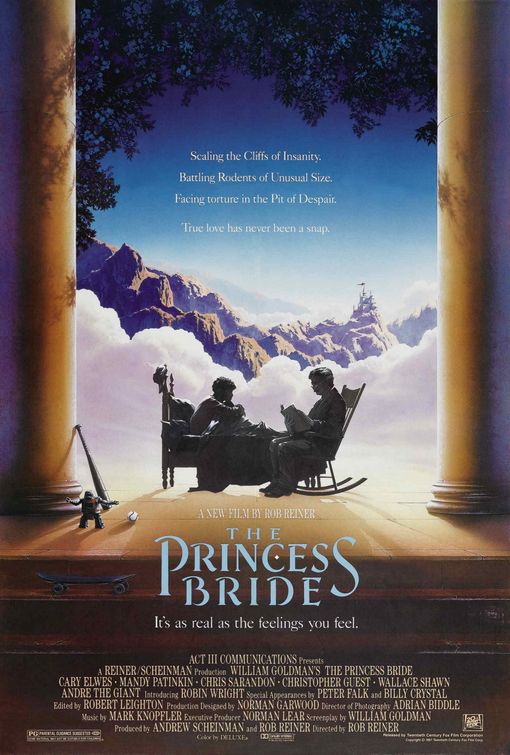
#112) The Princess Bride (1987)

princess_bride

#112) The Princess Bride (1987)

OR “Build Me Up, Buttercup”

Directed by Rob Reiner

Written by William Goldman. Based on the novel by S. Morgenstern.

Class of 2016

The Plot: As told by a grandfather (Peter Falk) to his sick grandson (Fred Savage), “The Princess Bride” is a romantic fairy tale about the beautiful Buttercup (Robin Wright) and her love for farm boy Westley (Cary Elwes). When pirates break them apart, Buttercup becomes engaged to the evil Prince Humperdinck (Chris Sarandon) and is kidnapped by a trio of bandits (Wallace Shawn, Mandy Patinkin & Andre the Giant). There’s swordplay, wordplay, magic and yes, a few kissing parts.

Why It Matters: The NFR calls the film “one of the decade’s most beloved…feel-good movies”. And then, like a true “Princess Bride” fan, they just keep quoting the film.

But Does It Really?: This is one of those great “something for everyone” films. It’s romantic, and adventurous, and funny in just the right amounts. The film skewers classic tropes in just the right places, and is perfect homage without ever becoming spoof. Films like these always look simple, but are actually quite difficult to pull off. Reiner, Goldman, and the entire team not only accomplish this, but also create a classic that holds its own alongside the real thing.

Everybody Gets One: Broadway legend Mandy Patinkin, future TV star Fred Savage, British comedians Peter Cook and Mel Smith, and Andre the Giant, possibly the only professional wrestler on the Registry. And although this is Cary Elwes’ only film on the registry, I suspect they’ll put “Glory” on here sooner or later.

Wow, That’s Dated: A soundtrack performed almost entirely on keyboards is the film’s most ‘80s quality.

Title Track: Peter Falk says the name of the book only once at the very beginning.

Seriously, Oscars?: “The Princess Bride” received one Academy Award nomination; Best Original Song for “Storybook Love”. The song is buried in the second half of the credits and is easily the least awards-worthy aspect of the entire film. “Storybook Love” got its forgettable butt handed to it by the category’s winner; “(I’ve Had) The Time of My Life” from “Dirty Dancing”.

Other notes

  • The first sound heard in this romantic swashbuckling fairy tale is that of a child coughing.
  • So if this book has been read by father to son for generations, why isn’t Fred’s dad reading it? Is he dead or just deadbeat?
  • The romantic tension between Cary Elwes and Robin Wright is palpable from their first scene together. It really does help propel the film.
  • Ah, the pre-Internet days when you could cast a Chicago-born man of Jewish descent as a Spaniard. Good luck getting away with that today.
  • What is it with William Goldman and characters that can’t swim?
  • I mentioned it before, but I really do not like this synthesizer score. It just doesn’t sound right.
  • Cary Elwes must have been so happy when he realized he looked like Errol Flynn.
  • Those ROUSs are creepy as hell. Well done, design team.
  • ‘80s Chris Sarandon kinda looks like Mark Ruffalo.
  • Shoutout to Margery Mason’s brief but memorable turn as The Ancient Booer. She lived to be 100 years old!
  • Odd that Count Rugen didn’t set his torture device to 11.
  • In his cameo as Miracle Max, Billy Crystal fulfills his destiny as America’s elderly Borscht Belt comedian. As his wife Valerie, Carol Kane gives us a preview of her character Lillian from “Unbreakable Kimmy Schmidt”.
  • Speaking of cameos, Peter Cook man. Talk about a strong choice.
  • Although she gets an “Introducing” credit at the end, this is actually Robin Wright’s second film. Her first was 1986’s “Hollywood Vice Squad”.

Legacy

  • A day where no one relentlessly quotes this film? Inconceivable!
  • Rob Reiner followed up “The Princess Bride” with such iconic films as “When Harry Met Sally…”, “Misery” and “A Few Good Men”. And then… “North” happened.
  • Cary Elwes as a dashing leading man never went further than “Robin Hood: Men in Tights”.
  • Someone turned this film into a video game. The only other Registry entry that can make that claim is “Chinatown”.

#111) Black and Tan (1929)

Screen Shot 2017-09-21 at 8.05.38 PM

#111) Black and Tan (1929)

OR “The Gospel According to Duke”

Directed & Written by Dudley Murphy

Class of 2015

The Plot: Duke (Duke Ellington) is an aspiring pianist who can’t catch a break. His girlfriend Fredi (Fredi Washington) lands a gig at a nightclub and arranges it so Duke and his band can perform there too. But Fredi’s heart condition rears its ugly head during the performance, and this look into the Harlem Renaissance gets real depressing real fast.

Why It Matters: The NFR singles out “Black and Tan” as “one of the first short musical films to showcase African-American jazz musicians”.

But Does It Really?: I give it a pass for Duke Ellington’s film debut, as well as its brief but important insight into the beginnings of the Harlem Renaissance. But be warned; for a short featuring several of Duke’s songs, it’s a real downer.

Everybody Gets One: Most of the creatives behind “Black and Tan” appear in Dudley Murphy’s fellow NFR entries “The Emperor Jones” and “St. Louis Blues” (the latter which was shot concurrently with this film).

Wow, That’s Dated: Four words: The Cotton Club Orchestra.

Title Track: The song “Black and Tan Fantasy” appears throughout the short, and is referenced by name before its reprise in the finale.

Other notes

  • Edward Kennedy Ellington got the nickname “Duke” as a child when his mother insisted on him dressing well and having good manners. His elegant appearance did not go unnoticed by his classmates.
  • Duke’s leading lady Fredi Washington was by all accounts a very talented actress and performer, but had trouble finding work due to being a light-skinned African-American. She is probably best remembered for playing the mixed-race daughter of the maid in the original version of “Imitation of Life”. Her career also included appearing in the original production of “Shuffle Along” and touring with Josephine Baker.
  • Speaking of, Fredi and Duke actually dated at one point, though I’m not sure whether it was before, during or after “Black and Tan”. Washington ended up marrying Ellington’s trombone player, Lawrence Brown, in 1933.
  • Arthur Whetsol can play a muted trumpet like nobody’s business.
  • You think it was hard for those two guys trying to move Duke’s piano out of the apartment? Wait till you hear about the two guys who pushed it up the stairway…
  • The only information I could find about the dance team in this film is that they were a specialty group called the Five Blazers. Such precision.
  • Well Cinematographer Dal Clawson clearly had fun with that kaleidoscope camera trick. Either Fredi is ill or those shots are from a fly’s point of view.
  • Okay Clawson, enough with the upskirt shot, thank you very much.
  • Wow this short is depressing. Now I know why they call it the blues.

Legacy

  • Duke Ellington didn’t make a lot of films after “Black and Tan”, but when he did he was either playing himself or providing the jazziest film scores. And sometimes, in the case of “Anatomy of a Murder”, both.

Listen to This: How could the National Recording Registry possibly pick one Duke Ellington song for its inaugural selection in 2002? The solution; pick them all. The Duke Ellington Orchestra’s RCA Victor recording sessions were all preserved in one fell swoop, highlighting his collaboration with bassist Jimmy Blanton and saxophonist Ben Webster from 1940 to 1942. Perhaps best known of their work is “Take the A Train”.

#110) Ferris Bueller’s Day Off (1986) [Original 2017 Post]

ferris_buellers_day_off

#110) Ferris Bueller’s Day Off (1986)

OR “The Best Von Steuben Day Movie Ever”

Written & Directed by John Hughes

Class of 2014

UPDATE: This is the original “Ferris Bueller” post. You can read the revised and expanded version here.

The Plot: Ferris Bueller (Matthew Broderick) is a high school senior who fakes an illness to spend the day with his girlfriend Sloane (Mia Sara) and his best friend Cameron (Alan Ruck). An eventful day through Chicago is almost thwarted by Ferris’ sister Jeannie (Jennifer Grey) and the high school’s borderline psychotic Dean of Students Ed Rooney (Jeffrey Jones). Oh, and it’s John Hughes, so all the teens are complex and come of age by the end. Plus it’s got a kick-ass ‘80s soundtrack.

Why It Matters: The NFR calls the film “a career highpoint” for John Hughes and singles out Broderick’s performance.

But Does It Really?: Oh but of course. This film is so charming and innocently fun how could you possibly hate it? It’s not hyperbole; Matthew Broderick is giving the best performance of his career in “Ferris Bueller”. The whole thing is wonderfully performed, masterfully edited by Paul Hirsch, and of course beautifully helmed by John Hughes. The film is an infectious love letter to Chicago, and more importantly to that very magical window of your life right at the end of high school when anything is still possible.

Shout Outs: References are made to “Dirty Harry”, “Star Wars”, “Alien”, and Hughes’ previous film “The Breakfast Club”.

Everybody Gets One: This is the only film on the Registry for pretty much everyone except Matthew Broderick and John Hughes. I’ll give a shout out to Charlie Sheen (though I suspect some of his other ‘80s fare will make the cut eventually) and the blink-and-you’ll-miss-it appearance by a young Louie Anderson.

Wow, That’s Dated: Like so many ‘80s films, “Ferris Bueller” reeks of its decade of origin, most conspicuously the soundtrack and all of the technology in Ferris’ room. On a similar note, how much longer is extending your thumb and pinky going to be the universal symbol for “phone”?

Seriously, Oscars?: No Oscar nominations for anyone, but Broderick did get a Golden Globe nod for Best Actor in a Comedy or Musical. He lost to Crocodile Dundee.

Other notes

  • Matthew Broderick was briefly engaged to his on-screen sister Jennifer Grey. So that’s how it is in their family…
  • In addition to being very clever and creative in his endeavors, Ferris benefits from having really oblivious parents.
  • What’s with the roll call in the economics class? There’s about six As, one B (Bueller…Bueller…) and then straight to the Fs (Frye…). How big/small is this class?
  • Everyone in this film is great, but Edie McClurg is the MVP.
  • Depending on your definition, Ferris’ claim that the (then) Sears Tower is the tallest building in the world might be incorrect, even in 1986.
  • This is one of many high school films in which none of the main actors were in high school. Mia Sara comes closest; she was 18 during filming.
  • Just a reminder that Alan Ruck was 29 when he played Cameron. That’s 29 years old. Carry on.
  • When all is said and done, I just don’t get modern art.
  • How the hell did they get the rights to a Beatles song? This was right after Michael Jackson bought the whole catalog and the songs became, to say the least, a bit pricey.
  • “Twist & Shout” is my favorite scene in the film, but then again isn’t it everyone’s favorite?
  • This is one of the rare times where knowing a little bit about a performer’s personal life makes their work much more interesting. If you know what Jeffrey Jones was arrested for in 2002, then watching him take repeated kicks to the face is just lovely.
  • And yes, that’s Charlie Sheen. Blah blah blah tiger’s blood, blah blah blah winning.

Legacy

  • An official attempt at a “Ferris Bueller” TV series, and its Fox bastardization “Parker Lewis Can’t Lose”.
  • We’re never getting a sequel, but we did get a Super Bowl commercial.
  • Not one, but two bands in the 90s.
  • Ben Stein’s acting career.
  • The reason the band Yello never has to worry about running out of money.
  • What became of Ferris? Well I hear he settled down with Patty from Weemawee High School.
  • And of course, every post-credits sequence ever.

#109) Gilda (1946)

gilda_ver2

#109) Gilda (1946)

OR “Don’t Lie to Me, Argentina”

Directed by Charles Vidor

Written by Marion Parsonnet. Story by E.A. Ellington. Adaptation by Jo Eisinger.

Class of 2013

The Plot: American gambler Johnny Farrell (Glenn Ford) ends up in Buenos Aires working for Ballin Mundson (George Macready), owner of an elegant illegal casino. A few months later, Mundson returns with his new wife Gilda (Rita Hayworth), who instantly recognizes Johnny. Turns out that they had a past together, and a bizarre love triangle unfolds as Johnny and Gilda’s tempestuous relationship comes to the forefront.

Why It Matters: The NFR says that this movie “defined the Hollywood glamorization of film noir”, especially in its fetishization of Hayworth. There’s also an essay by Kimberly Truhler, author of film fashion website GlamAmor.com, that focuses on Rita Hayworth and costume designer Jean Louis.

But Does It Really?: While I personally would place this film in the “good-not-great” category, I give “Gilda” a pass for it film noir notoriety, its star-making turn by Hayworth, and its legacy in connection with another film (See “Legacy” below).

Everybody Gets One: Perhaps most shocking, this is Rita Hayworth’s only film on the National Film Registry**. But hey, if you’re going to pick one…

Wow, That’s Dated: Old phrases like “case the joint” and “cock-eyed”. Plus a saying about Native Americans that definitely wouldn’t fly today.

Seriously, Oscars?: While “Gilda” did not receive any Oscar nominations, it did compete in the very first Cannes Film Festival in 1946. Didn’t win anything, but at least it was in competition.

Other notes

  • I don’t single out producers as much as I should on this blog, and special mention needs to be made of this film’s producer; Virginia Van Upp. She started as a screenwriter and worked her way up to producer after helping salvage the 1944 musical “Cover Girl” (also starring Hayworth). She was one of only three female contract producers in Hollywood for most of the Golden Age.
  • That’s a pretty cool opening shot. Not sure what it has to do with the rest of the film, but there it is.
  • I am convinced that Mundson also played the bad guy in “Indiana Jones and the Last Crusade”.
  • Gilda’s introductory shot, man. I don’t normally go for the Old Hollywood beauties, but after that I’m hooked.
  • Does everyone in this film talk in aphorisms?
  • Hayworth definitely knows her way around a suggestive line. The censors must have pulled their hair out with some of these line readings.
  • It’s one scene (between Gilda and a maid named Maria that we never see again), but this is one of the rare NFR films to pass the Bechdel test. Again, just barely. Like a D-.
  • The film’s almost complete lack of a score is a nice subtle choice. It helps build the tension in all of the secrets being kept.
  • At one point Gilda says “You wouldn’t think one woman could marry two insane men in one lifetime.” Yes, Gilda. Yes I would.
  • “Put the Blame on Mame” is a pretty sultry number. My question is when did she have time to rehearse? Also, how dare you pin this on Angela Lansbury! What did she ever do to you?
  • Not to spoil anything, but I do love movies where the bad guy gets interrupted while they’re monologuing. Ain’t nobody got time for that.

Legacy

  • “Gilda” is best known today for being the film Andy Dufresne sees in prison in “The Shawshank Redemption”.
  • The fourth atomic bomb dropped in the Bikini Atoll test of 1946 was nicknamed “Gilda” and had a poster of Rita Hayworth taped to its side. Hayworth did not appreciate the gesture.
  • Rita Hayworth’s performance in “Put the Blame on Mame” is one of many film noir performances thrown into Michael Jackson’s “This Is It”.

Further Viewing: To make up for the lack of Rita Hayworth on this list, be sure to check out some of her other classics. I recommend “The Lady from Shanghai” by her then-husband Orson Welles, and “You Were Never Lovelier” one of her early musicals with Fred Astaire.


**2017 Update: As if they heard me, Ms. Hayworth is now additionally represented by “Only Angels Have Wings“. But still check out those other movies too.

#108) The Corbett-Fitzsimmons Fight (1897)

1297800528

#108) The Corbett-Fitzsimmons Fight (1897)

OR “Aging Bull”

Directed by Enoch J. Rector

Class of 2012

The Plot: Footage of the championship boxing match of James Corbett defending his heavyweight title from Bob Fitzsimmons on March 17th, 1897 in Carson City, Nevada. Although the entire match was filmed, all that survives today is the final 20 minutes.

Why It Matters: The NFR gives a detailed rundown of the film’s historical context. Also included is a photograph of the fight that showcases the camera set-ups.

But Does It Really?: Historically yes. It’s kind of amazing that we owe the ability to film feature-length productions to some guy wanting to record a boxing match.

Everybody Gets One: Enoch J. Rector was an early film technician and boxing promoter who may or may not have invented the Latham Loop used to film this fight. As for the boxers themselves, “Gentleman Jim” Corbett was the World Heavyweight Champion at the time and was among the first to incorporate a scientific approach to his boxing technique. Bob Fitzsimmons, aka “The Freckled Wonder”, was known primarily for his fights in Australia, and is still one of the lightest heavyweights ever to compete professionally.

Wow, That’s Dated: Back then boxing had just become legal in the state of Nevada, so the idea of actually being able to watch a boxing match in broad daylight was pretty exciting. Also bowler hats, we need to bring those back.

Other notes

  • Among the film’s historical achievements; it was the longest film produced at the time, and was possibly the first widescreen film (albeit in roughly 1.65:1, not too different from today’s HDTVs). And while not the first boxing film to be exhibited, the length of the fight led to its success, as most prior filmed boxing matches ended in KOs during early rounds, leading to paying customers feeling cheated.
  • When did we move boxing indoors?
  • I wrote this post in the midst of a heat wave, so being toweled off by an attentive pit crew sounds great right about now.
  • There’s something delightfully 1890s about the rounds being called by a man lifting his hat in the air.
  • In true sports fashion, the final knockout is presented again in instant replay.

Legacy

  • Both Corbett and Fitzsimmons continued fighting, though a string of losses led to Corbett’s early retirement. Corbett pivoted towards performing, and his autobiography was eventually turned into the 1942 film “Gentlemen Jim” starring Errol Flynn.
  • Part of this film’s success was the ability to watch a boxing match in real-time. Some things never change.