#701) The Beau Brummels (1928)

#701) The Beau Brummels (1928)

OR “Two for the Show”

Written by Al Shaw & Sam Lee

Class of 2016

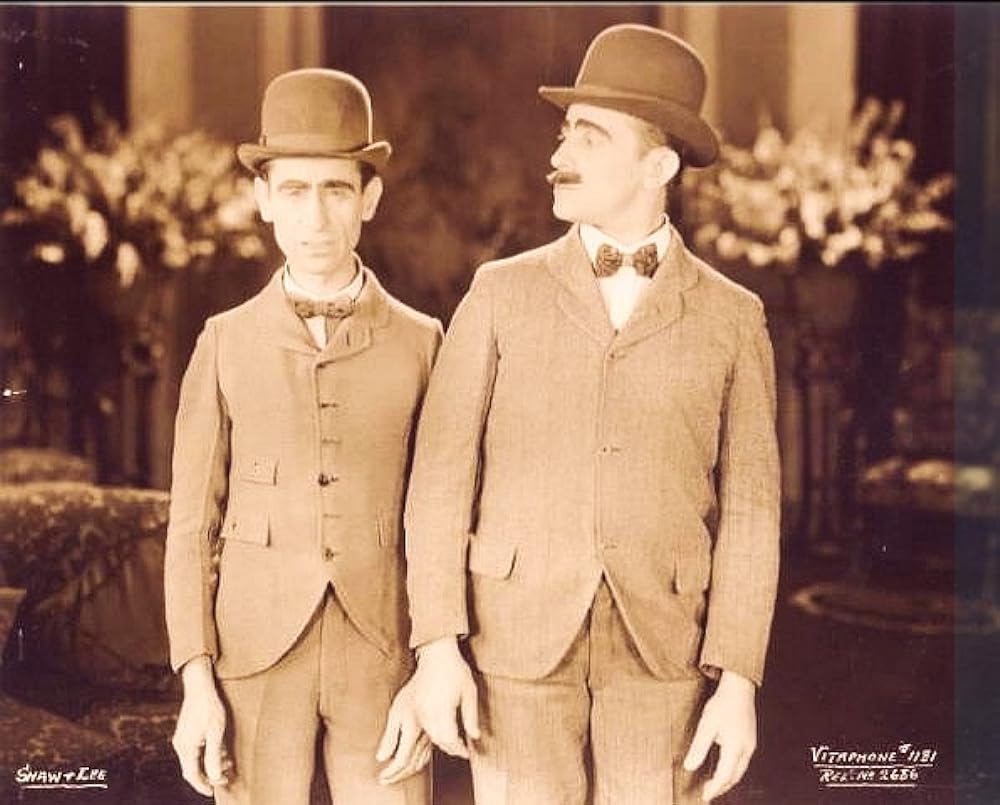
The Plot: The technological miracle of Vitaphone synchronized sound brings you the comedy stylings of Al Shaw & Sam Lee, aka Shaw & Lee! Straight from vaudeville, this comic duo performs a seemingly endless exchange of jokes and one-liners, as well as songs like “Don’t Forget to Breathe or You’ll Die”. Stick around at the end for a little soft-shoe, plus their famous hat swapping routine!

Why It Matters: The NFR gives a brief history of Shaw & Lee, stating “their brand of dry, offbeat humor is seen by some as well ahead of its time.” The write-up also includes a quote from critic Jim Knipfel: “If Samuel Beckett had written a vaudeville routine, he would have created Shaw and Lee.”

But Does It Really?: As much I enjoyed these two, I’m on the fence about this film’s historical significance. Don’t get me wrong, I laughed a lot at the unexpected absurdism of “The Beau Brummels”, but the NFR already has a Vitaphone short with a comedy team doing their vaudeville act: 1929’s “Lambchops” with the significantly more famous Burns & Allen (in fact, I’m convinced both movies use the same set). But if I’m going to nitpick, it stands to reason that if the NFR has enough room for more than one Marx Brothers comedy or Astaire/Rogers musical, then I guess there’s enough room for a second Vitaphone short. A pass for “Beau Brummels”: It’s not the most important film on the list, but it’s funny (and short) enough to warrant a viewing for the curious.

Everybody Gets One: Most of my information on Shaw & Lee comes from this very insightful article by historian Mary Mallory. Both Al Shaw & Sam Lee started in show business at a young age; Shaw in the music halls of his native England, Lee on the streets of his native New Jersey. Although stories differ on how Shaw & Lee met, we know that Shaw emigrated to America in 1907, and by 1911 the two were performing as a duo in vaudeville and burlesque. Originally, Shaw & Lee were a dance team, but over time they started adding their off-beat jokes into the act. By the early 1920s, Shaw & Lee were promoted to headliners, starring in several revues, including a few big ones on Broadway. When Warner Bros. started making sound shorts out of their recently purchased Vitagraph studio in Brooklyn, any famous stage performers with a ready-to-go act were brought in to film their routines, and Shaw & Lee got the call in early 1928. And for any future historians confused by which is which: Shaw is the shorter, clean-shaven one on the left side of the screen, Lee is the taller one on the right with the mustache.

Title Track: Much like the unrelated ’60s rock group of the same name, this film got its title from George Bryan “Beau” Brummel, a Regency-era Englishman who has become the cultural shorthand for high fashion. Shaw & Lee were known for performing on stage in nice suits, and advertisements for the two started referring to them as “The Beau Brummels” (although that was never officially the name of their act).

Seriously, Oscars?: No nominations from the newly formed Academy for “The Beau Brummels”. Create a shorts category, you cowards!

Other notes

  • Aside from Shaw & Lee themselves, there is no credit for any of the creative team on this film. I gave Shaw & Lee a writing credit at the top of this post based on my own assumption, but as is often the case with vaudeville, some of these jokes are older than the hills.
  • Right off the bat, you know these two aren’t your typical “take my wife, please” comedians. We begin with their rendition of “The Fountain in the Park” that rhymes “strolling through the park one day” with “the merry merry month of June”. The song then segues into a semi-stream of consciousness, including a verse in Yiddish!
  • I love that this is clearly just a filmed version of their vaudeville routine with no attempt to adapt it for this new medium. For example: Shaw & Lee always pause for laughs, which if you’re watching this in a movie theater with a big audience makes sense, and if you’re watching it by yourself on a TV or computer just adds to the overall absurdity.
  • Wow, these two were doing risqué updates on the “Jack and Jill” nursery rhyme long before Andrew “Dice” Clay.
  • Shaw & Lee’s presentation of their routine is fascinating. Except for their dance at the end, the two stand perfectly still, facing the camera/audience, delivering their jokes in a dry, wooden tone. It starts to feel like the kind of anti-comedy routine Andy Kaufman would perfect 50 years later: It’s so stilted it must deliberate.
  • The first true groaner of the jokes was the one about the 30,000 geese Lee has on his porch. Shaw: “Must be Portuguese.” 
  • My favorite exchange is Lee saying he works for his father. What does his father do? “He’s laid off.”
  • In a short that has already challenged my preconceptions of vaudeville-era humor, things get meta at the end with the song “This is the Chorus”, with lyrics that state which part of the song they are singing. It reminded me a lot of the theme song from “It’s Garry Shandling’s Show”. Finally, an excuse to mention Garry Shandling on this blog, because “What Planet are You From?” sure ain’t making the list anytime soon.
  • Another sign of a cut-and-pasted vaudeville routine: Shaw & Lee bow to house right and house left at the end of the act.

Legacy

  • “The Beau Brummels” was released in January 1928, playing in Los Angeles before screenings of the crime drama “Lights of New York”, Warner Bros.’ first “all-talking” picture. Funnily enough, “Beau” seems to have gotten the better reviews of the two. The short was successful enough that in 1930 the two filmed another Vitaphone short based on their routine: “Going Places”.
  • As the 20th century went on and vaudeville continued to go the way of…well, vaudeville, work for Shaw & Lee started to wane (though allegedly Burns & Allen assisted in getting them gigs in the later years). The duo continued to make appearances in film, on stage, and eventually on television, making their final appearance together playing two repairmen in the 1958 George Gobel comedy “I Married a Woman”. Sadly, this appearance would be a posthumous one for Al Shaw, who died in 1957 at age 66; Sam Lee followed in 1980 at age 88.
  • “The Beau Brummels” got a restoration in the early 2000s from the UCLA Film and Television Archive, with funding from the Vitaphone Project. While Shaw & Lee didn’t leave behind much of a legacy, “Beau Brummels” – along with “Going Places” – continues to be seen online and shared by new generations caught completely off-guard by their avant-garde style of humor.

#700) Midnight Cowboy (1969)

When I started this blog in January 2017, the National Film Registry totaled 700 movies, and even as that number grew over the last seven years, my goal from the start was to hit that 700 milestone. It has been quite the journey getting to this moment, and it is with immense pride that I present…

#700) Midnight Cowboy (1969)

OR “Rock the Voight”

Directed by John Schlesinger

Written by Waldo Salt. Based on the novel by James Leo Herilhy.

Class of 1994

The Plot: Joe Buck (Jon Voight) is a young, naïve Texan who moves to New York City with a dream of becoming a sex worker (“hustler” in his parlance) catering to rich older women. After an unsuccessful start with a bored Park Avenue socialite (Sylvia Miles), Joe meets Enrico “Ratso” Rizzo (Dustin Hoffman), an impaired Brooklynite con man who takes him in and agrees to manage his hustling. As the months wear on and the weather gets colder, Joe’s business continues to be hit or miss, while Rizzo’s health worsens. Despite their bleak existence, Joe perseveres in the hopes of helping Rizzo achieve his dream of moving to Miami. It’s a story of survival in the Big Apple’s rotten core, set to the same Harry Nilsson song playing on a seemingly endless loop.

Why It Matters: The NFR calls the film “gritty” and “frequently disturbing”, praising the “electric performances” of Voight and Hoffman.

But Does It Really?: Roger Ebert once said that no great movie can be truly depressing because a great film’s artistry can uplift even the most downer subjects, and that’s how I feel about “Midnight Cowboy”. While not the cultural touchstone it once was, “Midnight Cowboy” still has a compassionate quality that ultimately supersedes its gloomy subject matter to be a captivating experience. I attribute most of that compassion to Schlesinger’s realistic but never melancholy direction, as well as the compelling performances from Hoffman and especially Voight. “Midnight Cowboy” successfully tows the line of being timeless while simultaneously of its time, and the film is a no-brainer for NFR induction.

Shout Out: Among Joe’s possessions is a poster of Paul Newman from “Hud”.

Everybody Gets One: John Schlesinger was part of the British New Wave of filmmaking in the early 1960s, and one of the few openly gay film directors of the era. Following the international success of his 1965 film “Darling”, Schlesinger successfully pitched an adaptation of “Midnight Cowboy” to United Artists, who gave him total creative control and a budget of $1 million (which would ultimately balloon to $3 million). Screenwriter Waldo Salt got his start in the 1940s, but, like so many of his peers, was blacklisted in the 1950s after refusing to testify before HUAC. “Midnight Cowboy” was one of Salt’s first big projects following the dissolution of the blacklist. His daughter Jennifer appears in the movie as Joe’s hometown sweetheart Crazy Annie.

Wow, That’s Dated: Part of the sexual interplay between Joe and Shirley involves a game of Scribbage: the forgotten bastard child of Scrabble and Yahtzee.

Seriously, Oscars?: Although “Midnight Cowboy” didn’t enter the Oscar race with the most nominations of the year (“Anne of the Thousand Days” – 10) or win the most trophies that night (“Butch Cassidy and the Sundance Kid” – 4), it received seven nominations and scored three very important wins: Best Adapted Screenplay, Best Director, and Best Picture, the only X rated film ever to win the top prize (more on that rating later). The film lost its Editing nod to “Z”, Sylvia Miles lost Supporting Actress to Goldie Hawn in “Cactus Flower”, and Dustin Hoffman and Jon Voight lost Lead Actor to a very different cowboy: John Wayne in “True Grit”.

Other notes

  • Before starting this blog, I knew Jon Voight primarily as Angelina Jolie’s dad, but between this and “Deliverance“, it’s been fun to discover his undeniable talents. Voight manages to make Joe a compelling protagonist even during his darkest moments, successfully balancing Joe’s earnestness with his tougher, more brutal instincts. Michael Sarrazin was initially cast as Joe, but when Universal wouldn’t let Sarrazin out of his contract, he was let go. Casting director Marion Dougherty urged Schlesinger to reconsider Jon Voight, who agreed to be paid union scale for his work.
  • If you know one thing about this movie, it’s the song “Everybody’s Talking”, which pops up throughout as Joe’s motif. Harry Nilsson had originally written “I Guess the Lord Must Be in New York City” for use in the film, with his cover of Fred Neil’s “Everybody’s Talking” being used for the film’s temp track. Ultimately, Schlesinger preferred the temp song, and it found a second life thanks to this movie. And now I understand why everyone associates “Everybody’s Talking” with this movie: they play it every five minutes!
  • Oh, and apparently one of the bus passengers on Joe’s trip is M. Emmet Walsh in his film debut? Definitely missed that.
  • The film is a straightforward adaptation of the second half of the novel. The book’s first half is Joe’s life in Texas before he goes to New York, and while most of that is excised from the movie, the main points are featured throughout in flashbacks and dream sequences. The one thing I wish they had kept was Joe’s reasons for wanting to be a hustler. In the final film I get that his history with sex is complicated to say the least, but other than wanting to make money, they never clarify his choice. Still, I can’t begrudge a movie that doesn’t spell out everything.
  • Shoutout to two of this movie’s behind-the-scenes talents. Editor Hugh A. Robertson’s Oscar nod for his work here was the first for an African American in that category. And as of this writing, the film’s costume designer Ann Roth is still with us, having recently won an Oscar for her work on “Ma Rainey’s Black Bottom” and even more recently played the older woman on the bench in “Barbie”.
  • This film’s depiction of New York City is the epitome of its seedy reputation from the late ’60s onwards. As seen in “Midnight Cowboy”, this is the dingy, cacophonous Manhattan where you will get pickpocketed immediately upon arrival; a city that turns everyone into a hustler of some kind. The film plays it all so realistically you accept that this is what New York must have really been like.
  • A staple of Off-Broadway theater, Sylvia Miles makes quite the impression as Joe’s first “client”. As surprised as I am by her Oscar nomination (she’s in the film for about five minutes), I’m always in favor of anyone pulling a Beatrice Straight and getting a nod for a one scene performance. Unrelated, Sylvia Miles once dumped a plate of food on misogynist/critic John Simon’s head at a restaurant, which makes her my personal hero.
  • As Rizzo, Dustin Hoffman is clearly trying to distance himself from Benjamin Braddock and establish himself as an actor with range rather than a clean-cut leading man. To keep Rizzo’s limp consistent, Hoffman allegedly kept stones in one of his shoes. To paraphrase Laurence Olivier, “Have you tried acting, dear boy?”
  • Side note: Rizzo is in that co-lead/supporting gray area that confuses the Oscars, and I suspect putting Hoffman in the lead category hurt both his and Voight’s chances of winning.
  • If you know two things about this movie, the second thing is Rizzo shouting “I’m walkin’ here! I’m walkin’ here!” as he and Joe are almost hit by a cab while crossing a busy street. Both Hoffman and Voight attest that the cab was not supposed to be there and the whole thing was improvised, while producer Jerome Hellman insisted that the cab was always part of the scene, with Hoffman only improvising that specific line (there is a similar scene without the line in the original screenplay). Whatever the truth is, the actors’ version makes the better story, and as they say in another NFR movie “When the legend becomes fact, print the legend.”
  • That’s Bob Balaban as the student who picks up Joe at a movie theater. Not so much a “Before They Were Famous” role as it is “Before They Were That One Guy”.
  • The one element that seems to be absent in the novel is the film’s homosexual aura. There’s a lot of talk about Joe’s male clientele (always shown as desperation on Joe’s part), and unfortunately plenty of homophobic slurs. One interesting coincidence is that when Joe and Rizzo start arguing about masculinity they mention John Wayne!
  • Also very dated: The Warhol-inspired “happening” that Joe and Rizzo attend. It’s a bit excessive (even Schlesinger admitted later he should have trimmed it down), but you don’t mind it as you get lost in this unfamiliar territory alongside Joe and Rizzo. Speaking of Andy Warhol, party host Gretel is played by Viva, who in real life was one of Warhol’s superstars. According to Schlesinger, when he offered Viva the role, she immediately called Warhol with the news and while they were talking, Warhol was shot by radical feminist Valerie Solanis.
  • Although I haven’t seen a lot of her filmography, I always enjoy when Brenda Vaccaro pops up in things, and her performance here as Shirley, the playful partygoer who hires Joe, is a lot of fun. This is also your reminder that Johnny Bravo’s mom is on the NFR.
  • Joe’s rate is $20, which in today’s money is about $170. I know nothing about sex worker rates, but I feel like Joe’s lowballing himself. Also, Rizzo’s cut is $1 for cab fare, which is only about $9 today. Wow, that’s dated.
  • The ending was spoiled for me years ago, but I still found it devastating after seeing it in the right context. And yet, in keeping with this film’s MO, I also found it surprisingly beautiful, ending my viewing experience on a positive note. And for those of you keeping score, that’s two NFR movies that end with Dustin Hoffman and another actor sitting in the back of a bus contemplating everything that’s happened.

Legacy

  • Although the MPAA initially gave “Midnight Cowboy” an R rating (meaning anyone under 17 could see the film with adult supervision), United Artists erred on the side of caution and requested it receive an X rating (no one under 17 admitted at all). While the X rating attracted some controversy (many newspapers refused to carry ads for the film), “Midnight Cowboy” was still a massive hit, ranking #3 at the US box office for the year (behind “Butch Cassidy” and “The Love Bug”: What a time to go to the movies). Upon the film’s re-release in 1971, the MPAA once again gave the film an R rating, which UA accepted without making a single cut.
  • John Schlesinger followed up “Midnight Cowboy” with several successful films in the ’70s, including “Sunday, Bloody Sunday” and “Marathon Man”. Schlesinger continued working steadily in film, TV, and theater until his death in 2003.
  • Both Dustin Hoffman and Jon Voight spent the next few decades being movie stars, and coincidentally won consecutive Best Actor Oscars: Voight in 1978 for “Coming Home” (with the same producer and screenwriter as “Midnight Cowboy”), and Hoffman in 1979 for “Kramer vs. Kramer”. Oh, and they’re both in that new Coppola “Megalopolis” movie, the first time they’ve been in a narrative film together since 1969 (though I don’t know if they have any scenes together).
  • Both “Everybody’s Talking” and “I’m walkin’ here!” have entered the pop culture lexicon thanks to this movie, to the point where I imagine most people don’t know what they’re referencing.
  • The film has had a few parodies over the years, and I’m partial to this tribute from a “Seinfeld” episode with an appearance by Jon Voight!
  • And finally, the Muppet character Rizzo the Rat gets its name from this movie’s “Ratso” Rizzo. So thanks to an X rated drama, you have a rat puppet co-narrating your favorite Christmas movie.

And with that random Muppet reference, so concludes movie #700. My thanks to those of you who have stuck it out with me these last seven years, as well as to everyone who has discovered this site along the way. Now if you’ll excuse me, I still have 175 movies to go, 75 of which were part of the initial 700 I set out to watch in the first place. Onward!

Happy Viewing,

Tony

#699) Hands Up! (1926)

#699) Hands Up! (1926)

OR “Pest in the West”

Directed by Clarence Badger

Written by Monte Brice and Lloyd Corrigan. Story by Reggie Morris.

Class of 2005

The Plot: Near the end of the Civil War, both sides discover that they can win if they obtain a load of gold from a Union mine in Nevada. While the Union entrust Captain Edward Logan (Montague Love) to retrieve it, the Confederate send their own spy Jack (Raymond Griffith) to infiltrate the Union base and get the gold first. A sly, sophisticated criminal, Jack manages to evade capture and stumble onto a stagecoach carrying the mine’s owner Silas Woodstock (Mack Swain) and his two adult daughters Alice and Mae (Virginia Lee Corbin and Marian Nixon). Jack’s covert operation faces many setbacks along the way, but he still finds time to simultaneously woo both Woodstock sisters! And the hilarity just keeps ensuing in this comic output from one of the silent era’s many forgotten stars.

Why It Matters: The NFR write-up is mostly a tribute to Raymond Griffith, whose on-screen comic persona was “worlds away from the frantic, rubber-faced funnymen who stereotypically appeared in silent films.” An essay by silent film comedy expert Steve Massa is comprised of mini biographies for the major players of “Hands Up!”

But Does It Really?: When we think of silent film comedy, we think of Chaplin, Keaton, and Lloyd, as if these were the only three comedians at the time. While these three are the ones whose films have endured (both in a cultural and more literal sense), they are the tip of the iceberg for a plethora of comic filmmakers whose work is mostly lost to time. “Hands Up!” is on this list to represent Raymond Griffith, another popular comedian of the era. While “Hands Up!” is not without its faults, it made me laugh out loud a few times, and it was fun to discover Griffith’s work and talents. A pass for “Hands Up!”; an enjoyable, if not integral, silent comedy from an unsung artist.

Everybody Gets One: Raymond Griffith started out as a child actor in touring melodramas. Griffith would later claim that all the yelling he did in performances caused his unique raspy voice, though others have suggested his malady was caused by a case of diphtheria. Either way, he was a natural for silent film. His early film work with the likes of Mack Sennett was mostly behind-the-scenes as a writer, but by the 1920s he had developed his on-screen character: the unflappable, urbane dandy. “Hands Up!” was one of 10 starring vehicles Griffith made for Paramount from 1925 to 1927, and one of only a handful of his movies to survive.

Wow, That’s Dated: Well obviously the less-than-stellar depiction of a nameless Indigenous tribe in the middle of this movie. It’s a brief episode, but these are the stereotypical “savages” that all but defined Indigenous people in the early days of film (and by “early days”, I mean the first century or so).

Other notes

  • The film’s subtitle intrigued me: “An historical incident with variations.” Turns out that in addition to the film’s Civil War setting, we get actual historical figures like Abraham Lincoln! This is at least the fifth film I’ve covered for the blog to feature Lincoln as a character, which according to my notes ties Honest Abe with Jesus and Chaplin’s Tramp for most NFR appearances.
  • The first bit that made me laugh out loud was the scene in which Robert E. Lee enlists Jack to get the gold, reminding Jack that this mission should be kept a secret between the three of them. When Lee’s right-hand man is immediately shot and killed, an unphased Jack corrects Lee: “Two of us, sir.” Good stuff.
  • The hardest I laughed this whole movie was when Jack is up against a firing squad and uses nearby plates to reroute their fire. It’s a great comic premise with a funny visual, which is really all you can ask for in a silent movie. Jack’s eventual escape by painting a mock-up of himself puts him at a Bugs Bunny level of trickery.
  • And then the Woodstock’s stagecoach gets surrounded by “Indians” and things get uncomfortable real fast. Fortunately, Jack wins over this tribe by teaching them how to gamble and do the Charleston. What’s the opposite of a White savior?
  • According to one cast list, the tribe’s leader is supposed to be Sitting Bull? Either I missed that intertitle, or the film doesn’t mention him by name. Regardless, please don’t get Sitting Bull mixed up in this. What did he ever do to you?
  • Just when I think we’re out of the woods with the harmful stereotypes, along comes the film’s one Black character, a southerner who recognizes Jack and almost blows his cover. The unnamed character talks in intertitles phonetically spelled out in the most offensive ways possible. I’m beginning to see why this movie doesn’t get brought up that often.
  • This whole runner with the Woodstock sisters is so bizarre. First off, aside from their different hair colors there is no distinction whatsoever between the two. Secondly, they do practically everything in unison like they’re in a bad Doublemint commercial. And finally, how do neither of them have any objection to being hit on by this guy at the same time as their sister? Whatever, maybe I’m overthinking this and it was all a laugh riot in 1926.
  • Now I get why this movie is called “Hands Up!”: The third act is half of the characters holding the other half at gunpoint.
  • The final chase sequence is a lot of fun, with Jack trying to dodge everyone he has double-crossed in the last hour. But like so many film comedies thin on plot, what to do for an ending? Well, this movie offers two last minute solutions…
  • Historical deus ex machina #1: When Jack is surrounded by Union soldiers and all seems lost, it is announced that General Lee has surrendered, and the war is over. I guess this means Jack is off the hook (future treason charges notwithstanding). But what about his promise of marriage to both Woodstock sisters? About that…
  • Historical deus ex machina #2: While talking to Alice and Mae about their predicament, the trio happen to meet LDS president Brigham Young, travelling through town with five of his nineteen wives. Intrigued by the prospect of polygamy, Jack and the sisters hop in Brigham’s wagon and head to Salt Lake City. Sure, it’s funny, but I feel like the film was setting things up for Jack to not get away with anything. He doesn’t get the gold, but goes unpunished and gets to marry both girls? Yeah, I’m definitely overthinking this whole movie.

Legacy

  • As you’ve probably guessed, the film acting career of raspy-voiced Raymond Griffith was all but ended by the advent of sound. Griffith’s final on-screen performance was a brief turn as a dying French soldier in “All Quiet on the Western Front“, and he pivoted back to behind-the-scenes work writing and producing.
  • By the time Raymond Griffith died in 1957, his career as a silent comedian was all but forgotten. According to the Massa essay, interest in Griffith’s films was revived by theater critic Walter Kerr and his 1975 book “The Silent Clowns”, which devotes a chapter to Griffith among write-ups of his more impactful contemporaries. Although Griffith’s film legacy hasn’t measurably improved in the last 50 years, his surviving films are readily available online, and there are historians like Steve Massa willing to sing his praises.

#698) La Bamba (1987)

#698) La Bamba (1987)

OR “The Ritchie & Scrappy Show”

Directed & Written by Luis Valdez

Class of 2017

The Plot: Lou Diamond Phillips plays Ritchie Valens, the Mexican American teenager who achieved rock and roll fame with such songs as “La Bamba” before his tragic death in 1959 in a plane crash at age 17. When we meet Ritchie in 1957, he is still Richard Valenzuela, a part time farmhand in Northern California who moves to Pacoima, Los Angeles with his mother Connie (Rosanna DeSoto) and half-brother Bob Morales (Esai Morales, no relation). Richard’s rock and roll aspirations are juxtaposed with Bob’s dream of being an artist that are deterred by his alcoholism and volatile temper, often aimed at his wife Rosie (Elizabeth Peña). One of Richard’s first local performances is witnessed by Bob Keane (Joe Pantoliano), the owner of Del-Fi Records who quickly signs Richard and shortens his stage name to Ritchie Valens. Ritchie immediately has several hit songs, including “Donna”, which Valens wrote about his high-school sweetheart (Danielle von Zerneck). But the pressures of fame and the increasing instability of his brother start to weigh on Ritchie, culminating in that fateful performance in Clear Lake, Iowa with Buddy Holly and J. P. Richardson, aka the Big Bopper (Marshall Crenshaw and Stephen Lee) and a fatal flight that would later be dubbed “The Day the Music Died”.

Why It Matters: The NFR gives a rundown of the film and the real Valens, stating that the movie “reinvigorated interest in Valens’ brief but notable musical legacy”. There’s also an interview with Luis Valdez that chronicles all three of his NFR entries.

But Does It Really?: Despite knowing virtually nothing about Ritchie Valens going into this viewing, I enjoyed “La Bamba” a lot. Yes, it’s the kind of musical biopic that has oversaturated our movie landscape in the last two decades, but “La Bamba” is a fresh precursor to all that. Led by director Luis Valdez and an affable Lou Diamond Phillips, the film does an excellent job treating these characters as realistic people rather than historical figures, and none of the important moments are overplayed, but rather spring organically from the story. While I found the ending a bit awkward (more on that later) the rest of the movie is an enjoyable biopic and a fine tribute to a talent gone too soon. “La Bamba” is first-rate representation of Hispanic artists both in front of and behind the camera and is an iconic enough movie that its NFR induction can go undisputed.

Shout Outs: “Vertigo” is playing at a drive-in movie theater while Ritchie and Donna make out. I wonder why Columbia didn’t save money and use their own Stewart/Novak 1958 vehicle “Bell, Book and Candle” instead.

Title Track: Potentially dating back as far as the late 1500s, “La Bamba” originated as a Mexican folk song in Veracruz. Many different versions of the song have been performed and recorded over the years, with Andrés Huesca making it a hit in America in 1947. As seen in the film, Ritchie Valens recorded “La Bamba” as a tribute to his Mexican heritage and released it as the B-side to “Donna”. Both songs were a hit for Valens, with “La Bamba” peaking at #22 on the Billboard Hot 100. Funnily enough, the Los Lobos cover recorded for this movie did even better than Valens’ original, going all the way to #1.

Seriously, Oscars?: Despite being a critical and financial hit, “La Bamba” was not a major player during the 1987/1988 awards season. The film’s only major nomination was the Golden Globe for Best Drama, losing to “The Last Emperor” (though kudos to “La Bamba” for not going for the easier nomination and potential win in the Musical/Comedy categories). Columbia Pictures was the US distributor for “The Last Emperor”, as well as fellow Best Picture nominee “Hope and Glory”, which may explain why “La Bamba” was left in the dust.

Other notes

  • Documentarian Taylor Hackford and his assistant producer Daniel Valdez initially considered making a film about Ritchie Valens as far back as 1973, though Luis Valdez’s version has him and his brother thinking up the idea six years later during the Broadway run of “Zoot Suit”. Information on Ritchie Valens was scarce, and it took years of searching before the Valdez brothers successfully contacted the Valenzuela family when they learned that Bob Morales lived about 15 miles away from their homes in southern California. In addition to Bob, Valdez interviewed Ritchie’s mother Consuela, manager Bob Keane, and classmate Donna Ludwig, and the screenplay is based on these four interviews. Consuela was on set almost every day (she was barred from visiting when Ritchie’s last scene was filmed) and appears as a background extra during the Christmas homecoming scene.
  • Originally, Daniel Valdez wanted to play Ritchie, but by the time production began he was too old to convincingly play a teenager. After auditioning over 500 Chicano actors, Luis Valdez cast Lou Diamond Phillips, a 24-year-old Texas theater actor of Filipino, Scots Irish and Cherokee descent. Although Phillips took singing and guitar lessons prior to filming, both would ultimately be provided by rock band Los Lobos in the final film (Valens’ original recordings were deemed unusable).
  • Ritchie Valens is one of those pop culture figures I only know the main talking points about, so I had no idea that the real Valens had a fear of flying caused by a plane collision/crash at his elementary school (Valens was out that day to attend his grandfather’s funeral). The film begins with Ritchie’s reoccurring dream of him witnessing the plane crash. To quote Liz Lemon, “Oh no, you start with that?”
  • Right out the gate, this movie is as much about Bob Morales as it is about Ritchie. I sense in his research that Luis Valdez recognized an optimistic teenager wasn’t the most exciting lead for a movie, so the wise decision was made to have it be about both of them: Two brothers with artistic aspirations, one with a positive outlook and good luck, the other with a self-inflicting string of bad luck. It makes for a good dichotomy, though Morales’ intense performance occasionally sidelines Phillips in his own movie.
  • As Connie, Rosanna DeSoto puts a fun spin on the aggressively supportive mom. This isn’t a Mama Rose-type stage mom pushing her child into showbusiness; this a woman who will support her son’s dream in any way possible. It’s a shame DeSoto didn’t gain any awards traction for this performance. In fact, it’s a shame no one in this movie got nominated for anything.
  • You cannot have someone performing rock and roll in a ’50s gymnasium without me thinking of “Back to the Future“. I kept expecting Ritchie’s cousin Marvin Valens to make a phone call.
  • Shoutout to Joe Pantoliano as Ritchie’s manager Bob Keane. In 2017, Pantoliano achieved the rare distinction of having three of his movies inducted into the NFR in the same year: this, “The Goonies”, and “Memento“. And shoutout to Pantoliano’s work advocating for mental health, including his nonprofit No Kidding, Me Too!
  • I was ready to call BS on Ritchie having a girlfriend named Donna that inspired him to write the song, but it turns out that is true. The real Donna Ludwig was interviewed by Valdez for the film and even came to the premiere! Side note: The real Bob Keane felt that among the final film’s inaccuracies was the relationship between Ritchie and Donna, which he considered more akin to “a casual acquaintance”.
  • Kudos to whoever made the footage of Phillips as Valens on “American Bandstand” look like a ’50s black-and-white TV show. Very authentic looking. And yes, this is one of those movies where everyone is watching the same show at the same time, but to be fair there were only three channels back then. The odds of that happening were much better.
  • Alright, another movie for my Die Hard Not X-mas List!
  • I knew enough about Ritchie Valens beforehand that I started to squirm once Buddy Holly and the Big Bopper showed up. This infamous night is also dramatized in 1978’s “The Buddy Holly Story” with Gary Busy as Holly and Gilbert Melgar as Valens. I’ve never seen “Holly”, but I’m told the version of these events in “La Bamba” is more historically accurate. This all begs the question: Will the Big Bopper ever get his own biopic? 
  • I don’t know if this movie’s ending completely works. Of course, the death of Valens is as sudden and heartbreaking here as it was in real life (DeSoto’s performance made me tear up), but then the movie just ends, followed by a maybe-too-upbeat reprise of Valens performing La Bamba over the end credits. It all feels very abrupt. Allegedly, another ending was shot with the real Bob Morales paying tribute to his brother in the present day, but it was scrapped.

Legacy

  • To help ensure that Hispanic audiences would see the movie, “La Bamba” was the first film released simultaneously in its original English as well as a Spanish dub (the latter normally being produced after a movie’s general release). The film was also screened for Hispanic journalists, students, and youth groups for free in the months before its official premiere. Positive word of mouth, along with frequent airplay for the Los Lobos “La Bamba” cover, helped the film become a hit, earning almost ten times its budget at the box office.
  • As expected, the success of “La Bamba” led to a resurgence in popularity for Ritchie Valens and his music. Within a few years of the film’s release, Valens received several posthumous tributes, including a Grammy nomination for the Lobos “La Bamba” and a star on the Hollywood Walk of Fame.
  • Lou Diamond Phillips and Rosanna DeSoto would reunite shortly after “La Bamba” for another NFR movie: 1988’s “Stand and Deliver“.
  • “La Bamba” producer Taylor Hackford would go on to direct his own biopic about a legendary musician: 2004’s “Ray” starring Jamie Foxx as Ray Charles.
  • Upon the 2017 induction of “La Bamba” into the National Film Registry, Lou Diamond Phillips stated his pride in its place on the list and that the film “still speaks to the American Dream and to inclusion and representation”. In Luis Valdez’s interview with the Library of Congress, he stated how “very pleased and honored” he is to have three of his films on the NFR, noting that it is an acknowledgment of “the presence of Chicanos in the American scheme. I mean we’re all Americans.”

Listen to This: “La Bamba” was added to the National Recording Registry in 2019, with a write-up mentioning that Valens’ music “brought a new sound to the mainstream, and inspired generations of Chicano musicians”. An essay by Valens expert Larry Lehmer is a succinct history of the song’s origins and Valens’ cover.

#697) Touch of Evil (1958)

#697) Touch of Evil (1958)

OR “Chuck and the Fatman”

Directed & Written by Orson Welles. Based on the novel “Badge of Evil” by Whit Masterson.

Class of 1993

NOTE: This post is based on my viewing of the 1998 Reconstructed version.

The Plot: While crossing the Mexican border into the US, special prosecutor Miguel Vargas (Charlton Heston) and his new bride Susan (Janet Leigh) witness a car explode as it travels into Mexico. Vargas immediately postpones his honeymoon and returns to Mexico to investigate. Leading the US side of the investigation is Police Captain Hank Quinlan (Orson Welles), a bigoted recovering alcoholic with an unblemished track record of successful arrests. When Quinlan interrogates his prime suspect – the victim’s son-in-law Manolo Sanchez (Victor Millan) – he discovers sticks of dynamite that match those used for the car bomb. Vargas realizes that the dynamite was planted, and suspects that Quinlan’s entire career has been founded on corruption. As Vargas gets closer to the truth, Quinlan works with crime boss Joe Grandi (Akim Tamiroff) to get Vargas off the case, including having the Grandi gang harass Susan, who is staying in a nearby motel waiting for her husband. There’s a lot going on in this seedy crime thriller, but because it’s Welles it compensates for its lack of cohesion with his trademark cinematic flair.

Why It Matters: The NFR calls it “one of cinema’s most influential and audacious suspense dramas”, praising Russell Metty’s “shadow-drenched cinematography”, particularly during the opening shot. An essay by film critic Michael Sragow is a thorough rundown of the film, its production, and subsequent restorations.

But Does It Really?: Confession: I’ve never seen “Touch of Evil”, and I was worried it wouldn’t live up to its hype. Having now seen it, while I’m not a new convert to the church of this movie, I enjoyed it and understand why it’s a lot of people’s favorite Orson Welles movie. In what was ultimately his last movie for a Hollywood studio, Welles shows that he still has plenty of tricks left up his sleeve, creating a stylish, unsettling, captivating movie. It is not without its faults (once again, Charlton Heston is playing a Mexican), but like so much of Welles’ filmography, “Touch of Evil” is an entertaining movie that becomes more intriguing the more you study it. Orson Welles already had his two most famous films on the Registry at this point, but “Touch of Evil” is just as worthy of being considered a significant American film.

Wow, That’s Dated: We all know what this is going to be: White actor Charlton Heston plays Miguel Vargas in full-on brownface. It’s a very difficult pill to swallow. Heston later said that he regretted not using a Hispanic accent when playing Miguel. Really? That’s the part you regret?

Title Track: The film began production with the novel’s original title “Badge of Evil”. At some point during filming, producer Albert Zugsmith changed it to “Touch of Evil” (Zugsmith had a history of changing his movie titles, reasoning “I pick my titles to get ’em into theatres.”) Welles initially hated the new title, but eventually came around to it.

Other notes

  • The pulp novel “Badge of Evil” was published in March 1956, with Universal acquiring the film rights shortly thereafter. “King of the Bs” Albert Zugsmith was hired to produce, and in quite a coup got Charlton Heston – fresh off the blockbuster hit “The Ten Commandments” – to star as assistant D.A. Mitch Holt. When Orson Welles was cast as Hank Quinlan, Heston suggested the Welles also direct (or possibly assumed Welles was directing; sources vary). Eager to appease their star, Universal hired Welles to direct, co-star, and do a rewrite of the screenplay (Side note: There’s also a version of this story where Welles picked “Badge of Evil” because it was the worst script he was offered, and he challenged himself to make it into a great movie). Welles’ most significant changes to the script were moving the book’s San Diego setting to a border town in Texas and making the Holt character the Mexican Miguel Vargas. Unusually for a Welles movie, the six-week shoot went off without any major hitch, with Welles saying it was the most fun he ever had on a shoot.
  • The most famous scene in “Touch of Evil” is its opening: a 3 ½ minute uninterrupted take in which we meet Miguel and Susan, establish the film’s border town setting, and follow a ticking time bomb hidden in the trunk of a car crossing the border. It’s a wonderful sequence, and a great set-up to the whole movie and its unconventional style. It’s just a shame that Universal felt the need to put the opening credits over the shot for its original theatrical release (the credits are removed from the 1998 cut and placed at the end).
  • Hey another US/Mexican border movie! I told you the NFR loves these things.
  • Susan doesn’t have a lot to do in this movie, but Janet Leigh is great in this, making the most out of her first scenes confronting Grandi. Funnily enough, I can see flashes of her daughter, Jamie Lee Curtis, in this performance.
  • Of course Welles gives himself the best entrance, as Quinlan steps out of his car and towers both metaphorically and literally over the whole investigation. And shout out to makeup artist and “Citizen Kane” alumni Maurice Seiderman. The prosthetic makeup Welles is wearing is so convincing it took me about half the movie to remember that he would have been 20 years too young to play Quinlan.
  • Another big case of ethnic miscasting: Armenian actor Akim Tamiroff plays Mexican Joe Grandi. One look at Tamiroff’s filmography shows he was the Anthony Quinn of his day, playing practically every ethnicity other than his own.
  • I love when a movie has a “Guest Stars” credit, in this case Marlene Dietrich and Zsa Zsa Gabor! Dietrich agreed to play the local madam Tana for the opportunity to work with Welles, and shot all her scenes in one day, which explains why she appears almost entirely in close-up shots and rarely shares the screen with her scene partners. Gabor was friends with producer Albert Zugsmith (possibly dating at the time), and her brief appearance as the strip club owner makes one NFR film apiece for both showbiz Gabor sisters (Eva’s in “Gigi“).
  • Among the other established actors who agreed to appear in “Touch of Evil” in small roles are Keenan Wynn, Oscar winner Mercedes McCambridge, and another longtime Welles collaborator, Joseph Cotten (though Cotten’s one line as the town coroner is dubbed by Welles).
  • I had a good time watching “Touch of Evil”. It has a very tense quality throughout that keeps you on alert and compels you to watch. This movie has also helped me form a theory on how to become a classic: Break all the rules, then wait 20 years. Most groundbreaking movies aren’t recognized as groundbreaking at the time, but over the years other filmmakers start emulating the movie and before you know it, those broken rules become the norm and a movie like “Touch of Evil” is reevaluated as “ahead of its time”. The reconstructed version is great, but I also understand why Universal opted for a more conventional cut. Welles’ original version would have been too out there for your average 1958 moviegoer. Remember, these are the same people who hated “Vertigo“.
  • The second Janet Leigh said she’s checking into a motel I knew things weren’t going to turn out great for her.
  • Speaking of that motel: What in the actual fuck is going on with Dennis Weaver’s performance? It’s so out of whack with the rest of the movie it’s distracting to the point of irritating. Welles cast Weaver based on his work on the TV show “Gunsmoke”, and the two collaborated on making the motel night manager, in Welles words, “a Shakespearean loony”. I’m glad Welles enjoyed it because I sure didn’t.
  • Kudos to everyone who worked on the 1998 reconstruction. It’s typically easy to spot reinstated film footage by an obvious dip in sound and picture quality, but this reconstruction is so seamless I genuinely didn’t know what changes were made until I researched it after my viewing.
  • That ending with Miguel monitoring Quinlan and Sgt. Menzies packs in a lot. The surveillance sequence is an interesting precursor to “The Conversation“, and it’s nice of Quinlan to have zero peripheral vision while Miguel is trailing him with the recorder. After that, the last moments on the bridge focus on the decades-long work relationship between Quinlan and Menzies, which I guess we were supposed to care about this whole time? Seems like an odd choice that sidelines our supposed protagonist. And no spoilers, but what a twist!

Legacy

  • “Touch of Evil” started getting into trouble during its lengthy post-production, when four different editors took a stab at cutting the film for studio approval (Welles was working on other projects throughout 1957 and was unavailable/not asked to participate in the editing). In late 1957, Universal hired director Harry Keller to shoot 15 minutes of new scenes to help clarify the plot and replace deleted scenes (Charlton Heston and Janet Leigh participated in these reshoots under protest). When Welles finally saw the film with these new scenes (running roughly 108 minutes), he wrote a 58-page memo to Universal head Edward Muhl expressing his artistic vision for the film and what changes should be made to match that vision. These requests were ignored, and “Touch of Evil” was released in February 1958 at 94 minutes on a double bill with fellow Universal B picture “The Female Animal”. “Touch” did good but not great box office in the US, faring much better in Europe.
  • As with many a Welles movie, “Touch of Evil” got a reappraisal when the next generation of film lovers started discovering his work. In 1973, UCLA film professor Robert Epstein discovered the 108 minute “preview” version of “Touch of Evil” in the Universal film archives. This version was screened at festivals throughout the ’70s, being erroneously considered Welles’ “director’s cut” of the film.
  • In 1998, film historian Rick Schmidlin and editor Walter Murch used both available versions of “Touch of Evil” to make a “reconstructed version” with Welles’ 58-page memo as a blueprint. This version was met with near-universal acclaim from critics, historians, and even Welles’ daughter Beatrice who, while initially miffed that Universal did not ask for her approval or input on the restoration, felt the reconstructed film was very close to her father’s original intent.
  • “Touch of Evil” is one of those movies that gets referenced for its overall style rather than any specific line or moment. The film’s one-take opening sequence has been alluded to, emulated, and even topped by later movies. Most notable of these disciples is the eight-minute opening shot of Robert Altman’s “The Player”, which at least has the courtesy to mention “Touch of Evil” by name during the scene.
  • I love the sequence in Tim Burton’s “Ed Wood” where the titular director, dismayed by the production setbacks of his “Plan 9 from Outer Space”, meets and is encouraged by Orson Welles. “Touch of Evil” is never referred to by name, but Welles (as played by Vincent D’Onofrio dubbed by Maurice LaMarche) mentions he’s doing “a thriller at Universal” where the studio heads “want Charlton Heston to play a Mexican”. Hey, that was your idea!
  • After filming “Touch of Evil”, Orson Welles went to Mexico to film “Don Quixote”, a project he would continue on-and-off over the next decade but ultimately scrap. Welles completed five more feature films after “Touch of Evil” (including “Chimes at Midnight” and “F for Fake”), all of them independently financed productions. Welles returned to Hollywood in the 1970s, acting in any movie, TV show, or wine commercial that would have him to raise fundings for his projects. Orson Welles died in 1985 at age 70, leaving behind his undisputed classics and a seemingly endless collection of abandoned projects his devotees have spent the last 40 years trying to complete.