
#618) The Cry of Jazz (1959)

#618) The Cry of Jazz

Directed by Edward O. Bland

Written by Bland, Nelam L. Hill, and Mark Kennedy

Class of 2010

The Plot: Following a jazz appreciation club meeting, a group of Black and White members debate whether jazz is solely a Black creation. Alex (George Waller) explains that jazz was created through “the Negro’s cry of joy and suffering”, comparing jazz’s form and improvisatory style to the restraints that Black Americans face every day. Through an extended and nuanced conversation (plus jazz interludes by Sun Ra and his band), it is theorized that African-Americans are this country’s conscience, and that like jazz itself there must be an evolution in America’s treatment of its Black citizens in order to survive.

Why It Matters: The NFR highlights the film as “an early and influential example of African-American independent filmmaking.” There is also an expanded essay by film expert Chuck Kleinhans.

But Does It Really?: Based on the title alone, I assumed “The Cry of Jazz” would be another one of the NFR’s concert films. I was pleasantly surprised to find that the film is so much more: a documentary/educational hybrid dissecting the Black American experience through jazz. The points made are incredibly nuanced by 1959 standards, though it’s a bit concerning how many of them are still relevant over 60 years later. Filmed near the beginning of the Civil Rights movement, “The Cry of Jazz” is the powder keg waiting to explode as these inequalities are about to enter the national conversation, and Bland’s choice of music to illustrate his points is an inspired one, making this discussion far more palatable. “The Cry of Jazz” is an engaging, unique film experience, and I’m glad that the NFR found a spot for it.

Everybody Gets One: Shoutout to the aforementioned Chuck Kleinhans, whose detailed and very informative interview with Edward Bland served as an invaluable resource during my research. Edward Bland grew up on the South Side of Chicago, playing saxophone and clarinet at a young age, ultimately studying music on the G.I. Bill and finding work as a composer. One day while chatting with his friend the novelist Mark Kennedy, Kennedy off-handedly mentioned New York’s independent film community. Remembering a heated argument he had about jazz with White people at a club, Bland was inspired to make a film about the importance of jazz from a Black perspective and “put it in stone”. “The Cry of Jazz” was produced by the newly formed KHTB Productions, named for Kennedy, urban planner Nelam Hill, mathematician Eugene Titus, and Bland. The film was financed from the four men’s incomes (a budget of $3500), and the cast and crew agreed to work on the film for free.

Title Track: According to the film, the “cry of jazz” is the contradiction between freedom and restraint for Black Americans: the freedom representing what their life in this country should be, and the restraint representing their reality.

Seriously, Oscars?: To the best of my knowledge, “The Cry of Jazz” never played an Oscar-qualifying run. For the record: 1959’s Live Action Short Subject winner was “The Golden Fish“, produced by Jacques Cousteau.

Other notes 

  • Honestly, most of my note-taking was transcribing the film’s more potent theses. Alex discusses that the hazard of being Black in this country “starts before birth and extends beyond death.” The phrase “futureless future” also comes up quite a bit. There’s also mention of individualism leading to “nothing but death and destruction”, which can definitely be applied to this country’s response to COVID.
  • Bland later bemoaned the film’s more amateurish qualities, something the film’s more negative reviews also latched onto. Yes, it’s a group of first-time film actors spouting the writers’ viewpoints with minimal sound equipment, but ultimately you get past it and listen to the words. That being said, watching a low-budget film of actors arguing in someone’s living room definitely gave me some “Night of the Living Dead” flashbacks.
  • Unfortunately, when researching the film’s cast, it seems that only the White actors in this movie went on to any notoriety, most notably future Oscar nominee Melinda Dillon (in her film debut). In addition, Andrew Duncan had a steady career as an actor, while Gavin MacFadyen became an investigative journalist. All three of this film’s Black actors (George Waller, Laroy Inman and James Miller) – as well as White actor Dorothea Horton – make their sole film appearance in “The Cry of Jazz”.
  • The one part of this film I am truly qualified to discuss: jazz as performed by White artists. After explaining and demonstrating the Black origins of jazz, we hear what jazz sounds like when played by White performers. The result is a structured, harmonious sound; pleasant yet unexpressive. In short, the antithesis of true jazz. The footage shown during this is White families walking home in a snow covered suburbia, a counterpoint to the more dangerous inner city life of the film’s Black subjects.
  • Oh good, the White argument for jazz basically boils down to “All Lives Matter”. Why does this film have to remain so relevant?
  • The film’s jazz score was provided by Sun Ra and his Arkestra, right before they pivoted towards their more recognizable Afrofuturism aesthetic. Bland recognized that composing an original jazz score would take time and money, so he filmed Sun Ra and his band performing the variety of jazz featured in the film, and got permission to needle-drop Sun Ra’s records in the soundtrack.
  • Ultimately, the thing that made this movie stand out for me amongst other NFR films was its presentation. “The Cry for Jazz” isn’t about music, it’s about ideas. This is one of the rare movies that wants you to focuses on the words being said, not necessarily on how they are being presented. In that regard, “The Cry for Jazz” is a precursor to the modern video essay, with the visual elements illustrating and supporting the main talking points.

Legacy 

  • “The Cry of Jazz” quietly premiered in Chicago in 1959, gaining traction at that year’s Playboy Jazz Festival. Using Mark Kennedy’s New York connections, the film played at the Cinema 16 film society in 1960. “The Cry of Jazz” was divisive from the get-go, with the likes of Kenneth Tynan and Amiri Baraka praising the film, and Ralph Ellison (as well as most film critics of the time) dismissing it.
  • After its initial controversy, “The Cry of Jazz” lingered in obscurity, until being rediscovered in the 1990s by film scholars who cited it as an early example of Black independent filmmaking. The film was also recognized for its prediction of the Black pride movement of the 1960s and ’70s. Edward Bland lived long enough to see this revival (as well as its NFR induction), and while he came around to accept the film as representative of its time, he confessed in his later years, “I do wish we had made a better film.”
  • While Bland had intended to make more films following “The Cry of Jazz” (including a sequel titled “The American Hero”), he went back to composing, as it was easier for him to pay the bills. In addition to his original compositions, Bland worked on arrangements for the likes of Dizzy Gillespie and Sun Ra. He also wrote orchestrations for film and television, most notably 1984’s “A Soldier’s Story”.
  • While Sun Ra died in 1993, the Sun Ra Arkestra is still performing to this day, currently led by the band’s original saxophonist Marshall Allen.

Listen to This: Jazz and all its permutations are well represented on the National Recording Registry. Five of these recordings come from 1959, the same year as “The Cry of Jazz”: John Coltrane’s “Giant Steps“, Miles Davis’ “Kind of Blue“, Charles Mingus’ “Mingus Ah Um“, Ornette Coleman’s “The Shape of Jazz to Come“, and the Dave Brubeck Quartet’s “Time Out“.
#617) The Lead Shoes (1949)

#617) The Lead Shoes (1949)

OR “El Sid”

Directed by Sidney Peterson

Class of 2009

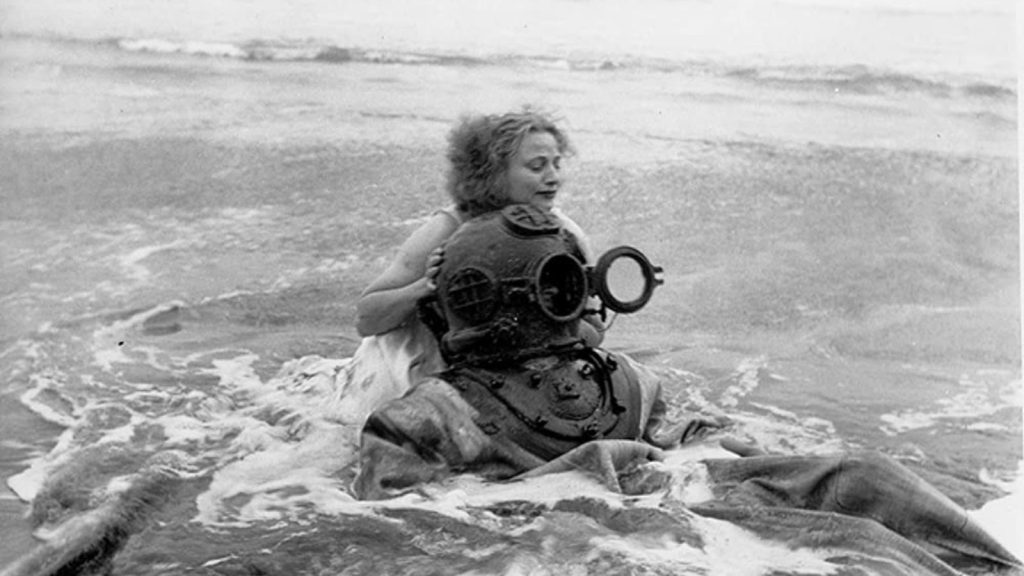
The Plot: Based on the Hans Christian Andersen fairy tale, “The Red Shoes” is some of the finest ballet ever captured on film. Set in the theater world of London, a young- I’m sorry what was that? It’s the wrong movie? Okay, I thought it was weird to be covering a British film. What movie is this? “The Lead Shoes”? What’s it about? It’s an experimental film about a woman disposing of a scuba diver’s dead body? And it has an off-putting soundtrack and distorted lenses? Oh boy.

Why It Matters: The NFR calls the film “a dreamlike trance showing the unconscious acts of a disturbed man”. An essay from the Northwest Chicago Film Society’s Kyle Westphal is a detailed breakdown of Peterson and this film.

But Does It Really?: Well that was a weird one. Even with a 16 minute runtime, “The Lead Shoes” packs in a lot of unpleasantness (If you love dead bodies, rats, and a bone covered in blood, this is your movie). While this kind of filmmaking isn’t my cup of tea, I won’t deny Sidney Peterson his place in film history, unintentionally leading the charge for San Francisco’s experimental art scene of the 1950s. A pass for “The Lead Shoes”. 

Everybody Gets One: Sidney Peterson is one of those artists who lived more lives than a cat. Prior to becoming an experimental filmmaker, Peterson was a medical student at UC Berkeley, a reporter for the Monterey Herald, and a sculptor and painter in southern France. An “all-around autodidact”, Peterson picked up experimental filmmaking in his mid-30s, with his first film – 1946’s “The Potted Psalm” – earning him a job teaching filmmaking at the California School of Fine Arts (now the San Francisco Art Institute). Using his students as resources (and their $10 materials fee to buy film stock), Peterson and his class created a new experimental film every semester. “The Lead Shoes” would be Peterson’s final film with his Workshop 20 class.

Seriously, Oscars?:  There’s no way in hell a film like “Lead Shoes” would have ever made it to the Oscars, even today. For the record: 1949’s Live-Action Short Subject winners were films about a state-of-the-art swimming pool (One-Reel) and Van Gogh (Two-Reel).

Other notes 

  • Most of “The Lead Shoes” is shot through distorted lenses, giving the film an elongated, surreal quality. Peterson started experimenting with anamorphic lenses in his 1947 film “The Cage”, and even he admitted that he didn’t know why he was drawn to them: “I don’t know exactly how this works. I only know that it does.”
  • The soundtrack is credited to “The Three Edwards and a Raven”, a reference to the poems being recited in the background: “The Three Ravens” and “Edward“. These recitations are seemingly random and, when mixed with a Dixieland band, quite disjointed. It helps to know that the soundtrack is an entirely separate undertaking from the film, with no attempt at synchronicity, except for – as Kyle Westphal calls it – moments of “occasional harmony”. Turns out “The Lead Shoes” was the “Dark Side of Oz” of its day.
  • The actor in the scuba diving gear is Harlan Jackson, then a student in Peterson’s class, later a famous abstract painter.
  • In my attempt to dissect the sights and sounds of “The Lead Shoes” to decipher its meaning, I came across this quote from Sidney Peterson in response to his film’s more literal reviews: “Do you suppose movie audiences will ever learn to take works as experiences instead of merely as expression, what does it mean? etc?” Point taken, Sidney. Perhaps my initial reaction of “What the hell was that?” is more in line with what Peterson intended his audiences to take away from his movies.

Legacy 

  • Among Sidney Peterson’s professional highlights following his departure from the California School of Fine Arts: directing MoMA’s educational television program, penning his novel “A Fly in the Pigment”, writing and directing for UPA (including two episodes of “The Gerald McBoing-Boing Show”), working for Disney on one of their many abandoned attempts at a “Fantasia” sequel, and returning to filmmaking one more time to make 1981’s “Man in a Bubble”. Sidney Peterson continued writing and lecturing up until his death in 2000 at age 94.
  • Man, that was a weird movie. I’m having a hard time shaking it off. Maybe I will watch “The Red Shoes” after all. Take me away, Powell & Pressburger!

#616) The Pawnbroker (1964)

#616) The Pawnbroker (1964)

OR “Rod Forsaken”

Directed by Sidney Lumet

Written by Morton Fine & David Friedkin. Based on the novel by Edward Lewis Wallant.

Class of 2008

The Plot: Sol Nazerman (Rod Steiger) is a middle-aged German-Jewish man living a quiet existence operating a pawnshop in East Harlem. Sol’s wife and children died during the Holocaust, and his memories of the concentration camps (as well as his survivor’s guilt) continue to haunt him 25 years later. Despite attempts by his optimistic young assistant Jesus Ortiz (Jaime Sánchez) and concerned social worker Marilyn Birchfield (Geraldine Fitzgerald), Sol refuses to connect with anyone on a human level, shutting himself off from the world and declaring the rest of humanity “scum” and “rejects”. As the real world continues to break through to Sol, he starts to recognize the prison he has kept himself in all these years. And if you’re looking for a last-minute happy ending, keep looking.

Why It Matters: The NFR praises the film’s “realistic, psychologically probing” grasp of the subject matter, as well as Rod Steiger’s “astounding” performance. An essay by film scholar Annette Insdorf is an almost scene-for-scene breakdown of the film’s metaphors and symbolism.

But Does It Really?: This is another one in the “minor classic”/”historical significance” camps. Although Sidney Lumet is one of my favorite directors, I had never seen “The Pawnbroker” until this viewing, and while it continues to be eclipsed by his other more famous films, it certainly delivers. Anchored by Rod Steiger’s performance, “The Pawnbroker” successfully translates the novel’s themes of isolation and grief into a visual medium, aided by a fine supporting cast and Quincy Jones’ creative score. “The Pawnbroker” earns its NFR standing thanks to its continued effectiveness, as well as its historical fight with the Production Code (more on that later).

Seriously, Oscars?: “The Pawnbroker” premiered at the Berlin International Film Festival in 1964, but due to its controversial subject matter did not receive a U.S. release until April 1965, making it eligible for the 1966 Oscars. The film’s sole Oscar nomination was Rod Steiger for Best Actor, which he lost to Lee Marvin’s comic performance in “Cat Ballou”. Steiger’s win two years later for “In the Heat of the Night” has been considered by many film buffs over the years (including yours truly) as consolation for his loss here.

Other notes 

  • Within a year of the novel “The Pawnbroker” being published, the film rights were purchased by producers Roger Lewis and Philip Langer. The two spent a year and a half being rejected by studio after studio before independent producer Ely Landau agreed to finance the film through his production company. After original director Arthur Hiller left the project (or was possibly fired), Sidney Lumet was hired based on his successful collaboration with Landau during “Long Day’s Journey Into Night”. Although James Mason was sought after for the role of Sol, the producers’ first choice was Rod Steiger who, like Lumet, deferred his usual salary to help the film get made.
  • I’ve never been wowed by a Rod Steiger performance, but I gotta say his performance here finally wowed me. Steiger effortlessly conveys the complex emotions (or lack thereof) Sol struggles with, showing us the character’s tragedy without becoming too hysterical or saccharine. The sorrow without the pity, if you will. I’d be pissed too if I lost an Oscar for this. Also, kudos to Ed Callaghan and Bill Herman for convincingly transforming Rod Steiger into an old man through minimal hair and makeup.
  • This is Quincy Jones’ first film as a composer! Lumet knew he wanted a classical film score for the flashbacks and a modern sound for the present scenes, and Jones was recommended based on his success as a jazz orchestrator as well as his classical training. The two hit if off immediately, with Jones’ film inexperience being seen as a plus by Lumet (no danger of falling into any movie score clichés). Jones’ two styles interweave as Sol’s past invades his present, and the result is simply marvelous.
  • Ah yes, the editing. Shoutout to the legendary Ralph Rosenblum for his landmark editing feat on “The Pawnbroker”. Rosenblum and Lumet successfully illustrate how Sol’s memories of the war are triggered throughout his life by splicing in fragments of the flashbacks (some as short as eight frames – one third of a second) throughout the movie. Slowly these fragments lengthen, eventually taking over the entire scene. It’s certainly more effective than a dissolve, that’s for sure.
  • As with the entire Sidney Lumet filmography, there’s plenty of great stage and screen actors in supporting roles. I’m enjoying Brock Peters as Rodrigues, Sol’s threatening boss and a full 180 from Peters’ more iconic role as Tom Robinson in “To Kill a Mockingbird“. There’s also a brief but important appearance by Baruch Lumet, Sidney’s dad and a successful actor and director of the Yiddish theatre. And apparently a young Morgan Freeman can be seen as an extra during the final scene? Has anyone asked him to confirm this?
  • The film’s supporting cast is wonderful, but the best part is how diverse they are. Never before had so many actors of color been given a chance to play nuanced, dimensional characters in a film. The results help “The Pawnbroker” age far better than its contemporaries, allowing me as a modern viewer to focus on the subject matter and not any tone-deaf casting.
  • The scene between Jesus and his girl in the bedroom is accompanied by Quincy Jones’ “Soul Bossa Nova“, immortalized 30 years later as the theme song to the “Austin Powers” films.
  • Steiger’s first “wow” moment for me was Sol’s monologue about the origins of the Jewish stereotype of thriftiness. It plays as an organic eruption of Sol’s pent-up frustration at how the world views and treats him and his people. Steiger successfully underplays without robbing the scene of its emotions. I was hypnotized watching it.
  • “The Pawnbroker” was noteworthy for being the first major film approved by the Production Code to feature bare female breasts (in this case, Thelma Oliver as Jesus’ prostitute girlfriend). Thankfully, the nudity is handled tastefully, demonstrating the commodification of women both during and after the war. Side note: Thelma Oliver was unaware that her nudity would appear uncensored, and had to be talked into exposing herself on film.
  • [Spoilers] As with any good film on this list, I didn’t take a lot of notes during the second half, mainly because I was just captivated by the film. My own takeaway from “The Pawnbroker”: Inhumanity breeds inhumanity. Sol’s trauma from the war manifests itself as him being as cold and dehumanizing to those around him as the Nazis were to him. Although Sol is given several opportunities to reach out and connect with the people in his life, he rejects every single one, leading to the self-fulfilling prophesy of his own isolation. Only after this rejection leads to Jesus’ death does he recognize the importance of empathy and connection. A death ironically brings him back to life. Man, what is it about this movie that brings out the film snob in me?

Legacy 

  • “The Pawnbroker” was one of the last films to help break down Hollywood’s long standing Production Code. The film was initially denied Code approval due to its nudity, but this decision was reversed on appeal with no further edits. Although the PCA considered this allowance of nudity a rare exception, it opened the doors for other films to challenge the Code, which ultimately dissolved three years later.
  • In addition to the film’s breakthrough in film nudity, “The Pawnbroker” was among the first American-produced films to focus on the Holocaust from a survivor’s perspective, as well as one of the first with a confirmed gay character (I guess that’s Rodrigues? It’s very subtle.)
  • On the one hand, “Pawnbroker” paved the way for Holocaust films like “Schindler’s List“. On the other hand, we’ve also gotten every other film about the Holocaust that dangled its Oscar-bait in front of an increasingly unwilling audience.
  • Following his debut in “The Pawnbroker”, Quincy Jones would go on to score countless films over the next 20 years including “In the Heat of the Night”, “In Cold Blood“, and “The Color Purple”.

#615) The Strong Man (1926)

#615) The Strong Man (1926)

OR “The Trouble with Harry”

Directed by Frank Capra

Written by Hal Conklin and Robert Eddy. Story by Arthur Ripley. Titles by Reed Heustis.

Class of 2007

The Plot: Belgian immigrant Paul Bergot (Harry Langdon) arrives in America as the assistant to Zandow the Great (Arthur Thalasso) and his strong man act. While in America, Paul is searching for his pen pal Mary Brown (Priscilla Bonner), who he has fallen in love with. A series of comic misadventures leads Paul and Zandow to Cloverdale, a small town overthrown by corruption and bootlegging. Can Harry save the town and get the girl? Also, remind me again who Harry Langdon is?

Why It Matters: The NFR write-up is mostly a rundown of Harry Langdon’s career, though they do applaud the movie for “successfully mixing belly laughs with scenes of great emotional tenderness.” An essay by Harry Langdon biographer Bill Schelly gives a more detailed account of his film career.

But Does It Really?: All I knew about Harry Langdon going into this film is that he is considered the fourth of the great silent film comedians (behind Charlie Chaplin, Buster Keaton, and Harold Lloyd). After seeing “The Strong Man”, I would rank Langdon as a distant fourth. Langdon is a remarkable physical comedian, and his screen persona helps him stand out from his contemporaries, but his brief success as a movie star doomed him to his permanent place in the shadow of three legends. As for the film itself, “The Strong Man” is entertaining at times, but is bogged down by comic bits that overstay their welcome and failed attempts at pathos, never reaching the visual imagination of Chaplin and Keaton or the evergreen optimism of Lloyd. “The Strong Man” makes the NFR cut as representation of Harry Langdon, with the added bonus of being Frank Capra’s directorial debut.

Everybody Gets One: A vaudeville star with a talent for pantomime, Harry Langdon didn’t make his film debut until he was 39, signing on to Principal Pictures before moving to The Mack Sennett Studios. Under Mack Sennett, Langdon became a star in a series of comic shorts as the doe-eyed innocent. By 1926, Langdon was ready to take on features, forming his own company (the Harry Langdon Corporation) and having a hit right out the gate with “Tramp, Tramp, Tramp” co-starring a young Joan Crawford. “Strong Man” was Langdon’s second feature, and the first to be directed by Frank Capra – one of Langdon’s gag writers who got the job because the director of “Tramp” went over budget.

Wow, That’s Dated: Mainly the film’s final set piece in a saloon during Prohibition. Also, shout out to Smith Brothers Cough Drops: For that cough.

Other notes 

  • Throughout the film, Harry Langdon and his impish antics reminded me of two different ’30s film stars: Stan Laurel and Dopey from “Snow White“. I am apparently not the only person to make either of these comparisons: Langdon not only served as one of Dopey’s inspirations during that film’s production, but he also ended up writing for Laurel & Hardy in the 1930s, replacing Laurel as Hardy’s co-star in 1939’s “Zenobia” while Laurel had a contract dispute.
  • Once again, a film on this list implies that going through Ellis Island as an immigrant was a breeze. Not so fast, everyone.
  • Man it was really hard to track people down pre-internet. All Harry has to go on is one photo and the very common name of Mary Brown? Good luck, pal.
  • I’m sure all of Langdon’s bits were a laugh riot in 1926, but now they are quite the slog to sit through. That being said, I did laugh out loud at a few of them, the bit of Langdon carrying Lily up a flight of stairs being the first.
  • Wait, one of the characters is named “Parson Brown”? Is he the one we’re supposed to pretend that snowman we built is?
  • Boy there sure isn’t a lot of the strong man in “The Strong Man”. Turns out this movie is a precursor to “The Big Lebowski“.
  • Oh no, Mary is blind? The NFR write-up makes the inevitable comparisons to “City Lights” (which this film predates by five years), but I’m here to tell you, “Strong Man” does not devote nearly as much time or compassion to this subplot as its more famous contemporary.
  • I honestly had to keep reminding myself that Frank Capra directed this. Obviously Harry Langdon was the muscle behind this film, and Capra was just a work-for-hire director, so we miss out on most of the Capra-corn hallmarks. Sure there’s some sentimentality between Paul and Mary, but it lacks Capra’s deft touch that would suggest his hand behind it.
  • One of the major set pieces is an extended comic bit where Paul, suffering from a cold, accidentally mistakes limburger cheese for chest rub. Like Langdon’s other bits in this film, it is excruciatingly long, but the pay off at the end had me laughing pretty hard. You win this round, Langdon.
  • The film’s finale, in which Paul must go on stage for an incapacitated Zandow, is the standout. There’s plenty of fun bits throughout, but I just wish the film had worked up to its ending better. This all being said, the final moments deliver on the first rule of film comedy: Tell the audience what you’re going to do and then do it. While predictable, the ending is a satisfying one.

Legacy 

  • While “Strong Man” was received well by critics, it did just okay with audiences, only doing slightly better business than “Tramp, Tramp, Tramp”. After “Strong Man”, Langdon fired Frank Capra and took over directing duties on his subsequent films, leading to a decline in quality. Mix this with the industry’s ongoing transition from silents to talkies, and Langdon’s days as a bona fide move star were numbered. Langdon went back to shorts, starring in a number of them for Hal Roach, eventually working his way up to supporting roles in comedies before his death in 1944.
  • After Frank Capra was unceremoniously fired by Langdon, he returned to working for Harry Cohn, now the head of Columbia Pictures. Capra directed a string of decent if not remarkable silent films, but finally struck gold with “It Happened One Night“. And now you know the rest of the story!
  • Totally unrelated, but shoutout to Tom Stoltman, who just a few days ago won the World’s Strongest Man competition for the second year in a row. He can deadlift 930 pounds! What am I doing with my life?

#614) A Time Out of War (1954)

#614) A Time Out of War (1954)

OR “Two Brothers On Their Way”

Directed & Written by Denis Sanders. Based on the short story “Pickets” by Robert W. Chambers.

Class of 2006 

The Plot: At the height of the Civil War, two Union soldiers (Corey Allen and Robert Sherry) find themselves having a shoot out with a Confederate soldier (Barry Atwater) on the opposite end of a riverbank. Exhausted from the heat, the three agree to a one hour truce to relax and do some fishing along the river. But can these men take each other at their word? And is anything gonna, ya know, happen in this movie?

Why It Matters: The NFR ranks this film “in the pantheon of best student films ever produced”, calling it a “sensitive, elegantly unhurried film that helped put student filmmaking on the cultural map.”

But Does It Really?: If you say so, NFR. There’s plenty of student films on the Registry, but “Time Out” was the breakthrough that proved there was an audience for these films outside of the classroom. A pass for “Time Out” for its straightforward conviction, as well as representation for legendary documentary filmmakers Denis and Terry Sanders.

Everybody Gets One: First off, shoutout to this article from UCLA’s alumni magazine, from which most of my information about this film’s production comes from. In the early 1950s, older brother Denis Sanders convinced younger brother Terry Sanders to ditch Caltech and join him as a film student at UCLA. The two first collaborated on the police training film “Subject: Narcotics” before wanting to make something more personal and creative for Denis’ thesis project. Denis wanted a Civil War story that was in the public domain (and therefore free to film), settling on “Pickets” and adapting the story into “A Time Out of War”, with Terry serving as the film’s cinematographer and co-producer. “Time Out” was filmed along the Santa Ynez River in Santa Barbara with a cast of three, a crew of eight (all UCLA students), and a budget of $2000.

Seriously, Oscars?: After completing “Time Out”, the Sanders brothers submitted the film to the Venice Film Festival on a whim, and wound up winning their Short Film category. The attention from that win led to an Oscar nomination for Live-Action Short Subject (Two-Reel), with “A Time Out of War” becoming the first student film to win an Oscar. Terry Sanders later recalled that they were congratulated backstage by a “puzzled looking” Walt Disney, the category’s perceived frontrunner.

Other notes 

  • Once again, a reminder that this film – added to the National Film Registry the same year as “Fargo“, “Notorious” and “Rocky” – was someone’s thesis film. Let that serve as inspiration to all you young film students out there.
  • Corey Allen and Barry Atwater were UCLA students when they were cast in “A Time Out of War”, and both would go on to have prominent careers playing secondary roles on film and TV. Allen is best remembered as James Dean’s adversary Buzz Gunderson in “Rebel Without a Cause“. Not only is “A Time Out of War” the only NFR appearance and film debut for Robert Sherry, it’s his only film appearance period.
  • This is either the cheapest B movie ever or the most polished student film ever. It tows the line quite well. And the somewhat choppy print I’m watching only adds to the confusion.
  • A quote from Terry Sanders in the aforementioned UCLA article confirmed my theory that the film was shot without synchronized sound. Apparently, the tape recorder loaned out from Paramount “failed almost immediately”.
  • I was ready to make a joke about how this is the same fishing spot Andy Griffith used to take Opie to, but then realized it could very well be. After some quick research, it turns out the opening of the “Andy Griffith Show” was filmed in Los Angeles’ Franklin Canyon Park, still a popular outdoor shooting location. The more you know, I guess.
  • Ultimately I don’t have a lot to say about the film itself. It is certainly one of the more confident “nothing happens” movies I’ve ever seen, I give it that. There’s an inherent tension throughout, and I kept expecting for one side to betray the other as a cautionary tale of how war damages the psyche. That never happened, making the film a subtle plea for peace and tolerance.

Legacy 

  • Following the success of “A Time Out of War”, Terry Sanders was hired to serve as the second unit director on Charles Laughton’s “The Night of the Hunter“. Denis would go on to win another Oscar for his other NFR entry “Czechoslovakia 1968“, while Terry co-founded the American Film Foundation with his wife Freida Lee Mock, winning his second Oscar (and Freida’s first) for “Maya Lin: A Strong Clear Vision”. Although Denis died in 1987 at age 58, Terry is still with us as of this writing, and continues to make movies alongside his wife, as well as their daughter Jessica Sanders.
  • Upon learning that “A Time Out of War” had been inducted into the National Film Registry, Terry Sanders called the experience “gratifying” as well as “a nice memorial for Denis”.