#6) Zapruder Film (1963)

#6) Zapruder Film (1963)

Filmed by Abraham Zapruder

Class of 1994

This is an expanded and revised edition of my previous post, which you can read here. While I am maintaining my vow to never watch that disturbing footage again, I feel that my decision to keep that original post to its bare minimum shortchanged the film’s historical significance. As always – and this cannot be stressed enough – this post is about the film itself, and not the Kennedy assassination, which I have zero interest in doing a deep-dive on.

1941: 36-year-old Ukranian-Jewish immigrant Abraham Zapruder moves to Dallas, Texas with his wife Lillian and their two children Henry and Myrna. Zapruder emigrated to America from the Russian Empire (now Ukraine) in 1920, residing in Brooklyn and working in Manhattan’s garment district.

1949: Zapruder co-founds Jennifer Juniors Inc., a dress manufacturing company. Zapruder’s office is at the Dal-Tex building on Elm Street in Dealey Plaza in downtown Dallas, across the street from the Texas School Book Depository. 

1962: Zapruder purchases an 8mm Bell & Howell Zoomatic camera, a then-state of the art model.

November 22nd, 1963

  • President John F. Kennedy arrives in Dallas as part of an extended tour of the south; partially to smooth things over with Texas Democrats, and partially to begin his 1964 re-election campaign. A few days earlier, the path of the President’s motorcade through downtown Dallas was finalized and released to the public. The president’s car would drive from Love Field to the Dallas Trade Mart by way of Dealey Plaza, carrying himself, his wife Jackie, Texas Governor John Connolly, and Connolly’s wife Nellie. 
  • A big supporter of Kennedy, Zapruder considers filming the motorcade, but initially doesn’t bring his camera due to an early morning rainfall. Upon arriving at work, an assistant convinces Zapruder to go home and bring his camera. Zapruder initially plans to film the motorcade from his office window, but decides to capture the footage on Elm Street.
  • Approximately 12:15 pm: Zapruder leaves the Dal-Tex building to stake out a good observation spot for President Kennedy’s motorcade. He settles on a 4-foot concrete abutment on a grassy knoll in the center of Elm Street. Zapruder’s secretary Marilyn Sitzman volunteers to hold onto his coat to help him with his vertigo.
  • 12:30pm: Zapruder begins filming the president as his car arrives in front of the Book Depository and down Elm Street. In the 26.6 seconds (486 frames) captured by Zapruder, both President Kennedy and Governor Connolly are shot by an off-camera assailant. While Governor Connolly survived this attack, President Kennedy would be pronounced dead at Parkland Memorial Hospital a half hour later. Zapruder would later recall that he knew at that exact moment the President had been killed. 
  • 12:45pm: Amidst the ensuing chaos, Zapruder returns to his office, and is visited by Harry McCormick, reporter for The Dallas Morning News, and Forrest Sorrels, agent with the Secret Service’s Dallas department. After some discussion, Zapruder agrees to give the footage to Sorrels, on the condition that it only be used for investigation, and not public viewing.
  • 2:00pm: The three arrive at TV station WFAA to get the film developed. It is discovered, however, that the station does not have the right equipment to develop Zapruder’s footage. While at WFAA, Zapruder is interviewed on-air, giving his account of the assassination, calling it “terrible, terrible” and saying that he’s “just sick”.
  • 2:30pm-8pm: The film is developed at the nearby Eastman Kodak processing plant, and three copies are made at the Jamieson Film Company. Zapruder keeps the original film and one copy, while Sorrels takes the other two copies to Secret Service headquarters in D.C.

November 23rd, 1963: Zapruder meets with Life magazine editor Richard Stolley, and sells the rights to the footage for $150,000 (Life outbids, among others, CBS). Still traumatized by what he had witnessed (and additionally distressed from a nightmare he had that evening), Zapruder sells the film on the condition that the frames showing the actual murder be omitted from Life‘s printing. Zapruder donates $25,000 of the Life money to the widow of J.D. Tippit, a police officer killed by Dallas resident and former U.S. Marine Lee Harvey Oswald shortly after the assassination.

November 25th 1963: CBS News correspondent Dan Rather, who happened to be in Dallas on November 22nd, describes his viewing of the Zapruder film on-air, the first national report of the footage’s existence. Rather erroneously describes Kennedy’s head as having moved “violently forward” following the shot, although the actual footage shows the head moving backwards. This discrepancy is believed to be the germ from which several conspiracy theories surrounding the assassination arose. 

November 29th, 1963: Life publishes 30 frames from the Zapruder film in black and white. Later publications would include these frames in color, as well as additional frames.

1964: Abraham Zapruder gives his recollections of the day’s events to the Warren Commission, who ultimately determine that Lee Harvey Oswald acted alone in his assassination of the President.

January 29th 1969: New Orleans businessman Clay Shaw is brought to trial by local D.A. Jim Garrison for his alleged involvment in the Kennedy assassination. The Zapruder film is shown as evidence, its first public screening. Zapruder himself is brought in to testify on February 13th. Clay is ultimately found not guilty on March 1st. During the trial, attorney and conspiracy theorist Mark Lane obtains Garrison’s copy of the Zapruder film (subpoenaed from Life), and makes several copies. These copies start getting distributed on the black market, adding to the film’s notoriety.

February 14th, 1969: The Zapruder film has its US television premiere on KTLA in Los Angeles. The footage is shown in conjunction with news of the Clay Shaw trial.

August 30th, 1970: Abraham Zapruder dies of stomach cancer at the age of 65.

March 6th, 1975: The Zapruder film makes its national TV debut on ABC’s late-night program “Good Night America”. Public outrage over this airing leads to a royalties suit between the Zapruder family and Time Inc. (owners of Life).

April 1975: In a settlement, Time Inc. sells the rights of the footage back to the Zapruder family for $1.

1978: After years of hesitation, the Zapruder family finally agrees to have the original footage stored in D.C.’s National Archives and Records Administration. The family does, however, retain the film’s ownership and copyright.

October 26th, 1992: President George H. W. Bush signs into law the President John F. Kennedy Assassination Records Collection Act (aka the JFK Act). This act automatically classifies the Zapruder film as an “assassination record”, and therefore government property. After some back and forth with the Zapruder family over ownership, the film is eventually purchased by the U.S. government from the Zapruders in 1999 for $16 million.

November 15th, 1994: The Zapruder film is inducted into the National Film Registry. In their annual write-up, the NFR calls the film “the most authoritative record” of the JFK assassination.

December 1999: The Zapruder family donates the film’s copyright (retained after the JFK Act settlement) to the Sixth Floor Museum at Dealey Plaza, thus ending any ownership of the film by the Zapruder family. In the ensuing years, the Zapruder film has been digitized and made available on the internet, making it one of the most viewed and analyzed pieces of film in American history.

Further Reading: David Wrone’s 2003 book “The Zapruder Film: Reframing JFK’s Assassination” is a detailed account of the film’s chain of evidence.

#590) The Inner World of Aphasia (1968)

#590) The Inner World of Aphasia (1968)

Directed by Edward R. Feil

Written by Naomi Feil

Class of 2015

This hard to find short is available courtesy of Indiana University’s Media Library. [NOTE: Currently the film is available for public viewing on the IU site, but has been limited to IU students only in the past. All the more reason to watch this movie when you have the chance.]

The Plot: Nurse Marge Nelson (Naomi Feil) is frustrated with her job at a local hospital, offering little support to her patients. When Marge stumbles down a flight of stairs, she suffers brain damage and develops global aphasia, losing her ability to comprehend speech or communicate with others. Through her inner monologue, we hear Marge’s frustration as she struggles with basic words, exacerbated by the nurses’ lack of empathy or understanding. With help from fellow aphasia patient Jack Campon (Actor Unknown), Marge begins the long, hard process of re-understanding the world, and ensuring that the world understands her.

Why It Matters: The NFR calls the film “empathetic and often poetic”, praising Naomi Feil’s “powerful performance” and admiring the film’s “innovative artistic qualities”.

But Does It Really?: As always, I’m looking for movies on this list that stand out for their creativity and individuality, and “Aphasia” passes the test. There’s a few rough edges in this film, but the Feils prove with their compelling storytelling that low-budget does not have to equal low quality. “Aphasia” surprised me with its delicate balance, showcasing the struggles of the disorder without ever becoming too saccharine. A yes for “The Inner World of Aphasia” and Edward & Naomi Feil.

Shout Outs: In a moment when Maggie is mentally berating herself for being “dumb”, she imagines herself as the Scarecrow from “The Wizard of Oz“, saying, “No brain, only straw.”

Everybody Gets One: A native of Cleveland, Ohio, Edward Feil was born to a family of doctors, but his love for movie making started early. After a stint in the Army and a B.A. from Yale, Feil founded Edward Feil Productions in 1952. Feil spent the next 50 years making short films and documentaries, many of them centering around the sick, disabled, and elderly, all treated with empathy and respect. As with “Aphasia”, Edward collaborated on many of these projects with his wife Naomi, a social worker and founder of Validation, a therapeutic method supporting elderly patients in cognitive decline.

Wow, That’s Dated: Hopefully the empathy towards brain damage victims by hospital staff has improved in the last 50 years.

Wow, That’s Not Dated: Understaffed hospitals. Man, we really suck at healthcare. Are we sure we don’t want Canada’s system? This is a situation where it’s okay to cheat off the guy sitting next to you.

Seriously, Oscars?: No Oscar love for “Aphasia”, or any of the Feils’ filmography (“Feilography”?). For the curious, the 1968 Live Action Short winner was Charles Guggenheim’s timely “Robert Kennedy Remembered“.

Other notes

  • Kudos to Naomi Feil for her performance in the film’s opening scene. She’s so natural I genuinely didn’t know if this was scripted or a documentary, or somewhere in between a la “Let There Be Light“.
  • Through an effective use of voiceover and flashbacks, this movie does a great job of really putting you in the headspace of someone with aphasia. Each moment of struggle for Marge is highlighted by some sort of triggering flashback. It seems incredibly frustrating on film, which means it’s undoubtedly even more frustrating in real life.
  • As Jack struggles to talk about the problems he and his wife have communicating, his doctor misconstrues this as “women talk all the time”. Oh goodie, there’s still room for sexism while dealing with aphasia.
  • I do love it when the phrase “all fouled up” is used in a medical context.
  • In one brief fantasy sequence, Jack is shown literally reaching for words as he attempts to speak to his nurse. Been there.
  • Some of these performances, let me tell you. Jack’s wife Janet and son in particular are letting me know that the Cleveland Playhouse was really thriving in 1968.
  • “It’s hard for a woman to understand what you’re going through.” Alright already! Yeesh.
  • The newspaper one of the nurses is holding for Marge to read is apparently an issue of the Cleveland Press, made evident by the column from their longtime sportswriter Bob August.
  • “Aphasia” would make a good companion piece with “Peege“, another NFR film about the breakdown in communication between family members when one of them is in decline. Just keep a box of tissue at the ready.
  • The shot of Janet realizing the error of her ways and consoling Jack is a low-key artful shot: You see the reflections of Janet and the doctors as they watch Jack and Margie through a two-way mirror.
  • “I nurse. I help you.” Time to break out that tissue.

Legacy

  • Edward Feil continued making movies for another 35 years after “Aphasia”, mostly dealing with the elderly and growing old. Among those films, “Looking for Yesterday”, “100 Years to Live” “My First 100 Years”, and “The More We Get Together”. These films (as well as several others in the Feil filmography) amassed a number of festival awards, as well as a Great Lakes Regional Emmy! Edward R. Feil died February 5th, 2021 in Springfield, Oregon at the age of 96.
  • Naomi Feil is still with us at age 89, as is Validation therapy and the Validation Training Institute. Feil is also the author of several books on the subject of elder care.
  • The Feils’ filmography was donated to the Moving Image Archive of Indiana University, and much of it can be viewed on Ed Feil’s YouTube channel.

#50) The Front Page (1931)

#50) The Front Page (1931)

OR “All the Film That’s Fit to Print”

Directed by Lewis Milestone

Written by Barlett Cormack and Charles Lederer. Based on the play by Ben Hecht and Charles MacArthur.

Class of 2010

This post is based on my viewing of the Domestic print (aka the “A” print), and is an updated and revised version of my initial post.

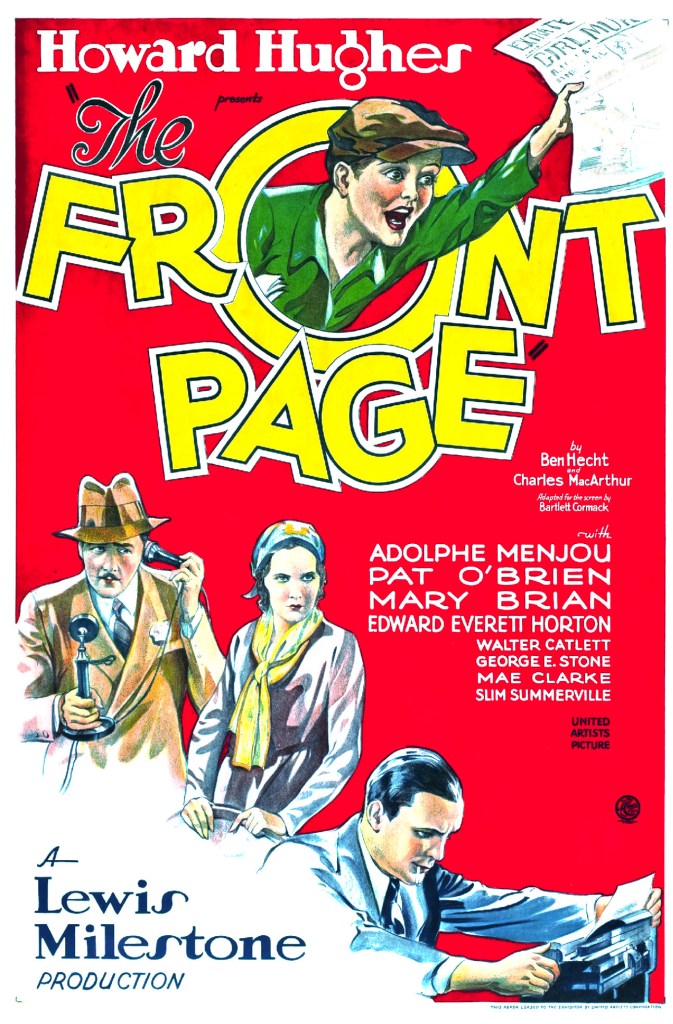
The Plot: “The Front Page” is a fast-talking comedy about reporters in the heyday of the printed press. On the eve of the hanging of political prisoner Earl Williams (George E. Stone), Chicago newspaper reporter Hildy Johnson (Pat O’Brien) announces to his tough-as-nails editor Walter Burns (Adolphe Menjou) that he’s leaving the business to live happily ever after with his fianceé Peggy Grant (Mary Brian). When Williams escapes the jail and takes refuge in the Criminal Courts press room, Hildy knows a scoop when he sees one and is torn between his love and his career. What follows is some classic screwball hijinks that sound awfully similar to another movie…

Why It Matters: The NFR praises this film for its “strong performances” and for having “one of the best screenplays of the 1930s”. The write-up goes on to highlight “Front Page” as an example of an early movie that “realiz[es] the capabilities of sound technology to invent new film narratives”.

But Does It Really?: On its own, “The Front Page” is a perfectly fine time-capsule of the pre-Code era that managed to get a few decent laughs out of me 90 years later. That being said, it’s hard to judge “Front Page” on its own merits when you have “His Girl Friday” just around the corner, surpassing this movie on almost every front. Throw in the discovery of two different prints of this movie, and “Front Page” seems more like an historical NFR choice rather than an artistic one. Presently, the cultural significance of “The Front Page” can be summed up by its Blu-Ray release: as a supplemental feature to “His Girl Friday”.

Wow, That’s Dated: Um…everything? This movie is jam-packed with so much ’30s jargon and dated references, even I couldn’t keep up, and I actually pay attention to this kind of thing!

Seriously, Oscars?: A modest box office hit in 1931, “The Front Page” received three Oscar nominations: Best Picture, Director, and Actor for Adolphe Menjou. Perhaps due to Milestone’s wins at the previous ceremony for “All Quiet on the Western Front“, “Front Page” lost to, respectively, “Cimarron”, “Skippy”, and “A Free Soul”.

Other notes

  • Before we go any further, a quick clarification of the multiple prints of “The Front Page”. During the silent era, many movies were shot with multiple cameras at once, with different prints using different angles of the same scene, culminating in slightly different versions of the same film. With the advent of sound, simultaneous filming was made impossible (early sound cameras were too noisy), so early talkies would use alternate takes for different prints. Documentation of “The Front Page” shows that for each scene, Lewis Milestone used the best take for the Domestic (“A”) print, the second best for the UK (“B”) print, and the third best for the General Foreign (“C”) print. For years, the B print (or possibly the C print) was the most widely available, but a discovery (and verification) of the film’s A print led to “The Front Page” getting a proper restoration in 2016.
  • Based on Hecht and MacArthur’s own experience working as Chicago newspapermen, “The Front Page” premiered on Broadway in 1928 and was an instant smash hit. Film producer/future cautionary tale Howard Hughes snatched up the film rights and offered Lewis Milestone the chance to direct following his success with “All Quiet on the Western Front”. Neither of the show’s Broadway leads – Lee Tracy and Osgood (father of Anthony) Perkins – were considered to reprise their roles for the film. Milestone wanted “Western Front” alumni Louis Wolheim as Walter Burns, but the actor died before filming commenced. Hughes vetoed Milestone’s first choices for Hildy (James Cagney and Clark Gable) opting instead for Pat O’Brien, who previously played the role in a Chicago production.
  • Speaking of Chicago, for whatever reason the censors of the day wouldn’t allow the film version of “The Front Page” to be set in Chicago (I guess to avoid accusing “The City That Works” of corruption). As the opening text proclaims, this film is “laid in a Mythical Kingdom”…whatever that means.
  • That being said, the censors obviously had no problems with the frequent sexism and occasional racist terminology sprinkled throughout this movie.
  • Oh Edward Everett Horton, how I’ve missed you. Mr. Fractured Fairy Tales appears here as Bensinger, the stuffy reporter whose germaphobia would fit right in during today’s pandemic lifestyle. Bensinger definitely would have worked from home before it was mandated.
  • The rest of the reporters get a decent amount of screentime, though none of them leave a big impression. Among them is actor Walter Catlett, best remembered today for his work in “Bringing Up Baby“, and his vocal performance as Honest John the fox in “Pinocchio“.
  • Of course you can’t have a movie where the lead character is referred to as “Mr. Burns” without making me think of the “Simpsons” character. I’d give anything to see Adolphe Menjou steeple his fingers and declare something as “Exxxxcellent“.
  • This movie is definitely in the “Applause“/”Hallelujah” category of early sound films trying to stay visually dynamic with the new technology. There’s plenty of inventive camera angles and dolly shots to help “open up” the play, plus some intercutting between scenes and at least one jump cut. Kudos to everyone involved.
  • This movie is covering a lot of subjects that would have been definite no-nos in the Code era: political corruption, Communism and “the red menace”, yellow journalism, not to mention a few jokes about sexual perversity. “His Girl Friday” may be the better movie, but “Front Page” has a lot more pearl-clutching in its dialogue, which I found more entertaining.
  • Pat O’Brien is definitely one of your standard-looking All-American leading man types. With his jet black hair he kinda looks like Steve Martin in “Dead Men Don’t Wear Plaid”.
  • This movie has another one of my favorite early movie tropes: Censoring by interruption. “Here’s a feature on the manhunt that’ll knock you right on your – excuse me, miss.”
  • Having “His Girl Friday” to compare this movie to definitely has its pluses and minuses. For one thing, it’s interesting to watch this story without a love triangle, making it more a tale of corruption and power than just a rehash of “The Awful Truth“. On the other hand, while this movie retains the fast talking of its source material, there’s little to no overlapping dialogue. Everyone talks fast, then pauses while the next person speaks, and then hurries through another line. It’s like watching a train travel in quick short spurts: the speed is there, but not the momentum. 
  • O’Brien and Menjou have a lovely rapport with each other. It’s just a shame you have to wait until the second half of the movie to see it.
  • “Get back in there, you Mock Turtle!” Wait, I thought Cary Grant ad-libbed that line for “His Girl Friday”. Is nothing real anymore!?
  • The film’s finale retains the original ending, with one noticeable difference. The play’s curtain line “That son-of-a-bitch stole my watch!” remains, but is partially censored by Burns resting his elbow on a typewriter’s carriage, causing the ding of the bell to obscure the most offensive part.
  • As for the two widely available prints, the A print is the overall better movie, with tighter editing and better delivery. The B print, however, is worth a viewing for the curious; its lackluster timing compensated for with alternate lines, and a shot of one reporter flipping off the mayor!

Legacy

  • While largely forgotten today, “The Front Page” has its devotees who champion it for depicting the kind of fast-talking reporters associated with this era of film. Some historians even go as far as calling “Front Page” the first true screwball comedy, even though that subgenre is typically reserved for romantic comedies.
  • Lewis Milestone’s directing career was hit or miss after “Front Page”, but he does have one more movie on the NFR, the 1945 war drama “A Walk in the Sun“.
  • Howard Hughes’ film career continued with another NFR movie set in not-Chicago with a Hecht/MacArthur screenplay: “Scarface“.
  • Nine years after this film’s release, another famous Howard – Hawks – was considering a remake, with the goal of making “Front Page” faster and funnier. While there are different accounts of how inspiration struck, Hawks’ key difference with this remake was the gender-swapping of Hildy, making him Burns’ ex-wife. The resulting movie – 1940’s “His Girl Friday” – is widely considered one of the rare remakes that surpasses the original.
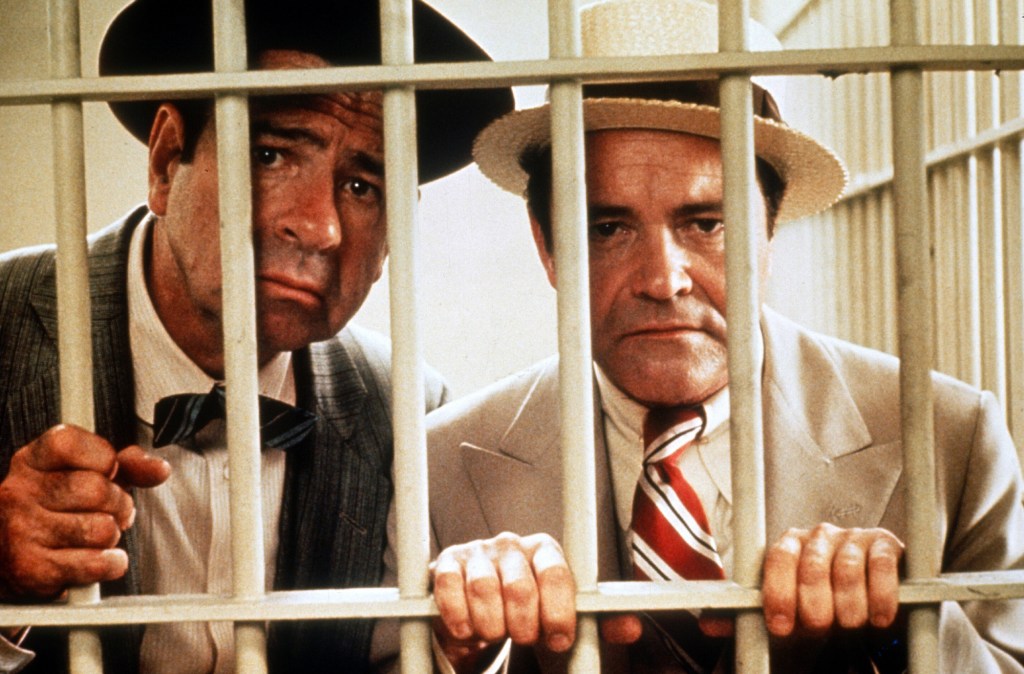
  • Aside from its most famous remake, “The Front Page” received a more faithful update in 1974. Directed by Billy Wilder, co-written by Wilder and I.A.L. Diamond, and reuniting Jack Lemmon and Walter Matthau as Hildy and Burns, this “Front Page” seemed like a recipe for success…”seemed” being the operative word. Like the 1931 version, the ’74 “Front Page” has all the essential elements, but nothing fully gels.
  • The original stage version of “The Front Page” still gets revived on Broadway from time to time. A 1960s revival saw MacArthur’s wife Helen Hayes in a supporting role, an 80’s revival starred John Lithgow and Richard Thomas, and a 2016 revival featured an all-star cast led by Nathan Lane and John Slattery.
  • In addition to its revivals, “The Front Page” was musicalized in the 1980s as “Windy City”. The New York Times review used words like “mundane”, “mediocre”, and “forgettable”, which explains why no one’s heard from “Windy City” since.
  • While the film maintained its status as an underrated classic for decades, it wasn’t until 2014 – and the discovery of the original “A” print – that things got interesting. This video from the California Film Institute does a very succinct job of explaining the differences, perhaps too succinct because the narrator talks really fast.

#589) Unmasked (1917)

#589) Unmasked (1917)

OR “To Catch a Thief”

Directed & Written by Grace Cunard and Francis Ford

Class of 2014 

I’ve been trying to track down this short for years, and I’m delighted that a high quality print has been posted on the official George Eastman Museum website. Please check out their preservation work, and donate if you can.

The Plot: Two thieves, Francis and Meg (Francis Ford and Grace Cunard) run into each other at a masked ball, both with the intention of stealing the necklace of their hostess Mrs. Montague (Actor Unknown). Francis is successful and flees the scene of the crime, evading two detectives (Edgar Keller and Harry Schumm). Meg congratulates Francis on his success, but uses this as a chance to retrieve the necklace for herself. Will Francis get away with it? Will Meg have a change of heart? Will Hollywood remember that it used to let women write and direct films all the time?

Why It Matters: The NFR calls the film “a succinct but illustrative example of the role of women in film history”, then goes on to praise its “artful and sophisticated cinematography”.

But Does It Really?: This is another short that makes the NFR for what it represents rather than for what it is. Grace Cunard was quite popular with filmgoers in her time (dubbed “The Queen of the Serials”), and her talents extended to behind the scenes as well. “Unmasked” is a brief, enjoyable little thriller, managing to pack in a heist and a car chase in its short runtime. The Cunard/Ford collaborations are noteworthy enough for recognition, and as one of their few surviving efforts, “Unmasked” makes the NFR cut.

Everybody Gets One: Grace Cunard started off as a stage actress, only accepting film work for the Biograph Company on a dare. After working with all of the east coast movie studios, she headed to California in 1912, finding employment with Thomas H. Ince. It was with Ince where Cunard first met actor/director Francis Ford, beginning their successful run of collaborations. When Ince fired Cunard for refusing to leave Ford’s unit, Ford followed suit, and the pair wound up at Universal. From 1913 to 1917, Ford and Cunard worked on hundreds of serials and B-pictures, often co-starring together, co-writing the scenarios, and occasionally co-directing.

Other notes 

  • As I said, “Unmasked” is available on the official George Eastman Museum website, and the video begins with a five minute introduction by Eastman curator Peter Bagrov. To be honest, most of my information regarding the movie comes from this introduction (and the text on the video’s page). Like so many films from the silent era, “Unmasked” lacks any decent documentation of its production.
  • Here’s an interesting one: “Unmasked” is actually a re-release of the 1913 Ford/Cunard short “The Black Masks”. While “Unmasked” is a one-reeler (about 12 minutes), “Black Masks” was a two-reeler, with the events of “Unmasked” being in the second reel. The first reel (from what we know – “Black Masks” is a lost film) featured the racing skills of driver Tony Jeannette (credited as “The Speed Demon”). After winning a race, Jeannette is invited to a masked ball, but loses the invitation, which ends up in the hands of the thieves played by Ford and Cunard. The first shot of “Unmasked” (an impressive-for-its-time composition of the crooks’ hands reaching for the necklace) is actually from the middle of “The Black Masks”.
  • Still very much in pandemic times while watching this, my first thought during the ball was “They’re wearing their masks wrong.”
  • I love me some old timey phraseology. Literally any other movie would have its character say “Step on it!” to the driver during a high speed car chase, but “Unmasked” has Francis command, “Say, put a little speed behind this boiler.”
  • Side note about Francis Ford: He is of no relation to Francis Ford Coppola, though both got the Ford in their names in honor of Henry Ford (Francis Ford was born Francis Feeney).
  • I definitely laughed out loud when Meg walks away from her encounter with Francis, revealing that she stole his watch. Well played, everyone.
  • If there was one thing the 1910s loved, it was movies where criminals were brought to justice. With all this morality being enforced, is it any wonder the ’20s were so aggressively decadent?
  • No offense, but I feel like it was a lot easier to be a burglar in the 1910s. Everyone was far more trusting, and nobody locked their doors or windows. Hell, Francis probably could have just asked Mrs. Montague “May I please steal your necklace?”
  • Much like the original racecar opening of “The Black Masks”, the short’s ending was trimmed for its “Unmasked” re-release. After returning the necklace to its rightful owner, Meg and Francis get married and donate all their stolen items to charity. Cutting out this ending makes it less sappy, and suggests that these two will continue to commit crimes. Very daring for 1917.
  • Sorry “Unmasked”, but when I want to watch a cinematic necklace heist I’ll watch “The Great Muppet Caper”, thank you very much.

Legacy 

  • In 1917, Ford left Universal to found his own (short lived) movie studio Fordart Films, thus ending his successful collaboration with Grace Cunard. As Ford’s movie career was starting to decline, things were looking up for Francis’ younger brother – John Ford. Little brother John got a leg-up in the industry thanks to advice from Francis, and would repay the favor by casting Francis in small parts for many of his movies, including “Stagecoach“, “The Grapes of Wrath“, and “The Quiet Man”.
  • Although Grace Cunard continued to appear in films for the next 30 years, the films were always B-pictures, and the roles began to diminish until she was playing bit parts. When Universal discontinued their serials in the mid-’40s, Cunard retired from show business, happily married to stuntman Frederick Tyler until her death in 1967.
  • While most of the Ford-Cunard collaborations are lost films, the duo have been getting their share of recognition for their place in film history in recent years. In addition to “Unmasked” making the NFR in 2014, Grace Cunard in particular continues to be singled out (along with her contemporaries) as a pioneer for women behind the camera.

#30) Fantasia (1940) – Part 2

Previously on “#30) Fantasia (1940)”…

Meet the Soundtrack

  • The “jam session” coming back from intermission is cute, and shines a brief spotlight on the xylophone, jazz’s unsung hero.
  • My brother and I always loved the Soundtrack segment as kids. It’s fun to watch the visualization of each instrument. In particular we enjoyed the low sounds of the bassoon, the waves starting to spill out under its own weight. This whole segment is even more impressive when you learn that the entire section is hand-drawn, and not just an actual sound wave (the sound wave of a triangle does not actually make a triangle shape).

The Pastoral Symphony

  • My “Six Degrees of Separation” from this film comes courtesy of my friend Ryan (whose was kind enough to share his zombie knowledge with me for a previous post). Ryan’s grandmother was dating Disney animator X. Atencio in the late 1930s, and X based the look of the dark blue-haired centaurette on her. Now that’s a legacy!
  • Cherubs have never done it for me. They’re supposed to be cute, but really they’re just naked babies with wings. Maybe they’re in here to appease the religious groups protesting the “Rite of Spring” dinosaurs? One thing’s for sure: thanks to the cherubs this movie has more butts than an ashtray.
  • A reminder that this segment once contained one of the most offensive stereotypes in Disney’s history, the black servant centaur Sunflower. Sunflower was removed in response to the Civil Rights movement of the 1960s, proof that this kind of cultural modification existed long before conservatives started yelling about the sanctity of Mr. Potato Head’s genitals. I agree with Roger Ebert, who once wrote that although films like “Fantasia” should always be preserved in their original form, the general public does not need to be subjected to the racial insensitivity of the time in a family movie.
  • And then the second half starts throwing in Greek gods: Bacchus, Zeus, Vulcan; it’s starting to look like a test run for “Hercules”.

Dance of the Hours

  • Random shout out to Alvise Loredan, the Venetian duke whose palatial home this segment apparently takes place in.
  • The whole segment is a lot of fun, but the punchline has been spoiled over the years by the occasional appearance by the hippos and gators in other Disney media. The elephants never seem to make the cut though. Overshadowed by “Dumbo” maybe?
  • It was during this segment that I realized how sleep inducing this whole movie is. And that’s not a comment on it being “boring”; practically every segment features a character yawning and/or napping: Yen Sid, Zeus, the Hippos, Chernabog later on. I also watched this movie on a particularly rainy Sunday, which didn’t help matters either. At this rate, who needs NyQuil?

Night on Bald Mountain/Ave Maria

  • “Bald Mountain” is the ultimate anti-Disney segment. I’m sure the current management hates that they constantly have to defend an 80 year old piece of animation that centers around ghosts gathering to worship the devil. Given that subject matter, “Bald Mountain” is hands down the scariest thing Disney ever produced (the Headless Horseman being a close second).
  • Also, just to clarify, this evil demon is Chernabog, not to be confused with Chernobog, the Slavic god of bad fate (and the evil yin to Belobog’s good yang).
  • Wow, Chernabog is ripped. Someone didn’t skip ab day.
  • All the ghost animation is stunning, but my favorite is the shot of spirits flying through the loop of a noose on their way to Bald Mountain.
  • HD transfers are great for animation, but you can definitely see where the animation ends and the background begins. It’s pretty easy to spot which parts of Chernabog will not be moving in any given shot.
  • Ave Maria” has some lovely visuals – and features the only vocals within the instrumental segments – but then it just kinda ends. Adding to this anticlimax is the film’s lack of end credits which, while preserving the film’s presentation as an actual concert, robs the audience of a chance to sit with the movie and see the names of the film’s creative talent. If I were Walt, I’d be a lot nicer to my animators right around now.

Legacy 

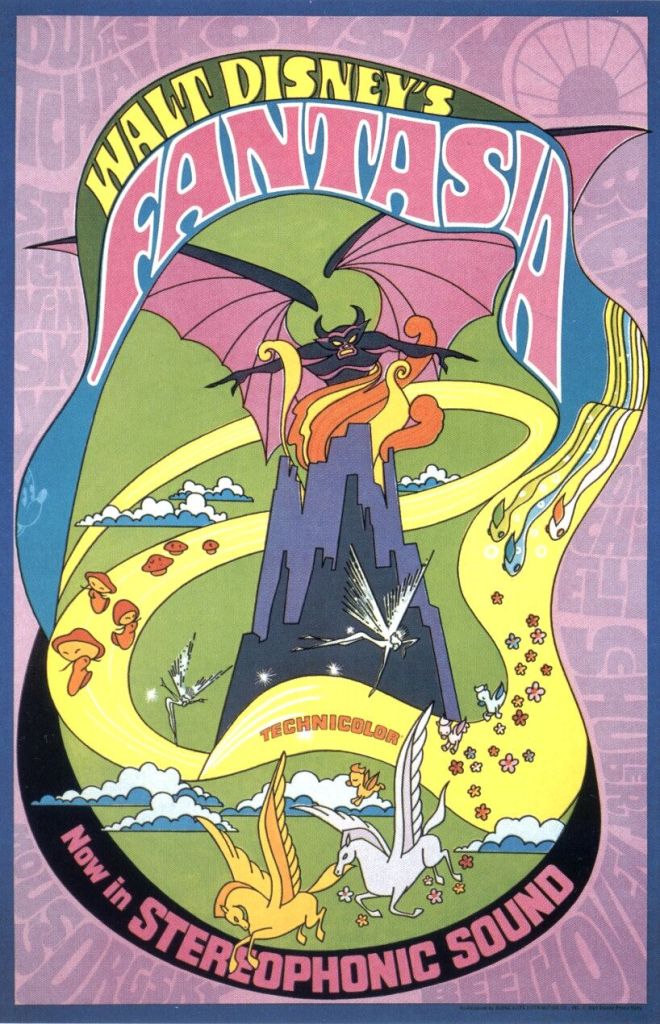
  • The original run of “Fantasia” consisted of a roadshow presentation at 13 theaters throughout 1940 and 1941. While a success with audiences and movie critics (though not necessarily music critics), “Fantasia” failed to recoup its investment due to the expensive installation of Fantasound equipment at each theater, and the ongoing economic impact of World War II. While “Fantasia” would be released several times over the decades, the film didn’t get out of the red until its very psychedelic reissue in December 1969.
  • Disney had talked about re-releasing “Fantasia” every few years with new segments. The closest he ever got in his lifetime was a selection of low-budget “package features” with musical-based shorts made to save money during the war. Among those films is 1946’s “Make Mine Music”, which includes the deleted “Clair de Lune” animation repurposed with a new song called “Blue Bayou”.
  • Ideas for a proposed “Fantasia” sequel always seemed to fall through, until the 50th anniversary reissue in 1990 (and subsequent success on home video) showed the Disney company that there was an audience for more “Fantasia”. Co-produced by Walt’s nephew Roy E. Disney, “Fantasia 2000” features seven new segments set to classical music. It’s…shorter than the original, I give it that.
  • I’m not sure if “The Sorcerer’s Apprentice” ended up helping Mickey’s film career, but it did give him one of his most iconic outfits. Fantasmic would be a lot weirder if Mickey was dressed as Steamboat Willie the whole time.
  • The Sorcerer’s hat even became a landmark at Disney’s Hollywood Studios, blocking the Grauman’s Chinese Theater and being an unpopular eyesore/pin trading station from 2001 to 2015.
  • Speaking of “Sorcerer’s Apprentice”, did the Nicholas Cage movie have anything to do with the short? Asking because I’m definitely never watching that movie.
  • Among Roger Meyers Sr.’s proudest achievements was the full-length musical “Scratchtasia”.
  • Sure, we’ve had other movies on this list that have inspired video games and theme park attractions, but “Fantasia” may be the only NFR movie to inspire a themed mini-golf course. Fantasia Gardens opened at Walt Disney World in 1996, and is still there!
  • But perhaps the biggest impact “Fantasia” made on pop culture was on Walt himself. Following the underwhelming critical and commercial response to the film, Disney never again attempted a film that emphasized artistic freedom over commercial appeal, opting to stick with the kind of safe, popular entertainment that became synonymous with the Disney brand. Walt occasionally struggled with this choice later on in his career, one such example occurring at a screening of “To Kill a Mockingbird” in 1962, after which Walt told his family, “I wish I could make a picture like that.”

Listen to This: Leopold Stokowski shows up three different times on the National Recording Registry: twice with the Philadelphia Orchestra, and once with his All-American Youth Orchestra. Of the film’s eight composers, Bach, Tchaikovsky, Stravinsky, Beethoven, and Mussorgsky all have their work represented on the NRR. Honorable mention to Ponchielli, whose “Dance of the Hours” is reworked as Allan Sherman’s “Hello Muddah, Hello Fadduh”.

Favorite Other Notes from the Original Post

  • Stokowski conducts the same way I dry my hands in a bathroom when there’s no paper towels left.
  • Pretty gutsy to do selections from “The Nutcracker Suite” but not the main march theme.
  • Did that dinosaur just mug at the camera?
“Hey Ma, I’m in a movie!”
  • I always felt sorry for the people who live in the town at the base of Bald Mountain. That can’t be fun. Every night with these ghosts and the loud music. Some of us have work in the morning!