#29) Gone with the Wind (1939) – Part 3 (Legacy)

For those who have lost their way, here’s Part 1 of this “Gone with the Wind” write-up, and Part 2 for good measure.

The Legacy of “Gone with the Wind”

  • “Gone with the Wind” opened in December 1939 and immediately became the biggest blockbuster in movie history. The film’s original run lasted almost two years; first as a prestige roadshow engagement, followed by a general release in 1941 at “popular prices”. In 1942, David O. Selznick liquidated Selznick International and sold his share of “Gone with the Wind” to his partner John Whitney, who immediately sold it to the film’s distributor MGM. Now raking in 100% of the profits, MGM re-released the film in 1942.
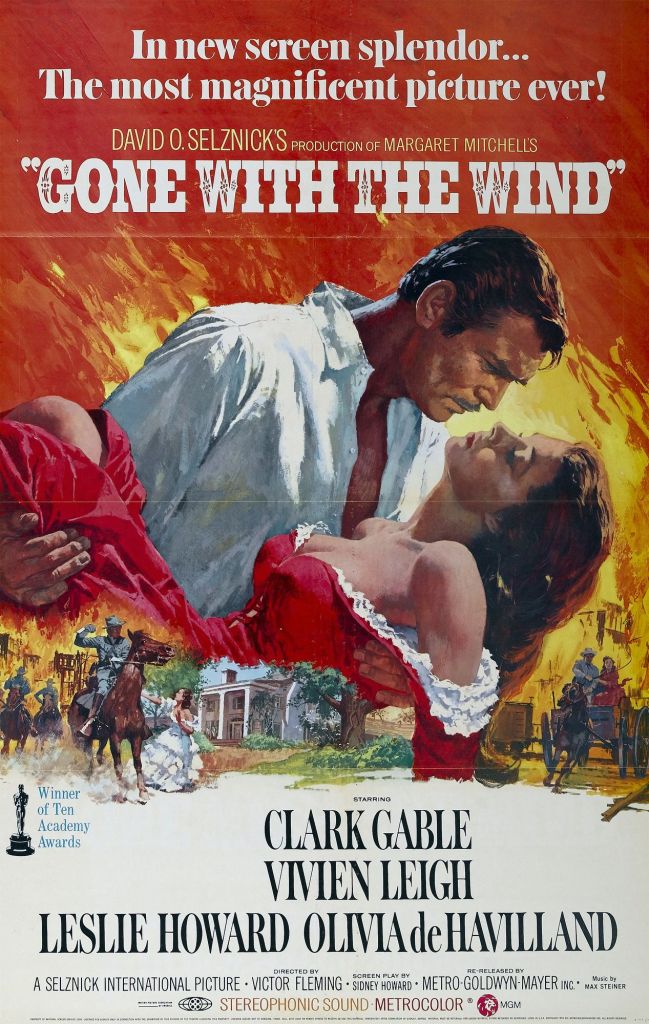
  • There have been a few other re-releases of “Gone with the Wind” over the years, most notably in 1961 to celebrate the Civil War’s centennial. Interestingly enough, it’s the poster for the 1967 re-release (as seen at the top of this page) that is most associated with the film.
  • Even before “Gone with the Wind” was made, readers were clamoring Margaret Mitchell for a sequel, but Mitchell always declined, saying she “left [Scarlett & Rhett] to their ultimate fate”. 25 years after Mitchell’s passing, her estate commissioned Anne Edwards to pen “Tara”, a novel that would concurrently be adapted for film. MGM was not happy with the final manuscript, and neither book nor film saw the light of day.
  • The Mitchell estate’s eventual sequel novel – 1991’s “Scarlett” by Alexandra Ripley – was a critical disaster, but a commercial success, and spawned a TV miniseries adaptation in 1994 with Joanne Whalley and Timothy Dalton.
  • Other novels have shown the events of “Gone with the Wind” from the perspective of other characters. The Mitchell estate approved of 2007’s “Rhett Butler’s People” by Donald McCaig, and definitely did not approve of “The Wind Done Gone“, Alice Randall’s 2001 novel from the slaves’ point of view. The Mitchell estate sued Randall and her publisher, but the case was settled when Houghton Mifflin (the publisher) agreed to make a donation to Morehouse College.
  • There have been at least three major attempts to turn “Gone with the Wind” into a musical. While they all remained true to the source material, and played around the world with the intention of coming to Broadway, none of them fared well in the shadow of the movie, and a musical of “Gone with the Wind” has yet to play New York.
  • Back to the movie: “Gone with the Wind” is so iconic, even its backstage story has a legacy. The casting call for Scarlett O’Hara has become so ingrained in Hollywood history, it eventually became a TV movie starring Tony Curtis as David O. Selznick.
  • NBC spent $5 million for a one time airing of “Gone with the Wind”, which aired in two parts on November 7th and 8th, 1976, and were the highest rated broadcasts in television history up to that point. Five nights later, CBS’s “The Carol Burnett Show” aired an extended parody skit “Went with the Wind!”. It’s a bit lengthy, and Vicki Lawrence’s take on Prissy is hard to swallow, but costume designer Bob Mackie’s send-up of Scarlett O’Hara’s makeshift curtain dress (with curtain rod still intact) is still one of the biggest laughs in television history. Carol Burnett’s immediate follow-up “I saw it in the window and just couldn’t resist” is the perfect button.
  • Speaking of parodies, IMDb lists over 1400 movies and TV shows that have referenced or spoofed “Gone with the Wind” at some point. The earliest comes from 1939’s “Second Fiddle”. Released six months before “Gone with the Wind”, “Fiddle” is about a publicity agent who falls for an actress during a nationwide search to cast the lead in a film version of a popular novel. Some veils are only so thin.
  • As for the other 1399 entries, some go after the movie’s iconic visuals, but most take a pass at the film’s famous dialogue. While I’m tempted to go with yet another classic “Simpsons” clip, let’s give “Clue” the final say this time.
  • But unfortunately this film’s most seismic legacy is its romanticizing of Civil War era south, and therefore the Confederacy and the white supremacy inherent. Although various organizations such as the NAACP were vocally opposed to this film’s racial depictions from day one, the topic didn’t seriously start being addressed until the mid-1990s, with nuanced discussion from many a film and history scholar. In more recent years, the Orpheum Theatre in Memphis cancelled its annual screening of the film due to public outcry, and of course HBOMax temporarily removed the film from its streaming service in light of the protests surrounding the murder of George Floyd. As someone who doesn’t believe in censoring art, I applaud HBOMax’s updated presentation of “Gone with the Wind” with appropriate historical context. To remove the film from the conversation entirely would be to ignore all the harm it has done. As I’ve said before on this blog, context excuses nothing, but does provide an opportunity to learn from the mistakes of the past.

As always, this blog post can only scratch the surface of the impact -good and bad – that this movie has had on our culture, but thanks for taking the ride with me. As much as I would love to “solve” the problem that is “Gone with the Wind”, it’s not up to one person; it’s up to all of us, as well as future generations who will continue to determine this film’s place in history. We can do better, and we must do better. After all, tomorrow is another day.

But wait, there’s more! As an added bonus, here’s Other Notes From the First Version!

  • “Gone with the Wind” was the first film shown on Turner Classic Movies, and was no doubt introduced by a young, bright-eyed Bobby Osborne.
  • This film features a man named Leslie playing a man named Ashley.
  • Yes, the sweeping romanticism of marrying your cousin. Cue the Steiner!
  • Love that intermission music. Sounds like an all-skate. Everybody on the rink!
  • This film was made the same distance from the end of the Civil War as we are currently from the end of World War II. Think about that, won’t you?
  • But of course, none of my original 2017 musings sums up my frustration with this movie better than “Goddamn you, ‘Gone with the Wind’.”

Further Viewing: That guy who did all those “premakes” I love so much also turned “Gone with the Wind” into a horror trailer. Please enjoy “Gone with the Wind…with Vampires”.
#29) Gone with the Wind (1939) – Part 2 (Other Notes)

Previously on “#29) Gone with the Wind (1939)”

Okay, got all that out of the way, on to “Other Notes

  • Right out the gate I got problems with this movie. The first shot is slaves toiling away in the cotton fields, with superimposed text heralding Mitchell’s novel as a “story of the Old South”. It’s gonna be a long four hours.
  • As previously stated, this film’s overall story is trash, but it’s well-made trash. Shoutout to cinematographer Ernest Haller (as well as Lee Garmes and Rey Rennahan) for the film’s Technicolor compositions, and composer Max Steiner for the best epic music score this side of “Lawrence of Arabia“.
  • There’s so much to unpack with Hattie McDaniel’s performance as Mammy. It’s certainly on par with the stereotypical black maid performances of the era, though McDaniel/Mammy is allowed some subtle nuance, actually interacting with the white characters on a personal level (by today’s standards it’s virtually nothing, but by 1939 standards it’s revolutionary). McDaniel got flak from the NAACP and other African-American groups of the day for playing an offensive stereotype, but McDaniel always commented “I’d rather play the maid than be one.” Side note: Although McDaniel did win an Academy Award for this performance, it was a segregated ceremony where she had to sit in the back. Despite the supposedly progressive stance the Academy took with this win, it would be another decade before another African-American was nominated in any category, and 24 years before the next competitive win.
  • I can’t stress enough that both Rhett and Scarlett are awful people. Sure they both evolve a lot as people by movie’s end, but man are they both rotten to each other in the process. The only compliment I can give is that Vivien Leigh has movie history’s definitive eyebrow arch.
  • While Leigh was able to successfully turn her British accent into that of a native Georgian, her fellow countryman Leslie Howard…not so much. Howard is either failing at his accent attempt or not attempting one at all. I honestly can’t tell.
  • I do not need a four hour movie telling me “Do Not Squander Time”.
  • On one hand, I think it’s important to acknowledge and learn about the Confederate’s perspective of the Civil War, but it shouldn’t be through the glossy rose-colored glasses of this movie. Add into the mix a persistent “happy slaves” trope, and you’ve got a movie with more gaslighting than “Gaslight“. You want a more nuanced look at the war, stick with Ken Burns.
  • Then known as the romantic lead in a series of adventure movies with Errol Flynn, Olivia de Havilland gets a chance to play slightly against type as the goody-two-shoes Melanie. A lesser actor would have made her too syrupy to the point of annoyance, but de Havilland plays her as a woman who conciously chooses to focus on the positive aspects of her life and those around her, turning her sunniness into her biggest strength. Also worth noting: At the time of this post, Olivia de Havilland is still alive, and turns 104 this week!
  • THERE’S A LARGE POSTER OF JEFFERSON DAVIS AT THE CHARITY DANCE! ALRIGHT I’LL TALK, JUST MAKE IT STOP!
  • Also hurting the film is the fact that every Black character in the movie is comic relief. Look no further than Thelma “Butterfly” McQueen as Prissy, the O’Hara house servant who famously “don’t know nothin’ ’bout birthin’ babies.” “Gone with the Wind” was McQueen’s first feature (although “The Women” was released first), and while she took the part as a stepping stone to better roles, she found the character demeaning and became frustrated when she became typecast. Although McQueen never got another role that surpassed Prissy in the mind of filmgoers, she worked steadily in film, television and theater for the next 50 years.
  • As I often state on this blog, Melanie Hamilton is the first recipient of the “Melanie Hamilton Award for Most Quiet Childbirth”. Even the baby doesn’t raise his voice, and he survived the burning of Atlanta!
  • Oh my god, everyone stop saying “darky”! It’s an uncomfortable moment every time someone says it, but the NAACP successfully lobbied the filmmakers to use that word as a substitute for…something else.
  • “We didn’t treat [slaves] that way. Besides, I’d have freed them all when father died, if the war hadn’t already freed them.” Oh, so NOW you want to backpeddle your depiction of slavery? Ashley’s “we were the good kind” dialogue is too little, too late.
  • Oh, and the “political meeting” Rhett and Ashley go to before raiding the shanty town is a Klan meeting. Even in the 1930s, they knew better than to explicitly mention that little detail.
  • If the film’s racist issues aren’t enough for you, this movie also offers you some marital rape. Rhett spends most of the movie telling Scarlett that he knows what’s good for her, and it’s easy to just assume he means in terms of life skills and common sense. Turns out he meant sex, and in a moment of drunken anger, forcibly carries Scarlett up the stairs and rapes her off-screen. As if that weren’t bad enough, the next shot is Scarlett in bed the next morning giving a satisfied sigh. WHY DID WE REVERE THIS MOVIE FOR SO LONG?
  • And now we arrive at perhaps THE line from this movie: “Frankly my dear, I don’t give a damn.” It’s definitely one of the best exit lines in movie history, and totally justified given how horribly Scarlett has treated Rhett throughout this movie (to say nothing of the vice versa situation). Stories of Selznick having to pay a fine to the Hays Office for the word “damn” are almost correct. One month before the film’s release, the Hays Office amended their stance on the words “hell” or “damn”, allowing instances in which the words are, among other examples, “a quotation from a literary work”.
  • For those of you who might not get the overall message of the movie, they really hit you over the head with it at the end. Scarlett hears several voice-overs of other characters reminding her that the Tara plantation (and its land) is the most important thing. “Gone with the Wind” has what I call a Rolling Stones ending: Scarlett doesn’t get what she wants (the love of Rhett or Ashley), but she gets what she needs (the land, and a more mature sense of self). Turns out there’s a well-crafted character arc underneath all this unpleasantness.

The legacy of “Gone with the Wind” (and a few bonus musings) can be found in Part 3!

#29) Gone with the Wind (1939) – Part 1

#29) Gone with the Wind (1939)

OR “A Movie Divided”

Directed by Victor Fleming

Written by Sidney Howard. Based on the novel by Margaret Mitchell.

Class of 1989

In the three years since I wrote my original “Gone with the Wind” post, the tone of this blog has evolved, and I’ve wanted to revise and expand this post to reflect that change. Also, in light of recent national events (as well as this film making headlines again), I felt that now was the best time to rewatch “Gone with the Wind” through the lens of our national dialogue about systemic racism. As always, this is a reminder that no single write-up can answer every question that this movie raises. Consider this post the beginning of a longer conversation we as a nation need to have about race relations and the continued impact of the Confederacy.

Also, brace yourselves: This is the Horse’s Head’s very first three-parter!

The Plot: In 1861 Georgia, spoiled plantation daughter Scarlett O’Hara pines over her neighbor Ashley Wilkes (Leslie Howard). Upon learning that Ashley is to be engaged to his cousin Melanie Hamilton (Olivia de Havilland), Scarlett throws a passive aggressive tantrum at their announcement party, much to the amusement of fellow guest Rhett Butler (Clark Gable). When the Civil War breaks out, Scarlett’s world is turned upside down, and through her hardship is forced to mature into an independent, shrewd business woman. This growth occurs simultaneously with her on-again, off-again attractions to Rhett Butler, which complicates her feelings for Ashley. There’s plenty of drama in this iconic, masterful…love letter to the Confederate South!? To quote another movie, fasten your seat belts.

Why It Matters: The NFR calls it “one of the most popular and influential American films produced” and “possibly the definitive example of filmmaking in the Hollywood studio era.” The work of composer Max Steiner, as well as the main cast, are highlighted. An essay by author Molly Haskell briefly touches upon the film’s problems, but is mostly of celebration of Scarlett O’Hara’s subversion of the female movie character tropes of the day.

But Does It Really?: It seems that in recent years “Gone with the Wind” has finally been removed from the “Casablanca“/”Citizen Kane” list of quintessential classic films and added to the “Birth of a Nation” list of important yet increasingly problematic American movies. “Gone with the Wind” is still the pinnacle of studio system filmmaking (ironic since it was a co-production with independent producer David O. Selznick), with an epic scope that no other movie from the era can match, and it spent the majority of the 20th century as an oft-referenced, oft-parodied cultural icon. This all being said, “Gone with the Wind” is a romanticized take on the Confederacy that due to its phenomenal success continues to create issues in our culture today, and its racist overtones permeate the entire film, even in scenes that don’t explicitly involve the slave characters. While the film’s entertainment value has plummeted in recent years, its historical and cultural significance is still being felt with a strength that very few movies of the era still possess. No argument for NFR inclusion, but the days of “Gone with the Wind” as one of the greatest movies of all time are, well….gone with the wind.

Everybody Gets One: Like many British movie stars of the era, Leslie Howard first found success on the London stage, followed by a transition to Broadway, and eventually Hollywood. When approached for “Gone with the Wind”, Howard felt he was all wrong for Ashley Wilkes, but David Selznick enticed him with an additional offer to produce and star in another movie (1939’s “Intermezzo”). Howard was devoted to the Allied cause during WWII, and was tragically killed in action when the aircraft carrying him was shot down over the coast of Spain.

Wow, That’s Dated: Oh, we will talk about what’s dated in this movie; you just keep reading.

Title Track: Margaret Mitchell chose the title “Gone with the Wind” from a line in a poem by Ernest Dowson: “I have forgot much, Cynara! gone with the wind”. Mitchell used the line as a reference to the loss of the Southern way of life (and/or lost love). Side note: the more flowery explanation of the title in the film’s opening segment was written for the movie, and was not featured in the original novel. Allegedly, Margaret Mitchell did not appreciate this addition.

Seriously, Oscars?: The last major release of the Greatest Year in Movies, “Gone with the Wind” opened to blockbuster business, becoming the most successful film of all time (and adjusted for inflation, still is). Two months later “Wind” entered the Oscar race with a record-breaking 13 nominations. The film won eight Oscars (also a record), plus an additional two tech awards. Among its wins: Best Picture, Director, Actress, and Supporting Actress for Hattie McDaniel (the first African-American to win or even be nominated for an Oscar). The “Gone with the Wind” sweep was such a foregone conclusion that first-time emcee Bob Hope jokingly dubbed the ceremony “a benefit for David Selznick”.

Before we get to “Other notes”, I felt that a few of the film’s production notes deserved their own section called…Production Notes.

  • Margaret Mitchell based “Gone with the Wind” on her family’s recollections of growing up in the Civil War/Reconstruction Era. The novel caught the eye of several studios before it was published. David Selznick was initially skeptical about the novel’s film possibilities, but his story editor Kay Brown convinced him of the potential.
  • Pre-production lasted 2 1/2 years! Playwright Sidney Howard was hired to write the screenplay, and George Cukor signed on to direct. When Howard refused to fly out to Hollywood for rewrites, subsequent drafts were penned by playwrights Ben Hecht, Jo Swerling, and John Van Druten, among others.
  • The film’s other delay came from waiting for popular choice Clark Gable to become available. Gable initially had no interest in playing Rhett Butler, but finally agreed when Selznick offered him enough money that he could divorce his wife and marry Carole Lombard.
  • The search for Scarlett O’Hara is still the biggest casting call in movie history (though most of it was exaggerated for publicity). Mitchell wanted Miriam Hopkins, Cukor lobbied for Katharine Hepburn, and popular opinion sided with Tallulah Bankhead. Practically every actress in Hollywood auditioned for the part, but only the two finalists auditioned in Technicolor: Paulette Goddard and Vivien Leigh. Goddard was very close to winning the role, but her then-unconventional common law marriage to Charlie Chaplin proved too controversial. 25 year old unknown British actor Vivien Leigh was in Hollywood while her partner Laurence Olivier was filming “Wuthering Heights“, and was introduced to David Selznick by his brother Myron (Leigh’s theatrical agent at the time). Leigh won over David on the strength of her performance in “Fire Over England“, as well as a reading and screen test with Gable. Leigh joined the cast in January 1939, a month after the film started production!
  • The film’s biggest setback occurred three weeks into filming when Selznick fired director George Cukor. Selznick felt that Cukor’s work wasn’t dynamic enough (and there is speculation that Gable didn’t like working with an openly gay director). MGM’s Victor Fleming was hired to replace Cukor, leaving “The Wizard of Oz” midway through its production (but that’s another story). Vivien Leigh and Olivia de Havilland were both devastated by the replacement, and secretly continued to meet with Cukor on weekends to develop their characters. Fleming filmed the bulk of the movie (and reshot most of Cukor’s work), but was temporarily replaced by Sam Wood when he took a hiatus due to exhaustion.

Okay, now we can get to the film proper….in Part Two!

#468) Emigrants Landing at Ellis Island (1903)

#468) Emigrants Landing at Ellis Island (1903)

OR “They’re Coming to America (Today!)”

Directed by Alfred C. Abadie

Class of 2019 

Ellis Island has a long history that a blog post like mine can only oversimplify. To learn more about Ellis Island, check out their official website!

The Plot: From the Edison film catalog:

“Shows a large open barge loaded with people of every nationality, who have just arrived from Europe, disembarking at Ellis Island, N.Y. A most interesting and typical scene.”

Why It Matters: The NFR gives an historical rundown of the film and Ellis Island, calling the film the first “to record the now-mythologized moment” of immigrants arriving at Ellis Island.

But Does It Really?: It’s always tough to justify the inclusion of yet another Edison actuality film on the NFR, but while other Edison films capture mundane moments like a sneeze, “Emigrants” is a rare glimpse at the Immigrant Boom of the early 1900s. In just two minutes of film we can witness more insight into an immigrants long struggle to get to America than we could by any other form of communication. A pass for “Ellis Island”, but mainly for what it represents rather than the film itself.

Everybody Gets One: Alfred C. Abadie was a cameraman for Thomas Edison c. 1898-1904. Although “Emigrants” was filmed stateside, the bulk of Abadie’s 1903 work for Edison was filmed abroad (allegedly because Edison wanted to beat the Lumière Brothers at their own game). Abadie appears on-camera as a sheriff in “The Great Train Robbery“, filmed in part at the Edison Studio in New York, and directed by Edwin S. Porter, who also got his start as one of Edison’s cameramen.

Wow, That’s Dated: Like many films of the early 1900s, “Ellis Island” documents that hats were seemingly required for all public appearances: men with their bowlers, women with their Edwardian garden hats.

Other notes 

  • First off, shout out to the indigenous Lenape people, whose land Ellis Island currently sits on.
  • Ellis Island changed hands a few times before becoming an immigration station. After being run by the Dutch during the 1600s, Little Oyster Island (as it was then known) was purchased by local merchant Samuel Ellis in 1774. After his passing, the island became a military base, being used by the US Army and Navy in the War of 1812 and the Civil War (among others). After the Civil War the magazines and other firearms were slowly dismantled, and the island was eventually controlled by the US Department of Treasury. In response to a call for a national immigration policy, Ellis Island was chosen to host a central immigration station (something that had been previously attempted in 1847). Ellis Island opened to immigrants in 1892 and in its prime took in as many as 4000 immigrants a day.
  • According to the Library of Congress and Edison’s records, “Ellis Island” was filmed on July 9th, 1903, and copyrighted two weeks later on July 24th. Most historians place the first public screening sometime that August.
  • Immediately following what you see in this film, the immigrants would then line up in the main building for further inspection. Each person would be inspected by multiple officials for any obvious physical impairment (At this point they would have already gone through two medical inspections: One in their home country before departure, and another on the boat immediately after docking.) After that, each person would be subjected to hours of basic questioning. If they passed the questioning, they were given a signed affidavit and free to enter America.
  • Anyone who did not pass the physical or medical examinations would be quarantined in the island’s hospital, detained, or even deported. Roughly 1% of all immigrants at Ellis Island were deported.
  • It should also be pointed out that Ellis Island officials considered such characteristics as homosexuality to be “moral defects” that qualified for automatic deportation. This common occurrence makes America guilty of the same eugenic practices we would one day condemn the Nazis for.
  • Sometimes while researching these films I stumble upon information that completely contradicts what I thought I knew about a subject. In this case: the myth that officials at Ellis Island would Americanize the last name of immigrants as they arrived. Turns out no officials did that; they were fluent in a multitude of languages and documented their names accurately, even correcting any spelling errors that had fallen through the cracks. Most immigrants Americanized their own names after the fact to help assimilate.

Legacy 

  • Ellis Island continued to be the epicenter for immigrant activity in the United States for the next 20 years, until the Emergency Quota Act of 1921 and the Immigration Act of 1924 sharply decreased the number of immigrants allowed in the country (turns out we’ve always had a problem with that). After that, Ellis Island became more of a detention center before finally closing in 1954. In 1965 the island was declared a national monument and reopened in 1976 as a museum dedicated to its former life.
  • After working for Edison, Alfred Abadie became a freelance filmmaker. His most notable post-Edison film is the 1917 educational short “Birth”, allegedly the first film to document an actual birth. God help me if that ever makes the NFR.
  • I actually visited Ellis Island in 2011 on my first trip to New York. Ironically, Ellis Island had an exhibit on Alcatraz at the time, so I flew across the country to learn about an island six miles from my house. Here I am in my younger, skinnier, tanner days using a jail cell as a fun photo op.
I used to look like this every day. Photo credit: Dylan West.

#467) Eve’s Bayou (1997)

#467) Eve’s Bayou (1997)

OR “Second Sight Unseen”

Directed & Written by Kasi Lemmons

Class of 2018

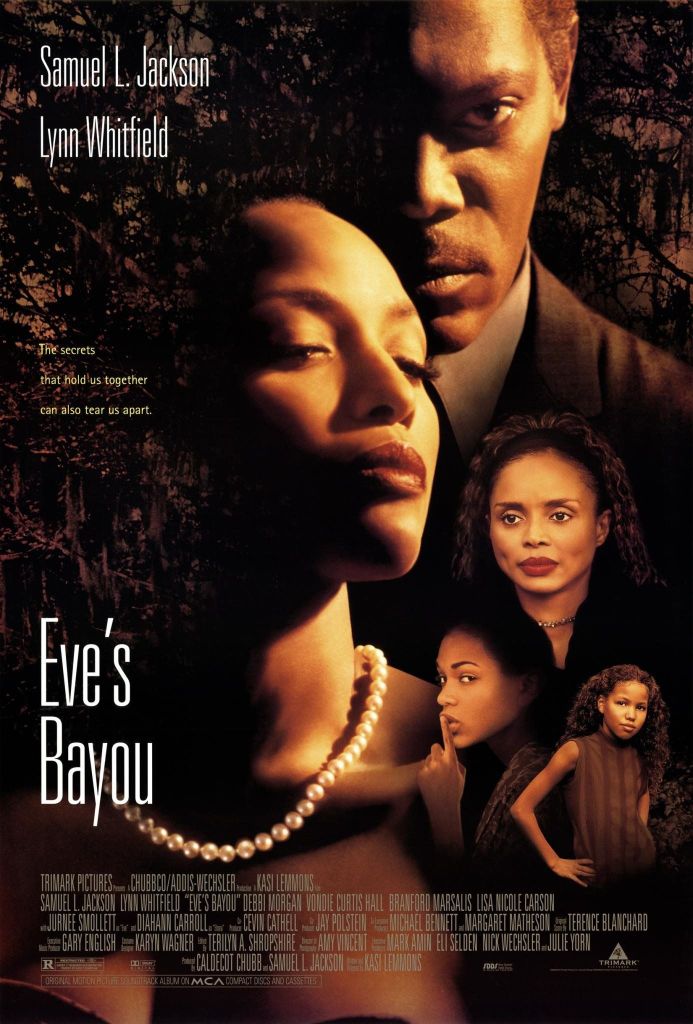
The Plot: In a Creole neighborhood in 1960s Louisiana, the seemingly perfect Batiste family falls apart through the eyes of middle child Eve (Jurnee Smollett). One night at a party, Eve witnesses her father, respected doctor Louis (Samuel L. Jackson), having an affair. Older daughter Cisely (Meagan Good) convinces her she didn’t see it, but Eve continues to pick up on her father’s extra-marital affairs throughout the summer. As this revelation becomes more apparent, Eve’s steadfast mother Roz (Lynn Whitfield) takes solace in the psychic counseling of Louis’ sister Mozelle (Debbi Morgan). When Eve learns of a tense interaction between Louis and Cisely, she consults with town fortune teller Elzora (Diahann Carroll) about using voodoo to kill her father. Director Kasi Lemmons highlights the frailty of memory and perception in her feature film debut.

Why It Matters: The NFR calls the film “one of the indie surprises of the 1990s”, and singles out the “standout cast” – especially the “remarkable” Jurnee Smollett.

But Does It Really?: As the rest of this post will reiterate, I was blown away by “Eve’s Bayou”. The film infuses the standard “coming-of-age” drama with a memory play that helps it stand out amongst other indie films of the era. Kasi Lemmons confidently tells her story with a top-notch ensemble led by Jurnee Smollett. In a time when we as a nation are making a conscious effort to make more Black voices heard, I cannot recommend “Eve’s Bayou” enough, not just as a great movie by an African-American woman, but a great movie, period.

Everybody Gets One: Kasi Lemmons started acting at a young age, but always knew that she wanted to direct. Her acting career is highlighted by her work as Clarice’s roommate/fellow FBI trainee Ardelia Mapp in “The Silence of the Lambs“. “Eve’s Bayou” was Lemmons’ first screenplay, and her first feature-length film as a director. To prove to skeptic studios that she could direct a movie, Lemmons took a section of the screenplay, and filmed it as the short “Dr. Hugo”.

Wow, That’s Dated: The film’s only real giveaway is the opening logo for long-gone distribution company Trimark Pictures.

Seriously, Oscars?: “Eve’s Bayou” was a critical darling, and went on to become the highest-grossing independent film of 1997. Despite being nominated for (and winning) several key precursor awards,”Eve’s Bayou” received zero Oscar nominations. The film’s biggest wins were at the Independent Spirit Awards: Best First Feature and Best Supporting Female for Debbi Morgan.

Other notes 

  • According to Kasi Lemmons it took “two years and…about a hundred meetings” to get any studio to fund “Eve’s Bayou”. The film finally got a break at Trimark Pictures, then known for such direct-to-video horror films as “Leprechaun”, looking to branch out into art films. Production took so long to commence that Lemmons’ first choice for Eve, Meagan Good, aged out of the role. Good was given the part of older sister Cisely, and Jurnee Smollett was a last minute replacement.
  • There truly isn’t a weak link in the entire ensemble. Rare is the 10-year-old that can hold a movie, but Jurnee Smollett is simply perfect. She successfully balances the innocence and naïveté of being ten with the dramatic weight the part calls for. I also enjoyed the work of Samuel L. Jackson, still riding high off his post-“Pulp Fiction” success, just before he became a blockbuster action star. His Louis is a man who has relied on his charm to overcompensate for his flaws, and that charm is starting to run out for him.
  • But perhaps most perfectly cast is Lynn Whitfield, who is of Creole descent and was raised in Louisiana during this film’s time period: she has known this character literally her entire life. Side note: Is there any woman – then and now – as stunningly beautiful as Lynn Whitfield? No, there is not.
  • Jurnee Smollett’s real-life brother Jake plays Eve’s younger brother Poe. If the Smollett name sounds familiar, you’re thinking of their older brother Jussie, “Empire” actor and recent newsmaker.
  • I feel it’s important to point out the film’s depiction of race. While the entire cast (including extras) were Black or African-American, the race of these characters is only mentioned once in passing. If a white director was making this, the racial aspects/racism of the era would pervade the entire film. Kasi Lemmons wisely showcases a diverse Black community, while simultaneously focusing on the family and these characters over their race or ethnicity.
  • Once we get to some of the more psychic/supernatural aspects of the movie, this whole plot could have gone off the rails, but everyone downplays it so naturally, it works. Lemmons et al achieve a very difficult balancing act.
  • At one point the kids are stuck in the house for weeks at a time, forbidden to go outside. I’m in Month Three of quarantine right now; this may be the most relatable part of the movie.
  • When Mozelle recalls how her last husband was killed, the film leans more into Tennessee Williams territory, shrewdly staging the events through a mirror without resorting to flashbacks or special effects.
  • It should be no surprise that Vondie Curtis-Hall is cast as the handsome, charming, all-too perfect man who sweeps Mozelle off her feet: he’s Kasi Lemmons’ real-life husband.
  • Speaking of Mozelle, Debbi Morgan is your MVP, and her monologue about whether or not life has a point is a standout.
  • Rounding out this fine ensemble is the late great Diahann Carroll. Probably best remembered now for her early musical career and her later work on the soap opera “Dynasty”, Carroll is wonderfully low-key in a role that could easily become campy. She’s so good in this I won’t even mention her work in “The Star Wars Holiday Special”. …wait.
  • Surprisingly, there’s a section of the end credits devoted to a special effects team and computer animators. Turns out there was an entire character cut from the movie: Uncle Tommy, a deaf-mute family member who lives in the Batiste household, and apparently witnessed one of the film’s key events. The studio investors requested his subplot be removed, and Uncle Tommy was digitally erased from the remaining background shots. While Lemmons was satisfied with the final cut, she did restore Uncle Tommy for her director’s cut in 2016.

Legacy 

  • Critics loved “Eve’s Bayou”, but it was Roger Ebert who put this film on the map by writing a four-star review, and naming it the #1 movie of 1997 on his TV show. As Kasi Lemmons stated years later, “Roger made my career”. She even has the original review framed in her home.
  • Kasi Lemmons only has a few directing/screenwriting credits to her name, the most recent being “Harriet”, the long-gestating Harriet Tubman biopic starring Cynthia Erivo, and the first of Lemmons’ movies to earn an Oscar nomination. When not making films, Lemmons teaches at NYU’s Tisch School of the Arts.