#461) Breakfast at Tiffany’s (1961)

#461) Breakfast at Tiffany’s (1961)

OR “Manic Pixie Dream Girl: The Motion Picture”

Directed by Blake Edwards

Written by George Axelrod. Based on the novella by Truman Capote.

Class of 2012 

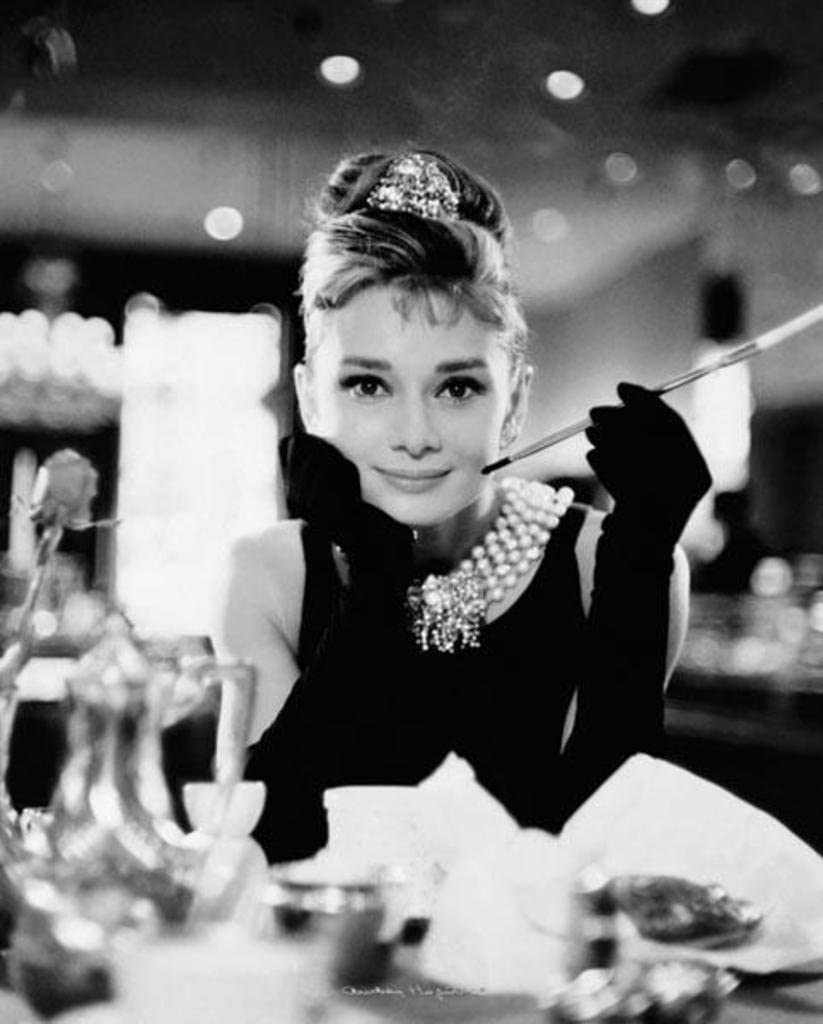
The Plot: Writer Paul Varjak (George Peppard) moves into his Manhattan apartment, where he meets his new neighbor, socialite and downplayed call girl Holly Golightly (Audrey Hepburn). The two develop a strong relationship, hampered by Holly’s desire to marry rich, and Paul’s status as the “kept man” of decorator 2E (Patricia Neal). Holly and Paul continue to be friends, sharing a series of episodes involving wild parties, Holly’s estranged husband Doc (Buddy Ebsen), and a morning trip to Tiffany & Co. If you’re looking for a movie that respects its source material, keep looking.

Why It Matters: Although the NFR details the film’s departures from the novella (and Truman Capote’s disapproval for casting Audrey Hepburn), the write-up highlights the more modern praise of Hepburn, her characterization of Holly compared to other female leads of the era, director Edwards, composer Henry Mancini, and the song “Moon River”.

But Does It Really?: For every iconic moment in “Breakfast at Tiffany’s”, there’s two that have aged terribly. Audrey Hepburn is giving a justifiably memorable performance, and “Moon River” is an undisputed classic, but this movie continues to get bogged down by its dated views on the sexes, to say nothing of Mickey Rooney’s performance (more on that later). The film survives thanks to Hepburn’s work and its overall positive misinterpretation of the source material. “Breakfast at Tiffany’s” deserves its status in the National Film Registry, but any modern viewing will question that distinction.

Shout Outs: 2E references “Love Finds Andy Hardy“, starring Mickey Rooney, which theoretically should have caused a black hole in this universe.

Everybody Gets One: This is Buddy Ebsen’s only NFR appearance, but that’s not his fault. A veteran of ’30s MGM musicals, Ebsen was originally cast as the Tin Man in “The Wizard of Oz“, but was replaced when his reaction to the makeup led to his hospitalization. Ebsen’s career faltered after that, but his appearances on the “Davy Crockett” TV series, and his excellent turn here, helped get him his most famous role: Jed Clampett on “The Beverly Hillbillies”.

Wow, That’s Dated: Let’s see, this movie has typewriters and landlines and checks and physical library index cards….yep, that’s it. That’s all that’s dated about “Breakfast at Tiffany’s”….

…okay fine. This movie has the YELLOWFACE WARNING to end all Yellowface Warnings. White actor Mickey Rooney plays Holly’s Japanese landlord Mr. Yunioshi with makeup and prosthetics to make him look like a cartoon stereotype. It’s bad, it’s very bad. Blake Edwards was adamant about casting Rooney in the part, and lived to regret the decision.

…oh, and this movie definitely has issues with its depiction of women. How is this still a classic?

Seriously, Oscars?: Despite mixed reviews (especially from those who had read the novella), “Breakfast at Tiffany’s” was a hit, and received five Oscar nominations. The film lost a few categories to NFR entries “West Side Story” and “Judgment at Nuremberg“, but Henry Mancini took home the Oscars for Best Score and (along with Johnny Mercer) Best Song for “Moon River”. “Breakfast at Tiffany’s” is one of the rare non-musicals to win both awards.

Other notes 

  • As George Costanza would not be able to explain, the novella “Breakfast at Tiffany’s” is vastly different from the film. For starters, Paul is an unnamed narrator in the book and there’s no love story (the narrator is a stand-in for Capote). The book goes into more detail about Holly’s dates with men, though it’s made clear she’s not a hooker, but rather an “American Geisha”. The story overall is more a cautionary tale about the café society lifestyle than a celebration of it. Capote gave the film his blessing, but called the final product more “a creation of its own than an adaptation.”
  • Capote lobbied for Marilyn Monroe to play Holly Golightly, but she opted to make “The Misfits” instead. Names like Shirley MacLaine and Joanne Woodward were mentioned, but Audrey Hepburn (always a strong contender) was cast. Side note: Hepburn found the role quite challenging, and admits to losing a lot of weight during production due to stress, so maybe we shouldn’t make her the standard for what all women “should” look like.
  • The $50 Holly gets for “going to the powder room” is about $433 today.
  • Shoutout to the supporting cast, who all do their best with their limited screen time. Patricia Neal excels as a character more commanding than her usual roles at the time. Martin Balsam turns a cameo as Holly’s agent into comedy gold. Even the cat is good!
  • The party scene is definitely Blake Edwards’ brainchild. Many of the comic setups here will appear in his later work, especially the “Pink Panther” series. It’s fun, but does stick out a bit.
  • “Moon River” is, of course, a beautiful song, and almost makes you forget this movie’s problems. Almost. This song also proves that Audrey Hepburn can sing, but she’s no Marni Nixon.
  • Doc says he married Holly in 1955 when she was “going on 14” (!). Assuming the film’s setting is 1960, that makes Holly 18-19; Audrey Hepburn was 31. No knock against Hepburn, but watching a 31-year-old be this flaky and make terrible life decisions is very different from watching a 19-year-old do so. This ultimately explains why I have such difficulty watching this movie. You’re all lucky Audrey Hepburn is so charming.
  • Wow, this movie has a lot of cat abuse. Cat gets tossed around the apartment, Holly pushes it out of a cab into the pouring rain. Where’s PETA? For the record: noted humanitarian Audrey Hepburn later stated how much she hated doing these scenes.
  • Oy, that ending. First of all, Paul saying that Holly belongs to him is very cringe-worthy today (I agree with Holly’s then-radical stance “People don’t belong to people”). Secondly, these two must have gotten some pretty bad pneumonia from making out in the rain. It’s a wonder this scene didn’t make Capote shoot his screen Elvis-style.

Legacy 

  • Everyone benefited from the success of “Breakfast at Tiffany’s”. Blake Edwards would go on to direct (among others) “Days of Wine and Roses” and “The Pink Panther“, while Audrey Hepburn pivoted to more quirky comedies like “Charade” and “How to Steal a Million”. And if you have a problem, if no one else can help, and if you can find him, maybe you can hire…George Peppard.
  • Audrey Hepburn’s black dress from this movie sold for $807,000 in 2006, and her shooting script (complete with handwritten notes) sold in 2017 for $846,000, the most ever spent for a script. The winning bidder: Tiffany & Co.
  • “Moon River” has become a standard, though Henry Mancini always called Hepburn’s rendition his favorite. Easily the most famous cover: Andy Williams!
  • There have been a few attempts to turn “Breakfast at Tiffany’s” into a play, most infamously the 1966 musical adaptation. Despite the talents of composer Bob Merrill and stars Mary Tyler Moore and Richard Chamberlain, the show never worked, and producer David Merrick shut it down after four previews, rather than subject an audience to, as he put it, “an excruciatingly boring evening”.
  • And finally: Rock band Deep Blue Something was inspired to write their hit song “Breakfast at Tiffany’s” after watching….”Roman Holiday“? Todd Pipes has stated that while “Roman” served as his inspiration, he felt “Breakfast at Tiffany’s” made for a better song title.

#460) The Iron Horse (1924)

#460) The Iron Horse (1924)

OR “A Rail of a Tale”

Directed by John Ford

Written by Charles Kenyon and John Russell

Class of 2011

The Plot: Set during the construction of the Transcontinental Railroad, “The Iron Horse” is an epic tale of unity in the wild west (well, Utah). While on the job, Union Pacific surveyor Davy Brandon (George O’Brien) reunites with childhood friend Miriam Marsh (Madge Bellamy). Although they still have feelings for each other, Miriam is engaged to civil engineer Peter Jesson (Cyril Chadwick). Davy is also trying to track down the “two-fingered Indian” who killed his father when he was a boy. Not-so-coincidentally, evil landowner Deroux (Fred Kohler) only has two fingers on his right hand, and occasionally poses as a Cheyenne warrior to agitate the local tribes and cause trouble with the townsfolk. It’s all the impressive filmmaking and harmful stereotypes you’ve come to expect from John Ford’s oeuvre, plus Abraham Lincoln (Charles Edward Bull)!

Why It Matters: The NFR calls it “[a] classic silent film” with a “reverential, elegiac mythology that has influenced many subsequent Westerns.” There’s also an essay by silent film expert David Kiehn. Hey, he wrote the essay for my last post too! What are the odds?

But Does It Really?: By today’s standards, this film is bloated and brimming with cliches – both stereotypical and otherwise – but at its core “The Iron Horse” is a well-made drama whose effect can still be felt (albeit faintly) almost 100 years later. “The Iron Horse” is on this list for its historical significance as a hit movie of its day, and its cultural significance as one of John Ford’s earliest successes. A pass for “The Iron Horse”, but this is another one reserved for the film buffs.

Everybody Gets One: Leading lady Madge Bellamy was a star of the silent era, equally known for her on-screen talent as her off-screen temper (fan magazines called her “Miss Firecracker”). Her career declined in the late ’20s when she turned down roles in such films as “Ben-Hur” and “7th Heaven“. Bellamy last made headlines in the early 1940s when she was arrested for firing shots at an ex-lover.

Wow, That’s Dated: Goddamit John Ford, we talk about this every time! Yes, Native Americans were angry when the Transcontinental Railroad took over their land, but that is a far more nuanced situation than the anonymous savages of “The Iron Horse”. And on top of that, the film has a misguided message about the immigrants who helped build the railroad, all of them depicted as one-note racial and ethnic stereotypes.

Other notes 

  • Like so many great movies, “The Iron Horse” was made to cash in on the success of another movie. Paramount’s 1923 western “The Covered Wagon” was a huge success, helping revive interest in the western genre. Fox Film wanted to get in on the action, but was only willing to give “The Iron Horse” half the budget of “Covered Wagon” ($280,000 vs. $500,000). John Ford was hired to direct because of his reputation for bringing his films in on-time and under budget (a streak he continued with “The Iron Horse”).
  • The first takeaway from “The Iron Horse” is just how reverential it is to Abraham Lincoln and a major event from the 1860s. It’s like “The Birth of a Nation“, but racist in a different way. Keep in mind this film was made 60 years after the fact. Today it would be like doing a movie about the moon landing and praising JFK to the hilt.
  • Along with Honest Abe, Buffalo Bill and Wild Bill Hickok also make appearances. In terms of brushes with history, this movie is less “Forrest Gump” and more “Titanic“.
  • The bulk of “The Iron Horse” was shot on location just outside of Reno, Nevada. The entire town of North Platte was built for the movie, and local justice of the peace Charles Edward Bull was cast as Lincoln based on his uncanny resemblance. The shoot did, however, face some unexpected snowfall, which Ford was able to quickly incorporate into a few scenes before having his cast and crew of hundreds shovel it all up in a matter of hours to continue filming.
  • And then the adult Davy shows up and this movie falls into its pattern: scenes of the railroad and its significance, followed by scenes of the Davy/Miriam love story, and then scenes of the comic relief railroad workers. It’s all fine, but I worry for Miriam’s well-being; Davy’s just gonna cheat on her with The Woman from the City. That joke was for you silent film buffs out there; you’re the real heroes!
  • A couple of things: first of all, the “two-fingered Indian” is the forefather to such notable criminals as the One-Armed Man from “The Fugitive” and Count Rugen from “The Princess Bride“. Secondly, it’s so obviously Deroux. Like, this should have been wrapped up in the first act. Side note: When Deroux goes to the saloon I assume he only orders two ounces of whiskey. What’s the term for that?
  • [Spoilers] My favorite unintentionally funny moment is Miriam’s response to Davy murdering her fiancée: “David, you promised.” Even in the 1860s, men failed to clear the exceptionally low standards set by the women who love them.
  • The movie’s finale is quite epic, and a harbinger of the kind of mammoth finales Ford would later hone in such films as “Stagecoach“. Plus, this has got to be one of the rare Westerns where the female characters get to fight alongside their male counterparts with no questions asked.
  • The final scene is, of course, the driving of the golden spike into the completed railway track. The intertitles go out of their way to mention that the Union Pacific’s No. 119 and the Central Pacific’s Jupiter used for the scene were the original engines. This is unquestionably false; the originals had been dismantled and scrapped some 15 years before this film’s production. Nice try, though.
  • Some John Ford western this is: Where’s Monument Valley?

Legacy 

  • “The Iron Horse” was the highest grossing film of 1924, and helped propel the career of John Ford. Over the next 40 years, Ford directed dozens of films, including 10 more that would make the National Film Registry (well, 9 1/2, he only directed part of “How the West Was Won“).
  • Among Ford’s later NFR films: Abraham Lincoln goes from glorified cameo to leading man in 1939’s “Young Mr. Lincoln“, which technically is a prequel to this movie.
  • The real life Transcontinental Railroad still exists, though large portions of the track have been rerouted and abandoned, and of course the original track has long been replaced and upgraded. The closest approximation to the original still running is the California Zephyr from Chicago to Emeryville.

#459) A Trip Down Market Street (1906)

#459) A Trip Down Market Street (1906)

OR “A San Francisco Treat”

Directed by Harry Miles

Class of 2010

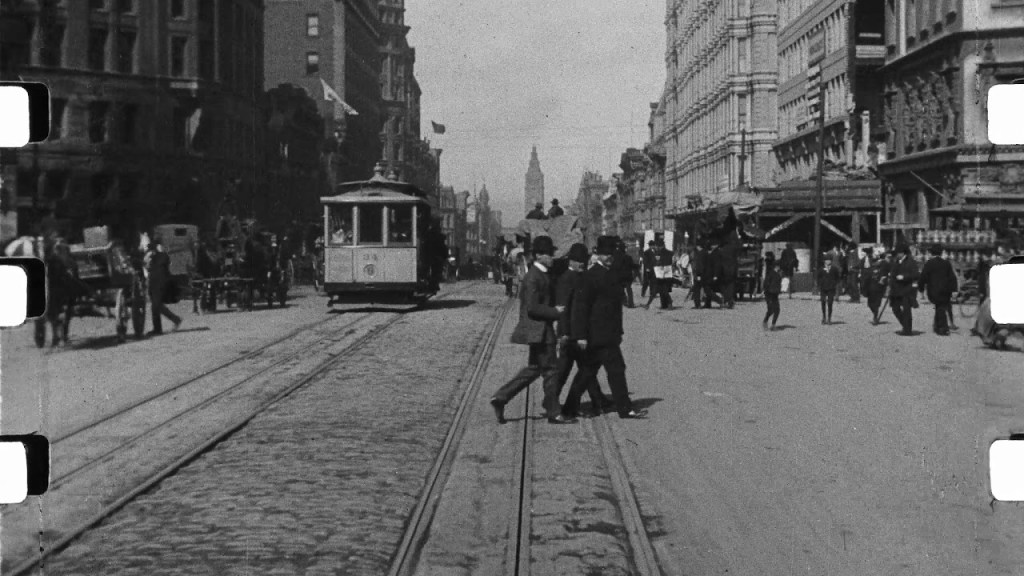
The Plot: In 1906 San Francisco, independent filmmaker Harry Miles took a camera, placed it in front of a cable car, and hand-cranked the camera during its trip down Market Street, from 8th Street to the Embarcadero Ferry Building. Along the way Miles captures the hustle and bustle of California’s (then) most prosperous city, capturing sights of horse drawn carriages, pedestrians in formal attire (complete with bowler hats), as well as plenty of those new-fangled automobiles. What started out as an experimental film documenting San Francisco suddenly became a sought-after historical artifact when, just four days later, the infamous 1906 earthquake struck.

Why It Matters: The NFR writeup gives a historical rundown, and an essay by historian David Kiehn details how Kiehn successfully determined the film’s production date.

But Does It Really?: Obviously my closeness to the subject matter gives me a bit of a bias, but “A Trip Down Market Street” is an invaluable historical document. The film’s innovative cinematography helps differentiate it from other actuality films of the era. Filming an entire street on a moving vehicle helps preserve so many details of turn-of-the-century living. And the film’s unintentional date with destiny adds an extra layer to the viewing experience. No argument here for the NFR induction of “Market Street”.

Everybody Gets One: The Miles brothers (Harry, Herbert, Earl, and Joe) started off with Biograph Studios before branching out into their own independent film company. They kept an office in New York, but moved their business to San Francisco, making theirs the first film company with offices on both coasts. After successfully filming an entire prize fight between “Battling” Nelson and Jimmy Britt in 1905, the brothers opted to film Market Street on a cable car. This wasn’t too big a stretch for the brothers; this film’s starting point is half a block away from their Market Street studio.

Wow, That’s Dated: As a San Francisco citizen I’ll point out the most important now-outdated aspect: Cars being allowed to drive down Market Street.

Other notes

  • For many years, the Library of Congress determined that the film was shot in September 1905, based on the buildings in the background. Something about that date didn’t ring true for film historian David Kiehn, who went about doing his own research on the film. Using newspapers and other artifacts in the San Francisco Library, Kiehn learned that several of the cars’ license plates weren’t registered until January and February of 1906. Puddles spotted on the tracks placed filming in late March or early April (San Francisco had no rain in September 1905). Finally, he found newspaper articles regarding production, and could pinpoint the actual shoot to Saturday, April 14th 1906, a little after 3pm. Kiehn chronicles his journey in his aforementioned essay, as well as this “60 Minutes” piece.
  • Also worth noting from Kiehn’s research: while Market Street appears to be bustling with cars, automobiles were still quite a novelty in America. The Miles Brothers hired a few chauffeurs to drive past the camera, circle back, and drive past them again. One car passes the camera six different times during the 12 minute film.
  • Because the camera is mounted on the front of a cable car, you can spot several people “hailing” the camera as it comes towards them.
  • Wow, everyone is cutting this cable car off. There’s also several close calls between cars, pedestrians, and horses. It helps that cars of the era had a top speed of around 30mph, no one’s getting hurt by these things.
  • My favorite detail: A giant sign of the side of one of the buildings advertising “Pianos”. Makes sense, every home had one back then.
  • Another prominent sign: M. Blaskower’s Cigar Shop with its “Nathan Hale” five cent Cuban style cigar. “If you have one life to live for this country, smoke ’em if you got ’em!”
  • The film ends with the cable car approaching the Ferry Building, then moving on a turntable to head back up Market Street. The final few frames are children waving at the camera, an occurrence that takes place in every era of American filmmaking.

Legacy

  • Of course, the film’s legacy was solidified only four days later when San Francisco was destroyed by the 1906 earthquake and fires. Among the many buildings destroyed was the Miles Brothers’ Market Street studio. “A Trip Down Market Street” was loaded onto a train for New York the day before the earthquake hit, and only three prints of the movie are known to exist.
  • While the brothers continued their business (their film of a pre-earthquake San Francisco became in-demand), they still never came out of the financial hole the studio’s destruction left them with. Following Harry’s death in 1908, and the company being forced into bankruptcy in 1910, the remaining Miles brothers went their separate ways, working for other small film companies.

Further Viewing: In 2005 (back when this film was believed to be from 1905), filmmaker Melinda Stone set out to recreate this film for its centennial. Even in only 15 years, the Market Street in this updated film differs from its present day iteration. One of the film’s producers/researchers is film curator Liz Keim, who I can say from personal experience is one of the nicest, most insightful people I’ve ever had the pleasure of knowing.

#458) The Story of G.I. Joe (1945)

#458) The Story of G.I. Joe (1945)

OR “Ernie Pyle, U.S.W.C.”

Directed by William Wellman

Written by Leopold Atlas & Guy Endore & Philip Stevenson. Based on the books “Here Is Your War” and “Brave Men” by Ernie Pyle.

Class of 2009

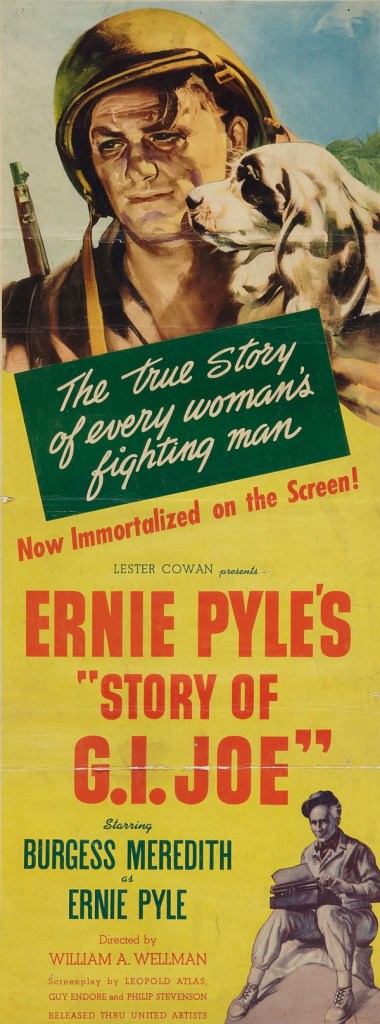
The Plot: “The Story of G.I. Joe” is the story not of the classic action figure, but rather the popular ’40s term for the average-Joe WWII soldier. Based on a true story, war correspondent Ernie Pyle (Burgess Meredith) tags along with the C Company, 18th Infantry, U.S. Army as they fight in Tunisia and Italy. Led by Lt. Walker (Robert Mitchum), the rookie infantry is tested battle after battle, fighting the elements, their deteriorating mental health, and an ongoing casualty rate. Despite all the hardships, Pyle stays with them, telling their stories to his readers, praising them as the best outfit in all the army.

Why It Matters: The NFR praises the film’s “gritty portrayal of the realities of war”, as well as Burgess Meredith’s “understated realism”. There’s also an essay by AFI writer/AMPAS librarian Amy Dunkleberger.

But Does It Really?: This is a tough one. Obviously, “G.I. Joe” is a well-made film (Director Wellman is no stranger to great war movies), but WWII movies made during the actual war have a tendency to assume the audience knows all the terminology, leaving future viewers in the cold. The Dunkleberger essay makes a compelling case for “G.I. Joe” being in the NFR, if nothing else as a tribute to the real-life Pyle. I want to support “G.I. Joe” on this list, but without a solid legacy or influence 75 years later, it’s a tough sell. “G.I. Joe” is a good movie, but I question its standing among the greats.

Everybody Gets One: After a brief stint in the Naval Reserve, Ernie Pyle sought to become a journalist. Indiana University didn’t have a journalism degree at that time, so Pyle majored in Economics, but took every journalism class they offered. His work editing the school paper led to a job as a columnist for the Scripps-Howard syndicate. After 17 years of well-received human interest write-ups, Pyle became a war correspondent during WWII, always sympathizing with and celebrating “G.I. Joe”.

Wow, That’s Dated: Typical ’40s wartime jargon, plus shoutouts to bandleader Artie Shaw and pin-up girl Carole Landis.

Title Track: “The Story of G.I. Joe” was released in some areas under the slightly different title “Ernie Pyle’s Story of G.I. Joe”. According to Pyle in one of his last columns “I never did like the title, but nobody could think of a better one, and I was too lazy to try.”

Seriously, Oscars?: A critical success but a financial misstep, “The Story of G.I. Joe” received four Oscar nominations, losing to, among others, future NFR entires “The Lost Weekend” and “A Tree Grows in Brooklyn“. Robert Mitchum’s Best Supporting Actor nod was his only nomination in what would be a 53 year acting career.

Other notes 

  • Ernie Pyle was initially against his writings being adapted into a movie, but producer Lester Cowan was persistent, wanting to do for the infantry what 1943’s “Air Force” did for the Air Corps. Once they settled on making the film a salute to the average soldier, Pyle agreed.
  • “The Story of G.I. Joe” is based on Pyle’s time with the 36th Infantry Division at the Battle of San Pietro, and the 133rd Infantry in the Battle of Monte Cassino. To add to the realism, many of the extras in the film were real life veterans of these battles, en route to more fighting in the South Pacific. Sadly, many of them would be killed in the South Pacific before the film was released.
  • It’s so interesting watching a young Burgess Meredith (well…younger: he was 38). Known for his larger-than-life performances in “Rocky” and the “Batman” TV series, Meredith is equally good playing reserved, down-to-earth folk like Ernie Pyle. No big emotional monologues for Meredith, he just quietly observes the proceedings and holds the movie together.
  • Also dated: sex-starved soldiers. We get it, there truly is nothing like a dame, but that doesn’t mean you get to be a creepy horndog to the handful of women in this movie.
  • Speaking of, Nurse Murphy (who Pyle “gives away” in a makeshift wedding ceremony) is played by Dorothy Coonan, star of “Wild Boys of the Road” and wife of director William Wellman.
  • One of the movie’s subplots is Sgt. Warnicki, who keeps trying to find a record player so he can listen to the recording his wife sent of their son talking for the first time. When he does finally find one, the needle is broken. As Pyle might say, “That’s not fair at all. There was time now…
  • Once again, Robert Mitchum’s performance does nothing for me, through no fault of its own. I guess I just don’t have an acquired taste for the man’s work. He mutters a few lines, has a nice heart-to-heart with Pyle, and then [spoilers] is killed off-screen. Like Gary Cooper in “Wings”, I’m baffled as to how this was Mitchum’s breakout role.
  • Right before production began, the Normandy Invasion of D-Day occurred and signaled the beginning of the war’s end. While previous war films of the time ramped up the victory propaganda, “G.I. Joe” characteristically ends with a less extravagant, more hopeful prayer for peace.

Legacy 

  • “The Story of G.I. Joe” helped propel Robert Mitchum from fresh-faced new talent to established movie star. Mitchum would go on to play more nuanced characters in such films as “The Night of the Hunter“, “Out of the Past“, and “Cape Fear”.
  • Unfortunately, Ernie Pyle did not live to see the final film: he was killed in combat while covering the invasion of Okinawa, two months before the film’s premiere. He received tributes from President Eisenhower and former First Lady Eleanor Roosevelt, and in the ensuing years has been honored by the U.S. Postal Service, Indiana University, and even The Peanuts.
  • In 1963, Donald Levin was trying to come up with a name for his new action figure, and remembered the name “G.I. Joe” from this movie. Now you know, and knowing is half the battle!

Listen to This: During the movie, the soldiers listen to an episode of “Command Performance” hosted by Bob Hope. This was a real wartime radio program produced for the Armed Forces, and a 1942 episode with Hope and Lena Horne made the National Recording Registry in 2005. Listen to it here.

#457) Deliverance (1972)

#457) Deliverance (1972)

OR “Paddle Your Own Canoe”

Directed by John Boorman

Written by James Dickey. Based on his novel.

Class of 2008

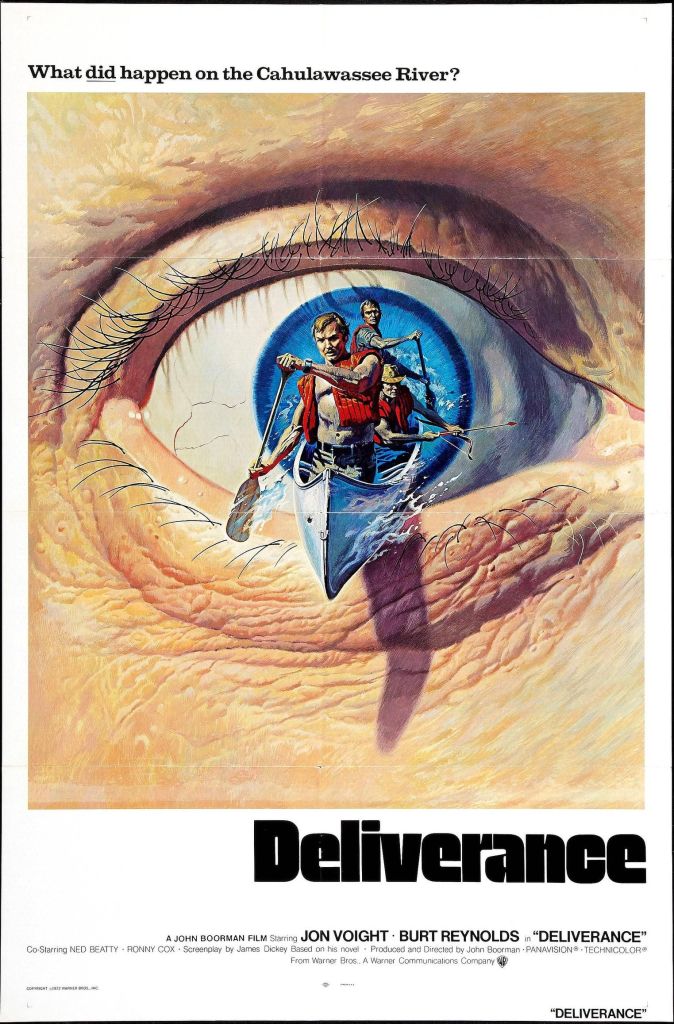
The Plot: Businessmen and acquaintances Ed, Lewis, Bobby and Drew (Jon Voight, Burt Reynolds, Ned Beatty, and Ronny Cox) take a long weekend getaway for some camping and canoeing down Georgia’s Cahulawassee River, soon to be flooded by a newly-built dam. What starts out as a relaxing vacation in the great outdoors slowly turns into a wide-awake nightmare. These “city folk” experience everything from a near-death experience on the rapids to a traumatizing encounter with some local hillbillies (Bill McKinney & Herbert “Cowboy” Coward). It’s a scary, thrilling survival film, complete with iconic banjo music!

Why It Matters: Wow, someone really likes “Deliverance” over at the NFR. Their write-up calls the film a “gripping Appalachian ‘Heart of Darkness'”, praises the “visual flair” of Boorman and cinematographer Vilmos Zsigmond, and calls the Mountain Men “two of the more memorable villains in film history”.

But Does It Really?: “Deliverance” is one of those movies that isn’t perfect, but does succeed at what it’s trying to be. Boorman et al create a backwoods atmosphere that is both idyllic and terrifying, and effectively set the scene for a realistic tale of flawed men trying to brave the elements. The film’s iconic first half makes the second half a bit of a letdown through no fault of its own, but overall “Deliverance” is a strong movie with an equally strong legacy. Though I do question how it took 20 years for “Deliverance” to make the National Film Registry.

Everybody Gets One: James Dickey had been an English instructor and a copy writer for Coca-Cola before becoming a published poet in the 1960s. “Deliverance” (his first novel) was published in 1970, and its film rights were immediately snatched up by Warner Bros. Despite some initial friction with director John Boorman over script re-writes, Dickey got along well with Boorman, who cast Dickey as the Sheriff at the end of the movie.

Seriously, Oscars?: One of the biggest hits of 1972, “Deliverance” received three nominations: Best Picture, Director, and Editing. Unfortunately, 1972 was also the year of “The Godfather” and “Cabaret“, and “Deliverance” went home empty handed. The film did, however, win an unexpected major showbiz award: Steve Mandell & Eric Weissberg took home the 1974 Grammy for Best Country Instrumental Performance for their rendition of “Dueling Banjos”.

Other notes 

  • Like so many great movies, we got our main cast because every other actor in Hollywood passed. Everyone from Steve McQueen to Henry Fonda to Marlon Brando were considered for or offered the roles of Ed and Lewis. When Boorman’s “Point Blank” lead Lee Marvin passed, the 48-year-old actor suggested that Boorman cast younger leads that would be up to the movie’s demanding physical scenes. All four eventual leads were in their early to mid-30s during production.
  • This is Ned Beatty’s film debut! Ironically, Beatty was the only main cast member who had ever paddled a canoe before, even though his character is supposed to be the least experienced.
  • I didn’t realize “Dueling Banjos” is right at the beginning. It’s pretty much the only moment of levity in an otherwise tense film. Ronny Cox may have been this movie’s fourth Ghostbuster, but he and his guitar get the film’s most iconic moment.
  • Why is Jon Voight wearing Burt Reynolds’ mustache? Did Reynolds lose a bet?
  • Speaking of, it’s so interesting seeing Burt Reynolds in a movie where he’s playing a character, rather than a variation of his screen persona. His Lewis speaks with a Southern accent, and is a bit more militant than, say, The Bandit. Reynolds does, however, sneak in his trademark high-pitched laugh at one point.
  • Shoutout to cinematographer Vilmos Zsigmond. Like he did for the Northwest in “McCabe & Mrs. Miller“, Zsigmond does a marvelous job capturing the deceptive peacefulness of the Georgia backwoods. Take away the film’s perpetually foreboding atmosphere and these shots would be picturesque. There’s also some brilliant camera compositions going on during the dialogue scenes, leading to some wonderful visual storytelling. How the Oscars continued to ignore Zsigmond’s work is appalling.
  • The canoeing scenes may be my favorite in the movie; the last bit of fun before it all goes to hell. On a related note: due to the film’s low budget, the actors did their own stunts, and were uninsured.
  • Full Disclosure: I have repeatedly held off viewing “Deliverance” for the blog because of the “squeal like a pig” scene. Having now seen it, the sequence earns its reputation as one of the most unforgettably disturbing moments in this or any film. It’s like a nightmare that you can’t shake after you wake up. The only real downside is that nothing in the rest of the movie can top that for sheer shock value or stake-raising. Like the car chase in “The French Connection“, this scene causes “Deliverance” to peak too soon.
  • This movie made me realize that I haven’t seen too many of Jon Voight’s performances (the only one that comes to mind is “Seinfeld“). He is definitely an actor who works from the inside out; each thought in Ed’s mind comes across on Voight’s face. It’s a subtly brilliant performance.
  • The movie’s other drawback for me is that it falters once the group is split up. Turns out I enjoyed watching these four character bond more than I enjoyed Ed’s personal journey. There’s nothing bad about the film’s second hour, it just becomes a different, less exciting movie.
  • For years, the internet has told me that the deputy in the hospital (whom I’ve dubbed “Officer Cheekbones”) is a pre-fame Ed O’Neill. Turns out it’s a similar looking actor named Lewis Crone in his only film appearance. O’Neill was still a young athlete in 1972 and wouldn’t begin his acting career for another few years.

Legacy 

  • “Deliverance” was the movie that catapulted Burt Reynolds from TV star to movie star. Reynolds spent the rest of the ’70s as a bona-fide A-lister, complete with trademark mustache and a relationship with Dinah Shore!
  • The film’s success not only made Georgia and the Chattooga River (filling in for the movie’s fictitious Cahulawassee) popular tourist spots, it also inspired then-Governor Jimmy Carter to start a state film commission. Today, Georgia is the most popular U.S. state outside of California for film production. Tyler Perry wouldn’t build his studio just anywhere.
  • “Squeal like a pig” and “You got a real purdy mouth” have become cultural shorthand for backwoods hillbillies. I bet that wouldn’t be the case if everyone remembered the context those lines were spoken in.
  • Also a cultural hillbilly shorthand: “Dueling Banjos”, easily one of the most popular instrumentals in film history. One only needs to hum the first five notes for people to get the reference.