#466) Spartacus (1960)

#466) Spartacus (1960)

OR “Gladiator Salvation”

Directed by Stanley Kubrick

Written by Dalton Trumbo…wait he’s actually credited? Oh, well then…

Written by Dalton Trumbo. Based on the novel by Howard Fast.

Class of 2017

NOTE: The only widely available version of “Spartacus” is the 1991 restoration by Robert Harris, which reinstates sequences cut after the film’s premiere, as well as some of Kubrick’s more epic battles scenes cut after previews.

The Plot: It’s the 1st Century BC, and Rome has become a collapsing empire in danger of becoming a dictatorship (sound familiar?). A slave named Spartacus (Kirk Douglas) is recruited by Lentulus Batiatus (Peter Ustinov) to train as a gladiator and eventually be sold to the Roman elite. After a fight staged for visiting Roman Senator Marcus Crassus (Laurence Olivier), Spartacus incites a riot and helps his fellow gladiators escape. With a growing army of former slaves, including servant girl Varinia (Jean Simmons) and Crassus’ slave Antoninus (Tony Curtis), Spartacus vows to end slavery and restore glory to the Roman Empire. Good luck with that.

Why It Matters: The NFR praises Kubrick’s “masterful direction”, as well as the film’s “sheer grandeur and remarkable cast”. The writeup also singles out the film’s efforts to end the Hollywood Blacklist of the ’50s by crediting blacklisted screenwriter Dalton Trumbo.

But Does It Really?: “Spartacus” is definitely a classic, but not quite one of the untouchables of American films. “Spartacus” differentiates itself from the era’s religious epics (“Ben-Hur“, “The Ten Commandments“, etc.) by being more political and emphasizing character over spectacle. In addition to its talented cast, the storytelling skills of Stanley Kubrick and Dalton Trumbo help this film’s 200 minutes clip along better than most shorter films. Despite its current status as Kubrick’s outlier film, “Spartacus” is still worth a view, and deserves a spot on the NFR.

Everybody Gets One: Producer Edward Lewis spent most of the ’60s backing movies for Kirk Douglas and John Frankenheimer (and both for “Seven Days in May”). Lewis’ career continued into the ’80s, with Best Picture Oscar nominee “Missing” and Emmy winning miniseries “The Thorn Birds”. Also making their sole NFR appearance is prolific actor Jean Simmons, appearing in “Spartacus” the same year she starred in “Elmer Gantry” with Burt Lancaster.

Wow, That’s Dated: HD transfers of old movies are great, but they definitely let you know where the real location ends and the matte painting begins.

Seriously, Oscars?:  The biggest hit of 1960 (and Universal Pictures’ biggest hit to date), “Spartacus” received six Oscar nominations, and won four: Art Direction, Cinematography, Costume Design, and Supporting Actor for Peter Ustinov. Despite winning the Golden Globe for Best Drama, “Spartacus” failed to receive a Best Picture nomination, one of the rare Globe winners to do so.

Other notes 

  • Kirk Douglas is the first to admit that he optioned “Spartacus” out of spite for not getting the lead role in “Ben-Hur”. He bought the rights to the Fast novel, producing the film under his company Bryna Productions (named after his mother), and convinced Universal to back the film after signing on Laurence Olivier, Charles Laughton, and Peter Ustinov.
  • Douglas essentially tricked Olivier, Laughton, and Ustinov to join the film by showing each of them a different version of the script that emphasized their respective characters. The final script favored Olivier’s Crassus, which upset Laughton, who remained prickly and difficult throughout the shoot. Ustinov, an acclaimed playwright himself, volunteered to rewrite Laughton’s dialogue to his satisfaction.
  • Anthony Mann was originally announced to direct, and filmed the opening sequences seen in the final film. Douglas, however, felt that Mann was intimidated by the scope of the film, and replaced him after two weeks of shooting with Stanley Kubrick, whom Douglas had worked with on “Paths of Glory“. “Spartacus” is notable for being the only film Kubrick ever made without complete creative control, which he vowed never to do again after his tense working relationship with Kirk Douglas on this film.
  • Although Dalton Trumbo had been blacklisted since 1947, he continued penning screenplays under various pseudonyms and fronts (most notably “Roman Holiday“). Trumbo was brought in to replace author Howard Fast, and planned on using the alias “Sam Jackson”, but Kirk Douglas insisted that Trumbo receive the credit himself. This occurred the same year that Trumbo received on-screen credit for Otto Preminger’s “Exodus”, although it’s unclear which film made this groundbreaking decision first.
  • Peter Ustinov is definitely this movie’s MVP. Sure, he’s the comic relief, but Batiatus gets the most complex characterization: he’s essentially middle management; authoritarian to his gladiators, cowardly towards his superiors.
  • The first fight sequence between Kirk Douglas and Woody Strode is very impressive. The fight choreography brings out the characters, and it has a wonderful tension throughout, plus a surprise ending.
  • Despite the backstage drama, Charles Laughton is a delight as Senator Gracchus. It’s nice to see that Laughton wasn’t completely disillusioned by his “Night of the Hunter” experience.
  • No offense to John Gavin, but this is now the third NFR film that I’ve forgotten he’s in. And he’s playing Julius Caesar for god sakes! Et tu, “Spartacus”?
  • The most infamous of the restored footage is a scene in which Crassus subtly seduces Antoninus while being given a bath. I could see how The Code wouldn’t be open to a discussion of “eating oysters” vs. “eating snails”. The scene’s original audio went missing, so Tony Curtis redubbed his own dialogue, while Anthony Hopkins filled in for the late Laurence Olivier. Hopkins’ spot-on impression of Larry bumps his NFR standing to 1½.
  • The battle sequences were filmed in Spain, Kubrick’s only win in his desire to shoot overseas (Universal wanted to prove they could make an epic without leaving Hollywood). The battle itself is an impressive undertaking, though the restored footage makes it all a bit more gruesome (Spartacus cuts a guy’s arm off! Is this where “Anchorman” got that from?).
  • “Spartacus” is filled with allusions to the blacklist, the “I’m Spartacus” scene being a prime example. Watching a ragtag group of former slaves refuse to “name names” adds to the power of this iconic sequence. Side Note: I’m pretty sure that’s Paul Frees dubbing the soldier who announces Crassus’ offer.
  • This is the second movie where Laurence Olivier chastises Jean Simmons for not loving him. The first was when Olivier played Hamlet to Simmons’ Ophelia. What a fun reunion this must have been.
  • We have to wait until the end, but Kirk Douglas finally gets one of his famous clenched-teeth outbursts. This is preceded by a similar outburst from Olivier, apparently channeling Al Pacino.
  • Fact: My Tony Curtis impression stems from his line “I love you, Spartacus”.
  • Ultimately, Spartacus has the same message as “Hamilton”: Who lives, who dies, who tells your story?
  • I’m confused: I thought this movie was about Agador Spartacus.

Legacy 

  • As previously stated, Stanley Kubrick went on to only direct films in which he had total control over the production. His follow-up to “Spartacus” is the significantly less epic, but significantly more Kubrick “Lolita”. Although Kubrick distanced himself from “Spartacus” for the rest of his life, he did give the 1991 restoration his blessing and even gave a few directorial notes.
  • “Spartacus” doesn’t get the parody treatment too often, but when it does, it always involves someone shouting “I’m Spartacus!”
  • This film (along with “Exodus”) helped end the Hollywood Blacklist, and restored Dalton Trumbo’s career. And Hollywood never ostracized a creative type due to their political beliefs ever again…
  • Shortly after my last post about a Kirk Douglas film, Douglas passed away at the age of 103. Looking back on his career in 2014, he considered “Spartacus” one of his best films.
#465) Suzanne Suzanne (1982)

#465) Suzanne Suzanne (1982)

Directed by Camille Billops & James V. Hatch

Class of 2016

Another rare NFR entry with no clips I can readily embed. Here’s an interview with Camille Billops & James V. Hatch.

The Plot: Artist Camille Billops turns the camera on her own family in her filmmaking debut “Suzanne Suzanne”. The Suzanne of the title is Billops’ niece Suzanne Browning, battling a heroin addiction following the death of her father, Brownie. Also interviewed are Suzanne’s mother Billie (Camille’s sister), and grandmother Alma (Camille and Billie’s mother). It is soon revealed that both Suzanne and Billie were victims of Brownie’s alcoholism and physical abuse. Billops and her husband James Hatch chronicle their family as they grapple with their problems head-on for the first time.

Why It Matters: The NFR calls the film a “cinematic drug intervention” that “captures the essence of a black middle-class family in crisis”. The film’s climactic moment is called “an intensely moving moment of truth”.

But Does It Really?: This one is definitely on the “culturally significant” side of the list. “Suzanne Suzanne” represents Camille Billops and James V. Hatch, two people who devoted their lives to preserving African-American culture and art. While their scholarly efforts were about preserving the past, their films were about preserving the present, showing Camille and her family confronting some very personal issues. Having now done my homework, I’m curious as to why “Suzanne Suzanne” made the cut over the team’s later, even more personal film “Finding Crista”. Regardless, “Suzanne Suzanne” perfectly encapsulates Billops and Hatch’s filmography, as well as their achievements in capturing the nuance of African-American life.

Everybody Gets One: By the late ’60s, Camille Billops was primarily known as a sculptor, with exhibitions of her ceramics in both New York and Germany.  In 1968, Billops met her future husband, UCLA theater Professor James Hatch, and the two started collaborating on collecting thousands of interviews and other documentation about African-American art and culture. Through encouragement from Hatch, Billops’ art pivoted from ceramics to plays, and eventually filmmaking. “Suzanne Suzanne” was their first film together.

Title Track: We have a title song! “Suzanne Suzanne” the song was composed by Billops’ daughter Christa Victoria (see “Legacy”), and sung by Victoria and Billops. Once again, I am surprised when a serious documentary or short has its own title song.

Seriously, Oscars?: No Oscar love for “Suzanne Suzanne”, or Billops & Hatch. 1982’s Documentary Short Subject Oscar winner was “If You Love This Planet“, a controversial anti-nuclear weapons film.

Other notes 

  • The film’s cinematographer is Dion Hatch, James’ son from a previous marriage.
  • Right out the gate, this film grapples with its complex subject matter. Both Suzanne and Billie are relieved that Brownie is no longer controlling their lives, but at the same time Suzanne admits that he was a role model for her, highlighting the complex relationship that some people have with their parents.
  • I cannot imagine how tough it must have been for this family to open up about any of these topics. Then again, I doubt any of them considered the possibility that this documentation would become part of a national film archive.
  • We get a brief glimpse at Camille’s reflection in the bathroom mirror while she is interviewing her nephew Michael (Suzanne’s brother). She is sporting her trademark braids and necklaces. And while we’re on the subject, that is one hell of a mustache Michael is sprouting. It’s a cross between a handlebar and extended muttonchops.
  • The rehab center Suzanne goes to (Tuum Est, Inc.) is in Venice Beach, CA. The building is still a rehab center, but is now called Phoenix House.
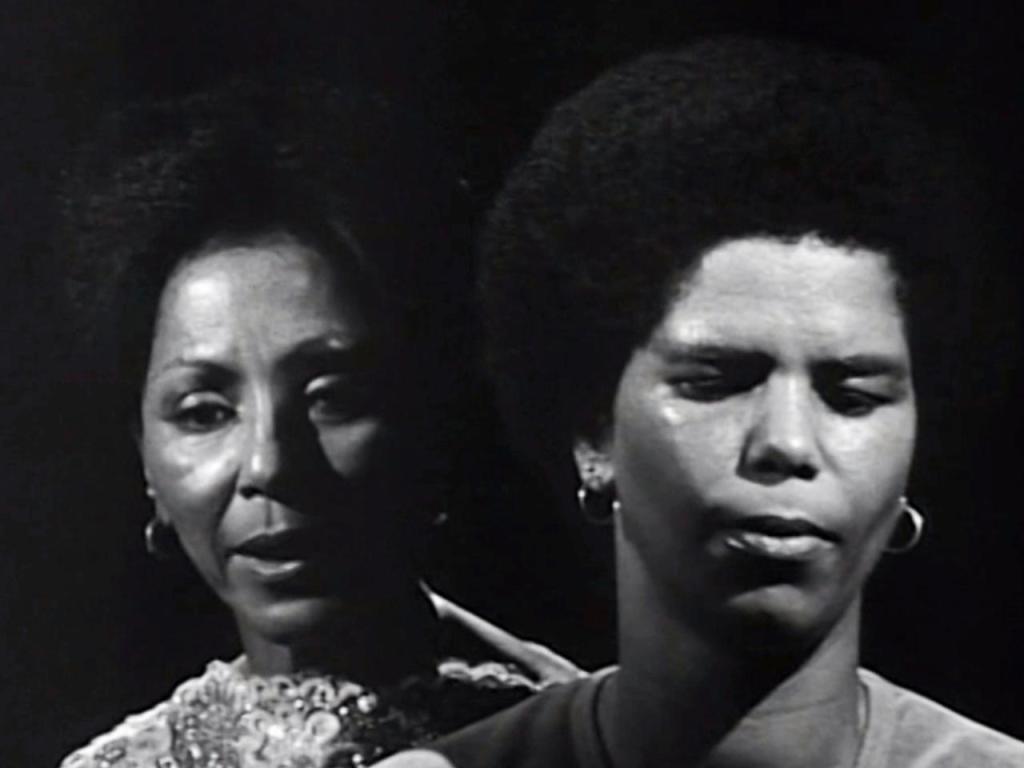
  • The film’s highlight is Suzanne and Billie working out their respective trauma one-on-one during Suzanne’s rehabilitation. They ask each other questions while looking away from each other, and seeing both of their faces as each one of them has a breakthrough is a compelling viewing experience.

Legacy 

  • Camille Billops and James Hatch made five more short films over the next 20 years, many of them centering around Billops and her family. Most notable of these is 1991’s “Finding Christa”, documenting Billops’ reunion with her daughter, whom she gave up for adoption in the early ’60s.
  • I had difficulty tracking down any present day information about Suzanne Browning. Anyone know what happened to her?
  • Billops died in June 2019 at the age of 85, with Hatch following in March 2020 at age 91. Their extensive collection of African-American interviews, plays, and manuscripts are available in the Camille Billops and James V. Hatch Archives at Emory University.

#464) Humoresque (1920)

#464) Humoresque (1920)

OR “Fiddler Under the Roof”

Directed by Frank Borzage

Written by Frances Marion. Based on the short story by Fannie Hurst.

Class of 2015

The Plot: In the Lower East Side of turn-of-the-century New York, the Kantor family struggle to make ends meet. Nine-year-old Leon (Bobby Connelly) wants a violin for his birthday, and while father Abrahm (Dore Davidson) discourages the expensive gift, Mother (Vera Gordon) supports it, stating that God has finally answered her prayer of a having a musical prodigy in the family. Leon grows up (Gaston Glass) to become a successful violin player, performing concerts for the likes of the Royal Family. Despite his success, and the love of childhood friend Gina Berg (Alma Rubens), Leon opts to give it all up and serve his country during the Great War. This family drama will stop at nothing to tug at your heartstrings, pun definitely intended.

Why It Matters: The NFR gives a rundown of the film’s plot and historical significance, and praises director Borzage and actor Vera Gordon’s “riveting” performance.

But Does It Really?: I’m definitely on the fence about this one. On the one hand, “Humoresque” holds up quite well 100 years later, despite its tinges of melodrama. On the other hand, this film rarely gets mentioned among great American films, and has no notable legacy. “Humoresque” works best as a document of the kind of movies 1920 audiences enjoyed; stories of immigrants in America, and their dream for their children to live better lives. I know I give most movies a slight pass for NFR induction, but “Humoresque” is getting by on my slimmest margin yet.

Everybody Gets One: Vera Pogorelsky was a child actor in her native Russia, but anti-Semitism in the Russian theater community led to her emigrating to America. For over 40 years Vera Gordon divided her time between film and the theater, almost always playing the lead’s Jewish mother.

Wow, That’s Dated: I want to take a moment and acknowledge Mannie Kantor, Leon’s brother and possibly one of the first developmentally disabled characters in a movie. The film makes him a purely pitiable figure, calling him “a living dead thing…with a tiny baby’s mind”. It’s all quite antiquated and manipulative by today’s standards, but still worth noting.

Title Track: A humoresque is a genre of music known for its lightness (you’ve probably heard Antonin Dvořák’s rendition). In this film, “Humoresque” is the piece that Leon plays on several occasions, his mother comparing it to life: “Crying to hide its laughing, and laughing to hide its crying.”

Seriously, Oscars?: Obviously, this 1920 film was not eligible for an award still eight years away, but it’s worth noting that “Humoresque” won the first Photoplay Medal of Honor for Best Film of the Year. The Medal of Honor is generally considered the first major American movie award, and was handed out for almost 50 years.

Other notes 

  • The producer of “Humoresque” is an uncredited William Randolph Hearst! That’s right, the real-life Citizen Kane (and his production company Cosmopolitan) was behind this, and it was allegedly Hearst himself who suggested giving the film a happy ending. This all begs the question: did Leon have a name for his violin? And did he cryptically utter it on his deathbed?
  • Intertitles are always a fun source for ’20s phrases, as well as those whose meaning have changed over the years. Young Leon is first introduced “showing off his birthday suit”, which has a very different meaning these days.
  • Adjusted for inflation, the $4 violin Leon wants would be over $100 today.
  • The main thing I appreciate about this film is how many Jewish traditions and customs are observed throughout the film, including lighting a menorah for non-Hanukkah reasons, touching the mezuzah upon entering a room, and Leon’s performance of “Kol Nidre“. It’s a detailed look at Judaism that unfortunately got lost once the Production Code set in. Added bonus: the intertitles give us such Yiddish words as “ganef” (thief), “potch” (slap or smack), and “nebich” (a poor thing).
  • Sure Vera Gordon is great in this, but she is every overbearing Jewish mother stereotype rolled into one. Kay Medford and Renée Taylor owe their careers to this woman.
  • With its family of immigrants, its violinist main character, and its reverence of Jewish traditions, this plot is somewhere between “The Jazz Singer” and “Golden Boy”
  • Wow, this audience is really clamoring for Leon to play “Humoresque”. It was the “Free Bird” of its day.
  • The poem Leon recites before leaving his family is a paraphrase of “I Have a Rendezvous with Death” by poet Alan Seeger, who was killed while serving in the French Foreign Legion during WWI. You’re more familiar with his nephew, singer and anti-war activist Pete Seeger.
  • The scene where Leon says goodbye to his family goes on forever. My (ultimately correct) suspicion that this was a short story padded out to a feature started here.
  • This is all well and good, but is it really a great idea to make a silent movie about a musician? Especially when the climax of the movie involves him playing the violin?

Legacy 

  • As the NFR write-up states, the success of “Humoresque” led to other studios making films about impoverished families in New York’s Lower East Side. They don’t list any specifically, but I’ll take their word for it.
  • Director Frank Borzage would continue making films for 40 years, most notably 1927’s “7th Heaven“, for which he won the first Oscar for Best Director.
  • “Humoresque” was remade in 1946, with some drastic departures. Joan Crawford is a married woman who falls for John Garfield’s violinist and almost wrecks his career. It ramps up the melodrama, and throws in some ’40s noir for fun.
  • There was a study some years back that suggested there was a correlation between a film’s IMDb connections and its likelihood of making it into the NFR. “Humoresque” may be the exception that proves the rule with only two IMDb connections: the aforementioned remake, and the now-lost 1921 Marx Brothers short “Humor Risk”.
  • Fannie Hurst would go on to write the novel “Imitation of Life”, which has not one, but two film versions in the National Film Registry. She is currently tied with Edgar Allan Poe and John Steinbeck for the author with the most film adaptations of their work in the NFR.

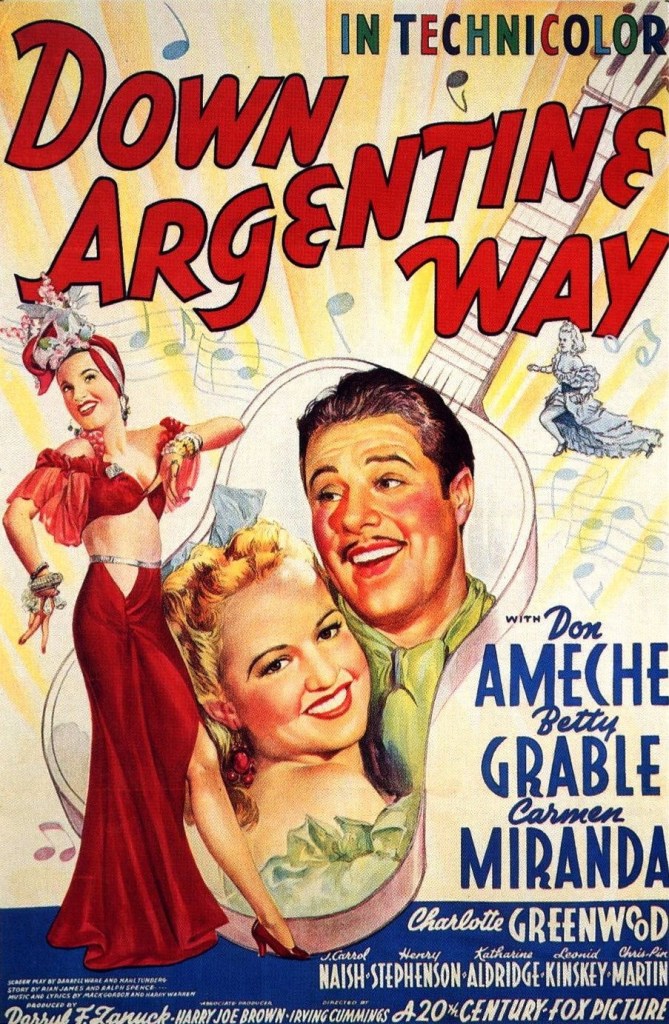
#463) Down Argentine Way (1940)

#463) Down Argentine Way (1940)

OR “The Unofficial Story”

Directed by Irving Cummings

Written by Darrell Ware and Karl Tunberg

Class of 2014

The Plot: While in New York with his prized horse, Argentinian playboy Ricardo Quintano (Don Ameche) hits it off with debutante Glenda Crawford (Betty Grable), not knowing that her father had betrayed Ricardo’s father (Henry Stephenson) years earlier. When Ricardo travels back to Argentina, Glenda follows along with her Aunt Binnie (Charlotte Greenwood). There are musical highlights from Carmen Miranda (in her American film debut) and the Nicholas Brothers, but very little of actual Argentine culture and customs.

Why It Matters: The NFR gives a rundown of Betty Grable, citing this film as the one that “established [Grable] as the pinup queen”. The only part of the movie that gets a superlative is the Nicholas Brohters’ “unparalleled” dance number. An essay by Library of Congress sound technician Carla Arton makes a compelling case for the film’s significance.

But Does It Really?: This is definitely a movie where the cons outweigh the pros. Yes, the film represents the kind of vibrant, Latin-infused “Good Neighbor” musicals that Hollywood was making at the time, but the stereotypes and misappropriation throughout really taint any modern viewing. The aforementioned Arton essay makes the “Good Neighbor” case, as well as one for its star Betty Grable who, while mostly forgotten today, was a major movie star/sex symbol of wartime America. Thanks to Arton’s essay, “Down Argentine Way” gets a pass for NFR inclusion.

Everybody Gets One: The child of what we would now call a “stage mom”, Betty Grable was a regular beauty pageant contestant, and at age 12 she and her mother set off to Hollywood. Grable bounced around from studio to studio throughout the 1930s, finally landing at Fox in 1940. Fox studio head/producer Darryl F. Zanuck was so impressed by Grable’s stage performance in “DuBarry Was a Lady”, he cast her as the lead in “Down Argentine Way” after first choice (and established star) Alice Faye backed out due to appendicitis.

Wow, That’s Dated: BROWNFACE WARNING: Don Ameche plays Ricardo with a stereotypical accent and either really bad makeup or a really good tan. This film also portrays South America as one big country where everyone speaks in ignorant broken English. Even in 1940, Latin American film distributors openly criticized the film and its offensive depictions of Argentina, to the point that Argentina banned any screenings of the film.

Title Track: The Oscar-nominated title song serves as a leitmotif throughout the film; practically everyone sings it at some point, complete with clicking noise.

Seriously, Oscars?: “Down Argentine Way” received three Oscar nominations, and lost all of them. Cinematography and Art Direction went to British import “The Thief of Bagdad”, while Best Song went to a little ditty called “When You Wish Upon a Star“.

Other notes 

  • Betty Grable wasn’t the only actor filling in for this movie’s first choice. Don Ameche stepped in for Desi Arnaz (already under contract with RKO), and Leonid Kinskey replaced Cesar Romero (another illness related cancellation; what was in the water back then?).
  • Speaking of Ameche, none of the credited cast members are actually from Argentina or South America in general. (Carmen Miranda comes closest: she was raised in Brazil, but born in Portugal). J. Carrol Naish is Irish, Henry Stephenson is British, Leonid Kinskey is Russian, and on and on and on.
  • The only performance that’s salvaging my viewing is Charlotte Greenwood as Aunt Binnie. Greenwood’s deadpan delivery of her various one-liners is a consistent delight. She even gets to do some of the high kicks she was known for in her vaudeville days! Greenwood is best remembered for playing another wise-cracking aunt in an NFR musical: Aunt Eller in “Oklahoma!
  • As a general rule, can we stop making fun of non-English speakers’ difficulty with American English syntax? It’s so friggin’ complicated, why do movies always focus on that?
  • The Nicholas Brothers’ dance routine has nothing to do with either this movie or Argentina in general, but it is one of this movie’s few saving graces. I even applauded at the end of their number. Side note: Fayard and Harold Nicholas’ home movies made the NFR some years back, and I cannot for the life of me find the footage online. Any leads?
  • Carmen Miranda was the hottest new star in New York when “Down Argentine Way” was in production. Fox signed her to a contract, but due to her nightclub commitments, Miranda could not leave New York to film in L.A. Her numbers (lifted directly from her nightclub act) were filmed in New York and interspersed throughout the film.
  • Oh, and if Miranda’s song “Mamãe Yo Quero” sounds familiar, you’re thinking of either Tom and Jerry or “Magical Maestro“.
  • Sometimes the subtitle I give a movie for their blog post comes to me during my viewing. I was all set to call this post “Seeing a Man About a Horse”, but then this movie beat me to the punch(line). Well played, movie. Well played.
  • The movie’s second half focuses more on the horse racing and “Romeo and Juliet” plots, and that’s when “Down Argentine Way” lost me. I don’t care about the love story or the countless stereotypes, I was enjoying the musical numbers; and if you’re not going to make everyone sing and dance then what’s the point? Despite its historical significance, “Down Argentine Way” is more flawed than fun.

Legacy 

  • “Down Argentine Way” was a hit, and propelled Betty Grable from supporting player to one of the decade’s biggest movie stars. Frank Powolny’s 1943 photo of Grable in a one piece bathing suit became the most requested photo by GIs during WWII. Incidentally, the reason her back is turned in this famous photo is because she was visibly pregnant with her daughter Victoria.
  • Irving Cummings, Don Ameche, and Carmen Miranda would all reunite for 1941’s “That Night in Rio”, along with Alice Faye, who apparently was feeling better. “Rio” is also notable for giving Miranda her trademark fruit hat.
  • “Down Argentine Way” and “That Night in Rio” are just two of the countless “Good Neighbor” films Hollywood studios were making throughout the ’40s. You are probably most familiar with one of Disney’s offerings: “The Three Caballeros”.
  • Weirdly enough, another Carmen Miranda musical – 1943’s “The Gang’s All Here” – was also added to the NFR in 2014, making Miranda one of the few performers to be inducted twice in the same year.

#462) The Lunch Date (1989)

#462) The Lunch Date (1989)

OR “I’ll Have What She’s Having”

Directed & Written by Adam Davidson

Class of 2013

The Plot: An upper-class Woman (Scotty Bloch) misses her train while rushing through Grand Central Station. Her plans dashed and her wallet missing, the Woman orders a salad from a nearby food stand with change from her purse. When she returns to her table after retrieving utensils, she finds a presumably homeless African-American Man (Clebert Ford) eating her salad. What could escalate into a heated argument fueled by bigotry becomes a moment of connection in which the Woman sees through her own bias and perception….or maybe not.

Why It Matters: The NFR gives some background, and calls the film “a simple, yet effective parable on the vicissitudes and pervasiveness of perception, race and stereotypes.” Full disclosure: I had to look up “vicissitudes”; it’s an unwelcome change of circumstances.

But Does It Really?: I can give “The Lunch Date” a pass on my “Everybody Gets One” mandate for its director Adam Davidson. The film overall is still effective, and delves a bit deeper than your typical student film. The NFR is always on the lookout for student films to put on this list, and “The Lunch Date” is a natural choice.

Everybody Gets One: Son of theater director Gordon and entertainment publicist Judi, Adam Davidson knew he wanted to be a filmmaker. He opted to attend Columbia over NYU because of Columbia’s emphasis on storytelling over technique. “The Lunch Date” was a film that Davidson considered a “practice run” while he was still contemplating what his thesis film would be. He covered most of the film’s $7000 budget by selling his motorcycle and trading “short ends” of film for a complete reel.

Wow, That’s Dated: The only giveaway is Grand Central Station’s pre-digital departure board. The clacking of the individual numbers is so satisfying, though.

Seriously, Oscars?: “The Lunch Date” played the festival circuit, and eventually the Cannes Film Festival, where it won the Palme d’Or for short films (The only American short in contention). The same week of the Cannes accolades, the film won a Student Academy Award, making it eligible for Oscar consideration. Nine months later, “The Lunch Date” won the Academy Award for Best Live-Action Short Film. All of this while Davidson was still a student at Columbia!

Other notes 

  • That story again, “The Lunch Date” was a film Davidson tossed off while he was considering his thesis project. And now he’s an Oscar winner with a film on the NFR. May we all be so blessed.
  • Both Scotty Bloch and Clebert Ford were New York character actors and stage veterans by the time “The Lunch Date” came about. And as with any true New York actor, they both have respectable “Law & Order” numbers: Ford with 2, Bloch with 4 (3 regular, 1 “SVU”). Davidson would go on to direct an episode himself in 1998.
  • A noteworthy attention to detail: the Man’s beanie still has a price tag on it.
  • The short sequence of our two characters eating a salad is the film in a nutshell: Simply executed, but conveying deeper layers underneath. Kudos to Davidson, as well as the subtle acting chops of Bloch and Ford.
  • I enjoyed the staging of the moment where the Woman cannot find her bag. It has a nice Hitchcockian quality to it.
  • The thing I most appreciate about “The Lunch Date” is that it’s left up to you to determine if this woman was actually changed by this experience. My answer is no, but that’s also because of the thoroughly depressing, racially charged times we’re currently living in.

Legacy 

  • Although Adam Davidson has only one feature-length film to his credit (2000’s “Way Past Cool”), he has been an in-demand TV director for the past 25 years. Highlights include episodes of “Six Feet Under”, “Grey’s Anatomy”, “Community”, and “Zoey’s Extraordinary Playlist”, which I keep meaning to watch. Is it any good?