#531) Freedom Riders (2010)

#531) Freedom Riders (2010)

Directed & Written by Stanley Nelson. Based on the book “Freedom Riders: 1961 and the Struggle for Racial Justice” by Raymond Arsenault.

Class of 2020 

As always, this post cannot possibly convey the scope and importance of the real-life events depicted in this movie, and I strongly encourage further research on the Freedom Rides.

The Plot: In 1961, the Congress of Racial Equality sponsored the Freedom Rides, a Civil Rights movement in which both Black and White citizens would ride in buses together, with a goal to highlight how many (mostly Southern) states were not upholding federal anti-segregation laws. Initially planned as a trip from Virginia to New Orleans, with several stops along the way, these initial Freedom Rides were met with hostility, violence, and even arrests for its riders. Although the Riders never made their destination, their actions (and those of subsequent rides) encouraged the growing Civil Rights movement. Almost 50 years later, “Freedom Riders” chronicles these events from as many perspectives as possible: the Riders themselves, local citizens, and even a few of the political figures who simultaneously helped and harmed the movement.

Why It Matters: The NFR praises the documentary for its “extraordinary clarity and emotional force” and predicts that “Freedom Riders” will “inspire later generations”. The NFR write-up includes a link to the American Archive of Public Broadcasting, and the raw, uncut interviews Stanley Nelson conducted for the film.

But Does It Really?: In less than two hours, “Freedom Riders” covered its events with such honesty and nuance, I really felt like I had experienced it. The film is an excellent companion piece to other Civil Rights movies on the list (“The March” and “4 Little Girls” to name just two), and is devoid of any false emotions or manipulation by the filmmakers. Overall, “Freedom Riders” is a reminder that while every historical movement has its leaders, it has to begin with ordinary people and their beliefs. It’s too early to call “Freedom Riders” a classic, but this movie is an important document of American history, and definitely worth a viewing.

Everybody Gets One: While studying at Leonard Davis Film School in the mid-70s, Stanley Nelson was inspired to become a documentarian after seeing D.A. Pennebaker give a lecture. After an apprenticeship with William Greaves, Nelson found himself working for PBS. Many of Nelson’s documentaries (including “Freedom Riders”) have aired as part of the PBS series “American Experience”. Nelson was inspired to make “Freedom Riders” not only because of the event’s place in Civil Rights history, but also because, as he put it, “many of the people involved are still living, vital and energetic.”

Wow, That’s Dated: Unfortunately the most dated aspect of this 2010 documentary is the national consensus that racism is bad. I’m not saying that racism and violent oppression weren’t happening 10 years ago, but in the wake of Obama’s election, White America was quick to believe we were living in a “Post-racial America” (Spoilers: We weren’t). A documentary like “Freedom Riders” was made with the message of “let’s not forget where we’ve been”, but sadly today is viewed as “history repeats itself”.

Seriously, Emmys?: After playing the film festival circuit in 2010, “Freedom Riders” aired on PBS in May 2011 to coincide with the original event’s 50th anniversary. That summer, “Freedom Riders” was nominated for, and won, three Emmys: Picture Editing, Writing, and Exceptional Merit in Nonfiction Filmmaking.

Other notes 

  • “Freedom Riders” is the first movie from the 2010s to be inducted into the NFR, and as of this writing is the most recent film on the list.
  • Among the first interviewees in this film is the late, great Congressman John Lewis. He was one of the first Freedom Riders on the initial trip, and was a devoted Civil Rights activist to the very end. Lewis often categorized his activism as “good trouble, necessary trouble“.
  • Both this film and “Crisis” highlight President John F. Kennedy’s lack of attention to the growing Civil Rights movement early in his administration. “Freedom Riders” paints JFK as more focused on foreign diplomacy, hoping that any stateside race issues would resolve themselves. It was not until after things got violent for the Freedom Riders that Kennedy took action.
  • Similarly surprising, Dr. Martin Luther King was initially against the Freedom Riders, asking them not to go in the first place. Dr. King would eventually support the cause, but declined to participate in the actual ride, leading to brief discord from some of the Riders, the kind you rarely see directed towards the lionized, infallible figure King has become.
  • Shoutout to Irene Morgan, an African-American woman in Virginia who refused to give up her seat on a segregated bus a full decade before Rosa Parks.
  • Ugh, John Patterson’s interviewed in this. Longtime readers may recall an idealistic version of Patterson played by Ricard Kiley in “The Phenix City Story“, made before Patterson became Governor of Alabama and upheld the state’s segregationist stance. Patterson’s 2010 interview tries to walk back some of his viewpoints, and place the blame on federal resources outside his jurisdiction.
  • The first instance of mob violence in Anniston, Alabama is a sobering viewing experience. “Freedom Riders” does an excellent job of making these attacks of the past feel alive in the present. In fact the entire documentary excels at that sense of unyielding tension and constant anxiety these activists faced every moment of the Rides.
  • Note: I watched “Freedom Riders” one day before the attack on the U.S. Capitol. Watching that horrible act of White supremacy on the news amplified what this movie was trying to convey, especially Black activist Frederick Leonard’s quote about dealing with violent White people: “They were always on guard, thinking that we were going to do something to them, while they were doing it to us.”
  • Perhaps the film’s most impressive feat: it’s a Civil Rights story featuring White participants without turning into a White Savior movie. The White Freedom Riders are depicted as no better or worse than their Black counterparts, and the White authority figures only do the right thing reactively, rather than proactively. The result is much more palatable than so many other films that tread the same water.
  • Then as now, anyone associated with a progressive movement is automatically labeled as an “agitator” by the opposing authority, claiming that the best course of action is a return to normalcy, despite the fact that this “normalcy” is what led to the need for a progressive movement in the first place. But I digress…
  • It’s somewhat ironic that martial law had to be evoked to overrule Governor Patterson’s disregard for the Freedom Riders: it’s the same tactic then-citizen Patterson urged the Alabama governor to use against Phenix City’s crime syndicate.
  • In an archival address, Attorney General Robert Kennedy reasserts his support of African-Americans, even suggesting that one could become president. This may be the first time that clip was prescient rather than empty rhetoric.
  • There are so many details I don’t have the time to go over, but I strongly suggest a viewing as a starting point for future research. Of special importance is Diane Nash, who kept the Freedom Rides going when it became too dangerous for the original group to continue.

Legacy

  • Stanley Nelson’s follow-up to “Freedom Riders” was the similarly titled “Freedom Summer”, about the 1964 campaign to encourage African-American voter registration in Mississippi. In recent years, Stanley Nelson has received both a Peabody and an Emmy Award for Lifetime Achievement. [2022 Update: Stanley Nelson received his first Oscar nomination for his documentary “Attica”.]
The Horse’s Head Celebrates Four Years!

Today is the fourth anniversary of The Horse’s Head! It’s hard to believe that four years have gone by since I started this blog. Normally it feels like only yesterday, though thanks to the events of last year it feels much, much longer.

In years past, I would acknowledge this anniversary with a bonus post covering another movie or something related to the NFR, but this year I want to do something different. As some of you may know, I am not the only blogger out there trying to watch every movie on the NFR. There are at least two other blogs, and I want to give them a proper shout-out.

First off, The Film Patrol has been chronicling their viewing experience with these movies in “The NFR Project“. Film Patrol started their NFR Project in 2015, a year and a half before I did, and have added the bonus challenge of watching these films in as close to chronological order as possible. Godspeed, Film Patrol.

The second blog is relatively new: The NFR Completist started in June 2020, and gives not only a rundown of each film, but also where you can find them for your own viewing. The NFR Completist has also been very generous in sharing their resources with both me and The Film Patrol, which has been very helpful for those hard to find titles.

Please check out these two; both of them write from a genuine place of love and adoration for these movies, and the movies in general. In my correspondence with the NFR Completist, we noted how small this NFR fan community seems to be. How many more of you are out there? We’d love to hear from you!

Thanks for supporting my blog for the last four years! It has been wonderful to hear from so many of you, including at least one of the filmmakers on the list! Here’s to a 2021 with good movies, and a better world.

Happy Viewing,

Tony

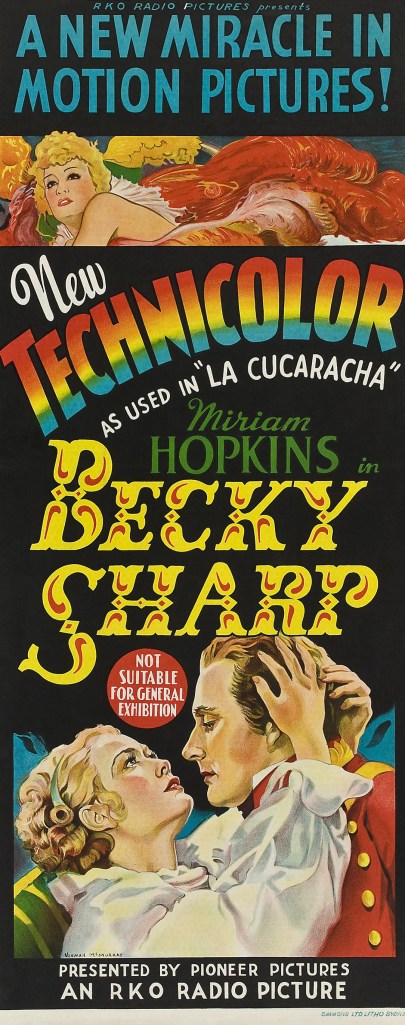
#530) Becky Sharp (1935)

#530) Becky Sharp (1935)

OR “A Movie without a Hero”

Directed by Rouben Mamoulian

Written by Francis Edward Faragoh. Based on the novel “Vanity Fair” by William Makepeace Thackeray, and the play by Langdon Mitchell.

Class of 2019

The Plot: Becky Sharp (Miriam Hopkins) is a poor young woman with ambitions of climbing England’s social ladder. After exploiting her well-meaning friend Amelia (Frances Dee) and Amelia’s equally oblivious brother Joseph (Nigel Bruce), Becky becomes a governess for the Crawley family, and marries their adult son Captain Rawdon Crawley (Alan Mowbray). Although Becky manages to preserve her social connections at the height of the Napoleonic Wars, her good will (as well as the trust of her friends) is running out. But all of this commentary takes a backseat to the new process of three-strip Technicolor!

Why It Matters: The NFR mentions the film’s “historical note as the first feature-length film to utilize the three-strip Technicolor process”, and praises the “shimmering visual appeal” that Technicolor provides. The write-up also includes a link to a more detailed look at the film’s restoration.

But Does It Really?: Yes, but I’m not too excited about it. “Becky Sharp” is on this list as an important piece of Technicolor history, and that’s about it. The film’s aesthetics have all the vibrancy you’d expect from Technicolor, but that novelty is lost in a modern viewing. Without a gimmick to focus on, “Becky Sharp” is a decent adaptation of a popular novel, but nothing extraordinary or essential on its own. A yes for NFR inclusion, but “Becky Sharp” is on here for its technical achievement rather than any artistic triumph.

Every Niche Production Company Gets One: Although three-strip Technicolor had been perfected by 1932, Hollywood was skeptical of the new technology (the first Technicolor cameras were expensive, bulky, and required special training to use). RKO executive/NFR filmmaker Merian C. Cooper was excited by Technicolor’s prospects, but couldn’t convince RKO to put up the money. Meanwhile, businessmen Jock and Cornelius Whitney wanted to get into the motion picture business, and founded Pioneer Pictures, which would produce only color films. Cooper was able to arrange a deal where RKO would be Pioneer’s distributor, therefore benefiting from any success from Technicolor, with none of the cost.

Seriously, Oscars?: At the 1936 Oscars, “Becky Sharp” received one nomination: Best Actress for Miriam Hopkins (the only nomination of her career). Hopkins lost to Bette Davis for “Dangerous”, widely considered a make-up Oscar for Davis (but that’s another story). Despite the technical breakthrough of “Becky Sharp”, the film was not nominated for its cinematography, though another Technicolor film (“The Garden of Allah”) would receive a special award the next year.

Other notes 

  • You may recall in previous posts that two-strip Technicolor consisted of a red filter and a green filter, while three-strip Technicolor added a blue filter. When processed, these three strips of film became their complimentary colors: Cyan, magenta, and yellow; still used today as the foundation of any color printing. In addition, the overall quality and definition of the three-strip film was greatly improved compared to two-strip.
  • Although Pioneer had dabbled in three-strip Technicolor shorts (including Oscar winner “La Cucaracha”), and some studios included Technicolor sequences in their movies, “Becky Sharp” was the first full-length feature to be shot entirely in the three-strip process.
  • Shoutout to Lowell Sherman, director of “She Done Him Wrong“, and the original director of “Becky Sharp”. Sadly, Sherman died of double pneumonia two weeks into production. Replacement director Rouben Mamoulian reshot all of Sherman’s work.
  • Like any film adaptation of a novel, “Becky Sharp” omits a few things to get down to a manageable runtime. Despite losing the book’s overall framing device, unreliable narrator, and somewhat downer ending, “Becky Sharp” is a faithful adaptation of the novel’s key events.
  • I confess I’ve never read “Vanity Fair”, so I knew virtually nothing about the story. I’m all for female leads that flout the conventions of their time, but Becky Sharp is such a horrible person. She manipulates everyone around her with a lying streak that borders on the pathological. I get that Thackeray made sure that all of his characters were flawed, and therefore dimensional, and “Vanity Fair” as a whole is a satire on England’s social structure, but I feel like a lot of that is lost in this adaptation. What we’re left with is a central character who disrespects everyone around her for no good reason.
  • Although the Napoleonic Wars loom large in “Becky Sharp”, the man himself is seen only once in this movie, in shadow (like George Steinbrenner). While we’re on the subject, stories of Napoleon being a short man are false. Bonaparte stood approximately 5’6″ (average for the time), but his short stature came from the political cartoons of James Gillray, who depicted the Emperor as a small child throwing a tantrum.
  • What a waste of Billie Burke. A few years away from playing Glinda, Ms. Burke is only in one scene in this movie, playing the kind of befuddled socialite she often portrayed in the movies.
  • A period piece about a woman manipulating the men around her to climb the social ladder with a wartime backdrop? This is just British “Gone with the Wind“.
  • Becky spends a lot of the film’s second act trying to borrow money to pay off previous debts. When did this become “Uncut Gems“?
  • I don’t know if it’s the early Technicolor or the crew getting use to this new technology, but Miriam Hopkins’ big close-up in her scene with the Marquis of Steyne is out of focus. Perhaps reshoots would have been too costly?
  • Both Cedric Hardwicke and Alan Mowbray look like Sacha Baron Cohen wearing prosthetic makeup for another hidden camera prank. I just hope Rudy Giuliani’s not around.
  • My main question about “Becky Sharp” is how did this get past the Production Code? Becky is a manipulative lead character who doesn’t learn anything, and gets away with her various schemes. I guess by cutting the ending short it’s implied that she will change her ways when she leaves with Joseph (Spoilers: She doesn’t). Did the novel’s standing as a classic help tide over the Code?

Legacy 

  • Shortly after “Becky Sharp”, the Whitneys of Pioneer Pictures invested in another up-and-coming production company: Selznick International Pictures. Once Pioneer’s contract with RKO ended, they officially merged with Selznick International.
  • Technicolor quickly became the gold standard for film stock, often used for epics and musicals. The process was refined over the years, but by the early 1950s Technicolor found itself a distant second to Eastmancolor. The last three-strip Technicolor film was 1957’s “Test Pilot”, though in the ensuing years a few films have been processed in Technicolor for that nostalgic look.
  • There have been countless adaptations of “Vanity Fair” over the years, most recently a 2018 miniseries starring Olivia Cooke, with Michael Palin as the narrator/”Vanity Fair” author William Makepeace Thackeray.
  • In 1943, “Becky Sharp” was sold to Film Classics, Inc., who re-released the film in a cheaper (and shorter) two-strip color print, as well as a black-and-white print. Aided by the film’s lapse into public domain, these two versions were the most readily available for viewing, until UCLA restored “Becky Sharp” to its full (and uncut) Technicolor glory in 1984.

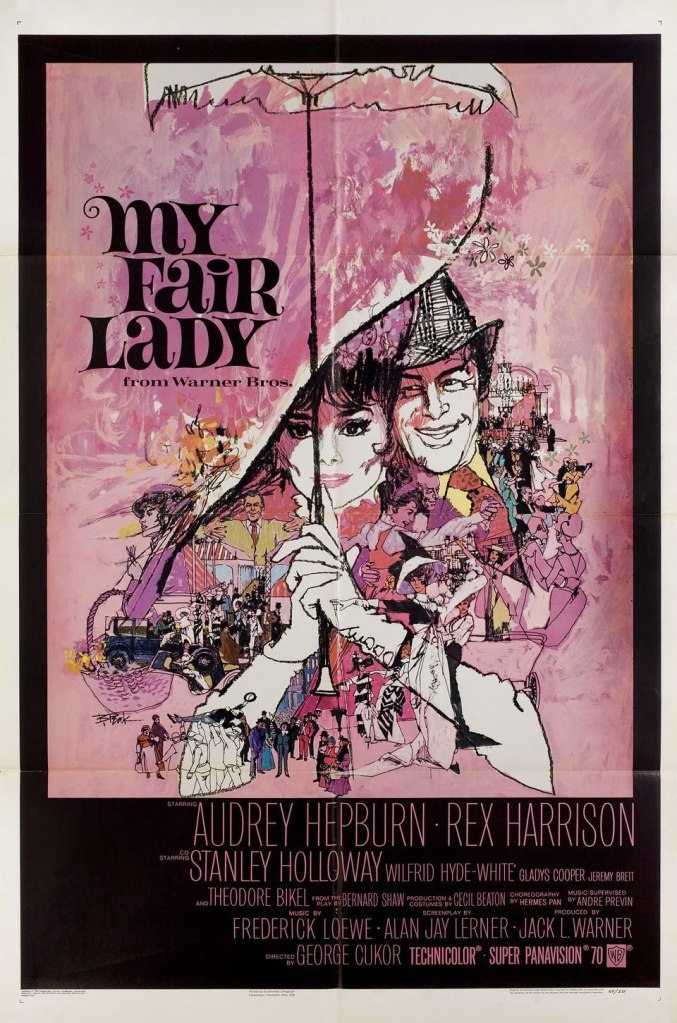
#529) My Fair Lady (1964)

#529) My Fair Lady (1964)

OR “Misogyny: The Musical!”

Directed by George Cukor

Written by Alan Jay Lerner. Score by Lerner & Frederick Loewe. Based on the stage musical by Lerner & Loewe, and the play “Pygmalion” by George Bernard Shaw.

Class of 2018

The Plot: In Edwardian London, phonetics Professor Henry Higgins (Rex Harrison) makes a bet with colleague Col. Pickering (Wilfrid Hyde-White) that he can take ordinary Cockney flower girl Eliza Dolittle (Audrey Hepburn) and turn her into a proper upper-class lady. After some trepidation, Eliza agrees to the training, and despite the insensitive teaching skills of Higgins, she learns to speak and behave in a more socially acceptable way. There’s a few bumps in the road, and some interference with Eliza’s freeloading father Alfred (Stanley Holloway), but Eliza ultimately becomes her own woman. Oh, and it’s a musical.

Why It Matters: While the NFR admits the film is “opulent in the extreme”, it does concede that the “expert” direction of George Cukor, as well as the cast, crew, and “sparkling” source material, help make this film “the enchanting entertainment that it remains today.”

But Does It Really?: As much as I love this musical, I’m gonna mark this movie as “historically significant”. The score is lovely, the performances are great, but “My Fair Lady” never really transcends beyond a “filmed musical” to become a “musical film” a la “The Sound of Music” or “West Side Story“. Add to that an increasingly problematic subject matter, and you’ve got a movie with an uphill battle to retain its “classic” standing. A pass for NFR inclusion, if for nothing else, a documentation of one of the great stage musicals of the 20th century.

Everybody Gets One: After 25 years of stage and film work in both England and America, Rex Harrison achieved worldwide acclaim as Henry Higgins in “My Fair Lady” on Broadway. Harrison had never sung on stage before, and after extensive (and mostly unsuccessful) rehearsals it was decided that he would speak his songs. Harrison only got to reprise his stage role for the movie when the likes of Cary Grant and Peter O’Toole turned it down.

Wow, That’s Dated: Mainly the idea that a story about a sexist man verbally abusing a woman he sees as a project would make for one of the most successful movie musicals of all time.

Seriously, Oscars?: Easily the most anticipated movie of 1964, “My Fair Lady” was second only to “Mary Poppins” in terms of box office and Oscar nominations (12 to Poppins’ 13). “My Fair Lady” prevailed, however, as the big winner on Oscar night with 8 wins, including Best Picture, Actor for Rex Harrison, and Director for George Cukor (His first win after 34 years and four previous nominations). The biggest Oscar news, however, concerned someone not nominated: Audrey Hepburn was snubbed for Best Actress, and we’ll get to why in a bit.

Other notes 

  • At a time when Broadway was still America’s cultural epicenter, “My Fair Lady” opened in 1956, and was Broadway’s biggest hit of the decade. Warner Bros. purchased the film rights to “My Fair Lady” in 1962 for $5.5 million, a record at the time. Jack Warner supervised the production himself, and the film cost anywhere from 12 to 17 million dollars. Controversy arose when Warner cast Audrey Hepburn to play Eliza, bypassing the role’s originator Julie Andrews. Warner believed a movie star of Hepburn’s stature would bring in more money (at this point Andrews had never made a film). Despite this uproar, Julie Andrews expressed no animosity towards Audrey Hepburn (who was unaware Julie wasn’t being considered), and the two became friends. Shortly after this slight, Andrews signed on to “Mary Poppins”, and became a movie star.
  • Roughly 90% of Audrey Hepburn’s singing in the final film was dubbed by infamous ghost singer Marni Nixon, which Hepburn learned about only after she had filmed and recorded her numbers. Warner Bros. tried to keep Marni Nixon’s participation a secret, but word got out just before the film’s release, which may have cost Audrey Hepburn an Oscar nomination.
  • This movie has some rough patches, but Hepburn and Harrison are so good in this. Hepburn is clearly relishing the opportunity to play against-type (at least for the first act), and Harrison remains the patron saint of Sprechgesang. And this may be one of the rare times in Hollywood history where the female lead got paid significantly more than the male lead: Hepburn got $1 million, Harrison $200,000.
  • Yes, that’s not Audrey singing “Wouldn’t It Be Loverly?”, but at least she gets to do her own dancing. A trained ballet dancer in her native Belgium, Audrey only began taking acting gigs to support herself and her family after the war.
  • In a revolutionary move, Rex Harrison was allowed to sing his songs live on set, rather than lip-synch to his own recording. The Warner Bros. sound department developed one of the first wireless microphones for Harrison to wear under his tie, and received an Oscar for this achievement.
  • Like Harrison, Stanley Holloway played Alfred Dolittle on Broadway, and only got the film after James Cagney passed. While Holloway properly reigns in his performance for film, you get the feeling he was a showstopper on stage.
  • Henry Higgins may be the most verbally abusive teacher this side of “Whiplash”. I kept expecting him to throw a chair at Eliza. You’re all lucky Rex Harrison is so good at charming light comedy.
  • The one-two punch of “The Rain in Spain” and “I Could Have Danced All Night” is wonderful, but you really wish it could have been Audrey doing the singing. Hepburn performs the hell out of each number, and hearing another voice with a different energy come out of her mouth makes for a disjointed viewing.
  • The “Ascot Gavotte” is here for one reason only: Costumes! Look at all those designs. You win that Oscar, Cecil Beaton! Side note: If wearing a fedora was still fashionable, I would rock Higgins’ checked wool hat.
  • Shoutout to Gladys Cooper, Hollywood’s go-to socialite, reprising her role of Higgins’ mother from an unrelated TV production of “Pygmalion”. Cooper’s Oscar nomination makes her one of the rare acting nominees for a non-singing role in a musical.
  • There are few things funnier than Eliza speaking Cockney slang with her newfound upper-class accent, culminating in “Come on Dover! Move your bloomin’ arse!”.
  • “On the Street Where You Live”: Charming romantic number, or the stalker national anthem? You decide.
  • Higgins’ monstrous behavior towards Eliza somehow gets more repulsive after he wins the bet. From the director that brought you “Gaslight“!
  • It was around “Get Me to the Church on Time” I realized that while each individual number in this movie is pleasant and well-made, they all have a sameness to them. I think it’s because they all feel like a filmed version of the play, rather than a cinematic reinterpretation. Still enjoyable (I sang along to almost every song), but in the pantheon of great movie musicals, a bit lacking.
  • Watching this movie with attention towards the Higgins/Eliza relationship, I agree with George Bernard Shaw: these two should not get together. Hepburn and Harrison try their best to add the romantic subtext to justify the ending, but I just don’t understand why these two would ever want anything to do with each other. “My Fair Lady” has many lovely individual elements, but this movie may just be for us theater buffs.

Legacy 

  • “My Fair Lady” was a hit, and one of the last successful big budget musicals of the ’60s. Jack Warner attempted to recapture this success with movie musicals “Camelot” and “1776”, but both came across as old-fashioned in the wake of New Hollywood. Same for Rex Harrison’s next musical: “Doctor Dolittle”.
  • “My Fair Lady” still gets referenced in pop culture, though I argue the references are to the show itself rather than the film. Most notably, Seth MacFarlane based the voice of Stewie from “Family Guy” on Rex Harrison, and the show makes the occasional “My Fair Lady” allusion.
  • Broadway has hosted several revivals of “My Fair Lady” over the years, most memorably a 1981 25th anniversary production with Rex Harrison’s final turn as Higgins, and a 2018 production that tried to tweak the material for a post #MeToo audience, with mixed results.
  • And finally, shoutout to Robert Harris, whose restoration of “My Fair Lady” in the early ’90s came when the original negative was starting to deteriorate beyond repair. Any modern viewing of this film is thanks to Harris and his team.

Further Viewing: Want to watch “My Fair Lady” in literally half the time? Check out 1938’s “Pygmalion” with Leslie Howard and Wendy Hiller. Adapted for the screen by Shaw himself, you can see just how much of Shaw’s text was preserved for the musical. You can practically hear the Lerner & Loewe score while watching this movie.

Listen to This: For those wondering what Julie Andrews sounded like as Eliza, look no further than the Original Cast Recording of “My Fair Lady”, added to the National Recording Registry in 2007. As always, Cary O’Dell is on hand with an informative, loving essay.

#528) Dumbo (1941)

#528) Dumbo (1941)

OR “The Wonder Ears”

Directed by Ben Sharpsteen (and a bevy of sequence directors)

Written by Joe Grant & Dick Huemer (and a plethora of others). Based on the book by Helen Aberson & Harold Pearl.

Class of 2017 

The Plot: While traveling through central Florida, a circus train is visited by storks delivering babies to all the animals. The elephant Mrs. Jumbo (voiced by Verna Felton) receives a baby boy named Jumbo Jr. The baby elephant, however, is born with very large ears, leading to the other elephants nicknaming him “Dumbo” and mocking his anomaly. Seperated from his mother, and with a mouse named Timothy (voiced by Edward Brophy) as his only friend, Dumbo learns to accept his differences, and eventually discovers that his ears give him the ability to fly. It’s a heartwarming Disney classic that’s sure to…oh crap I forgot about the racist crows! This is why we can’t have nice things.

Why It Matters: The NFR calls the film “charming”, praising its “lovely drawing, original score…and enduring message”.

But Does It Really?: “Dumbo” can be endearing and at times quite heartwarming, but is unfortunately bogged down by some incredibly racist material towards the end. It’s a shame, because everything else about this movie still works 80 years later: the energetic score, the beautiful character animation, and the overall uplifting spirit of the movie. “Dumbo” continues to be a classic, but its racial insensitivity will be its eventual undoing for a modern audience.

Wow, That’s Dated: Well there’s no use ignoring it: let’s acknowledge the elephant…’s friends in the room. The flock of crows that help Dumbo fly are straight up minstrel show stereotypes, complete with offensive African-American dialects. It’s a tough watch, and they dominate the last portion of the film. “Dumbo” may be the number one reason Disney+ has that disclaimer about “outdated cultural depictions”.

Seriously, Oscars?: An instant hit with both critics and audiences, “Dumbo” received two Oscar nominations. Frank Churchill and Oliver Wallace took home the prize for Best Musical Score, but “Baby Mine” lost Best Original Song to “The Last Time I Saw Paris” from “Lady Be Good”. Turns out “Paris” was not written specifically for “Lady Be Good”, leading to a rule change from the Academy.

Other notes 

  • With the financial disappointments of “Pinocchio” and “Fantasia“, Walt Disney needed a hit, and it needed to be made on the cheap. “Dumbo” was allotted a budget of $950,000 (roughly 2/3 the budget of “Pinocchio” or “Fantasia”). While typical animated films are in production for 3-4 years, “Dumbo” was written, animated, and completed in less than two years, during which production was interrupted by the Disney animators’ strike of 1941.
  • Of course a movie about an exploited circus elephant would be set in Florida.
  • Wow, Mr. Stork gets quite the intro: a dramatic narrator, a whole song. You know he’s not the main character, right?
  • This is the first Disney voiceover work for both Sterling Holloway (Mr. Stork) and Verna Felton (Matriarch Elephant & Mrs. Jumbo). Both actors would go on to voice a number of notable Disney characters in “Alice in Wonderland”, “The Jungle Book”, and many others.
  • I completely forgot about the circus roustabouts, all of them anonymous African-Americans. They don’t even have faces!
  • Even at 63 minutes, there’s a lot of padding in “Dumbo”. Most of it you don’t mind, however, because the animation is so good, especially the character work on both Dumbo and Mrs. Jumbo.
  • Between the passive aggressive lady elephants and the super annoying kids, I side with Mrs. Jumbo on this one. Take them all out! Sympathy is very easy when every other character is literally the worst.
  • Timothy Mouse comes across as Jiminy Cricket’s cousin from Brooklyn, but he makes a good team with Dumbo. Also, it turns out the whole “elephants are afraid of mice” cliché is a myth. They’re more afraid of any small creature who suddenly darts in front of them.
  • If this circus is going to exploit its animals, why not exploit the fact that all of them speak fluent English?
  • This clown act has achieved the impossible: it’s actually funny. Shoutout to all the animators and story developers who came up with those gags. My one question: Where’s that clown that gets slapped all the time?
  • In a movie filled with sentimental moments, “Baby Mine” tops them all. It’s a simple, sweet moment between mother and child that gave me legitimate chills while watching.
  • Ah yes, “Dumbo”: the animated classic with underage drinking. Dumbo’s accidental sip of champagne leads to “Pink Elephants on Parade”, aka “Let’s sneak some surrealism into this movie”. It has nothing to do with anything, and it runs longer than it should, but it’s fun to watch these animators cut loose.
  • There are those who defend the crows for their sympathy towards Dumbo and the fun they have singing and dancing, but at the end of the day, they all talk like Stepin Fetchit. Oh, and the lead crow is voiced by Cliff Edwards (a White actor) and was originally named Jim Crow. Ugh.
  • The finale also gave me some chills. Watching Dumbo fly through the crowd is still a thrilling moment, and his reunion with his mother is the movie’s final successful heartstring tug. Now if only we could do something about those goddamn crows…

Legacy 

  • “Dumbo” was the hit the Disney Studios needed it to be, grossing over 1.3 million dollars. The film was immediately popular, with Dumbo himself slated to appear on Time Magazine’s cover as “Mammal of the Year”. The story was slated for December 8th, 1941, but major news from the day before bumped Dumbo off the cover.
  • Due to the film’s continued popularity, “Dumbo” is often used as a test subject when Disney is contemplating new entertainment mediums. “Dumbo” was one of the first Disney movies shown on television, one of the first released on home video, and one of the first to appear on a streaming service. Thanks to its home video releases, “Dumbo” has never been out of print in the last 40 years.
  • When Disneyland opened in July 1955, two attractions based on “Dumbo” were…almost ready. “Dumbo the Flying Elephant” was delayed a month due to technical issues, and while the “Casey Jr. Circus Train” appeared on the opening day telecast, it was closed immediately afterwards for safety testing, and reopened two weeks later. Both attractions are still working 65 years later, and can be found in Disney parks around the world.
  • “Dumbo” still gets referenced from time to time, typically in a general sense regarding elephants and/or big ears. My personal favorite among the homages: “Operation Dumbo Drop”, one of Disney’s more bizarre “Based on a True Story” movies.
  • Even “Dumbo” wasn’t safe from Disney’s live-action remake juggernaut. Despite the talents of Tim Burton, and an honest attempt to address issues of animal cruelty in circuses, the 2019 “Dumbo” failed to connect with audiences.
  • I have a soft spot for “Dumbo’s Circus”, the weird puppet/animatronic hybrid show that aired on the Disney Channel back in the ’80s. Dumbo Talks!
  • Despite the little elephant’s big theatrical triumph, Dumbo was loaned out to Maroon Studios in 1947 (along with half the cast of “Fantasia”). Allegedly, R.K. Maroon wanted Dumbo and the other characters because “they work for peanuts”.