#654) A Woman Under the Influence (1974)

#654) A Woman Under the Influence (1974)

OR “Rowlands in the Deep”

Directed & Written by John Cassavetes

Class of 1990

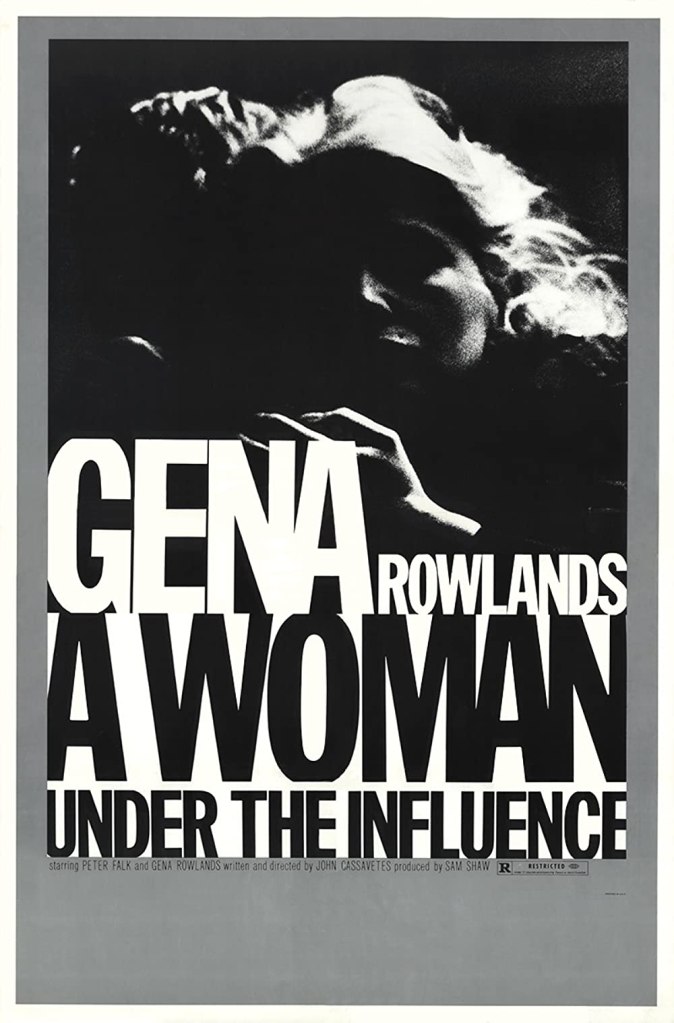
The Plot: “A Woman Under the Influence” is several days in the life of Mabel and Nick Longhetti (Gena Rowlands and Peter Falk). Mabel is a housewife with an undiagnosed mental condition, and Nick is a construction worker who loves his wife, but lacks the overall empathy and support she needs to help her deal with her condition. After a particularly troublesome incident during a party Mabel throws for their children, Nick makes the difficult decision to have her institutionalized. That’s about it as far as story goes, with John Cassavetes focusing more on the complexities and unexplored dynamics between these two characters.

Why It Matters: The NFR write-up is lacking in superlatives specific to the movie, giving us instead a rundown of Cassavetes’ influence on independent films. Also they refer to Gena Rowlands’ character as a New York housewife even though the film is clearly set in Los Angeles. Whoops. An essay by Cassavetes expert Ray Carney posits that the character of Mabel is a semi-autobiographical depiction of Cassavetes rather than Rowlands.

But Does It Really?: “A Woman Under the Influence” is perhaps the definitive American independent film: a movie created, produced, and released purely through determination and love of the game. John Cassavetes is a maverick of American film, and I’m glad the NFR inducted him so early into their run. This all being said, did I like the actual film? Well, yes and no. Yes because of the incredible work of Cassavetes, Falk, and especially Rowlands, no because of my own issues with the film’s subject matter and overall length. We’ll get into all of this in more detail as we go, suffice it to say that even though I won’t be ranking “A Woman Under the Influence” on my personal list of favorites, it’s a no-brainer for inclusion among this roster of important American films.

Shout Outs: Not in the film directly, but “Woman Under the Influence” was produced by Cassavetes’ company Faces International, which gets its name from Cassavetes’ “Faces“, a fellow NFR inductee.

Title Track: Now that I think about it, the movie never explains what exactly Mabel is “under the influence” of. We never see her take drugs, and she only drinks in one scene. Like everything else about this movie, there are no easy answers.

Seriously, Oscars?: Despite its small release, “A Woman Under the Influence” managed to be seen by enough people to garner a string of critics awards, and eventually two Oscar nominations. John Cassavetes lost the only Best Director nomination of his career to Francis Ford Coppola for “Godfather Part II“, and Gena Rowlands lost her first Best Actress nod to Ellen Burstyn in “Alice Doesn’t Live Here Anymore”.

Other notes 

  • “A Woman Under the Influence” began as a play written by Cassavetes for his wife Gena Rowlands. Upon reading the play Rowlands quickly realized that the character would be too intense to perform on stage multiple times a week, and the material was adapted into a screenplay. Cassavetes self-financed the project (no studio was interested in a movie about “a crazy, middle-aged dame”), mortgaging his house and hiring a crew of students from the nearby American Film Institute. Peter Falk believed in the script so much he invested $500,000 of his own money into the project (which makes you wonder just how much they were paying him over at “Columbo”). The bulk of the film was shot in 1972, but delays in post-production shelved the film for two years.
  • Another trademark Cassavetes cost-cutting measure, several of the actors are family members. Cassavetes and Rowlands’ children Nick and Xan make appearances, and both of their mothers play the lead characters’ moms (with Lady Rowlands acting alongside her real-life daughter). The Longhetti’s eldest son Tony (great name, by the way) is played by Matthew Cassel, son of longtime Cassavetes collaborator Seymour Cassel.
  • As on the fence as I am about this movie, I gotta admit how great everyone is. Gena Rowlands as always is instantly compelling, and I stuck it out with her Mabel even during the more intense moments. Peter Falk manages to be the “Peter Falk type” we associate him with, but in this case it fits the character of Nick like a glove, and Falk somehow disappears into the character while maintaining his singular persona. Side note about Falk: If he looks directly into the camera, but only with his artificial eye, does that count as a fourth wall break?
  • Maybe it’s just where we were in terms of mental health issues in the 1970s, but it’s never specified what exactly is going on with Mabel. All we get is characters referring to her as “crazy”, with Nick at one point correcting them by saying she’s “not crazy, she’s unusual.” The internet has more or less diagnosed Mabel as being bipolar, but I’m siding with the movie and leaving her undiagnosed.
  • Hats off to Cassavetes, because I have no idea how you can direct a movie like this. Every scene is so natural and organic, I can’t imagine his direction being anything other than “Just be real.” This goes hand in hand with the cinematography by Mitch Breit and Al Ruban, who give the film its cinéma vérité style without drawing attention to itself. The cameras always feel like the proverbial fly-on-the-wall, capturing the action without ever knowing where it will go next. It’s all so natural I suspect that a 1974 audience was either in awe of the aesthetic or bored out of their minds.
  • Admittedly, my issues with the movie are based in my own personal biases. “Woman Under the Influence” is about what happens when your family lacks the emotional tools to support you in times of crisis. Most of Mabel’s family wants to help, but don’t know how to go about it; Nick in particular unable to articulate his frustration while still loving his wife. I found this all very distressing, but also recognize that this is very intentional on Cassavetes’ part. So, well done I guess.
  • My other issue with the movie is its length. I agree with critics of the time who said in essence, “It’s good, but does it have to be 2 1/2 hours?” Of course there are plenty of classic movies that are longer, but 148 minutes is a long time to watch a slice of life movie where “nothing happens”. In its favor, by the end of the film you feel just as emotionally drained as the characters do, something you can still achieve in under two hours but perhaps not with the same impact.
  • This was another movie where I didn’t take a lot of notes. I was simultaneously engaged with and turned off by this movie, ultimately concerned for Mabel and her future. Like “The Deer Hunter“, I’m glad I saw “A Woman Under the Influence”, but it’s going to be a while before I feel up to a rewatch.

Legacy 

  • “A Woman Under the Influence” premiered at the New York Film Festival, and despite its positive reception, John Cassavetes was unable to secure a distributor. Cassavetes self-distributed through his company Faces International, booking the film in art house and college campuses. In the ensuing years, “A Woman Under the Influence” has been reappraised and declared Cassavetes’ definitive film.
  • John Cassavetes directed five more films in his lifetime, including “The Killing of a Chinese Bookie” and “Opening Night”. His final film was 1986’s “Big Trouble” (a modern riff on “Double Indemnity“) before his death in 1989.
  • Gena Rowlands continued acting on film and TV for the next 40 years, earning a second Best Actress Oscar nod for 1980’s “Gloria” (also directed by Cassavetes), and picking up an Emmy nomination seemingly every time she was on TV. In 2015, Rowlands received an Honorary Academy Award as “an original talent” and “an independent film icon”. The award was presented to her by her son Nick Cassavetes.
  • “A Woman Under the Influence” is still considered a seminal piece of ’70s cinema. It is no coincidence that the 2003 documentary about the ’70s indie scene is called “A Decade Under the Influence”.

#653) All That Heaven Allows (1955)

#653) All That Heaven Allows (1955)

OR “Between a Rock and a Hard Place”

Directed by Douglas Sirk

Written by Peg Fenwick. Based on the novel by Edna and Harry Lee.

Class of 1995 

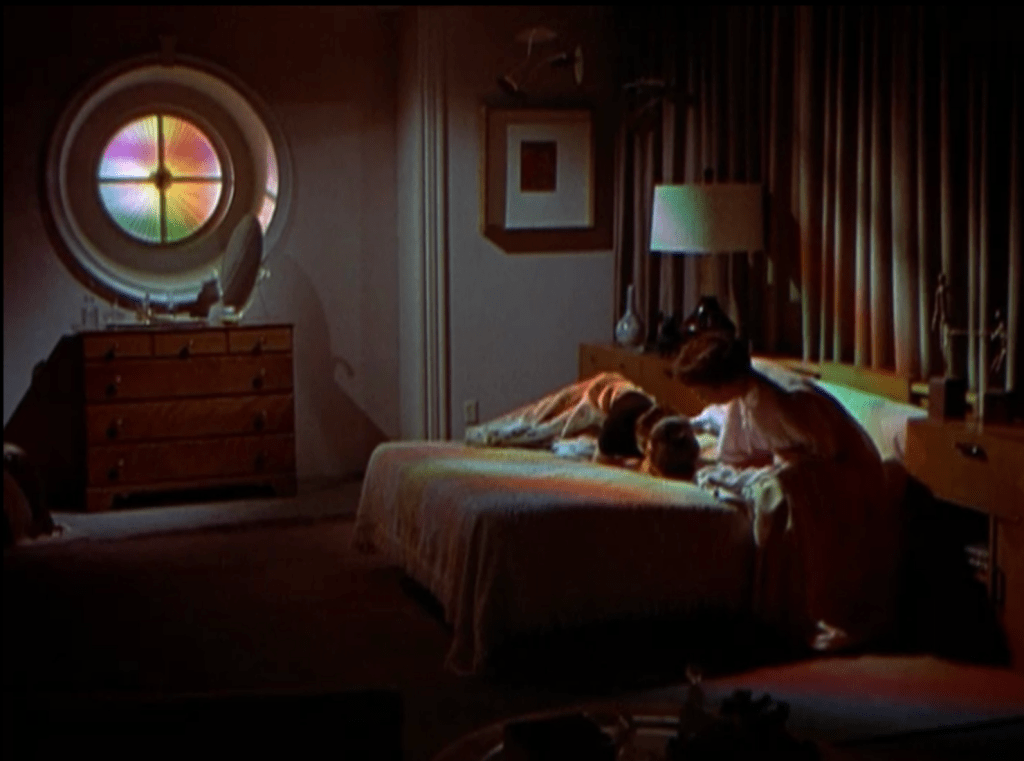
The Plot: Cary Scott is deeply unfulfilled with her life in Stoningham, New England; widowed and spending her time with her college-age children (Gloria Talbott and William Reynolds) and shallow acquaintances at the local country club. One day Cary strikes up a friendship with her arborist Ron Kirby (Rock Hudson), and is immediately drawn to his intelligence and free-living philosophy. The two begin a romantic relationship, but when they become engaged Cary’s friends question their age-gap and view Ron as a gigolo mooching off of Cary’s wealth. Will the stuffy societal norms of the 1950s keep Cary and Ron apart? And what’s with the lighting?

Why It Matters: While the NFR admits that at first glance the film is a “standard weepie”, its “rich visual texture” and “soaring emotional score” turn the subject into “a deeply disturbing, deeply compassionate portrait”. An essay by author John Wills takes a deeper dive into the film’s metaphorical imagery.

But Does It Really?: This was…interesting. I can definitely say I was more intrigued than entertained by “All That Heaven Allows”. Yes, it’s a highly-stylized melodrama, but it has that Douglas Sirk touch to it that keeps it watchable. No other movies look or sound like a Douglas Sirk production, and “All That Heaven Allows” is no exception; from its borderline avant-garde lighting to its incredibly progressive stance on what a woman’s life can or can’t be. Plus, it’s 89 minutes; points as always if you keep your story moving. “All That Heaven Allows” is on the list to represent Sirk’s run of artistic soap operas at 1950s Universal, and there’s nothing wrong with that.

Everybody Gets One: Shoutout to Conrad Nagel, seen here as Cary’s would-be suitor Harvey. Nagel was a silent film veteran, and a founding member of both the Academy of Motion Pictures of Arts and Sciences and the Screen Actors Guild.

Wow, That’s Dated: All the usual ’50s suburbia stuff, but at least here Sirk is commenting on its banality, so that helps.

Title Track: “All That Heaven Allows” is the last line of the poem “Love and Life” by John Wilmot. In the poem, all that Heaven allows is the present moment, but Sirk chose the title because it felt ironic within the film’s context: “As far as I’m concerned, Heaven is stingy.”

Seriously, Oscars?: No Oscar love for “All That Heaven Allows”. In fact, no Oscar love for any of Universal’s 1955 releases. Keep in mind that Universal was cranking out mostly B pictures back then. Heck, in 1955 their biggest star was still Francis the Talking Mule.

Other notes 

  • “All That Heaven Allows” got greenlit based on the success of another Sirk film: 1954’s “Magnificent Obsession”. Like “All That Heaven Allows”, “Magnificent Obsession” was based on a novel, starred Wyman as a widow who falls in love with Hudson amidst controversy, featured a supporting turn by Agnes Moorehead, and included a finale involving one of the leads’ near-death experience. “Obsession” was one of the highest grossing films of 1954, and Sirk was given a bigger budget and more creative freedom on “All That Heaven Allows”.
  • If Cary’s neighborhood looks familiar, it’s Colonial Street, the fake street on the Universal backlot. The houses and facades have been used for countless TV shows and movies, most notably “Leave It to Beaver”, “The Munsters”, and “Desperate Housewives”.
  • You know something is up with this movie once you see the stylized lighting in Cary’s house. You don’t see this kind of lighting outside of film noir or a Gene Kelly third act ballet. It’s distracting, but also much more visually engaging than other domestic dramas of the time; very much the mis-en-scene that film critics love pointing out about this movie.
  • I know it’s the point, but everyone at this country club is the worst. Mona’s a back-stabbing gossip, and Howard straight-up assaults Cary. It really says something when the nicest person in your community is Endora.
  • Most of my viewing was me marveling at how progressive this film is. Everything about “All That Heaven Allows” would fit right in with the more laidback character studies of the 1970s with its challenging of social norms and nuanced female lead. And yet here it is in the middle of a Hollywood “product”. A rare sight indeed.
  • I’ve realized I haven’t seen a lot of Jane Wyman’s filmography (and I’ve genuinely forgotten she was in “Lost Weekend“). I don’t have a lot to say about Wyman’s performance here, other than she’s good enough that I cared about Cary’s well-being throughout.
  • Rock Hudson: the ’50s answer to Fabio. Hudson doesn’t have much to do in this film, but he’s the perfect combination of standard ’50s he-man and sensitive lover the part calls for. I was waiting for the neighbors to start gossiping about his apocryphal marriage to Jim Nabors.
  • Continuing my inability to tell how old everyone is in classic movies: Wyman was 38 during filming, Hudson 30. Not so much a May-September romance as a May-April romance. There must not be a lot going on in this town if this is your big controversy.
  • Today in Coda-era profanity censorship: “Here’s to those who wish us well, all the rest can go to Hackensack”.
  • Interestingly enough, when Ron mentions his service in the war, I assumed he meant World War II. Turns out it was Korea.
  • Cary’s kids really got on my nerves. Why are they so upset about having to move if Cary and Ron get married? They’re both in their mid-20s. Find a roommate, you freeloaders!
  • Any movie scores points with me when there are character actor sightings. Among the party guests are Hayden Rorke (aka Dr. Bellows) and Eleanor Audley (aka Maleficent and the Evil Stepmother). Also at the party is – Howard again!? Oh no!
  • Sirk’s lighting design goes a little too far in Kay’s room when Cary consoles her. Do they live next door to a kaleidoscope?
“Good morning, Dr. Meacham.”
  • Hey it’s a Die Hard Not-Christmas movie! I haven’t had one of those in a while.
  • There’s a recurring thread in this movie about Cary buying a television. You never hear TV talked about so openly in the movies, especially in the 1950s when it was still the enemy as far as big movie studios were concerned. Universal had just started producing TV shows, so it seems they knew the writing was on the wall. And sure, getting a TV is all well and good, but wait until Cary sees who’s hosting “General Electric Theater“. She may end up shooting her screen Elvis-style.
  • [Spoilers] What in the hell is that ending? Just when you think things are wrapping up, there’s a last-minute curveball as Ron falls of a cliff and becomes unconscious. Sirk toyed with the idea of Ron dying at the end, but producer Ross Hunter convinced him that the film needed a happy ending. This movie is already dramatic enough, we don’t need a brush with death too. Haven’t these two gone through enough already?

Legacy 

  • “All That Heaven Allows” opened on Christmas Day 1955. Both critics and audiences were dismissive of the film, finding it inferior to “Magnificent Obsession”. The film found a second life in the early 1970s, thanks to Jon Halliday’s book “Sirk on Sirk” and praise from German filmmaker Rainer Werner Fassbinder. Douglas Sirk’s entire filmography was reappraised in the ’70s, with “All That Heaven Allows” coming out from its predecessor’s shadow and receiving acclaim for its own merits.
  • Douglas Sirk made a handful of films with Universal after “All That Heaven Allows”, including “Written on the Wind” (also starring Rock Hudson) and his final film: a remake of “Imitation of Life“.
  • Heir apparent to the Douglas Sirk filmography is Todd Haynes, whose films “Far from Heaven” and “Carol” both play on the “repressed ’50s housewife” themes of “All That Heaven Allows”. Also he’s got a new movie called “May December” which may also tread the same water. What say you, readers of the future?
  • Coincidentally, while I was writing this I learned about an HBO documentary about Rock Hudson subtitled “All That Heaven Allowed” that just premiered. What are the odds?
  • And finally, Ross Hunter would go on to produce such bloated all-star movies as “Airport” and the musical remake of “Lost Horizon”, still considered one of the worst movies ever made. What a delightfully odd filmography.

#652) Westinghouse Works, 1904 (1904)

#652) Westinghouse Works, 1904 (1904)

OR “Steel This Movie”

Directed by G. W. Bitzer

Class of 1998

The Plot: When at the 1904 Louisiana Purchase Exposition (aka the St. Louis World’s Fair), be sure to visit the Westinghouse exhibit, featuring over an hour of footage from inside their main factory in Pittsburg, Pennsylvania. Filmed by legendary cinematographer G. W. Bitzer of the American Mutoscope and Biograph Company, “Westinghouse Works, 1904” showcases employees on the factory floor making turbines, generators, and an assortment of other products. Of the 29 Westinghouse films produced, 21 are known to survive.

Why It Matters: The NFR gives a rundown of the films, with the only superlative being a description of the shorts as “highly illustrative”.

But Does It Really?: I guess. “Westinghouse Works, 1904” is an interesting enough watch, with its blatant disregard for these workers’ safety serving as an unintentional suspense builder. Even then, this is a slog of a viewing given that I’m watching a film that was one component of a live presentation (more on that later). A historical pass for “Westinghouse Works”: another figure in the carpet of early filmmaking.

Everybody Gets One: Westinghouse Electric and Manufacturing Company (as it was known then) was founded in 1886 by engineer George Westinghouse, and specialized in making generators, turbines, and motors. The company focused on developing infrastructure for this new thing called electricity, and was the foremost rival of Thomas Edison (even employing Nikola Tesla for a time). Fun fact: George Westinghouse invented the railroad air brake, which can be seen being made in several of the films.

Wow, That’s Dated: Any sort of safe work environment. We won’t get the Bureau of Labor Standards for another 18 years, and then another 49 before that becomes the Occupational Safety and Health Administration (OSHA).

Other notes 

  • When presented at the 1904 World’s Fair, “Westinghouse Works” was accompanied by live narration and music, which makes this one of the rare times that a 1904 audience had a better viewing experience than I did. As these films are available online only in total silence, I had to supply my own soundtrack for the first time in a while. My viewing of “Westinghouse” was accompanied by a random Spotify playlist of Elton John, The Beatles, Bowie, etc. plus the occasional yapping from my neighbor’s dog.
  • Most of my notes are about how big the machinery is and how easily everyone there could get injured. I was waiting for someone to be standing in the wrong spot and get an arm ripped off.
  • I really should have looked up what kind of things Westinghouse makes before viewing, because I have no idea what any of this machinery is. It all looks like equipment from Dr. Frankenstein’s lab.
  • I believe that Turbine machine makes Everlasting Gobstoppers.
  • Do you think everyone on camera worked harder because they knew they were being filmed?
  • Wow, the air brake makers have the slowest assembly line ever. I guess George Westinghouse really wanted plenty of TLC when making his babies. Lucy and Ethel would have been just fine if they had worked at Westinghouse.
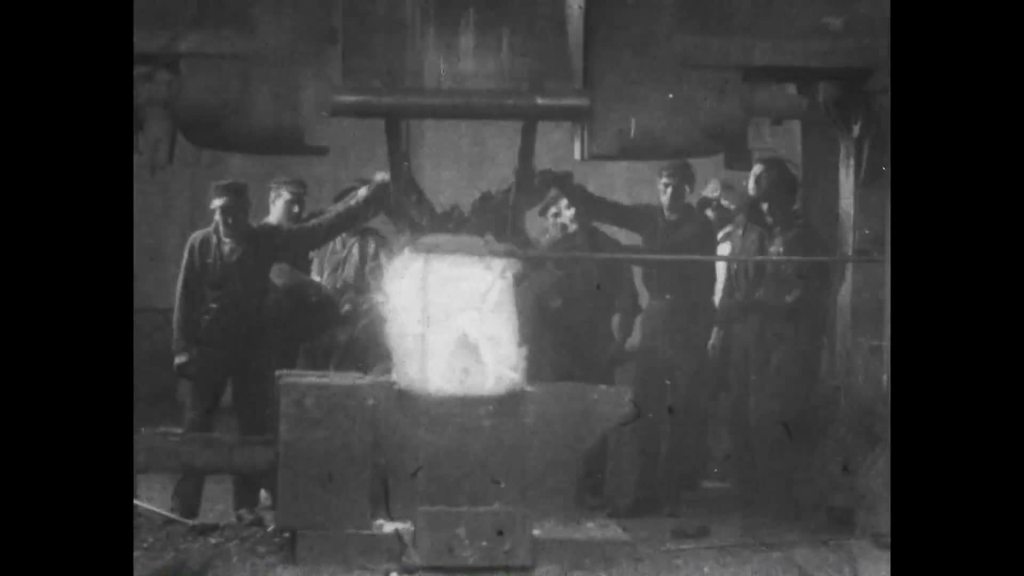
  • Of the 21 films, “Steam Hammer’ currently has the highest view count on YouTube, and it’s easy to see why: We watch the titular hammer forge – as it is officially described – “a large, glowing block”. Seriously, is that plutonium?
  • Are these the first crane shots in film history? I guess someone had to invent them.
  • Everyone in this movie looks like they’re in the opening credits of “Cheers”.
  • A handful of the “Westinghouse” films feature the roles that women (or “Girls” as they’re called here) could work: mainly winding and taping coils. Based on how these women are dressed, this is either 1904 Westinghouse or present-day See’s Candies.
  • The extended shot of the female employees punching out just feels like Mutoscope’s American remake of “Workers Leaving the Lumière Factory“. Also, several of the woman are smiling and laughing as they leave. Stop that! Everybody knows that nobody smiled or had fun of any kind in the 1900s.
  • When you show an extended shot of a steam whistle going off at a factory there’s only one thing to say: Yabba-Dabba-Doo!
  • Well they definitely saved the best for last. The camera goes outside and takes a train ride around the Westinghouse factory. After an hour of watching static shots of men working, it was great to see actual traveling shots.

Legacy 

  • George Westinghouse resigned from his company following the Bankers’ Panic of 1907. In the ensuing decades, Westinghouse continued its reign as a leading electronic company, becoming a conglomerate in the 1990s when it bought CBS. Shortly thereafter, Westinghouse pivoted to media and sold off its industrial assets. Presently, Westinghouse is part of Paramount Global, and while Westinghouse no longer makes any of the products they built the original company on, the Westinghouse name is still loaned out to various electronic and motor companies.
  • Westinghouse would continue its self-promotion at the World’s Fair with the greatest film on the NFR: 1939’s “The Middleton Family at the New York’s World’s Fair“.

#651) Bread (1918)

#651) Bread (1918)

OR “A Slice of Life”

Directed by Ida May Park

Written by Park and Evelyn Camp

Class of 2020 

The Plot: “Bread” is a unique NFR entry, in that we only have Reels 3 & 4 of a six reel film, so a full plot synopsis involves some guesswork. Based on what we know about the first two reels of “Bread”, the film is about Candace Newby (Mary MacLaren), a young woman who leaves her small town and moves to New York to become a stage actor. She meets theater producer Emil Krause (Louis Morrison), who puts her on his payroll, and playwright Arnold Train (Edward Cecil), who falls in love with her. Reel 3 begins with Krause bringing Candace into his office, locking the door, and making advances. Candace rejects Krause and runs away. Krause retaliates by cutting off her finances, and soon Candace only has enough money for a single loaf of bread. On her way home she loses the bread and…well that’s where Reel 4 ends things. What a cliff hanger!

Why It Matters: The NFR write-up is primarily a shoutout to Ida May Park, whose “accomplished ability” as a director and scenario writer are praised. The survival status of “Bread” is also mentioned.

But Does It Really?: This is the most NFR film the NFR has ever inducted. It’s a silent melodrama directed by a woman that deals with social issues and only survives in part: That’s an NFR bingo! Obviously it’s impossible to judge this film solely on its own merits, but even as an 18 1/2 minute excerpt, “Bread” clearly has the hallmarks of a solid melodrama, and is representative of an era of female filmmaking that soon disappeared. “Bread” is definitely on the “historical significance” side of things, but I have no objection to its NFR induction. Now let’s go find those missing reels!

Everybody Gets One: We don’t know a lot about Ida May Park, other than she was a native Angeleno who started her showbiz career as a stage actor, meeting her husband Joseph de Grasse in the process. The couple were hired by Universal in 1914, with Park writing scenarios for films directed by de Grasse. Park’s first directing job was for 1917’s “The Flashlight”. Park’s pivot to directing was in part based on her successful collaborations with her husband, and in part because of Universal’s then-practice of hiring more women directors (they were the ones that gave Lois Weber her start). In 1920, Park wrote this essay about film directing, in which she refers to filmmaking as “the great cinema octopus”, which is my new favorite description of anything film-related.

Other notes 

  • There is no weirder feeling than coming into the middle of a movie with no frame of reference, especially when your first scene is an attempted rape. I feel like Donny in “Big Lebowski“.
  • A bit of discrepancy: According to the AFI Film Catalog, the lead character is named Candace, but the intertitles call her Helen. What’s going on? I’m going with Candace until I hear otherwise. Also, her last name is Newby? A bit on the nose, eh?
  • We get a scene where another woman (presumably the character of Estelle played by Gladys Fox) berates Candace for rejecting Krause after he supported her financially. First of all, yikes. Second of all, YIKES. This is more psychological manipulation than “Rebecca” and “Gaslight” combined!
  • Estelle, admonishing Candace: “I’m the goat – my chance of being SOMEBODY is smashed-” I assume she means “goat” like a fool and not as the Greatest Of All Time.
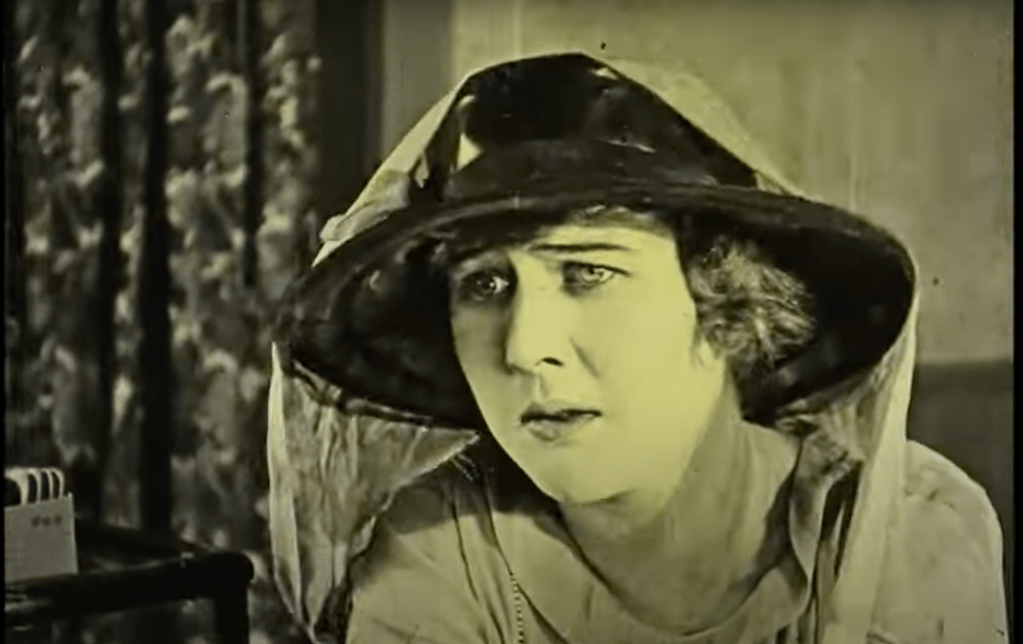
  • I am once again reminded that Mary MacLaren kinda looks like Amy Schumer. Last time I mentioned that I wondered what Schumer was up to. Turns out the answer was doing a forgettable job co-hosting the Oscars where Chris Rock got slapped.
  • Thank god we still have the part of the film where the title is explained. Otherwise I would have assumed they meant bread as in money.
  • Candace loses the bread when she bumps into a passerby on the street and drops the bread on the running board of a passing car. And that’s why cars don’t have running boards anymore! I assume that car will be hunted down by Javert for the next three hours.
  • “[The bread] symbolized all the good things in life.” Thank you, movie, we get the symbolism.
  • As far as I can tell, the ending of “Bread” involves Candace being reunited with her bread and accepting Arnold’s marriage proposal. Maybe I saw the most interesting third of this movie after all.

Legacy 

  • Like many of her contemporaries, Ida May Park’s directing days ended in the 1920s; her last two films as director were 1920’s “Bonnie May” and “The Midlanders”. Park continued to write scenarios, and her final writing credit was for 1931’s provocatively titled “Playthings of Hollywood”. Ida May Park died in 1954 at age 74.
  • Of Ida May Park’s 14 films as director, only three are known to survive, all from 1918: “Bread”, “Broadway Love”, and “The Risky Road”. Of the three, “Broadway Love” is the only film that survives in its entirety.
  • I assume “Bread” is Oprah’s favorite movie.

#650) Red River (1948)

#650) Red River (1948)

OR “Where’s The Beef?”

Directed by Howard Hawks

Written by Borden Chase and Charles Schnee. Based on the Saturday Evening Post story by Chase.

Class of 1990

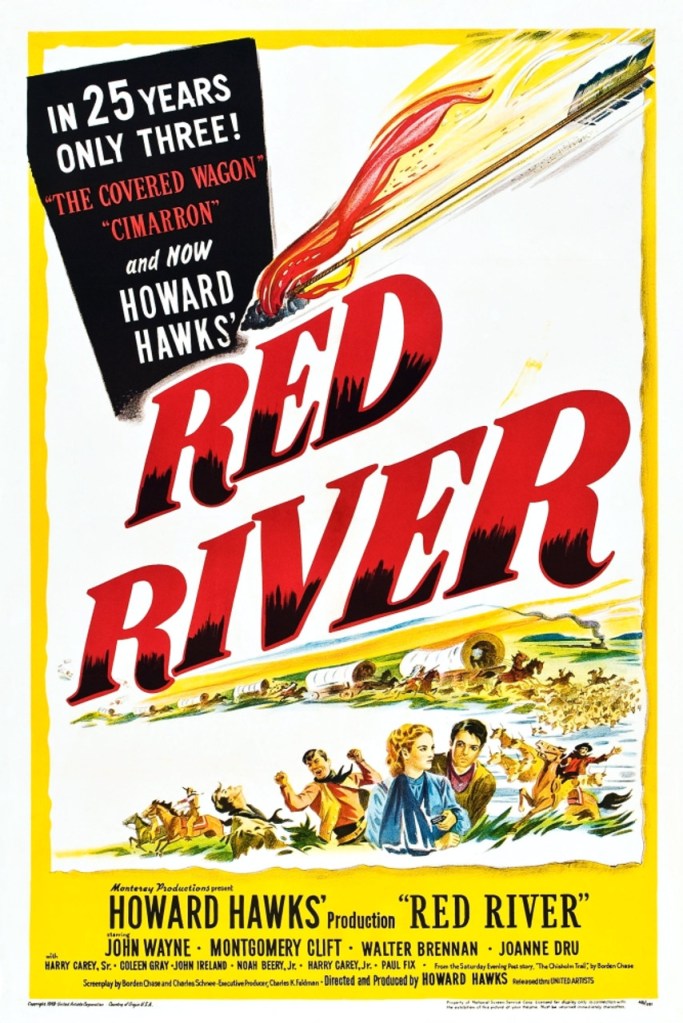
The Plot: In a semi-fictional take on the first cattle drive along the Chisholm Trail from Texas to Kansas, “Red River” focuses on Thomas Dunson (John Wayne), a cattle rancher who becomes broke after the Civil War. With no other choice, Dunson leads his herd and a band of volunteers hundreds of miles to Missouri to sell his cattle for the best price. As the conditions worsen on the journey, Dunson becomes more tyrannical and cruel to his men. This causes a major discord between Dunson and his adopted son Matthew Garth (Montgomery Clift), who believes they will have better luck if they reroute to Kansas. And behind the camera, Howard Hawks takes his first stab at the Western genre.

Why It Matters: The NFR writeup is mostly a rundown of the film’s talent, as well as a surprising amount of space devoted to the plot details from the film’s opening 10 minutes. A more appreciative essay by filmmaker and distributor Michael Schlesinger gives “Red River” its due.

But Does It Really?: I liked “Red River” better than other Westerns on this list, but that’s not saying much. As a film experience, it’s entertaining and holds your interest thanks to the A+ talent involved behind the scenes. As a significant American film, however, it never gets brought up as often as you’d think it would within the canon of Hawks’ filmography and/or classic Westerns. There’s a generation of film historians (Your Peter Bogdanovich-es, for example) who love “Red River”, but as the years go on that admiration hasn’t really been passed down. I’m gonna put “Red River” in the “minor classic” category: a memorable movie that has started to get lost in the shuffle of classic films.

Wow, That’s Dated: Yes, there are instances of the kind of misogyny towards women and racism towards Indigenous people you should expect from Westerns, especially those of this era, but…um…yeah I got nothing.

Title Track: [In Comic Book Guy voice] Technically they do not cross Red River in this movie, but rather the Prairie Dog fork, in which the Red River merges with both the Palo Duro Creek and Tierra Blanca Creek. Worst. Title. Ever.

Seriously, Oscars?: One of the highest grossing films of 1948, “Red River” received two Oscar nominations. The film’s nods for Story and Editing lost to, respectively, “The Search” and “The Naked City“.

Other notes 

  • Right off the bat, there’s a credit that intrigues me: Co-Director Arthur Rosson. I can’t imagine a titan like Howard Hawks sharing his title with anyone, but Rosson (the film’s second unit director) impressed Hawks with his shooting of the cattle drive sequences and this was Hawks’ way of thanking him.
  • “Red River” was Howard Hawks’ first western, but he injects a bit of his screwball comedy instincts into the movie’s DNA, with its comic relief supporting characters and overlapping dialogue. Speaking of comic relief: A reminder that Walter Brennan’s character is named Nadine Groot. Does this make “Red River” part of the MCU?
  • The film’s cinematography by Russell Harlan is the kind of impressive, expansive vistas associated with the genre, though it makes the handful of rear projection shots stick out like a sore thumb.
  • Wow, John Wayne actually did walk like that?
  • We meet Matt as a young boy played by Mickey Kuhn, who is so miscast as young Monty Clift I didn’t realize they were supposed to be the same person until it was mentioned by the other characters later on.
  • Of course Montgomery Clift is good in this, but even more impressive is the fact that “Red River” was his first movie! (though “The Search” was released first) It’s pretty impressive watching a 25 year old stage actor give John Wayne a run for his money. In fact, having an actor as skilled as Clift kinda highlights how little John Wayne is doing in this film (though I’m in the minority in this opinion). In an unintentional battle between Wayne’s untrained naturalism and Clift’s Method approach, Clift easily outacts the Duke. Side note: Monty kinda looks like a young Tom Cruise, doesn’t he? With a bit of Peter Gallagher thrown in?
  • John Ireland is quite good as Matt’s rival Cherry Valance (better utilized here than in “All the King’s Men“). In his first scene Cherry and Matt handle and admire each other’s guns at length, which begs the question: What in the name of “Brokeback Mountain” is going on here? There’s enough gay subtext in the scene to make Gore Vidal blush. Hawks denied anything intentional, but come on. “Can I see it? Maybe you’d like to see mine. Nice, awful nice.” Come on!
  • There’s a very impressive 360 degree shot of Dunson, his men, and the herd as they prepare to embark on their trek. I assume getting all those steer was quite the cattle call. Thank you!
  • Oh good, the one Indigenous character is a full-on stereotype. Shoutout to Chief Yowlachie, a member of the Yakama tribe of Washington State, forced to play the stoic, Tarzan-level broken English speaking straight man to Walter Brennan’s antics.
  • Wow, this is the most effective stampede scene this side of “The Lion King“. You definitely feel the danger these men are in both by the potential loss of and death by the cattle. Easily the highlight of the movie for me.
  • There’s definitely a “Mutiny on the Bounty” vibe going on with Wayne and Clift’s characters. Even Borden Chase admitted that his original story was just “‘Mutiny’ with saddles and stirrups.”
  • The wrangler Sims Reeves, about Dunson reading from the Bible after killing one of his men: “Why try to bring the Lord in as a partner on the job?” Sims gets it.
  • Joanne Dru fills the Hawksian Woman trope neatly as Tess, the outspoken woman who comes between Dunson and Matt. Funnily enough, it was John Ireland who caught Dru’s attention in real life, and the two married shortly after production wrapped. Fun Fact: Joanne Dru is the older sister of original “Hollywood Squares” host Peter Marshall!
  • Blink and you’ll miss Shelley Winters as a background performer in the wagon train. She was a bit player when “Red River” was filmed, but by the time it was released her star had risen with her breakout performance in “A Double Life”. Technically this is Winters’ NFR debut, but thankfully “A Place in the Sun” would be inducted the next year.
  • It’s always nice to see silent screen star Harry Carey in a movie; he has an appealing soft-spokeness to him, plus he automatically makes me think of Harry Caray. “Red River” is the only time Harry Carey Sr. and Jr. would be in a film together (Jr. is one of the wranglers), and sadly would be Carey Sr.’s final movie, released almost a full year after his passing.
  • [Spoilers] Well that was definitely an ending. The original story ended with Dunson getting shot, and Matt taking his body back to Texas to be buried on his property. Hawks didn’t like the idea of the main character learning a lesson and then immediately dying, so he opted for a happier ending. Neither Borden Chase nor Montgomery Clift liked this new ending (Clift called it a “farce”), and they are right to feel that way. It definitely sticks out from the rest of the movie, wrapping things up too neatly with a broadly comic bow. You expect this kind of ending from “I Love Lucy”, but not from a John Wayne western.

Legacy 

  • “Red River” was filmed in 1946, but its release was delayed for almost two years due to extensive re-editing when Hawks was dissatisfied with the original cut. The film’s release was delayed again thanks to this blog’s recurring heel Howard Hughes. Turns out Hughes was still bitter about Hawks quitting on Hughes’ “The Outlaw” six years earlier, and sued Hawks for similarities between the climactic shootouts of “Red River” and “Outlaw”. “Red River” was cut down by six minutes (with new footage and alternate narration) before hitting theaters in August 1948. At some point the theatrical print was lost, and the original “Directors Cut” started appearing on television and home video. Side note: Peter Bogdanovich claimed that Hawks preferred the theatrical cut, but this has been debated.
  • Allegedly Hawks was so grateful of Christian Nyby’s Hail Mary editing pass that he gave Nyby the chance to direct his first movie, 1951’s “The Thing From Another World” which, depending on which film historian you believe, may or may not have actually been directed by Nyby.
  • Howard Hawks gave key members of the “Red River” team commemorative belt buckles with the Red River D brand, which John Wayne wore in subsequent films (including Hawks’ “Rio Bravo”). These buckles have become collector’s items over the years, with Clift’s buckle selling for almost $14,000 at a 2014 auction.
  • Wayne pays tribute to the late Harry Carey in the iconic final moment of “The Searchers“. As Wayne stands in the doorway, he holds his right elbow with his left hand, a stance Carey took in many of his movies. Carey’s widow Olive appears in this scene and was moved by the homage.
  • “Red River” quickly became part of the John Wayne mythos, and was one of many clips utilized in the opening montage of Wayne’s character in his final film, 1976’s “The Shootist”.

Wow, Movie #650, the last major checkpoint before I reach 700 movies, a personal goalpost I always wanted for the blog. Onward!