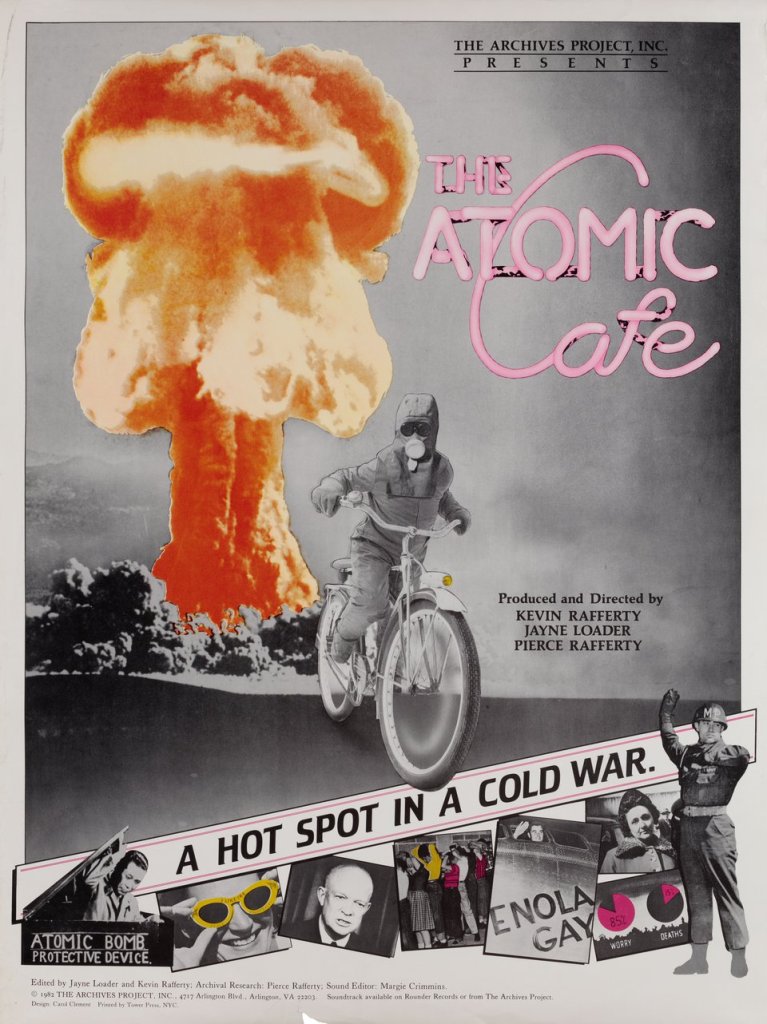
#665) The Atomic Cafe (1982)

#665) The Atomic Cafe (1982)

OR “Apocalypse Then”

Directed by Jayne Loader, Kevin Rafferty, & Pierce Rafferty

Class of 2016

You can watch the entire film for free on Kino Lorber’s YouTube channel.

The Plot: In the early 1980s, when Reagan-era politics reignited the nuclear arms race, we revisited the first era of Cold War paranoia with “The Atomic Cafe”. Clips from dozens of government propaganda films, newsreels, and TV interviews are spliced together in a “compilation vérité”: no narrator, no modern-day interviews for context, just archival footage illustrating how the invention of the nuclear bomb in 1945 quickly escalated into a full-on arms race, and how the US government used the surrounding fear to keep its citizens in line. The footage is edited to highlight the absurdities of the era, as well as the darkness of a government trying to normalize this new weapon of mass destruction.

Why It Matters: The NFR calls the film “a unique document of the 1940s-1960s era” and praises the “vast, yet entertaining, collage of clips”. An essay by the University of Kent’s John Wills contextualizes the film’s production.

But Does It Really?: Oh sure. I enjoyed this movie a lot, or at least as much as I can enjoy a movie about such a dark subject matter. “The Atomic Cafe” is on the list for its succinct representation of Cold War politics, and its unique presentation makes it more accessible than a lot of its contemporaries. Part documentary, part collage, part cautionary tale, “The Atomic Cafe” isn’t an essential American film, but is an alternatingly humorous and terrifying account of essential American history. On a list with its share of government propaganda, I’m glad the Registry found room for a post-modernist takedown like “The Atomic Cafe”.

Shout Outs: It wouldn’t be a film about atomic age propaganda without an appearance from our friend Burt the Turtle in “Duck and Cover“. The NFR write-up also mentions the use of “The House in the Middle“, though I wasn’t able to confirm its appearance here. And among the needle drops from old film scores is the theme from “The Killers” by Miklós Rózsa.

Everybody Gets One: While in San Francisco, Pierce Rafferty found a catalog of US Government films and was intrigued by their unique titles such as “You Can’t Get Away With It“. He convinced his brother Kevin – then a CalArts film student – to work on a film highlighting their fascination with government propaganda. Journalist Jayne Loader was brought on board, and helped narrow the focus of the movie on government films pertaining to the Cold War and atomic bomb. The trio sifted through an estimated 10,000 hours of footage and outtakes for their 86 minute movie. While most of these films were in the public domain, a majority of the movie’s $300,000 budget went to acquiring the rights to the remaining footage, as well as the soundtrack.

Title Track: The Atomic Cafe is the name of an actual cafe seen about 72 minutes into the movie, in the midst of a montage of all the random things that got nuclear names at the time.

Seriously, Oscars?: No Oscar nomination for “The Atomic Cafe”, though it was nominated at the BAFTA’s, and the Boston Society of Film Critics gave it their Best Documentary prize. The Oscar’s Best Documentary winner that year was “Just Another Missing Kid”, John Zaritsky’s film about the disappearance of a Canadian teenager in Nebraska in 1978.

Other notes 

  • The print of “Atomic Cafe” I watched was the 2018 restoration by the good people at Kino Lorber, supervised by the original filmmakers. The film’s NFR designation is mentioned upfront, and the NFR logo appears during the restoration credits at the very end.
  • There is something to be said about only using archival footage for this film. Obviously, even without a narrator, the clips are being edited to manipulate a narrative, but so much of that narrative is already baked into the footage: the awkward speeches, the fear mongering, the deliberate lies. Everything that needs to be said can be found within the subtext of the original footage.
  • The filmmakers do an excellent job of showing the ripple effect of how the first atomic bomb led to the end of one war and beginning of another. And it all escalates so quickly, much like how I imagine it must have felt in real life. It’s saying something when your movie can only touch on the McCarthy hearings and the Rosenberg executions for only a few brief moments. But then again, if you’re looking for a streamlined documentary about the McCarthy hearings, the NFR has got you covered.
  • It was very interesting watching this film so shortly after seeing “Oppenheimer” (a movie that I owe a second viewing that isn’t immediately followed by “Barbie”). In fact, “Oppenheimer” serves as an excellent primer to “Atomic Cafe”, which picks up more or less where the Nolan film left off. If nothing else, it made me appreciate the appearance in this film of Lewis Strauss, the Chair of the U.S. Atomic Energy Commission and future Robert Downey Jr. awards-bait. Strauss is on hand to downplay the nuclear fallout at Rongerik and Utirik, two islands downwind of the nuclear testing on Bikini Atoll in 1954. Strauss speech is intercut with footage of the Marshallese and their obvious signs of acute radiation syndrome.
  • In addition to Strauss, this movie has a lot of notable politicians sprinkled throughout, including future presidents Lyndon Johnson, Richard Nixon, and Ronald Reagan (’80s filmmakers loved their ironic Reagan footage). Also on hand is Senator Owen Brewster, remembered today as Alan Alda’s character in “The Aviator”, and Representative Lloyd Bentsen, who would go on to famously tell Dan Quayle “Senator, you’re no Jack Kennedy.
  • For a movie hailed as being so funny, I actually found this an unsettling watch. Perhaps it’s because I don’t have the nostalgic lens of Boomers who grew up with this atomic culture, who can afford to look back on their childhoods as adults and laugh. Sure I learned about the Cold War in high school (kinda), but seeing actual footage of the frenzy that Americans whipped themselves up into is a distressing viewing experience. In some ways the film is even more relevant now than in 1982. I recognize so many of the same scare tactics in today’s cable news and clickbait headlines, applicable to any hot button issue a politician wants to scare their followers with. To paraphrase from this movie, it can happen here today, and it can be a lot worse.
  • Wow, I did not realize how many songs there were about nuclear bombs. This movie’s soundtrack has such ’50s classics as “Atom Bomb Baby”, “Atomic Love”, and “Jesus Hits Like an Atom Bomb”. There’s so many of these that the movie had a soundtrack album! One song that has actually come up on this blog before is Bill Haley And His Comets’ “Thirteen Women (And Only One Man In Town)”, sung from the perspective of the lone male survivor of an atomic bomb. Unfortunate subject matter aside, you’re probably more familiar with that record’s B-side: “(We’re Gonna) Rock Around The Clock”.
  • The final sequence in the film is an approximation of what a nuclear attack would have been like in the ’50s, with the nuclear family (another atomic namesake) heading into their fallout shelters and waiting out the bombing. The film ends with Father telling his kids to sweep up the glass and debris while they just relax and wait for the authorities to tell them what to do. I know it’s supposed to be funny, but I just found it all disturbing.

Legacy 

  • “The Atomic Cafe” marks the only directing credit for either Jayne Loader and Pierce Rafferty, though Loader continues to write, and Pierce would go on to found the stock footage library Petrified Films. Kevin Rafftery’s next film was 1991’s “Blood in the Face”, which uses this movie’s archival footage approach to discuss American Neo-Nazism.
  • “Atomic Cafe” was one of several films released in the late ’70s/early ’80s about the fears of nuclear power, including “The China Syndrome”, “Silkwood”, and the TV movie “The Day After” to name a few.
  • Interestingly enough, it is speculated that “Duck and Cover” got a resurge in popularity thanks to its appearance in this film.
  • Perhaps this film’s biggest influence: among its devotees was a young journalist named Michael Moore, who reached out to Kevin Rafferty and asked how exactly the film was made. Rafftery passed on his knowledge, and even assisted Moore as a cinematographer on his first film: “Roger & Me“. And now you know the rest of the story!

#664) The Perils of Pauline (1914)

#664) The Perils of Pauline (1914)

OR “Pearl, Interrupted”

Directed by Louis J. Gasnier and Donald MacKenzie

Written by Charles W. Goddard and Basil Dickey. Based on the novel by Goddard.

Class of 2008

The Plot: Pauline Marvin (Pearl White) is a young woman who dreams of living a life of adventure before she settles down with her beau Harry (Crane Wilbur). Around the time she makes this vow, her adoptive father Sanford (Edward José) dies, leaving his fortune to Pauline, which she will inherit as soon as she marries Harry. Sanford’s secretary Koerner (Paul Panzer) knows he will get the money if Pauline dies before getting married, so he attempts a series of plots (perils, if you will) to murder Pauline. In this nine-part serial, a typical episode is Pauline setting off on an adventure, Koerner hiring a shady character to kill her during said adventure, and Pauline getting out of harm’s way just in time. Lather, rinse, repeat.

Why It Matters: While the NFR admits that “Pauline” is “now regarded as a satirical cliché of the movie industry”, they give the series its due as “among the first American movie serials” and gives a pre-feminist shoutout to Pearl White.

But Does It Really?: I suppose. We don’t have a lot of serials on this list, and it makes sense to include the first successful one. I tried to space out my viewing of these episodes to one every few days, but even then these were a slog to get through. Once you get the hang of what each episode is like, there isn’t a lot of variety to spice things up. Still, you can trace a lot of influence back to “Pauline”: from melodramas and their tropes all the way to modern binge-watching. “The Perils of Pauline” earns its spot on the list as the film serial that started it all, but this is another viewing reserved for people like me forcing themselves to go through this list.

Everybody Gets One: Pearl White lived a life as exciting as her cinematic counterpart, performing on stage at age six and eventually working as a bareback rider in the circus. As a young adult she traveled South America as a singer until she developed voice problems, which naturally led her to a career in silent films. White was already a regular at Pathé Frères when “Pauline” came her way, and the serial made her a star.

Other notes 

  • “The Perils of Pauline” was produced by none other than William Randolph Hearst! This was just a few years before he founded his own production company – Cosmopolitan Productions – and became involved with film star Marion Davies. This serial was a co-production with Pathé, a French film company that is still around today.
  • Originally released as a 20 part series, the surviving version of “Pauline” is an edited, re-shuffled nine part version released in theaters around 1916. The most notable difference is that the main villain, known as Raymond Owen in the original release, has been renamed Koerner because of the strong anti-German sentiment during the Great War. This post covers the edited cut, with notes on where these episodes appeared in the original 20 part series.
  • Among the episodes lost to time: Pauline being held hostage in a Chinese temple, acting in a movie (meta!), landing a plane by herself, and fighting a giant ape.

Episode 1: Trial by Fire (Original Cut: Episodes 1, 6, & 7)

  • We start off with the standard “pilot” stuff as mentioned in the plot synopsis, and Koerner’s first attempts to kill Pauline involve setting her out in a hot air balloon, abandoning her by the edge of a cliff (the famous New Jersey Palisades), and trapping her inside a burning house. All this, and she’s got eight more episodes to go? She’s resilient, I give her that.
  • Oh man, this serial needs a restoration, stat. The version I watched is clearly a VHS rip of a duplicate film print. We are nowhere near the original film elements and it shows.
  • Sure it’s impressive that Pearl White did her own stunts, but that’s a lot of actual peril putting your actors in a burning building. I’m surprised film actors didn’t unionize right then and there.
  • This re-edit does a lousy job with the cliffhangers. Episode 1 ends with Pauline being rescued from the burning house. Shouldn’t it end with her still trapped in the house, to be resolved next week? And before that she was literally hanging off a cliff. It was right there! Instead we get Pauline safe and sound at home, with a tacked on question mark in the final moments. This question mark appears at the end of every episode, becoming more and more useless with each ending.

Episode 2: The Goddess of the Far West (Original Cut: Episodes 7 & 8)

  • Pauline heads west and is kidnapped by some bandits hired by Koerner, then rescued by an Indigenous tribe who think she’s their god.
  • Another on-going issue with this print is the intertitles. The surviving version of “Pauline” is a French print, so these titles are translated back into English with mixed results. That being said, I’m enjoying the random words they choose to hyphenate, like “cow-boys” and “high-way”.

Episode 3: The Pirate Treasure (Original Cut: Episodes 3 & 4)

  • Blinky Bill the Pirate is hired to take Pauline out on a boat, abandon ship, and set off a bomb hidden in the boat. I’m beginning to sense that these are all like Wile E. Coyote/Road Runner shorts, except way less entertaining (same amount of spoken dialogue though). We don’t even see the bomb explode! Definitely not hitting the “peril” aspect this week.
  • And because we can never have nice things, Harry disguises himself as the ship’s cook in FULL BLACKFACE. I mean, I really should have expected that from a 1914 serial, but geez Louise.

Episode 4: The Deadly Turning (Original Cut: Episode 15)

Episode 5: A Watery Doom (Original Cut: Episode 14)

  • Koerner hires a band of “gypsies” (who look more like pirates) to kidnap Pauline and Harry, trap them in the cellar of an abandoned mill, and drown them. Didn’t we already have a drowning scheme? Back in the cave in the Western one? I guess if you saw these bi-weekly you had time to forget.
  • My main problem with this whole serial is the overall lack of suspense. There’s a way to do this kind of cliffhanger serial and give it the element of “How are they gonna get out of this one?” (The James Bond and Indiana Jones films are both great examples of this). I know Pauline is going to escape, but it never feels interesting or earned. I guess it was easier to entertain back in 1914. Whatever. Next!

Episode 6: The Shattered Plane (Original Cut: Episode 2)

  • Koerner tries to get Pauline to fly in one of those newfangled aeroplanes, which one of his cohorts secretly tampers with. It helps that the plane is a Wright Flyer, so Koerner doesn’t need to do anything; that thing’s already a deathtrap.
  • I like the moment when Koerner worries that Pauline will be late for the flight. It’s like the old punchline “Gee, I hope nothing happened to her.”
  • Another problem I have with this serial: Too much lead-up to a thing, not enough time on the actual thing. After the promise of a dangerous flight, most of this episode is Pauline trying to get to the airfield. And then when she gets there, SHE DOESN’T EVEN GET ON THE PLANE! You can’t really deliver on peril if you don’t put your hero in the perilous situation.

Episode 7: The Tragic Plunge (Original Cut: Episode 18)

  • Koerner outsources this week’s scheme to Mlle. Yagow, who gets Pauline onboard a submarine with a bomb! That’s right, another “bomb on a boat” episode. I guess there are only so many ways to kill someone. At least this one has a few underwater shots (well, underwater via an obvious set) as Pauline escapes the sub via the torpedo tube.

Episode 8: The Serpent in the Flowers (Original Cut: Episodes 12 & 13)

  • Koerner once again hires “gypsies” to kidnap Pauline. Only this time, after Pauline escapes, one of them vows revenge by placing a snake inside a basket of flowers. I assumed this title would be metaphorical but nope, there’s a motherf***ing snake in these motherf***ing flowers.
  • The serpent in the flowers plotline finishes halfway through this episode, with the second half being devoted to a steeplechase in which Koerner drugs Pauline’s horse, causing it to wildly convulse during the race and throw Pauline off. I feel like you could have made this episode a standalone and bumped the series up to an even 10.

Episode 9: The Floating Coffin (Original Cut: Episode 20)

  • In the final episode, Pauline and Harry go on yet another boat, with Koerner half-assing it by cutting a hole in a rowboat Pauline takes on a mini-excursion with her dog Rusty. They escape the sinking boat, only to find themselves on an abandoned ship being used by the Navy for target practice. All ends well as Pauline is rescued by the U.S. Navy and decides that she is through with adventures and will settle down with Harry. Oh, and Koerner falls overboard and drowns, but no one seems to notice or care.

Legacy 

  • “The Perils of Pauline” was a hit upon release. Pathé immediately followed up with “The Exploits of Elaine“, while Kalem Studios responded in kind with “The Hazards of Helen”. All of these serials have fused together in the public consciousness to become the standard damsel-in-distress melodrama clichés (think Nell from “Dudley Do-Right” or Penelope Pitstop from “Wacky Racers”).
  • Pearl White would go on to star in the aforementioned “Exploits of Elaine”, which was even more successful than “Pauline”. She spent most of the 1910s as “Queen of the Serials” before retiring from film in the early 1920s.
  • “The Perils of Pauline” was remade as a serial in 1933, and as a film in 1947 and 1967. It should be noted, however, that the only connection any of these have to the original serial is the title. Heck, the ’47 movie is a fictionalized biopic of Pearl White with Betty Hutton.

Further Viewing: One item that pops up in a lot of write-ups about “Perils of Pauline” is the melodrama trope of the woman tied to the railroad tracks. While this never happens in “Pauline”, it does occur in other films of the time such as “The Hazards of Helen” and “Teddy at the Throttle”, with these films being conflated with “Pauline” over time. I know it’s a stretch, but shouldn’t one of these be on the NFR?

#663) Tevya (1939)

#663) Tevya (1939)

OR “Fiddle Me This”

Directed and Written by Maurice Schwartz. Based on the “Tevye the Dairyman” short stories by Sholem Aleichem.

Class of 1991

The Plot: In the Russian Empire village of Anatevka Boyberik circa 1905, the dairyman Tevya (Maurice Schwartz) balances his devout Judaism with the increasing anti-Semitism of the Russian government. His daughter Chava (Miriam Riselle) has started seeing Fedya (Leon Liebold), an intelligent Christian, which infuriates Tevya and his equally devout wife Golde (Rebecca Weintraub). Despite the pleading of her parents, Chava marries Fedya, and Tevya declares her dead to him, never to spoken of or remembered again. When the town council announces the immediate expulsion of all Jews from the village, Tevya grapples with his place in the world. Sholem Aleichem’s most famous character comes to the screen in this Yiddish production that’s all about traditiooooon. Tradition. Bump-ba-da-dum-dum-bump-ba-da-dum-dum-bump tradition.

Why It Matters: For starters, the NFR’s official listing names the film “Tevye”, with “Tevya” being listed as an alternate title (the print I watched is titled “Tevya”, so that’s what I’m going with). Other than that, the NFR writeup is just a plot summary and its connections to “Fiddler on the Roof”. An essay by film critic J. Hoberman is a detailed history of the film’s production and reception.

But Does It Really?:  This in another one of those movies where I get why it’s on the Registry, but I was more interested in the story behind the film than entertained by the film itself. “Tevya” is the first foreign-language movie to be inducted into the Registry, and represents a culture that was in serious danger of being wiped out in the upcoming war. It also helps that there is a significantly more iconic adaptation of the same material keeping this film’s memory afloat, but more on that later. “Tevya” is an historically important piece of American film, and its unique presentation helps it stand out among other NFR movies. It’s worth a watch for film/Yiddish theater buffs, but everyone else can just watch the musical instead.

Everybody Gets One: Avrom Moishe Schwartz emigrated to New York City in 1901, changing his name to Maurice shortly thereafter. As a teenager, Schwartz became fascinated by the Yiddish theater, and spent years working odd jobs until he could afford to become a full-time actor. In 1918, Schwartz founded the Yiddish Art Theatre, with a goal of presenting both classics and new works to a Yiddish audience. In 1919, Schwartz first played the role of Tevye on stage in a production directed by himself and based on an adaptation Sholem Aleichem penned shortly before his death. Almost twenty years later, Schwartz returned to the role of Tevye for the film adaptation, which he felt compelled to make in response to the wave of anti-Semitism sweeping Europe throughout the 1930s.

Seriously, Oscars?:  No Oscar attention for “Tevya”, but its successor “Fiddler on the Roof” fared much better: Eight nominations and three wins.

Other notes 

  • Solomon-Olesksii Naumovich Rabinovich had been writing stories since the age of 15, when he adopted the pen name Sholem Aleichem (a Yiddish version of the Hebrew phrase meaning “peace be with you”). By the time the first “Tevye” story in 1894, Aleichem was already a celebrated figure in Yiddish literature, dubbed by some as “the Jewish Mark Twain”. Like Tevye, Aleichem lived in the Russian Empire at the turn of the century, witnessed the violent pogroms on Kyiv in 1905, and emigrated shortly afterwards. Aleichem wrote eight Tevye stories, the last being published in 1914, two years before his death. The 1939 film is primarily an adaptation of the fifth story “Chava” and the eighth “Lekh-Lekho” (aka “Get Thee Out”), with one brief interlude from the first story – “Tevye Strikes It Rich” – added to the film’s beginning.
  • “Tevya” was made on a budget of $70,000 (roughly 1.5 million today), financed primarily by Schwartz and a group of friends. Shooting took place in the summer of 1939 on a 130-acre potato farm in Long Island. In late August 1939, the Nazis seized the city-state of Danzig with the invasion of Poland happening the following week. Many on the “Tevya” production team had family in Poland, and despite the political anxiety, filming was completed shortly thereafter.
  • As previously mentioned, “Tevya” is one of the rare non-English language films on the NFR, presented primarily in Yiddish, with some Ukrainian and Russian sprinkled throughout. It makes the entire film feel more authentic, therefore making the characters feel more dimensional and more sympathetic for a viewing audience. And shoutout to whoever did the English subtitles on the Kino Lorber restoration; the translation has some character to it, retaining the spirit of Aleichem’s prose rather than just being a copy-and-paste Google Translate.
  • It was such a relief to see a film this Jewish from this point in history. In the late 1930s, Hollywood strategically shied away from overt Jewish depictions for fear of their films being banned in Nazi Germany and losing money. It’s unfortunate that the only way an openly Jewish film could be made at this time was an independent production, but you can feel the sense that this team had to make this film at this exact moment in time; a flaunting to the anti-Semites of the world as if to say “We’re here and we’re not going anywhere.”
  • As with many other films based on short stories, you can sense the padding in “Tevya”. There’s a lot of scenes of Tevya giving extended monologues about his feelings towards his daughter’s marriage and the world around him, but after a while it feels less and less earned. I suspect they opted for this rather than adding more of the original stories into the film in order to save money (Tevya goes from seven daughters to two in this version, and there isn’t a matchmaker, matchmaker in sight).
  • The moment when Tevya yells at Tzeitel “I have no other daughters!” got an unintentional laugh out of me. Poor Hodel, to say nothing of Shprintze, Beilke, Taybele, and the unnamed seventh one that’s only mentioned in the first story.
  • [Spoilers] For those of us (including myself) more familiar with the musical than the original stories, it’s surprising that this movie is even more of a downer. For starters, Golde dies! Like the stories, this movie ends with Tevya and his family being evicted from the town, although the film (and the musical) remove the ambiguous ending and let Tevya reconcile with Chava. In the end, “Tevya” is essentially an extended melodrama. A good melodrama, I grant you that, but still.

Legacy 

  • “Tevya” premiered in New York City on December 21st, 1939. The Yiddish papers that reviewed the film were in near agreement that while the film as a whole was quite powerful (especially Schwartz’s performance), it departed too drastically from the source material to be considered a success. Although the film had been deemed lost for decades, a print was rediscovered in 1978.
  • After “Tevya”, Maurice Schwartz returned to the theater, though Yiddish theater was slowly dying due to the ongoing assimilation of its audience. Schwartz performed on Broadway and in a few Hollywood movies before his death in 1960 at age 69.
  • There have been multiple adaptations of the “Tevye” short stories before and after the 1939 film, but of course the best known is the musical “Fiddler on the Roof”. With a score by Jerry Bock and Sheldon Harnick and a book by Joseph Stein, “Fiddler” adapted the material for a post-Holocaust generation, and subsequently became the longest running Broadway musical of its time. There have been revivals all over the world, including five on Broadway, and a successful film adaptation in 1971 by Norman Jewison. It’s worth noting that as of this writing, the 1971 film has not made the NFR. That’s gotta be an oversight, right?

Listen to This: The original Broadway cast recording of “Fiddler on the Roof” made the National Recording Registry in 2019. “Fiddler” expert Alisa Solomon is on hand with an essay that delves into the score and the album’s recording session.

The NFR Class of 2023: My Ballot

It’s that time of year again; when the National Film Board Preservation meets to determine this year’s NFR inductees and I post my ballot as a not-so-subtle attempt to sway their votes. Here are my 50 picks for films that deserve to be on the Registry. Movies with an * are movies I’m nominating this year for the first time.

The Five Timers Club (Movies that I have nominated at least five times but have yet to make it): 9 to 5 (1980), Big (1988), It’s a Mad, Mad, Mad, Mad World (1963), The Miracle Worker (1962), Mystery Science Theater 3000: The Movie (1996), The Sixth Sense (1999)

Personal Favorites: Rope (1948), Witness for the Prosecution (1957), Exploratorium (1974), Hardware Wars (1978), Clue (1985), Home Alone (1990), The Birdcage (1996), Best in Show (2000), Hedwig and the Angry Inch (2001)

A Favorite that Should at Least Be on the List of Eligible Titles on the NFR’s Website: Original Cast Album: Company (1970)

Animation!: Humorous Phases of Funny Faces (1906), Feline Follies (1919)*, Der Fuehrer’s Face (1942), Cat Concerto (1947)*, Alice in Wonderland (1951), Winnie the Pooh and the Honey Tree (1966)*, The Nightmare Before Christmas (1993), Space Jam (1996)*, Finding Nemo (2003)

A Whole Buncha ’80s: Star Trek II: The Wrath of Khan (1982), Gremlins (1984)*, The Karate Kid (1984), The Color Purple (1985), Blue Velvet (1986), Labyrinth (1986), Dirty Dancing (1987), Fatal Attraction (1987), Beetlejuice (1988), Say Anything… (1989)*

Grab Bag: The Wolf Man (1941)*, Creature from the Black Lagoon (1954), The Great Escape (1963), Fantastic Voyage (1966)*, The Heartbreak Kid (1972)* Alice Doesn’t Live Here Anymore (1974), Sleepless in Seattle (1993), Cast Away (2000)*, O Brother, Where Art Thou? (2000)*, Moulin Rouge! (2001)*, Borat (2006)*, 300 (2007)*, Bridesmaids (2011)

And finally, the Newly Eligible from 2013: 12 Years a Slave (2013)*, Frozen (2013)*

On average, three of the movies on my nominations ballot make the cut. Which ones will it be? Can I beat my personal best of getting five films on the list in one year? And is anyone on the National Film Preservation Board actually reading this? We’ll find out the answers to all of these questions in December.

Happy viewing,

Tony

#662) The Prisoner of Zenda (1937)

#662) The Prisoner of Zenda (1937)

OR “The Heir Apparent Trap”

Directed by John Cromwell

Written by John L. Balderston. Adaptation by Wells Root. Additional dialogue by Donald Ogden Stewart. Based on the novel by Anthony Hope and the stage adaptation by Edward Rose.

Class of 1991

Wow, no trailer to be found for this version of “Zenda”, so here’s an introduction to the film by one of those new TCM hosts.

The Plot: Englishman Rudolf Rassendyll (Ronald Colman) takes a vacation in the fictional European country Ruritania in the summer of 1897. He soon discovers that he looks nearly identical to Ruritania’s King Rudolf the V (also Ronald Colman), soon to be coronated and wed to Princess Flavia (Madeleine Carroll). Amused by their resemblance, King Rudolf invites Rudolf to dine with him on the eve of his coronation, where the king drinks a bottle of wine from his half-brother Michael (Raymond Massey) and is drugged. Worried that Michael will try to overtake the throne while Rudolph V is incapacitated, Colonel Zapt and Captain von Tarlenheim (C. Aubrey Smith and David Niven) convince Rudolf to fill in for the king for the coronation. Shortly afterwards, the real king is kidnapped by Michael’s henchman Rupert of Hentzau (Douglas Fairbanks Jr.) and held prisoner in the nearby village of Zenda. There’s action, romance, and some impressive optical effects in the kind of historical adventure that could only come from 1930s Hollywood.

Why It Matters: The NFR write-up is mostly a rundown of the film’s plot and production, with the only superlative going to the movie’s “escapist charm”.

But Does It Really?: This is another one of those movies that I think made the NFR a little sooner than it should have. I enjoyed “Zenda” quite a bit as an entertaining example of a Classic Hollywood studio adventure, but this should not be part of the same NFR class as “2001” and “Lawrence of Arabia“. While “Zenda” succeeds at being a charming historical romp, there are just so many other movies of the era that do it better (the Errol Flynn “Robin Hood” came out the next year). Also not helping things is the fact that no one reads or remembers the original novel of “Prisoner of Zenda”, so its cultural footprint isn’t what it was when this film was made. “Zelda” is fun if you’re willing to track it down, but I’d hardly call it a film essential, and I give its NFR designation a hearty “I guess?”

Everybody Gets One: John Cromwell started off as a stage actor, pivoting to directing before heading out to Hollywood as a dialogue director for this new thing called talking pictures. Cromwell pivoted to film director quickly, earning a reputation as an actor’s director. Fun Fact: John Cromwell is the father of the actor James Cromwell. This is also the only NFR appearance for leading lady Madeleine Carroll, whose most iconic film appearance is ineligible for this list: Hitchcock’s original 1935 version of “The 39 Steps”. Carroll retired from acting shortly after the war to focus on humanitarian efforts, and considered “Zenda” her favorite of her own film work.

Seriously, Oscars?: A hit upon release, “The Prisoner of Zenda” received two Oscar nominations. The film lost Art Direction to fellow NFR entry/Ronald Colman vehicle “Lost Horizon“, and Original Score to something called “One Hundred Men and a Girl”.

Other notes 

  • “The Prisoner of Zenda” was written by Anthony Hope in 1894 and was immediately successful, spawning a sequel novel and a popular stage adaptation. Prior to the 1937 film, there had been three silent film adaptations, most notably a 1922 version starring Lewis Stone and Ramón Navarro. In the early 1930s, the film rights to the “Zenda” were owned by MGM (its predecessor Metro Pictures made the 1922 version), and there were plans to make a musical adaptation starring Jeanette MacDonald and Nelson Eddy. A non-musical film to be produced by David O. Selznick was in production turnaround when Selznick left MGM to form his own studio, but his interest in the property was reignited when King Edward VIII abdicated the British throne in December 1936 to marry American divorcée Wallis Simpson. Recognizing the parallel story themes, Selznick quickly bought the film rights to “Zenda” from MGM, with production starting in March 1937 and the final film premiering that September.
  • I love me some creative writing in the credits. This ain’t no film adaptation, it’s a “picturization of the celebrated novel”. There’s also a disclaimer that any resemblance to a “Great Royal Scandal” from the last century is purely coincidental. Anyone know what they’re alluding to?
  • As expected, Ronald Colman is quite dashing in this, and is clearly having fun playing scenes with himself. In previous posts, I’ve referenced David Niven succeeding Ronald Colman as Hollywood’s “Charming British Guy”, but I didn’t realize they were in a movie together. I imagine Niven took a lot of notes during filming.
  • C. Aubrey Smith is a bit of stunt casting: He had played the lead dual roles in a stage production of “Zenda” 40 years earlier, appearing in other productions through the years and joking that he “played every part except Princess Flavia.”
  • I was hoping for some old-school split screen effects when the two Rudolphs meet, and this film does not disappoint. And then this movie goes the extra mile and includes a wide shot of Colman shaking hands with himself! How did they do that?
  • We don’t see a lot of Raymond Massey in this blog. Most of his NFR representation comes from his later work squaring off with James Dean and briefly reprising his work as Lincoln. It’s fun watching him play a heavy, and I’m still holding out for his best villainous performance to make the NFR: Jonathan Brewster in “Arsenic and Old Lace”.
  • Douglas Fairbanks Jr. looks remarkably like his dad, yet differently enough that every time he turns up in one of these movies I think “Who’s that guy? He looks familiar.” Fairbanks wanted to play Rudolf, and was initially disappointed when offered the role of Rupert, until Fairbanks Sr. reminded him it’s one of the best written villains in all of literature.
  • Poor Mary Astor: always the third wheel, always the other woman. That being said, I like her character Antoinette; Michael’s mistress who helps Rudolf so that she can marry Michael. Sort of an “Everybody loves somebody” deal.
  • Well there’s a lot of spectacle going on, especially with this coronation. Makes sense, there was no live news coverage in 1937. If you wanted to see a coronation, you had to go to one.
  • I love when Rudolph really leans into the king stuff, especially in his early scenes with Flavia where he berates Fritz for the fun of it. I actually laughed out loud at these scenes. Not bad for an 86 year old movie.
  • The conductor at the ball who gets increasingly frustrated at having to stop and start is played by Al Shean, uncle of the Marx brothers!
  • I questioned this movie’s reference to Florence Nightingale as anachronistic, but by 1897 Nightingale was already famous for her nursing achievements during the Crimean War. Side note: Despite having the Florence Nightingale Effect named after her, there is no evidence that she ever fell in love with one of her patients.
  • What is Rupert wearing in the last few scenes? He looks like one of the aliens from “Plan 9 from Outer Space”.
  • The presence of Douglas Fairbanks Jr. and the sword fight depicted on the poster led me to believe that there would be a lot more swashbuckling in this movie. Aside from the climactic sword fight between Rudolf and Rupert, my swash was hardly buckled at all. The weird thing about the sword fight is how much quippy dialogue there is throughout. Shouldn’t they save their energy for the actual fighting? Apparently I was not the only one disappointed by this fight scene; Selznick hated the original version and had the whole thing re-shot by an uncredited W. S. Van Dyke after production wrapped.
  • With the exception of some streamlining in the third act, this film of “Zenda” is very faithful to the book, including the downer ending in which Rudolf and Flavia don’t get together because of her obligation to marry the king. Oh come on! This all being said, that’s a great final shot of Rudolph literally riding off into the sunset. James Wong Howe, you’ve done it again!

Legacy 

  • “The Prisoner of Zenda” was a box office hit upon release, encouraging Selznick International Pictures to go big with one of their upcoming projects in pre-production at the time: an adaptation of the novel “Gone with the Wind“.
  • Selznick had plans to film the book’s sequel “Rupert of Hentzau” in the late 1940s with Joseph Cotten taking over the dual Rudolph roles, but the film never made it to production.
  • John Cromwell reunited with Raymond Massey for the 1940 biopic “Abe Lincoln in Illinois”. Cromwell spent the next decade making a number of historical pictures before being blacklisted in the early 1950s. He returned to New York and the theater, making only a handful of movies after the blacklist.
  • Always happy to crank out remakes of public domain IP, “Prisoner of Zenda” got two more major film adaptations after 1937. 1952’s version starred Stewart Granger and was virtually a shot-for-shot remake of the 1937 version (even using the same screenplay). The 1979 remake starred Peter Sellers and was a more broadly comedic version of the tale. As with many a later Sellers project, Peter’s on-set tyranny led to a forgettable, unfunny final product. All was forgiven, however, with the release of Sellers’ next film: “Being There“.
  • While no one remembers “The Prisoner of Zenda” either in novel or film form, the “commoner switches places with royalty” trope has echoed throughout pop culture; from “History of the World Part I” to “Dave”.
  • Oh, and apparently the crew outfits in “Star Trek II: The Wrath of Khan” were inspired by the uniforms in this film. I…got nothing, I’m not a Trekkie. But this is the best excuse I’ve had to play that clip of Shatner shouting “Khaaaaan!”