
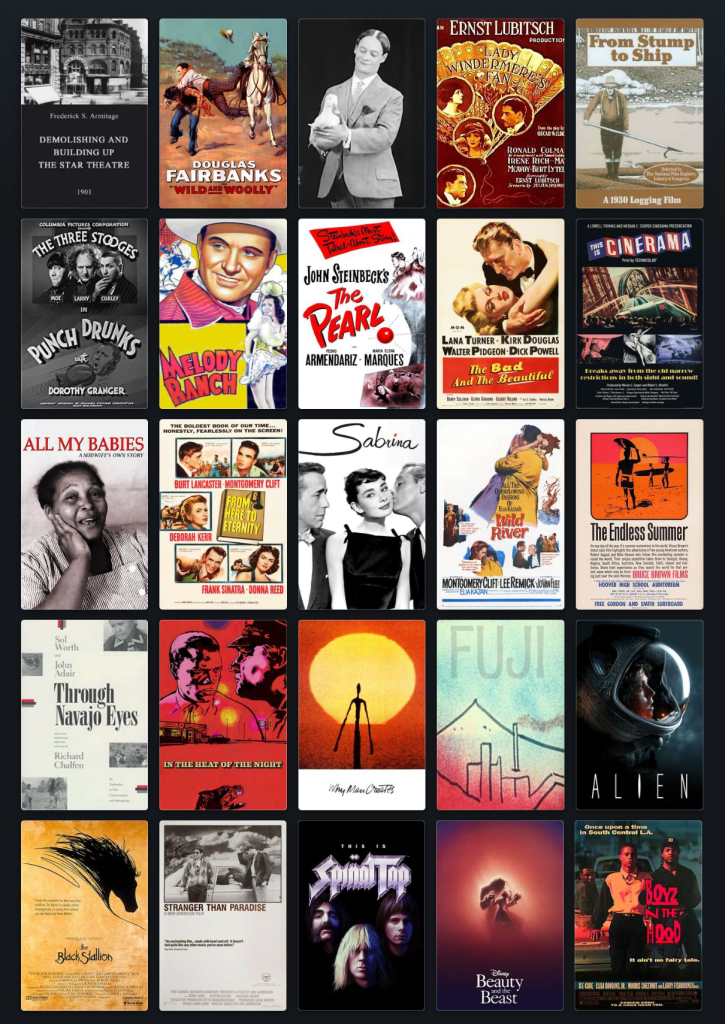
December 16th 2002: The Library of Congress announces 25 more films added to the National Film Registry, bringing the total to 350 films. With all 25 films finally under my belt, let’s take a look back at the NFR Class of 2002:
Star Theatre (1901): “time-lapse photography is neat, and someone had to introduce it to the American mainstream.”
Wild and Woolly (1917): “[Douglas] Fairbanks is entertaining, but we’ve already got three of his later iconic movies on the list.”
Lady Windermere’s Fan (1925): “impressive as an exercise in translating a very wordy play into a much more visual film.”
Theodore Case Sound Test: Gus Visser and His Singing Duck (1925): “technically it has historical significance, but…there weren’t any other films to choose?”
From Stump to Ship (1930): “Thanks to this 30-minute documentation, I feel wholly qualified to be a 1930s logger”.
Punch Drunks (1934): “checks all the boxes you want from a Stooges short”.
Melody Ranch (1940): “a perfect encapsulation of the all-in-good-fun type of movies [Gene] Autry specialized in.”
La Perla [The Pearl] (1947): “Not a classic, but not a relic of its time either.”
The Bad and the Beautiful (1952): “a well-made tale of corrupt Old Hollywood”
This Is Cinerama (1952): “essentially the birth of the widescreen movie as we know it.”
All My Babies: A Midwife’s Own Story (1953): “the kind of unique film the NFR was made for…Just don’t eat before watching it.”
From Here to Eternity (1953): “A well made film with good performances all around, but that’s about it.”
Sabrina (1954): “iconic enough for eventual NFR inclusion, but not tops on anyone’s list.”
Wild River (1960): “an engaging examination of time and place, but as an NFR entry it doesn’t pass muster.”
The Endless Summer (1966): “If you’re going to have one surf film on the Registry, this is a fine choice.”
Navajo Film Themselves (1966): “a specific glimpse into an Indigenous culture…courtesy of the culture itself.”
In the Heat of the Night (1967): “A top-notch film that shows us where we were, where we are, and where we’re going. Now that’s a classic.”
Why Man Creates (1968): “I have no objections to including a film by Saul Bass, whose praises I have sung in many previous posts.”
Fuji (1974): “highlights what experimental animation is capable of.”
Alien (1979): “There’s no way [the NFR] could ignore a move as iconic, as memorable, or as perennially exciting”.
The Black Stallion (1979): “set the template for kids-and-animal films for the next two decades.”
Stranger Than Paradise (1984): “a perfect representation of [Jim Jarmusch’s] work.”
This Is Spinal Tap (1984): “one of the most consistently funny movies ever made.”
Beauty and the Beast (1991): “a spectacular feat of animation, an incredible piece of musical theater, and an overall outstanding film.”
Boyz n the Hood (1991): “a realistic, sincere movie with a strong message.”
Other notes
- The NFR Class of 2002 has “minor classic” written all over it. While these 25 movies do cover a diverse array of both films and their filmmakers, none of them feel like absolute essentials. Even some of the NFR write-ups can’t be bothered to fully endorse their selections, peppering in the occasional caveat or back-handed compliment. Most of my write-ups fall into this “minor classic” qualification, the most succinct version coming from my “Wild River” post: “It’s good, but is it NFR good?” The only films in this group that receive unconditional praise from me are the smaller independent projects I could discover for myself or the more recent inductees whose cultural legacy has continued to grow in the last two decades. On a related note: Shoutout to “Beauty and the Beast” and “Boyz n the Hood” for making the NFR in only their second year of eligibility!
- While not as prevalent as it will be in future NFR inductions, the Class of 2002 still has its share of “What’s not on the list yet?” entries. There’s canonized Hollywood classics like “From Here to Eternity” and “Sabrina”, but we also get a Three Stooges short, a Gene Autry movie, films by Ridley Scott and Rob Reiner, a Mexican co-production, and the first entry from the Disney Renaissance. Most surprisingly, “In the Heat of the Night” is the first Sidney Poitier movie on the list. How the NFR managed to go 13 years without Poitier representation is anyone’s guess. And to top this all off, the NFR found room for a sound experiment in which a man forces a duck to quack on cue. Still not sure what to make of that one.
- The Library of Congress’ press release for these films is your standard Billington-era comments: “This is not a ‘best-of’ list”, “We must preserve our film heritage”, etc. One interesting addition is the first mention of the National Audio-Visual Conservation Center in Culpeper, Virginia, under construction at the time and scheduled to open in 2005 (it opened in 2007).
- Another interesting note from the press release: The National Film Preservation Board considered “nearly 1000 films nominated by the public.” Compare that to the over 6700 films publicly nominated in 2024. Looks like us film nerds are growing in numbers.
- When the Class of 2002 was announced, “Maid in Manhattan” had just won the weekend box office in the U.S. Future NFR entry “Real Women Have Curves” was still playing in theaters, as was a special IMAX re-release of “Apollo 13”. Speaking of IMAX, “Beauty and the Beast” was re-released on IMAX screens earlier in 2002, which no doubt helped the film’s NFR chances.
- I believe my “In the Heat of the Night” post is my first usage of “the vic”, a term I use to describe the minor character whose death serves as the focus of many an NFR murder mystery. I guess I picked it up from all those years of my mom watching “Law & Order”.
- We have a smaller crop of double-dippers this year; I could only confirm three, all of them actors: Billy Bletcher, Francis X. Bushman, and Montgomery Clift.
- Thematic double-dippers: Modern cowboys, beach activities, irrigation projects, high society love triangles, Southern racial tensions, references to T. E. Lawrence, diegetic musical numbers, international travel, adaptations with major alterations, and two different Clevelands (Ohio and Tennessee).
- Favorite of my own subtitles: Lie With Your Boots On, Wilde Abandon, The Maine Event, Million Dollar Curly, Local Cowboy Makes Good, Captain Kirk, Curve Appeal, and Mock & Roll.
- And finally, it’s worth noting that just a few weeks after the Class of 2002 announcement, the Library of Congress announced the first 50 inductees in their National Recording Registry. Like its older sibling, the NRR continues to this day, and as of this writing has 675 recordings on the list. Will I ever make an attempt to listen to all of them while maintaining a corresponding blog? No.
- To end on a much more positive note: once again, here’s the Curly Shuffle.
 The Horse's Head