#821) The Quiet Man (1952)
OR “The Courtship of Reddie’s Sister”
Directed by John Ford
Written by Frank S. Nugent. Based on the story by Maurice Walsh.
Class of 2013
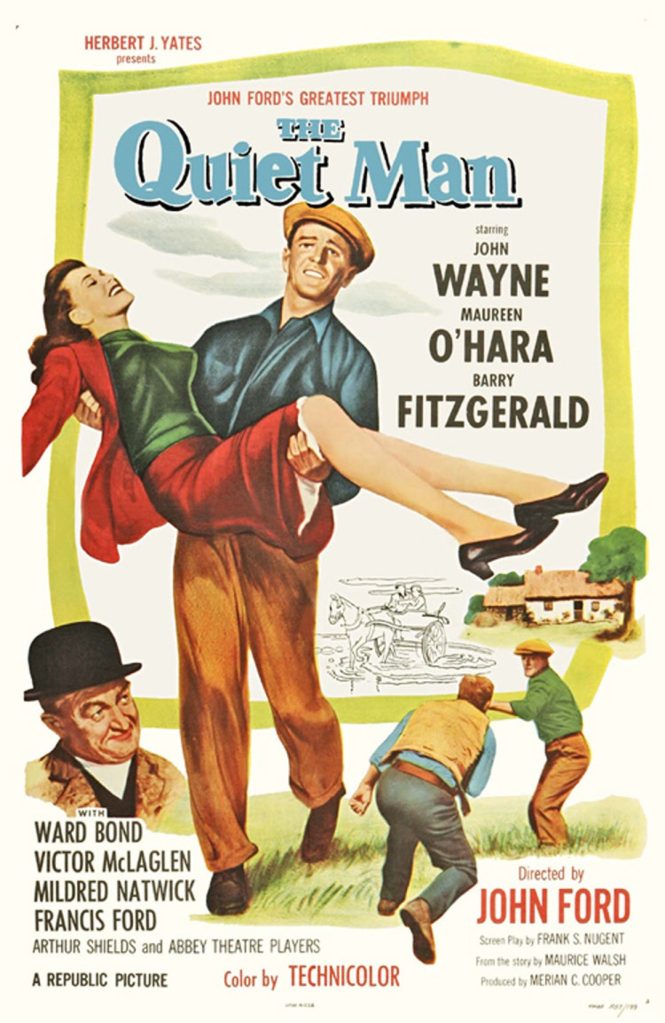
The Plot: American Sean Thornton (John Wayne) returns to his native Ireland in the 1920s to buy his family farm, infuriating local “Red” Will Danaher (Victor McLaglen) who has been trying to get his hands on the property for years. Thornton meets and is immediately smitten with Mary Kate Danaher (Maureen O’Hara), Red’s sister, who, in accordance with Irish custom, cannot be courted by Sean without her brother’s permission. Many of the locals conspire to get Red to agree to Sean and Mary Kate’s courtship, but things only get more complicated once the two finally get married. John Ford takes a break from his run of iconic Westerns to helm the most aggressively Irish movie in the National Film Registry.
Why It Matters: The NFR calls the film “a perennial St. Patrick’s Day television favorite”, praising Ford’s “unadulterated adulation of his Irish heritage”, as well as the work of Wayne, O’Hara, composer Victor Young, and the cinematographers. An essay by author and archivist Scott Allen Nollen is a thorough rundown of the film’s production and Ford’s influence on the material.
But Does It Really?: This hasn’t happened on the blog in a while, but I think “Quiet Man” was overhyped for me. I was prepared to be charmed by John Ford’s non-Western masterpiece, but instead I found it…adequate. “Quiet Man” is by no means a bad movie, it just didn’t do it for me. Which is a shame because it’s clearly made with a lot of love for Ireland, with some lush, beautiful cinematography of the Irish countryside. We’ll put “The Quiet Man” in the “minor classic” category: not the quintessential John Ford movie, but certainly among his better efforts.
Wow, That’s Dated: A lot of sexism towards the handful of women in this movie, but it’s somehow more palatable than other similar movies on the list, perhaps because Maureen O’Hara’s Mary Kate is willing to fight back.
Title Track: Michaleen calls Sean “a nice, quiet, peace-loving man”. So close.
Seriously, Oscars?: “The Quiet Man” received seven Oscar nominations (tying for the most of the year), including Best Picture. While the film lost Best Picture to “The Greatest Show on Earth”, Winton C. Hoch and Archie Stout won for their color cinematography, and John Ford won his fourth Best Director Oscar, an accomplishment that has never been tied or surpassed. That same ceremony, “Quiet Man” co-producer Merian C. Cooper won an Honorary Oscar “for his many innovations and contributions to the art of motion pictures” (keep in mind this is the man who gave us “Grass”, “King Kong”, and Cinerama).
Other notes
- Irish novelist Maurice Walsh sold his short story “The Quiet Man” to The Saturday Evening Post in 1933. Shortly thereafter, John Ford read it, paid for the film rights, and spent the better part of two decades trying to get a film studio interested in the property. Republic Pictures finally took on the project, but only if Ford, John Wayne, and Maureen O’Hara made a western first; the result was 1950’s “Rio Grande”.
- That’s quite a cast Ford has assembled. As the titular quiet man, John Wayne is good, giving a performance devoid of most of his John Wayne-isms. Maureen O’Hara is playing feistier and livelier than usual, easily going toe-to-toe with Wayne. The supporting cast is filled out with such reliable characters actors as Ward Bond (again!), Mildred Natwick, and Barry Fitzgerald at his most leprechaun-y. Special mention to Victor McLaglen as Red. It’s not as solid a performance as he gives in Ford’s “The Informer”, but he’s a worthy antagonist for the proceedings. And boy howdy that’s a lot of face for one man.
- Like I said, this thing is aggressively Irish. It’s saying something when John Wayne is your most articulate actor
- The old man who knew Sean’s grandfather is played by Francis Ford, John’s older brother and fellow NFR filmmaker. In fact, the film features several family affairs, with John Wayne’s children, Maureen O’Hara’s brothers, John Ford’s son, and Barry Fitzgerald’s brother all making appearances within the film.
- The first kiss between Sean and Mary Kate is a little too early for me, but it all works out in the end so I guess it’s fine. And hey, that’s the “E.T.” clip!
- The exteriors of “The Quiet Man” were filmed on location in Cong, a village straddling County Mayo and County Galway, with interiors filmed on soundstages in Los Angeles. I guess the on-location budget ran out for the horse race, clearly filmed on soundstages with rear projection. Even John Wayne thought the final effect was unconvincing.
- Man, I really don’t have a lot to say about this movie. Again, beautifully shot, but ultimately I didn’t care about the characters or the story. I do have to mention the climactic fight between Sean and Red, which goes on for almost a whole ten minutes! I admit it makes me laugh that a movie that’s essentially a love letter to Ireland ends in a giant donnybrook.
Legacy
- Although critics were initially divided, “The Quiet Man” was a hit with audiences, ultimately becoming one of the highest grossing films of 1952. In addition to its seven Oscar nominations, the film was also an official selection at the 1952 Venice Film Festival, losing to René Clément’s “Forbidden Games”.
- “The Quiet Man” is one of several NFR films that have become musicalized. “Donnybrook!” came to the Broadway stage in May 1961 and closed two months later. Coincidentally, one of the dancers in the show was named John Ford.
- Cong still looks more or less the way it did during the production of “Quiet Man”, and is still very proud of its connection to the movie, attracting tourists to this day. They even have a statue of John Wayne and Maureen O’Hara!
- Speaking of Maureen O’Hara, she considered “The Quiet Man” the best of her own films. When she died in 2015, she was allegedly listening to Victor Young’s “Quiet Man” score on her deathbed.

