2001: An NFR Odyssey

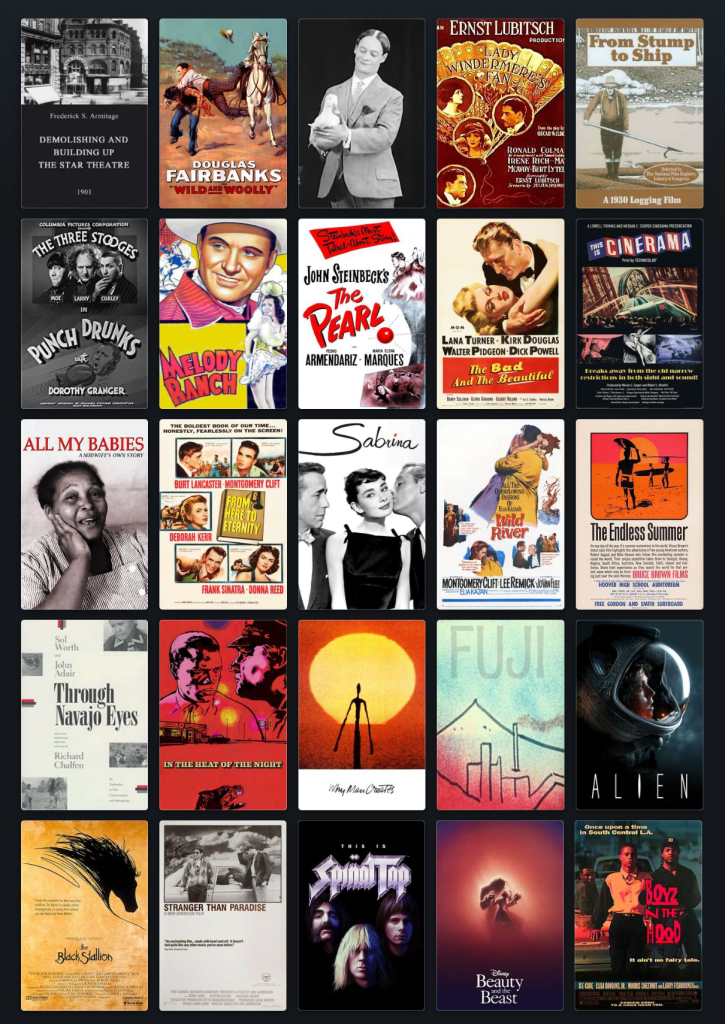
December 18th, 2001: With perhaps their least impressive press release to date, the Library of Congress announces the next 25 films to make the National Film Registry, bringing the total to 325 movies. Having just finished watching all 25, it’s time for me to take a look back at my writings on the NFR Class of 2001: 

The Evidence of the Film (1913): “one of the sole survivors from the short-lived Thanhouser Company film library.”

Miss Lulu Bett (1921): “neither wows nor bores in its presentation”, “on the NFR list because it survived”

It (1927): “a perfect encapsulation of the ‘20s flapper era” “has a certain…enticement?…allure?”

Rose Hobart (1936): “[a] deconstruction of a Hollywood ‘product’ into an ethereal examination of obsession.”

Cologne: From the Diary of Ray and Ester (1939): “paints quite the picture of small-town Americana”.

Marian Anderson: The Lincoln Memorial Concert (1939): “a historical pass, but the corresponding NBC radio broadcast of the concert is a much better documentation.”

Jam Session (1942): “gets a pass for its representation of the Soundies.” “pave[d] the way for the modern music video.”

Stormy Weather (1943): “an outstanding array of African-American talent”

The Memphis Belle: A Story of a Flying Fortress (1944): “[William] Wyler’s key contribution to the war effort”

The Miracle of Morgan’s Creek (1944): “a sweet, funny little slice of Americana with a lot of meat on its bones.”

Abbott and Costello Meet Frankenstein (1948): “Abbott & Costello’s iconic filmography and pitch-perfect timing are more than deserving of NFR recognition.”

All the King’s Men (1949): “a bit muddled and confusing, but…has enough political bite to warrant a viewing”

The Thing From Another World (1951): “a taut, thrilling film”, “Kudos to the director, whoever it may be.”

The Tell-Tale Heart (1953): “a new style of animation for UPA”, “the reason I’m not sleeping tonight.”

The House in the Middle (1954): “How did this make the NFR before the definitive Cold War short, ‘Duck and Cover’?”

America America (1963): “isn’t Elia Kazan’s greatest film, nor his most memorable, but it is definitely his most personal.”

The Sound of Music (1965): “not only one of the most delightful musicals ever, but one of the most delightful movies, period.”

Planet of the Apes (1968): “one of the best science-fiction movies ever made.”

Serene Velocity (1970): “The NFR loves them some avant-garde filmmaking”, “take some Dramamine beforehand.”

Jaws (1975): “still one of the best crafted action movies ever made and a landmark in film history.”

National Lampoon’s Animal House (1978): “at times side-splittingly funny.”

All That Jazz (1979): “the film’s legacy isn’t so much the film itself, but rather the insight into one of last century’s greatest artists.”

Manhattan (1979): “perhaps the film’s retroactive controversy is reason enough for preservation.”

Hoosiers (1986): “its inspirational spirit and love of the game is flawless”, “one of the greats of the feel-goods.”

The Thin Blue Line (1988): “definitive proof that movies can change the world.”

Other notes

  • Maybe it’s just my elder millennial viewpoint, but I can’t help but look at the Class of 2001 through the lens of 9/11. While the NFR’s official press release for that year makes no reference to the attacks, I can’t help but feel like this class of inductees was influenced by those events. At least four of these movies take place in part or in whole in New York City, most notably “Manhattan”, a full-length love letter to the city. There’s also films that harken back to a seemingly simpler time in America and/or lean heavily on very pro-American themes. While two of the films on this list highlight corruption and flaws in our political and judicial systems, most of the better-known titles are iconic crowd-pleasers and laugh-out-loud comedies that could no doubt lift your spirits after a national tragedy. And topping it all off is the superfluously patriotic “America America”, a story about immigration and the American dream: two things this country used to care about. Alright, rant over, back to the movies.
  • My writings about the Class of 2001 are mixed to positive. Aside from the big headliners on the list, I couldn’t muster up a lot of excitement for these films, giving many of them a pass for historical or cultural significance. That being said, I always enjoy the excuse to look back on my own writing because I learn a lot about myself. Past Me helped speed up that process this time by including a list of my favorite things at the end of Part 2 of the “Sound of Music” post.
  • Also, weirdly in two of these posts I slam Seth MacFarlane’s Oscar hosting gig. I mean, it wasn’t great, but I don’t remember hating it that much.
  • A bit of trivia: Both “The Sound of Music” and “Jaws” were at one point the highest-grossing movie of all time.
  • When the Class of 2001 was announced, the Tom Cruise film “Vanilla Sky” was number one at the US box office. Surprisingly, no movies currently in the NFR were playing in theaters (the first “Lord of the Rings” film would begin its theatrical run on December 19th), but there were such notable titles as “Ocean’s Eleven”, “Harry Potter and the Sorcerer’s Stone”, “Monsters, Inc.”, “The Royal Tenenbaums”, and “Training Day”. Coincidentally also playing in theaters, Tim Burton’s remake of “Planet of the Apes”. 
  • Only a few double dippers this year: Actors Karen Allen, Roy Scheider, and Wallace Shawn, producer Adolph Zukor, cinematographer Leon Shamroy, composer Jerry Goldsmith, and costume designer Albert Wolsky. This list almost included Richard Dreyfuss in lieu of Scheider, as Dreyfuss was originally cast as Joe Gideon in “All That Jazz” before bowing out.
  • Thematic double-dippers: 1979 New York, experimental films at a 16 fps frame rate, the U.S. Air Force, films loosely based on historic events, complicated love triangles, women flouting archaic conventions, movies that got 20th Century Fox out of the red in the 1960s, super talented Black artists, people fighting Nazis, and climactic scenes involving the Statue of Liberty.
  • Favorites of my own subtitles: Spinster Act, Dude Where’s My Husband?, When Directors Collide, My Big Fat Greek Emigration, Nun Better, Monkey See Monkey Doomed, Shark From Adversity, and 5-6-7-8 1/2!
  • Speaking of subtitles: Yes, I am breaking my tradition of subtitling these retrospective posts from a hit song of the same year, but come on, if I didn’t go for the “2001” reference, what are we even doing here? If forced to pick a hit song from 2001 for this post…I don’t know, “Bootylicious”? 
  • And finally, a reminder that “Serene Velocity” is missing from the NFR’s “Brief Descriptions and Expanded Essays” page. Can some LoC intern get on that, please?

As always, thanks for reading, happy viewing, and please keep taking care of each other.

Tony

#774) Serene Velocity (1970)

#774) Serene Velocity (1970)

OR “Gehr and Far”

Directed by Ernie Gehr

Class of 2001

The Plot: The avant-garde practice of structural filmmaking comes to the NFR with Ernie Gehr’s “Serene Velocity”. Filmed in a basement hallway at Binghamton University, “Serene Velocity” is a static shot of the hallway at night, with changes in the focal length showing you less and more of the hallway, edited to alternate between smaller and wider focal lengths. While the contrast is minimal at first, by the end of the film you find yourself seemingly zooming back and forth from one end of the hallway to another. Even Ernie Gehr felt nauseous after first seeing it!

Why It Matters: We have an historic first for the blog: “Serene Velocity” has accidentally been left off the NFR’s page of inductee descriptions and essays! While I was able to find the Library of Congress’ press release for the NFR Class of 2001, it does not include descriptions for each inducted film beyond its release date and primary cast and crew. But I’m sure someone in the Library had something nice to say about “Serene Velocity”, right?.

But Does It Really?: The NFR loves them some avant-garde filmmaking, and while most of these filmmakers are unknown to your average moviegoer, Ernie Gehr is legendary within the experimental film community, and his breakthrough work in “Serene Velocity” is an appropriate selection to represent his filmography. This all being said, it is 23 minutes of a hallway, spiced up with editing that is equal parts measured and unrestrained. It’s like if one of Andy Warhol’s movies was edited to look like “The Wild Bunch”. If you’re watching this at home to cross it off your NFR list, take some Dramamine beforehand.

Everybody Gets One: We don’t know a lot about Ernie Gehr’s early years, other than he was inspired to become a filmmaker after seeing the films of Stan Brakhage while living in New York in the 1960s. While teaching at New York’s Binghamton University in 1970, Gehr was walking down the hallway in the film department’s basement and was inspired by its cold, plain appearance to film his next short there. “Serene Velocity” was shot over the course of one evening on a 16mm film camera, with Gehr changing the camera’s focal length by increments of 5 mm throughout the shoot. Following the shoot, Gehr’s fingers had become swollen from hours of manually pressing the release button for each frame.

Wow, That’s Dated: Towards the end of the film, we see a bowl-shaped object attached to the right side wall of the hallway. At first I thought this was a drinking fountain, but other write-ups believe it to be an ashtray. It is so bizarre to think of a time when smoking was so commonplace we built ashtrays into our structures.

Title Track: I will argue that “Serene Velocity” is neither serene nor does it execute velocity in the truest definition of the word. Discuss.

Seriously, Oscars?: If this blog has taught me anything, it’s that experimental films don’t get Oscar nominations. I’d be amazed if the Oscars knew experimental films even existed. For the record: the Oscar for Live-Action Short Subject in 1970 went to “The Resurrection of Broncho Billy”…whatever the hell that is.

Other notes 

  • A quick word about structural film: This subgenre of experimental film came into vogue in the mid 1960s thanks to films like Tony Conrad’s “The Flicker” and Michael Snow’s “Wavelength”. While difficult to characterize, most examples of structural film are films captured at a fixed point, typically in some sort of minimalist setting, with the only movement coming from how the film is edited, often creating a flicker effect. “Serene Velocity” definitely checks off those boxes. We’ll learn more about structural film (and the role Library of Congress paper prints played in the movement) when I get around to covering Ken Jacobs’ “Tom, Tom, the Piper’s Son”.
  • Another technical note about “Serene Velocity”: Gehr opted to screen the film at 16 fps, so that each frame appears on screen longer (each “shot” in the film is 4 frames). While “Serene Velocity” has a runtime of 23 minutes, there are versions of the film online that run about 15 minutes, most likely because it’s being played at the standard 24 fps frame rate. I imagine watching the 24 fps version is more seizure inducing that the 16 fps version.
  • As with most experimental films, “Serene Velocity” is not a piece of entertainment, but rather a piece of art you watch and observe. As the film progresses, its juxtaposition of focal lengths becomes somewhat hypnotic. For me, it felt like an optical illusion, or like the most intense eye exam ever. “Better 1 or 2 or 1 or 2 or 1 or 2…”
  • This hallway could definitely use some artwork or at least a plant. Apparently this was the hallway Gehr would walk down to get to the editing room at Binghamton, so maybe a few film posters on the wall to brighten things up?
  • The floor reflection of the overhead lights kinda looks like the robot from “The Black Hole”. BO.B.? Maybe V.I.N.CENT. You may be wondering “Why a ‘Black Hole’ reference?” and to that I say “This film is 23 minutes of a hallway, what the hell else is there to talk about?”
  • As we get closer to (and further away from) the double doors at the end of the hallway, you can see daylight beginning to seep through. And that’s as close as this film gets to any sort of narrative.
  • If you think about it, this film has pretty much the same plot as that Grover bit from “Sesame Street”. “This is near…this is far!”

Legacy 

  • “Serene Velocity” played at a number of museums and festivals in 1970, including San Francisco’s First International Erotic Film Festival! The film was well received upon these initial screenings, and has since gained a reputation as an important example of structural filmmaking. For the record: Gehr objects to his films being called “structural”, arguing that the term and similar labels “stop people from actually seeing, actually experiencing the work.”
  • Ernie Gehr continued making films in New York until his move to San Francisco in the 1990s, where he taught film at the San Francisco Art Institute. As of this writing, Gehr is still with us, experimenting with digital filmmaking and making appearances at various career retrospectives (including last year at MoMA).

#773) The Pride of the Yankees (1942)

#773) The Pride of the Yankees (1942)

OR “Lou’s on First”

Directed by Sam Wood

Written by Jo Swerling and Herman J. Mankiewicz. Story by Paul Gallico.

Class of 2024

The Plot: Gary Cooper IS Lou Gehrig, the New York Yankees’ legendary first baseman, nicknamed “The Iron Horse” due to his incredible batting average and his then-record of over 2100 consecutive games. We follow Gehrig from his childhood dream of becoming a baseball player, to his early success in the minor leagues (much to the disapproval of his mother [Elsa Janssen]), and his legendary 16 year run with the Yankees. Gehrig quickly establishes himself as a fan favorite, especially with Eleanor Twitchell (Teresa Wright), a Chicago socialite Gehrig woos and eventually weds. But just as things are looking up for Gehrig and his new bride, Lou notices a sharp decline in his physical ability to play the game, receiving a grim diagnosis of amyotrophic lateral sclerosis (aka ALS, aka Lou Gehrig’s disease). Despite only being given a few months to live, Gehrig perseveres, giving a farewell address at Yankee Stadium declaring himself “the luckiest man on the face of the earth”.

Why It Matters: The NFR gives a summary of the movie, Lou Gehrig, and the final scene, with the film being declared “[o]ne of the seminal sports films that has inspired audiences for decades”.

But Does It Really?: This is definitely a minor classic. Overall, the film is fine; it holds up well and has some good performances, but there’s definitely some trimming that should have happened to bring this thing in under two hours. Released in theaters just over a year after Lou Gehrig’s passing, the film is clearly coming from a place of love, and although it plays fast and loose with some historical events, it manages to avoid feeling too clichéd or treacly. With its iconic final speech and Gehrig’s ongoing legacy, “Pride of the Yankees” was going to make the NFR at some point, but as you can tell there was no rush, with the film spending 35 years in the NFR dugout before finally making it to bat (or something like that; baseball metaphors aren’t my strong suit).

Seriously, Oscars?: One of the biggest hits of the year, “Pride of the Yankees” received 11 Oscar nominations, one nod behind that year’s eventual Best Picture winner, “Mrs. Miniver”. While “Yankees” lost most of its nominations to “Miniver” (which, coincidentally, also starred Teresa Wright), it took home one trophy for Daniel Mandell’s editing. Director Sam Wood wasn’t nominated for “Yankees” because he was already nominated in the Best Director category for the drama “Kings Row”.

Other notes 

  • Samuel Goldwyn secured the film rights to Lou Gehrig’s life story in July 1941, about six weeks after Gehrig’s passing. Goldwyn was initially reluctant to make a Gehrig biopic (he was not a baseball fan), but was persuaded after seeing the newsreel footage of Gehrig’s farewell speech. Eleanor Gehrig was involved in the film’s production as a consultant, and Gary Cooper was her first choice to play her late husband (with Spencer Tracy an approved back-up).
  • A few interesting things in the opening credits: After the obligatory thanks for “Mrs. Lou Gehrig” as well as Ed Barrow of the Yankees and Gehrig’s agent Christy Walsh, we get Sam Wood’s director credit, which oddly shares the screen with William Cameron Menzies’ art direction credit. Huh? We also get a written prologue saluting Gehrig attributed to Damon Runyon, who as far as I can tell made no other contribution to the film’s script. Maybe he was a fan.
  • The first chunk of the movie is Gehrig’s childhood in East Harlem with his German immigrant parents (even though they’re Swedish in the movie). It’s standard biopic stuff, but it sets up the rest of the movie well enough. Fun Fact: Douglas Croft (the kid playing young Lou) would go on to play Dick Grayson/Robin in the first “Batman” film serial in 1943.
  • The film rests on Gary Cooper’s performance, and unsurprisingly Coop uses his natural charm to deliver a winning performance. His Lou can be strong when he needs to be, but is equally endearing in his shy, awkward phase. My one quibble: during filming Cooper was three years older than Gehrig was when he died. This is especially noticeable when 40 year old Cooper plays Gehrig in his university days. 
  • Like his producer, Gary Cooper was not a baseball fan and essentially had to learn how to play the game from scratch. A longstanding story is that Cooper (who was right-handed) was filmed batting with his right and running to third base, with the footage flipped optically to match the left-handed Gehrig. This has been debunked in recent years, with evidence that Cooper learned to bat left-handed. Only one brief shot of Cooper throwing a ball right-handed was flipped, with all other throwing shots were achieved in wide shots with a double: baseball player Floyd “Babe” Herman who was slumming it in the minors at the time of filming.
  • In one of his rare non-Western NFR appearances, Walter Brennan plays reporter Sam Blake, a composite of several reporters who covered Gehrig, including Fred Lieb, a close friend of Gehrig’s. This has got to be Brennan’s least Walter Brennan-y performance ever; there’s nary a “dagnabbit” in sight, consarn it!
  • I wasn’t expecting the recurring subplot about Gehrig’s mom disapproving of his profession or his marriage. This was apparently true of the real life Anna Gehrig (referred to only as “Mom” or “Mama” in the film), who successfully chased away Lou’s girlfriends before Eleanor showed up.
  • Mama Gehrig describes America as “a wonderful country where everybody has an equal chance”. Who wants to break it to her?
  • Once Gehrig joins the Yankees, several of Gehrig’s real-life teammates appear playing themselves, including Babe Ruth! Like his fellow ball players, Ruth is no actor, but he’s good here, though admittedly he doesn’t have to do much except be charming and swing a bat every now and then. Unfortunately, Ruth was in bad physical health throughout the shoot, which caused some production delays.
  • I think the movie’s biggest inaccuracy is that despite several scenes in the Yankees dugout, there’s no scratching or spitting from anyone.
  • It’s been a minute since we’ve covered a Teresa Wright movie on this blog. As always, Wright is her usual, charming, proto-Eva Marie Saint self, in only her third movie! Eleanor Gehrig had wanted Barbara Stanwyck or Jean Arthur to play her, but was eventually won over by Wright. Side note: Eleanor is a co-lead/supporting role, but Teresa Wright was already competing in the Oscars’ Supporting category for “Mrs. Miniver” (which she would eventually win), so she got bumped up to Lead Actress, losing to her “Miniver” co-star Greer Garson.
  • On one of Lou and Eleanor’s first dates, they go to a nightclub and watch a lengthy dance number by Veloz & Yolanda that goes on forever and has nothing to do with anything. Frank Veloz & Yolanda Casazza were a husband and wife dance team performing in New York at the time of filming, and producer Samuel Goldwyn insisted on the two appearing in “Pride of the Yankees” because he worried that women would be otherwise uninterested in a baseball movie. When I think of scenes that could have been cut to shorten the runtime, this scene is number one with a bullet.
  • The dance number is followed by a performance of Irving Berlin’s “Always” by Ray Noble and His Orchestra. While equally superfluous as Veloz & Yolanda, “Always” becomes the film’s leitmotif for Lou and Eleanor’s romance, playing in the underscore and/or being hummed by our leads throughout the rest of the movie.
  • Most of Gehrig’s career successes are touched upon via a montage of clipped-out newspaper headlines in Eleanor’s scrapbook. What a convenient hobby for Eleanor to take up for the purposes of narrative pacing. I guess it would have taken too long for her to knit all those headlines.
  • As well made as this movie is, it never feels like it’s leading towards anything. Of course the ALS diagnosis is as unexpected here as it was in real life, but that doesn’t happen until three-quarters of the way through the movie. Up to that point the movie just feels like it’s meandering from one biographical highlight to the next. On a related note, it occurred to me during this viewing that the NFR doesn’t have a lot of quote-unquote “terminal illness movies” on the list. The only one I can think of off-hand is “Knute Rockne”, but that’s a subplot in the middle of the movie.
  • The only scene I knew about going in was Lou’s farewell address at Yankee Stadium’s Lou Gehrig Day on July 4th, 1939. It’s appropriately stirring, and I respect the decision to not include any underscoring while Gehrig is talking. I didn’t realize this was the last scene in the movie; he calls himself “the luckiest man on the face of the earth”, walks off the field, and roll credits! Director Sam Wood fought for this ending, rather than the studio-preferred version with a final kiss between Lou and Eleanor.

Legacy 

  • “Pride of the Yankees” was released in summer 1942, and went on to be RKO’s highest grossing release of the year. Unfortunately, due to Samuel Goldwyn’s distribution fee, the film ended up losing money. This was apparently par for the course with RKO’s Goldwyn films, and the studio continued to distribute Goldwyn’s movies for another decade.
  • The “luckiest man” speech has received plenty of parodies over the years, but my favorite will always be Norm Macdonald on “Saturday Night Live”. “I was being…sarcastic.”
  • Lou Gehrig has several memorials and tributes named after him, including MLB’s annual Lou Gehrig Memorial Award, which has been given out every year since 1955, including on five occasions to players with the New York Yankees.
  • After her husband’s death, Eleanor Gehrig spent the rest of her life managing Lou’s estate and raising awareness of ALS. In 1976, Eleanor wrote the memoir “My Luke and I”, which became the 1978 TV movie “A Love Affair: The Eleanor and Lou Gehrig Story”, starring Blythe Danner and Edward Herrmann. Although Eleanor lived another 43 years after Lou’s death, she never remarried, writing in her memoir “I would not have traded two minutes of my life with that man for forty years with another.”

Further Viewing: “How to Play Baseball”, the Goofy cartoon that preceded “Pride of the Yankees” during its original theatrical run. Apparently Samuel Goldwyn requested Disney make a baseball short for this movie, and “How to Play Baseball” was completed in just under three months to meet the “Pride” release date.

The NFR Class of 2025: My Ballot

It’s that time of year again, say it with me now: National Film Preservation Board meetings regarding public nominations for the National Film Registry season! Of the thousands of films considered by the board every year for the NFR, here are the 50 I have nominated for the Class of 2025. Films with * next to them indicate films I am nominating for the first time. In arbitrary categorization, they are: 

The Five-Timers Club: Creature from the Black Lagoon (1954), Witness for the Prosecution (1957), The Great Escape (1963), It’s a Mad, Mad, Mad, Mad World (1963), Original Cast Album: Company (1970), Alice Doesn’t Live Here Anymore (1974), 9 to 5 (1980), Clue (1985), The Sixth Sense (1999), Best in Show (2000), Hedwig and the Angry Inch (2001), Finding Nemo (2003)

Favorites: Advise and Consent (1962), F for Fake (1973), Edward Scissorhands (1990), The Player (1992), The Birdcage (1996), The Truman Show (1998), Eternal Sunshine of the Spotless Mind (2004), There Will Be Blood (2007)

Animation: The Jungle Book (1967), Charlotte’s Web (1973)*, Aladdin (1992)*, The Incredibles (2004)*

Classic Hollywood: Three Ages (1923)*, Animal Crackers (1930)*, Mr. Deeds Goes to Town (1936)*, The Little Foxes (1941)*, The Picture of Dorian Gray (1945), The Ghost and Mrs. Muir (1947)*, Royal Wedding (1951)

The David Lynch Memorial Double Feature: The Elephant Man (1980), Blue Velvet (1986)

The Peter Bogdanovich Memorial Double Feature: What’s Up, Doc? (1972)*, Paper Moon (1973)*

How Have I Gone Almost Nine Years Without Ever Nominating These?: Dial M for Murder (1954)*, Barry Lyndon (1975)*, Footloose (1984)*, Glengarry Glen Ross (1992)*, Dazed and Confused (1993)*, Se7en (1995)*, Inception (2010)*

Grab Bag: Richard Burton’s Hamlet (1964)*, Duel (1971)*, Wall Street (1987)*, Rudy (1993)*, American Psycho (2000)*, Bowling for Columbine (2002)*

And finally, New for 2025: Carol (2015)*, Tangerine (2015)*

How many of my 50 will make the final list of 25? Five? Ten? All 50? Okay, maybe not all 50, but my record is still five in one year, and it’s a record I’d love to break if the NFPB is willing.

Happy Viewing, Happy Nominating, and pleeeeease keep taking care of each other,

Tony

#772) The Memphis Belle: A Story of a Flying Fortress (1944)

#772) The Memphis Belle: A Story of a Flying Fortress (1944)

Directed by William Wyler

Written by Wyler, Jerome Chodorov, and Lester Koenig

Class of 2001

The Plot: After flying 24 missions over France and Germany in World War II, an American B-17F bomber plane nicknamed Memphis Belle is assigned its 25th and final mission: bombing the Nazi forces in Wilhelmshaven, Germany. Knowing that this mission will conclude their tour of duty and send them home, the Belle crew, led by Captain Robert K. Morgan, is determined to succeed. But as the plane (and the rest of the 324th Bomb Squadron) flies over enemy territory, the prospect of victory takes an uncertain turn. From the director of “Mrs. Miniver” comes another bit of wartime rabble-rousing, this time documenting real-life pilots and a (mostly) true story.

Why It Matters: The NFR writeup is primarily a rehash of the film’s production, with praise going to Wyler’s directing and Koenig’s script. There’s also a link to view the film via the Library of Congress online screening room.

But Does It Really?: We are in the thick of this blog’s WWII era, and while I am definitely experiencing some wartime propaganda fatigue, I found “Memphis Belle” to be an intriguing watch. It’s still very much another bit of military propaganda, but “Memphis Belle” has a few things going for it. For starters, it’s in color; and with William Wyler at the helm, the narrative is more dramatic than the standard “good vs. evil” storyline (not by much, but it’s something). Also, by 1944, Allied victory seemed in reach, so “Memphis Belle” is more upbeat with the prospect of an end in sight, and therefore more watchable after the preceding uncertainties of titles like “Siege” and “Why We Fight”. A pass for “Memphis Belle”, Wyler’s key contribution to the war effort, and the film that gets me that much closer to being done with the NFR’s WWII entries.

Shout Outs: I’m pretty sure that is Flower, the effeminate skunk from “Bambi”, painted on the nose of a B-17 nicknamed “In Der Fuehrer’s Face”, featured briefly in the film’s opening. Makes sense, the plane’s nickname is also a Disney reference.

Title Track: The plane Memphis Belle got its name from its pilot, Captain Robert K. Morgan, as a tribute to his fiancée Margaret Polk. Originally to be named Little One (Morgan’s pet name for Polk), the name was changed after Morgan and copilot Captain James A. Verinis saw the Joan Blondell/John Wayne film “Lady for a Night”, which featured a steamboat named Memphis Belle (Polk hailed from Memphis, Tennessee). Side note: Morgan and Polk called off their engagement shortly after Morgan’s return to the U.S. in 1944, but the two remained friends, and Polk was among those who actively campaigned for the plane’s preservation following the war.

Seriously, Oscars?: Although “Memphis Belle” played a theatrical run, it did not receive an Oscar nomination. For the record: 1944’s Best Documentary Short went to a film from the U.S. Marine Corps: “With the Marines at Tarawa”.

Other notes 

  • Following the successful release of “Mrs. Miniver” in summer 1942, director William Wyler volunteered with the U.S. Air Force, serving as a major and directing two documentaries, the first of which was “Memphis Belle”. Wyler originally planned to chronicle the bomber Invasion 2nd with the 401st Bomb Squadron, but sadly it was shot down over Germany in April 1943. Wyler selected the Memphis Belle because he liked the name, and given the successful track record of Morgan and his men, Wyler felt the plane had “a pretty good chance of coming back.” Even then, Wyler had another film crew discreetly working with the 303rd Bombardment Group and their Hell’s Angels bomber just in case something happened to the Belle.
  • The Memphis Belle was one of 12,000 B-17F bomber planes manufactured by Boeing in 1942 alone, completing construction that July and arriving at an RAF base in Cambridgeshire, England that October. The “Flying Fortress” of the title was coined by Seattle Times reporter Richard Williams who, upon seeing the first B-17 in 1935, described it as a “15-ton flying fortress”, a phrase quickly copyrighted by Boeing.
  • While the Memphis Belle did fly a mission over Wilhelmshaven in May 1943, not all of the footage in “Memphis Belle” was from that mission. Some of the footage was shot during an earlier mission over Wilhelmshaven done by the Jersey Bounce the previous February, with additional footage taken from the Belle’s other missions over France around the same time. Tragically, it was during one of these France missions in April 1943 when one of the Belle’s fellow bombers – nicknamed Daisy Mae – was shot down, killing among others this film’s co-cinematographer Harold J. Tannenbaum.
  • All this background out of the way, the film proper is quite engaging. The stakes are set up well without hitting you over the head with anything, and the footage, especially the aerial shots of the planes, is breathtaking. Wyler succeeds at making you feel as if you’re in the middle of the action, and I was on the edge of my seat during the second half wondering what will happen to everyone. 
  • The narrator of “Memphis Belle” is Eugene Kern, best known as…the narrator of “Memphis Belle”. Seriously, this is his only film credit; I have no idea who this guy is. There’s also a point where another narrator slips in, and that appears to be Art Gilmore, previously mentioned on this blog for lending his voice to fake FDR in “Yankee Doodle Dandy”.
  • This film doesn’t shy away from the casualties of war, showing us that while the Memphis Belle made it back, its crew was badly injured, with at least one member killed in action. The drama of this moment is undercut a hair by one surviving crew member receiving a life-saving blood transfusion while smoking a cigarette.
  • Surprise guest stars: The King and Queen of England! King George VI and consort Queen Elizabeth (better known later on as The Queen Mother) travel to the base to congratulate the Belle’s surviving crew members. For those of you keeping track on the King George VI historical drama timeline, this would be four years after he was Colin Firth in “The King’s Speech” and about three years before he was Jared Harris in “The Crown”.
  • This all begs the question: Will the NFR ever run out of WWII footage? I mean, there has to be a finite amount, right?

Legacy 

  • A final cut of “Memphis Belle” was screened for President Franklin Roosevelt, who enthusiastically urged that the film receive nationwide distribution. Paramount Pictures picked up the distribution rights, and “Memphis Belle” held its premiere in Memphis on April 4th, 1944, with a national release nine days later.
  • William Wyler made one more military-sanctioned film during the war: “Thunderbolt”, a documentation of the Twelfth Air Force stationed in Italy. “Thunderbolt” was filmed in 1944, but due to a variety of technical and legal issues didn’t get released until 1947. Upon his return home from the war, Wyler’s first studio feature was “The Best Years of Our Lives”, a film whose influences can definitely be traced back to Wyler’s experience with Memphis Belle. Look no further than Dana Andrews’ performance as a traumatized former bombardier pilot.
  • The Memphis Belle got the dramatic film treatment once again in the 1990 film “Memphis Belle”. Directed by Michael Caton-Jones and co-produced by William’s daughter Catherine Wyler, “Memphis Belle” is a fictionalized version of the Belle’s final mission. Upon its release, the film received mixed reviews from critics, who agreed that the film was good, but also felt it was bogged down by a generous helping of war movie cliches.
  • As for the plane itself: After its final mission, the Memphis Belle returned to America for a six month, 31-city war bond tour. The Belle eventually ended up on display in Memphis, Tennessee near the city’s fairgrounds. Decades of neglect led to the plane’s deterioration, with practically every instrument picked off by tourists over the years. Since 2018, a fully restored Memphis Belle has been on display at the National Museum of the United States Air Force in Dayton, Ohio, where it was unveiled on the 75th anniversary of its final mission.

Further Viewing: While working on a film restoration of “Memphis Belle”, filmmaker Erik Nelson discovered 90 hours of outtake footage Wyler shot of the Belle and her crew in the US National Archives. Nelson turned these outtakes into the 2018 documentary “The Cold Blue”.