For Your NFR Consideration: Jane Fonda

FYNFRC: Jane Fonda

Jane Fonda does not have a single movie on the National Film Registry.

I will repeat that: Jane Fonda does not have a single movie on the National Film Registry.

Impossible, right? But with the exception of quick archival clips in “Precious Images“, none of Jane Fonda’s filmography has been added to the National Film Registry as of this writing. Her father Henry Fonda has eight movies on the list, brother Peter has one; hell, even her niece Bridget shows up in “Easy Rider“. Despite her legendary status, her iconic filmography, and her remarkable longevity in a business that shuns any woman who dares to age, Jane Fonda has yet to appear on a list of films that has inducted the likes of Fran Drescher, Martin Lawrence, and the kid from “Dennis the Menace”.

Thankfully, you – the movie-viewing public – can nominate any American film you want for NFR consideration. If you’re thinking of submitting one of Jane’s movies to the Registry, here are a few titles that stand out for their cultural, historical, and/or aesthetic significance. Side note: Sorry “Barbarella” fans, but that movie was a French-Italian co-production.

Cat Ballou (1965): The quintessential western spoof before “Blazing Saddles” came along, “Cat Ballou” represents Fonda’s early film work in light comedy, and helped solidify her standing as a movie star. Plus, it got Lee Marvin an Oscar!

Barefoot in the Park (1967): Most years I submit “The Odd Couple” for NFR consideration as representation of the plethora of hit Neil Simon comedies we got in the ’60s and ’70s. That being said, “Barefoot” would be a fine substitution, with great early performances from both Fonda and Robert Redford. My other option in the Jane Fonda/Neil Simon collaborations would be “California Suite” which….no, not happening.

They Shoot Horses, Don’t They? (1969): This drama set at a Depression-era dance marathon proved that Fonda was more than just another Ann-Margret type sex kitten, and could easily carry the weight of a period drama (and a dead Red Buttons) on her back. The film was also an early success for its up-and-coming director, Sydney Pollack.

Klute (1971): “Horses” earned Fonda her first Oscar nomination, but “Klute” won her the trophy. As a call-girl mixed up in a missing persons case, Fonda added complexities to the “hooker with a heart of gold” trope that ended up enhancing her feminist ideology, rather than detracting from it.

F.T.A. (1972): If the NFR wants to recognize Fonda’s politics among its ranks, look no further than “F.T.A.”. Francine Parker’s documentary chronicles Fonda (along with her “Klute” co-star Donald Sutherland and many other performers) as they travel to army bases in the Pacific Rim with their anti-Vietnam revue, the antithesis of Bob Hope’s pro-Vietnam USO tours of the time.

Julia (1977): Who better to play controversial activist and artist Lillian Hellman than controversial activist and artist Jane Fonda? “Julia” has a lot going for it: it is the penultimate film of director Fred Zinnemann, it was the film debut for a 30 year old stage actor named Meryl Streep, and it attracted a large share of controversy in its day, thanks to Fonda as well as the film’s other NFR-less star: Vanessa Redgrave.

Coming Home (1978): The post-Vietnam movie for everyone too emotionally drained to watch “The Deer Hunter” again, “Coming Home” sees Fonda as a military wife who develops a relationship with a paraplegic veteran (Jon Voight) while her husband (Bruce Dern) is in Vietnam. Jane served as the “muscle” for “Coming Home”: producing the film with her own company (IPC Films), hiring the creatives and helping re-write the screenplay. For her efforts, she received her second Best Actress Oscar.

The China Syndrome (1979): Part social drama, part ’70s disaster movie, “The China Syndrome” tackled the dangers of nuclear power, and unexpectedly entered the zeitgeist when Three Mile Island had a partial meltdown days after the film’s release. In addition to getting Fonda on the NFR, “China Syndrome” would add another Jack Lemmon movie (vastly underrepresented with three of his early films), and would be the first with a Michael Douglas performance (Douglas is only on the list as the producer of “One Flew Over the Cuckoo’s Nest“).

9 to 5 (1980): While it’s not a “Jane Fonda movie” per se, “9 to 5” is my annual pick to get Jane on this list. Like so many of the movies we’ve discussed, “9 to 5” speaks to real-world issues of its time, in this case the gender gap for women in the workplace. In a filmography with over 50 movies, “9 to 5” may be the most memorable and timeless of Fonda’s films. It’s a comedy classic, with outstanding work from Fonda, Lily Tomlin, and Dolly Parton, the latter of whom penned one of the most iconic songs in film history. You’re humming it right now, aren’t you?

On Golden Pond (1981): Again, not a vehicle for Ms. Fonda, but one that she championed, leading to the only film collaboration between her and Henry Fonda. As a play, “On Golden Pond” wasn’t the most profound or dimensional character study, but with Henry Fonda and Katharine Hepburn in the leads, the film version goes beyond its contemplation of old-age and serves as a curtain call for Classic Hollywood. Plus, if this and “9 to 5” make the list, they will join “Tootsie” in my unofficial “Smarmy Dabney Coleman” trilogy.

Jane Fonda’s Workout (1982): This is NOT a joke: Smithsonian archivist and National Film Preservation Board member Wendy Shay has pushed for the NFR to add “Jane Fonda’s Workout” multiple times through the years, and the title appears on their official list of films not yet on the Registry. I get it: “Workout” was the biggest video cassette of the 1980s, and Fonda was the first major celebrity to embrace the lucrative world of VHS productions. Plus, after almost five years of watching classic movies every week, I could use the exercise.

Monster-In-Law (2005): Okay, this one IS a joke. Moving on…

Hopefully, one or more of these titles will compel you to nominate them for NFR consideration. Hell, nominate all of them if you want, and be sure to add your own favorites. I’m confident Jane Fonda will make the NFR someday, but the question is: which movie will finally welcome her to the club?

July 2021 Poll: Birthday Grab Bag!

Thanks for your votes in June. The bonus July post will be…

Toy Story“! That should be a fun re-watch/ugly cry.

Now onto this month’s poll to determine the August bonus post. August happens to be my birthday month, so let’s do something fun; a movie I’ve covered that is either a personal favorite or one that I enjoyed discovering through the blog. And the nominees are…

Airplane!: Arguably the funniest remake of all time.

All That Jazz: It’s Fosse, it’s the Broadway scene of the ’70s, and it’s super morbid. What could be better?

The Middleton Family at the New York World’s Fair: Sure, it’s pure capitalist propaganda, but look at that robot smoking a cigarette! He thinks he’s people!

Peter Pan: No, not that one. …Or that one. ….No, you’re thinking of “Hook”. …Look, I’ll just tell you: it’s the 1924 silent version.

Happy voting and happy viewing,

Tony

#22) All the President’s Men (1976)

#22) All the President’s Men (1976)

OR “Bob & Carl and CREEP & Nixon”

Directed by Alan J. Pakula

Written by William Goldman. Based on the book by Carl Bernstein and Bob Woodward.

Class of 2010

There is so much to unpack about the Watergate Scandal (or as I like to call it “Watergate-gate”), but this post is focusing on the film itself. Also, this is a revised and updated version of my original “All the President’s Men” post, which can be read here.

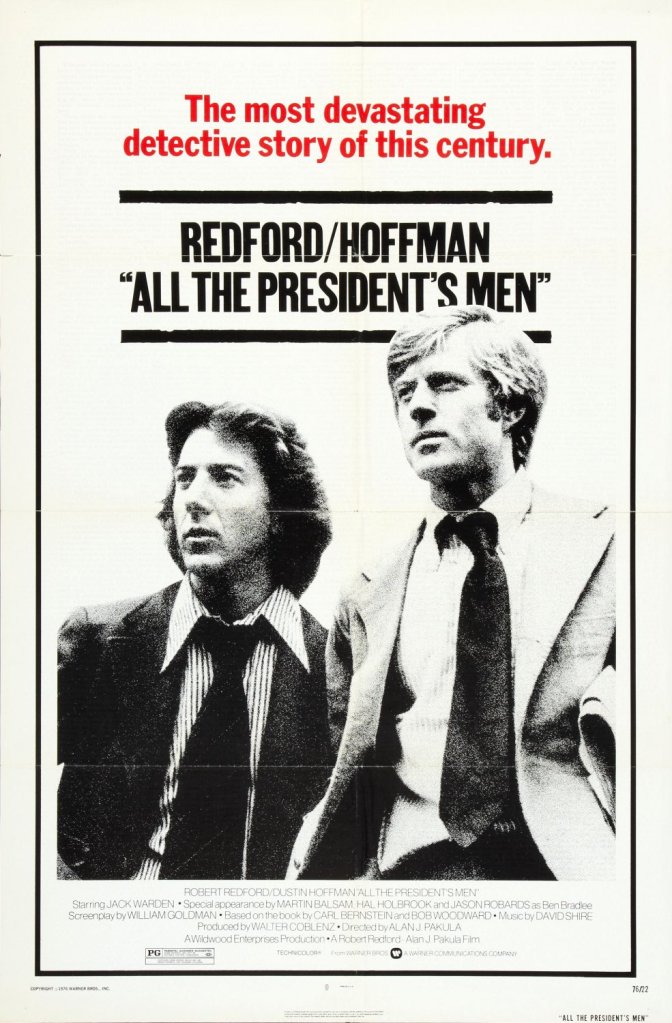
The Plot: In June 1972, rookie Washington Post reporter Bob Woodward (Robert Redford) is assigned to cover a minor story about five burglars arrested for breaking into the Democratic National Committee’s D.C. headquarters at the Watergate complex. Upon learning that the five burglars all have CIA connections, Woodward continues to investigate, joined by fellow Post reporter Carl Bernstein (Dustin Hoffman), who is also intrigued by the mystery surrounding this break-in. With support from Post editor Benjamin Bradlee (Jason Robards) and enigmatic informant “Deep Throat” (Hal Holbrook), Woodward and Bernstein’s research leads to President Richard Nixon’s re-election campaign and the biggest political scandal in American history. Well…up to that point.

Why It Matters: The NFR calls the original book the rare source material to be “transformed into a hit film and a cultural phenomenon in its own right.” Pakula’s “taught” directing is also praised. D.C. film critic Mike Canning pens an essay that is mainly an overview of the movie through a series of segmented trivia. What kind of two-bit operation is this?

But Does It Really?:  There are good movies, and then there are damn good movies. “All the President’s Men” is a damn good movie. There are a lot of films out there about journalistic integrity and freedom of the press, but “President’s” is the only one that accurately conveys the rush of covering a news story. Part detective noir, part historical reportage, the movie has a wonderful forward momentum as you watch Woodward and Bernstein pull at a thread that quickly unravels. Aided by a first-rate ensemble, wonderful direction, and a screenplay that depicts everyone as grounded people rather than historical deities, “All the President’s Men” has endured as the gold standard for movies about journalism.

Wow, That’s Dated: I honestly don’t know how to contextualize this movie in a post-Trump/”Fake News” America. How do I explain that there was a time when you assumed the President wasn’t corrupt and that all news information came from credible, trustworthy sources? I worry this movie plays more like a Sorkin-esque fantasy nowadays.

Title Track: The title is, of course, derived from the novel “All the King’s Men“, itself taken from the “Humpty Dumpty” nursery rhyme about a great fall and something broken that cannot be fixed. Get it? GET IT?

Seriously, Oscars?:  One of the biggest hits of the year, “All the President’s Men” entered the Oscar race with eight nominations, second behind “Network” and “Rocky“. “President’s” lost four of its nominations to these two films, but tied “Network” for most wins of the night with four: Adapted Screenplay, Art Direction, Sound, and Supporting Actor for Robards.

Other notes 

  • Bob Woodward and Carl Bernstein were on the fence about writing a book regarding their experience breaking the Watergate story, but when Robert Redford approached them about buying the film rights, the two were motivated to complete the project. Redford had been fascinated by Watergate since its beginning, and encouraged Woodward and Bernstein to focus on their personal experience rather than a rehash of the events.
  • William Goldman was hired to write the screenplay, but his draft was rejected by Redford following disapproval from Woodward and Bernstein. Bernstein and his then-girlfriend Nora Ephron took a crack at a draft, which – unsurprisingly – highlighted Bernstein as the real hero and quite the ladies’ man. When Alan J. Pakula came on board to direct, he and Redford threw out the Bernstein/Ephron draft (save for a fictional scene where Bernstein outsmarts a secretary) and conducted their own research. Despite the extensive re-writes, enough of Goldman’s original screenplay was used to warrant him receiving sole credit in the final film.
  • Man alive is that a great opening. With the startling crack of a typewriter key mixed with the sound of gunfire, this film tells you exactly what kind of ride you are in for.
  • One of the cops who busts the Watergate break-in is a pre-“Amadeus” F. Murray Abraham, and one of the burglars is a pre-“Sopranos” Dominic Chianese. Also involved in this scene is Frank Wills, the actual security guard who reported the break-in, playing himself. In fact, the break-in’s attention to detail is impressive, except for the omission of the ping pong player staying at the hotel who called security.
  • While we’re talking about Watergate, can we please put the kibosh on giving every major scandal the “-gate” suffix? It makes no sense. The word “gate” is not short for scandal, it was the name of the building!
  • Everybody’s so damn good in this. Redford and Hoffman have their natural charisma of course, but their performances have a drive to them. You get caught up in their unrelenting pursuit of this story. As Jack Warden says later on to Martin Balsam, “They’re hungry. You remember when you were hungry?”.
  • Speaking of, shoutout to Warden and Balsam, two angry men reuniting as editors Harry Rosenfeld and Howard Simons. You really get the feel that they are old-school journalists who have been on this beat forever. Also great is Jason Robards as Ben Bradlee, with a winning combination of command and approachability. You see Bradlee’s inner fire get reignited by being around Woodward and Bernstein.
  • Many scenes were filmed on location in Washington D.C., including the Library of Congress, birthplace of the NFR. Interestingly enough, the Library was not happy with the production being there, at one point revoking permission to film and straight up denying its Watergate connection. Fortunately, the production called on Jack Valenti to intervene, and the scenes were shot. Subsequently, very few films have been allowed to shoot inside the Library of Congress.
  • The identity of “Deep Throat” was not revealed until 2005, when former FBI Associate Director W. Mark Felt divulged his participation as Woodward’s deep background source. The casting of “Deep Throat” for the movie was left up to Woodward, who selected Hal Holbrook from a pile of headshots. And while we’re on the subject: Due to its significance within this scandal, is the 1972 porno “Deep Throat” worthy of NFR recognition? Discuss amongst your group.
  • My love for single take scenes continues with a beautiful six minute shot of Woodward on the phone with Kenneth Dahlberg as the story inches closer towards Nixon. The scene is covered in a slow zoom, with split focus on both Redford and the background of the newsroom. It’s a wonderfully tense composition, and yet another example of Gordon Willis’ stunning camerawork being snubbed by the Oscars.
  • Who ISN’T in this movie? In addition to everyone mentioned already, there’s Ned Beatty, Polly Holliday, John McMartin, Penny Fuller, Meredith Baxter, Robert Walden, and so on. Making the most of their limited screentime is Jane Alexander, who earned an Oscar nomination for playing Judy Hoback, Nixon’s re-election campaign bookkeeper who helped Woodward and Bernstein follow the money.
  • Washington Post publisher Katharine Graham was originally to appear as a character in one scene, and names like Lauren Bacall and Geraldine Page were considered. Graham, however, requested the scene be removed from the screenplay, and no one was ever officially cast. Graham later regretted this decision.
  • The best part about this movie is that with the exception of the opening break-in, no information is revealed until Woodward and Bernstein learn about it. You get the sense of discovery alongside them, and like the two, you don’t really get what it’s all about until they start putting the pieces together, only realizing how big it is when you take a step back.

Legacy 

  • “All the President’s Men” premiered in April 1976, and played well into the fall, though Warner Bros. claimed this was not a deliberate attempt to influence the 1976 presidential election. While some critics were disappointed in the lack of character development for Woodward and Bernstein, both of their real-life counterparts approved of the final film.
  • While this may have been Alan J. Pakula’s peak as a film director, he certainly left behind an impressive filmography. Between this, “Klute”, and “The Parallax View”, choosing Pakula’s best film is a real “Sophie’s Choice”, which he also directed.
  • “All the President’s Men” still gets referenced with some regularity in pop culture, though mainly because of the title and the historical events depicted. There are, however, the occasional references to “Follow the money”, a line written specifically for the film.
  • One of the film’s more faithful parodies is this classic “Simpsons” episode, right down to Woodward and Bernstein’s dad waiting in the car reading Archie Comics.
  • A few other film projects have some shared DNA with “All the President’s Men”. The 1989 TV movie “The Final Days” is an adaptation of Woodward and Bernstein’s follow-up book about Nixon’s resignation. 2015’s “Spotlight” covers the Boston Globe’s takedown of Catholic priests, and features Ben Bradlee Jr. as a major character. The film’s parallels to “President’s” were highlighted frequently in its ultimately successful Oscar campaign. 2017’s “The Post” stars Tom Hanks and Meryl Streep as, respectively, Ben Bradlee and Katharine Graham during their controversial decision to publish The Pentagon Papers. The film even concludes with the Watergate break-in.
  • I’m gonna go ahead and reserve this space now for the inevitable movie made about the Trump presidency. We’ve gotten “The Comey Rule“, but we’re still waiting on the Oscar-bait, “Hindsight is 20/20” one that focuses on the journalists and their fight for freedom of speech.

Further Viewing: Nixon’s “I’m not a crook” speech, which, and I can’t stress this enough, was delivered at the Contemporary Resort at Walt Disney World. Remember the magic!

Further Further Viewing: The 2012 documentary “All the President’s Men Revisited”. Come for the reflections on Watergate upon its 40th anniversary, stay for Ben Stein crying during his interview.

#579) A Bronx Morning (1931)

#579) A Bronx Morning (1931)

OR “Jay and Silent Job”

Directed by Jay Leyda

Class of 2004

The Plot: As the title suggests, “A Bronx Morning” is…well, a morning in the Bronx. Jay Leyda chronicles an average day in New York’s fourth largest borough, as its businesses open up and all walks of life travel across its sidewalks. But Leyda is also quick to note the effects the Great Depression has started to have on the Bronx, with several businesses closing or having fire sales, and several residents now living on the streets.

Why It Matters: Well someone likes “Bronx Morning” over at the NFR. They call it a “renowned city symphony”, praising the “sensational and stylish use of European filmmaking styles.” There’s also an essay from film expert Scott Simmon, cribbed from his liner notes for the film’s DVD release.

But Does It Really?: Oh sure. I’m always willing to give a pass to documentaries, short films, or avant-garde pieces from influential filmmakers, and “A Bronx Morning” is all three! That being said, studying Leyda led to the kind of artsy film critique that makes my eyes glaze over (if I see Leyda’s filmmaking style described as “European” one more goddamn time…). Jay Leyda is an important figure in film history, and while his contribution to film study has overshadowed his actual film output, one of his movies should be on the NFR, and “A Bronx Morning” is the right choice.

Everybody Gets One: Not a lot of information out there about Jay Leyda before “A Bronx Morning”, other than he was born in Detroit, grew up in Ohio, and moved to New York in 1929. An accomplished still photographer, Leyda used the money from various gigs to buy a movie camera and film. Just so we all feel bad, Jay Leyda was 21 when he made “A Bronx Morning”.

Wow, That’s Dated: Obviously, the film’s Depression era setting is on full display. Also, look for a few shots from the Bronx El train, part of which would be destroyed two years later by a giant stop-motion ape.

Other notes

  • For starters, a reminder that the Bronx sits on Lenape land.
  • Named after Swedish and/or Faroese farmer Joseph Bronck, the Bronx became part of New York City in stages: the land west of the Bronx River in 1873, and the land east of the river in 1875. The Bronx became one of the five boroughs when New York City officially consolidated its land into the City of Greater New York on January 1st, 1898. Like most of New York, the Bronx saw an immigrant boom in the early 20th century, with immigrants arriving from Europe and the Caribbean (as well as African-Americans emigrating from the South).
  • Not a lot to say about “A Bronx Morning”, other than it is artsy, and not without its ironic humor: a title card stating “The Bronx does business” is followed by a store sign reading “Lost Our Lease”.
  • For anyone interested in an NFR film festival: “A Bronx Morning” would make a good companion piece with “In the Street“, the Levitt/Loeb/Agee short about 1948 Spanish Harlem. Both would pair well with “On the Bowery“, Lionel Rogosin’s 1956 docudrama about the titular Manhattan neighborhood.
  • Looks like someone learned how to intercut. Several of this film’s shots cut back and forth between each other. If there’s some layer of symbolism Leyda’s trying to convey I ain’t catchin’ it.
  • Anyone looking for the Eisenstein influence on Leyda can spot it in a lingering shot of an abandoned baby carriage. Of course, it’s easy to assume that any baby carriage in a movie is a reference to “Battleship Potemkin“…or “Naked Gun 33 1/3“.
  • This is where film stock makes all the difference. Presented in black-and-white, the Bronx of “A Bronx Morning” appears even drabbier than it would in real life (even the sky is gray). You can’t help but wonder how different this film’s tone would be if the exact same shots were in color.
  • Like many a documentary before and after, “Bronx Morning” closes with shots of children at play, including two kids putting the “rough” in roughhousing. They’re fighting on concrete! There is something about kids being kids that appeals to anyone trying to capture natural life on film.

Legacy

  • “A Bronx Morning” was screened primarily at various New York art galleries, and Jay Leyda included the film when he applied to Sergei Eisenstein’s directing course at the Moscow State Film School. Leyda was accepted, and worked with Eisenstein on many of his projects.
  • Following his return to America in 1936, Leyda did…pretty much everything. Over the ensuing decades he was assistant film curator at the Museum of Modern Art, wrote extensive biographies of Herman Melville and Emily Dickinson, wrote the first English book about Chinese cinema, and taught film studies at several universities, including Yale. Jay Leyda died in 1988, just three days after his 78th birthday.
  • The Bronx as seen in “A Bronx Morning” was the beginning of a new era for the borough, one defined by an economic decline brought on by the Depression and World War II. Like most of New York, the Bronx spent the mid-20th century in urban decay, with crime rates skyrocketing. The good news: the quality of life has improved in the Bronx in recent years. The bad news: It’s because of gentrification. 
  • On a less depressing note, the Bronx has given so much to American culture; from Off-Off-Broadway to the creation of Hip-Hop, and even the Bronx Cheer. But the greatest piece of pop culture associated with the Bronx: “Leave the Bronx. You are ordered to leave the Bronx.”

#578) National Velvet (1944)

#578) National Velvet (1944)

OR “Brown Beauty”

Directed by Clarence Brown

Written by Helen Deutsch. Based on the novel by Enid Bagnold.

Class of 2003

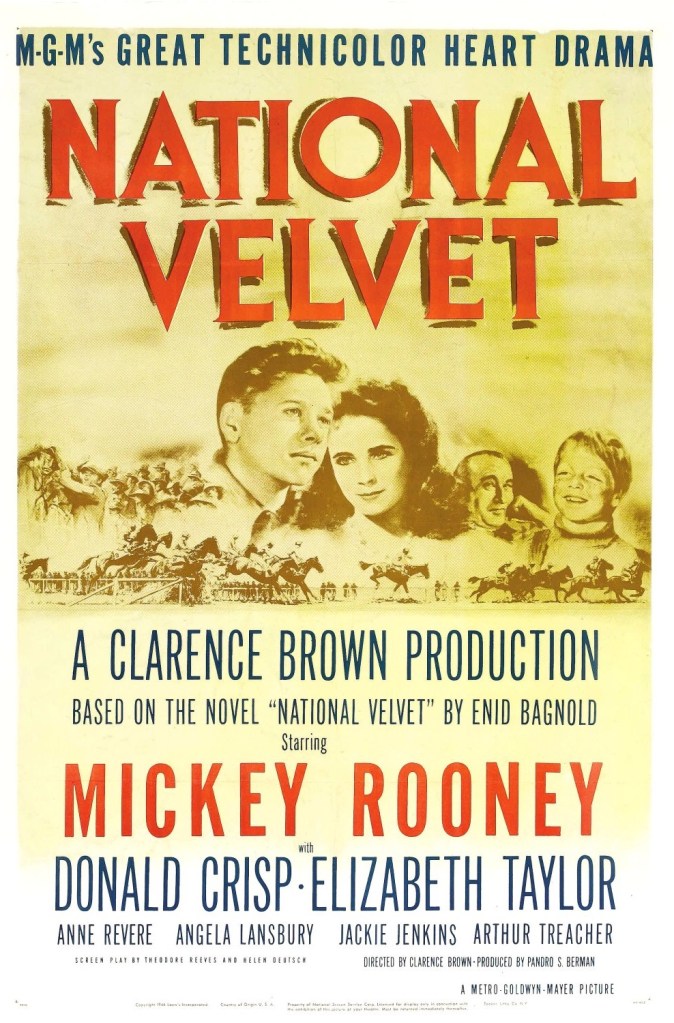
The Plot: In the small town of Sewel in Sussex, England in the late 1920s, young Velvet Brown (Elizabeth Taylor) becomes infatuated with a gelding she nicknames Pie (King Charles). After the Brown family wins Pie in a raffle, Velvet forms a close bond with the horse, and is convinced he could win the Grand National steeplechase. With the support of her parents (Donald Crisp & Anne Revere), and former jockey Mi Taylor (Mickey Rooney), Velvet and Pie make it to the Grand National. But will this horse run the course in a tour de force? Of course, of course.

Why It Matters: The NFR calls it an “enduring family classic” and gives shoutouts to the main cast.

But Does It Really?: What a lovely surprise “National Velvet” is. Most wartime era films need an explanation or introduction for a modern audience to appreciate it, but “Velvet” holds up on its own and still strikes the appropriate chord of sincerity without crossing over into sentimental or syrupy. “Velvet” is a sweet, genuinely heartfelt movie with a timeless story and a strong lead performance from 12 year old Elizabeth Taylor. I’m glad the NFR found a place for “National Velvet”.

Everybody Gets One: Grandson of Man o’ War and first cousin of Seabiscuit, King Charles was cast as Pie at the age of 7. Allegedly, King Charles was a holy terror to everyone on set, except for Elizabeth Taylor, who bonded with her new co-star both on and off-screen (though Taylor developed lifelong back problems after being thrown off of King Charles). After filming wrapped, Taylor received King Charles as a birthday present, and took care of the horse for the rest of his life.

Title Track: Until this viewing, I assumed “National Velvet” was the name of the horse.

Seriously, Oscars?: “National Velvet” premiered in New York in December 1944, but didn’t play its Oscar-qualifying run in Los Angeles until January 1945. “Velvet” received five 1946 Oscar nominations and won two: Anne Revere for Best Supporting Actress (beating out her on-screen daughter Angela Lansbury for “Dorian Gray”), and Robert J. Kern for film editing. Among its losses: Clarence Brown lost the fourth of his eventual five unsuccessful bids for Best Director.


Other notes

  • A film adaptation of the 1935 novel “National Velvet” had been in some form of development for almost a decade. Delays were caused when the project moved from Paramount to RKO to MGM, and further delayed by World War II. An extensive search took place to find the right young actor to play Velvet, and MGM contract player Elizabeth Taylor was passed over for being too young and too short. Determined to land the role, Taylor grew three inches before production began, and won the part.
  • Also making an early film appearance is Angela Lansbury, playing Velvet’s sister Edwina, and somehow looking 19 and 40 at the same time. It’s a shame this movie does little to demonstrate what a big star Lansbury would soon become.
  • Look closely in early scenes for walk-on cameos by Howard Taylor (Elizabeth’s brother) and Moyna MacGill (Angela Lansbury’s mother).
  • The last time Liz Taylor showed up on the blog, I admitted that I was distracted by her future celebrity and couldn’t fully appreciate the performance. Thankfully, no such problems here: Liz successfully carries the whole movie on her back with her naturally endearing performance. This is a star turn in the making, and you root for Liz/Velvet all the way.
  • Most of the cast are doing a “Reverse Leslie Howard“: non-English actors making no effort to do an English accent. Even the actual Brits in this movie sound Americanized!
  • It didn’t occur to me until watching “National Velvet” just how similar the careers of Mickey Rooney and Elizabeth Taylor were. Both were MGM child stars, both had long careers where their fame ebbed and flowed, both were regular targets of the tabloids, both turned to theater and television when their movie careers waned, and both lived long enough to parody themselves on “The Simpsons”. And between the two of them, they were married 16 times to 15 different people!
  • I’m enjoying the performances from Donald Crisp and Anne Revere. Their Mr. and Mrs. Brown can be strict in their parenting, but also know when to let loose and have fun with the kids. It’s an enjoyable dynamic from two seasoned pros.
  • Well, we found Anne Revere’s Oscar clip. The scene where Mrs. Brown tells Velvet about swimming the English Channel is a heartwarming moment, and Revere delivers a powerful, yet understated monologue. I was ready to give her the Oscar then and there.
  • It wasn’t until Mi got drunk and gave away Velvet’s money that I realized just how invested I was in this movie and its characters. Damn you, Mickey!
  • I’m always on the lookout for classic movies that can be introduced to children without having to give them a context lecture or apologizing for racial insensitivities. “National Velvet”  is a strong candidate: it’s sweet natured, with a bright Technicolor palette, and a lot of scenes with the horse. All that’s left is determining if kids today can sit through a two-hour movie.
  • By virtue of appearances by Reginald Owen, Arthur Treacher and Angela Lansbury, “National Velvet” is one of the rare films with cast members from “Mary Poppins” and “Mary Poppins Returns”.
  • And now the real meat and potatoes of this movie: the climactic steeplechase. The wonderful thing about minor classics is that the endings are not common knowledge, so I was genuinely on edge as I watched the outcome of this race. Forget “Ben-Hur“, you want a heart-stopping horse race, look no further than “National Velvet”. No spoilers, but the ending is kind of a mix between the ending of “Rocky” and the opening of “Rocky II”.
  • “Would you like to go to America and act in the cinema?” A little meta, but I’ll allow it.

Legacy

  • “National Velvet” was a hit with audiences and critics (it has a 100% on Rotten Tomatoes), and made a star out of Elizabeth Taylor. Looking back on her career in her memoir, Taylor called the film “still the most exciting film I’ve ever done.”
  • Mickey Rooney would go on to play another horse trainer 35 years later in future NFR inductee “The Black Stallion“.
  • MGM would adapt “National Velvet” for a television series that ran for 2 seasons on NBC in the 1960s. Most of the episode titles sound like lost “Seinfeld” episodes: “The Raffle”, “The Barbecue”, “The Swindle”.
  • Determined to ring out every last cent from its IP, MGM made a belated sequel in 1976. “International Velvet” saw Tatum O’Neal as Velvet’s niece traveling to England and competing in the Olympics’ horse event. British actor Nanette Newman filled in for Velvet when Elizabeth Taylor turned the part down.
  • Perhaps its NFR induction was inevitable: when the Library of Congress started their film collection in 1945, “National Velvet” was one of the first films selected, in recognition of showcasing “the contemporary life and tastes and preferences of the American people”.