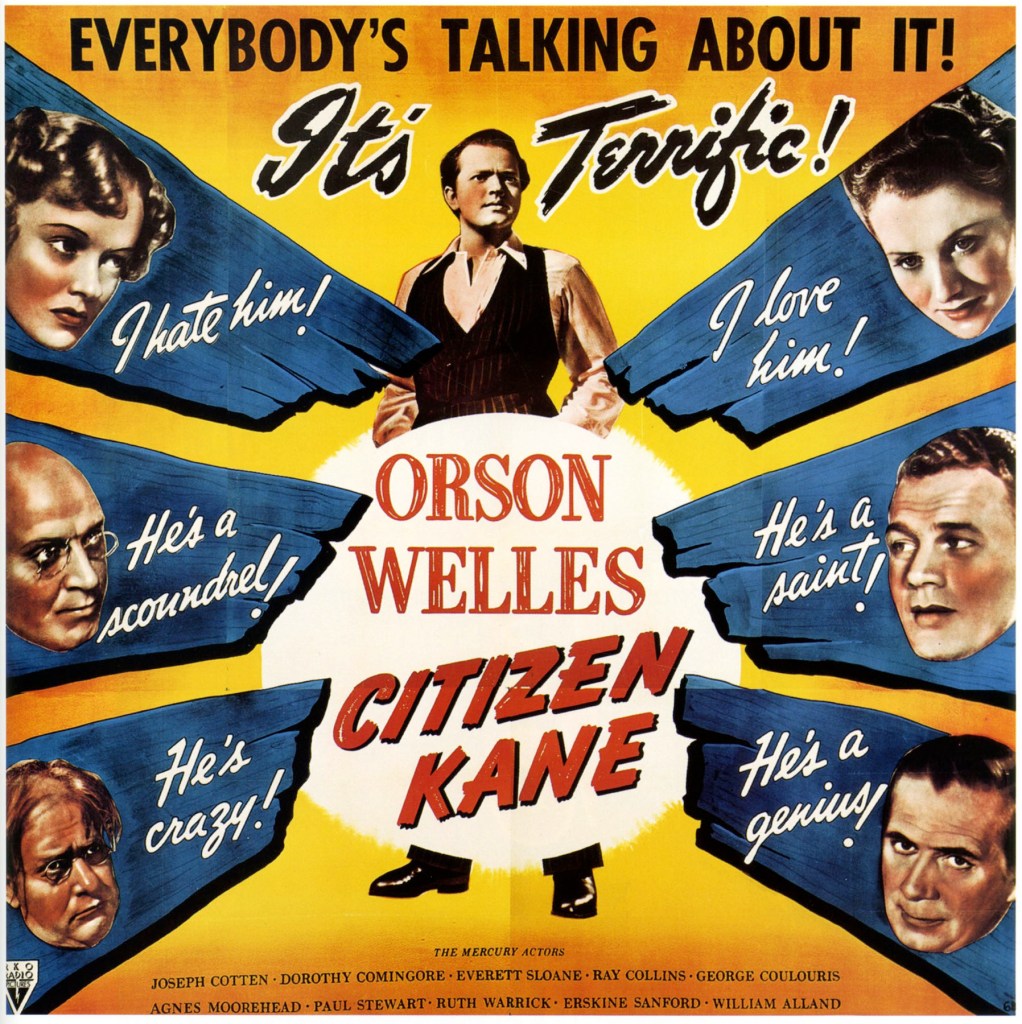
#500) Citizen Kane (1941) – Part 2 (Other Notes)

Previously on “#500) Citizen Kane”…

Other notes

  • The opinion of “Kane” being overrated probably stems from the film’s overall lack of emotional resonance. While the film is just as powerful as any undisputed classic, it lacks the heart of “The Wizard of Oz” or the romanticism of “Casablanca“. Even “The Godfather” outpaces this movie in terms of sympathetic depictions of its reprehensible protagonist. The cold central figure of Kane, mixed with the film’s outstanding technical achievements, makes “Kane” an admirable film on an academic level more than a personal one.
  • Right from the start you know this movie is going to be different. After the RKO logo, there’s no opening credits with a mood-setting score, just a title card in silence, and we’re off to the races. This I feel is the key to appreciating “Kane”. Welles was not a filmmaker, so he’s not going to lean on the standard film tropes of the day out of habit. “Kane” is a movie by a theater director making up his own cinematic language as he goes along, with the added luxury of zero studio interference. Welles didn’t invent any of the techniques in “Kane” (some of them date back to “Dr. Caligari”), but he was the first to put them all together in a mainstream Hollywood picture.
  • Who or what was the real Rosebud? Stories that Rosebud was Hearst’s nickname for Marion Davies’, um, person, stem from an unsubstantiated 1989 Gore Vidal essay. More likely, Herman Mankiewicz named Rosebud after Old Rosebud, a Kentucky Derby winner that Mankiewicz allegedly won a lot of money betting on. This, paired with a bicycle that Mankiewicz lost as a child, make for a more plausible inspiration for Rosebud.
  • I do love that whole “News on the March” sequence, edited by RKO’s newsreel staff for authenticity. Blink and you’ll miss a cameo by Hitler!
  • Shoutout to Maurice Seiderman, the film’s makeup artist, for creating some surprisingly convincing old-age makeup. The HD transfer points out some of the seams, but overall the makeup does not distract from the film. And kudos to the cast, most in their late ‘20s to mid ‘30s, for effectively playing their older counterparts.
  • If this film has a breakout star other than Welles, it’s Agnes Moorehead nailing her one scene as Kane’s mother Mary. It’s so weird to think that one of the actors in the greatest movie ever would go on to play Endora on “Bewitched”.
  • Gregg Toland you beautiful bastard. Cinematographer Gregg Toland personally requested to work with Orson Welles on “Kane”, knowing that Welles was new to film and therefore more open to experimental camerawork. And boy, does he not disappoint. Toland’s mastery of storytelling, composition, and deep focus (shots with the background and foreground in focus simultaneously) are on full display in this movie. Everyone’s Oscar snub is surprising, but Toland’s is unforgivable.
  • The comic relief in this movie is few and far between, but Thatcher’s reading of “I think it would be fun to run a newspaper” (and subsequent fourth-wall harrumph) gets me every time. Also keeping things light: Erskine Sanford’s performance as the perpetually befuddled Herbert Carter.
  • Orson Welles is so damn charismatic in this movie. You never fully sympathize with Charles Foster Kane, but Welles makes a strong argument, and you can’t help but be charmed by him, especially in his earlier flashbacks at the Inquirer.
  • Another good line: “It’s no trick to make a lot of money, if what you want to do is make a lot of money.”
  • I always forget there’s a musical number in this movie. Welles continues to lay on the charm with his dance moves; he should teach them to the chorus girl on the far right who messes up the routine.
  • This movie has its share of incredible montages. The big one is the breakfast scene between Kane and his first wife Emily. In a matter of minutes, we see 12 years go by as their marriage deteriorates, each progressive shot showing subtle differences until the final pan of their extended table. Kudos to everyone involved.
  • For years I had heard that Kane’s mistress/second wife Susan was based on Hearst’s mistress, film star Marion Davies. Now that I’ve seen Davies’ work (fellow NFR entry “Show People”), I can conclude that it’s Davies in only the vaguest terms. While Hearst did push Davies to play more dramatic roles, she was an accomplished and talented comedian, and certainly not a no-talent opera singer. To Welles’ credit, he always pointed out the lack of similarities between Susan and Marion, calling Ms. Davies “an extraordinary woman” and “nothing like the character”.
  • During his political campaign, Welles vows that his first act will be to put his opponent in jail. It’d be funny if it weren’t so depressingly prescient. Side Note: what do you think is Trump’s “Rosebud”? I’m guessing some sort of physical affection from his parents. It would explain why he keeps hugging the flag.
  • As good as “Citizen Kane” is, it is increasingly difficult to sympathize with a man we would today refer to as “the one percent”. Sure he wasn’t born into this life, and he was separated from his parents, but you can’t feel too bad for a man who is stinkin’ rich. 
  • When Palmer shows up to the office drunk, Joseph Cotten allegedly fumbled his line about “dramatic crimiticism”, but ad-libbed a cover and kept going. Welles was amused by this and kept that take in the final film. This is also the famous shot where you can see both the floor and ceiling in the frame, created by placing Toland’s camera in a hole drilled into the cement floor.
  • I don’t know, I thought Susan’s singing sounded fine. She’s not the best singer, and certainly not the best voice for opera, but she sounded okay to me. Maybe I just don’t get opera.
  • I’m still sheltering in place while watching this, so the scene where Susan puts together a giant jigsaw puzzle goes beyond its metaphoric use here. Can I borrow that when you’re done with it? I’ve gone through all of my puzzles.
  • Gah! I think the random screeching cockatoo shot was to make sure everyone was awake for the last scenes.
  • After destroying Susan’s bedroom, Kane walks down the hallway and past several large mirrors that reflect him into an infinity. Dramatic use of mirrors? File that one away for later, Welles…
  • Wait, the butler heard Kane say “Rosebud”? I’m willing to concede that Raymond heard him say “Rosebud” on a few occasions, but he was definitely not there for the deathbed version. Some have theorized that those opening camera shots are from Raymond’s point of view, and to that I say “bullshit”. By that logic, the opening of the movie is Raymond flying over Xanadu into Kane’s window and pressing up to his lips. Not buying it, film snobs.
  • Like so many of the classic movies on this list, the surprise ending was spoiled for me long before my first viewing. That being said, it still stings when we finally learn what Rosebud is, and the film does a good job of subtly hinting at it throughout. In the end, Kane’s lost childhood was the one thing he could not buy and control.
  • Did you miss the upbeat opening credits? Don’t worry, because this movie ends with upbeat closing credits! It’s an odd choice after that dramatic ending. I was half expecting them to show bloopers.

Continue to Part Three for “The Legacy of Citizen Kane”…

#500) Citizen Kane (1941) – Part 1

Welcome to movie #500! I’m happy to have made it this far, and there’s no better movie to cover for this milestone than the quote-unquote “greatest movie of all time”. Buckle up, because this is another Horse’s Head three-parter.

#500) Citizen Kane (1941)

OR “Hearst Hassle”

Directed by Orson Welles

Written by Welles and Herman J. Mankiewicz 

Class of 1989

Even the trailer for this movie is groundbreaking. Filmed by Orson Welles during production, it’s a four minute teaser for “Kane” that doesn’t show a single frame of the final film.

The Plot: Newspaper magnate Charles Foster Kane (Orson Welles) dies in his palatial manor Xanadu, and his final word is the cryptic “Rosebud”. Upon learning his dying word, a team of reporters attempt to figure out who or what is Rosebud. Among their interviewees are Walter Parks Thatcher (George Coulouris), Kane’s legal guardian in accordance with his parent’s trust fund, Jed Leland (Joseph Cotten), Kane’s best friend who helped him launch his newspaper empire, and Susan Alexander Kane (Dorothy Comingore), Kane’s mistress and second wife. Each offers their own often-contradictory perspective of Kane, furthering the mystery of the man. But the biggest mystery surrounding “Kane” isn’t the identity of Rosebud, it’s whether or not real-life newspaper magnate William Randolph Hearst will notice some pretty obvious allusions to his own career.

Why It Matters: The NFR gives a brief rundown of plot and production, with the only superlatives going to Gregg Toland’s “stunning black and white cinematography” and the film’s overall status as the “greatest film of all time”. An essay by film critic Godfrey Cheshire tries to downplay the hype (calling it “the greatest critic’s film”) and focus instead on its actual accomplishments.

But Does It Really?: While I cannot conclusively deem “Kane” the greatest movie ever made, it is definitely a strong contender for the title. One of my notes simply read “just so fucking engaging”, and if nothing else, “Kane” is an engaging film from start to finish. In his first movie, Orson Welles assembles an awesome array of talent, and uses his natural theatrical flair to create something truly unique. With his outsider status, Welles is able to take apart the standard Hollywood studio film and put it back together in a way that profoundly changed movie making, taking on such subjects as power and corruption in a new, complex way. Many will argue that “Kane” is boring or overrated, and I will agree that there is some homework that needs to be done to fully appreciate this movie, but at the end of the day, “Citizen Kane” is a remarkable accomplishment in film, and one that will stand among the untouchables for generations to come.

Shout Outs: The opening “News on the March” sequence is a full-on parody of the “March of Time” newsreel, for which many of Welles’ Mercury Radio/Theater crew had previously worked as announcers. According to Welles, “March of Time” producer Henry Luce was one of the first people to see “Kane”, and greatly enjoyed the parody. Bonus Shout Out: Among the films Welles viewed to prepare for “Kane” was John Ford’s “Stagecoach” which he screened 40 times during production.

Everybody Gets One: Most of the cast were members of Welles’ Mercury repertory company, and would return for his next film “The Magnificent Ambersons”. The main exceptions were the actors playing Kane’s wives. Ruth Warrick was a radio singer who (along with most of the cast) made her film debut in “Kane”. Dorothy Comingore was recommended to Welles by Charlie Chaplin, and while she was poised to be the next big movie star, she was eventually blacklisted when she refused to testify in front of HUAC. 

Wow, That’s Dated: The main ones for “Citizen Kane” are newspapers as a major influence, and the idea that a single scandal could end a political career. Plus I’ll pour one out for the late great RKO.

Title Track: Herman Mankiewicz’s first draft was originally titled “American”, but RKO studio chief George Schaefer expressed concern it was too close to Hearst’s newspapers “American Weekly” and the “New York Journal American”. Schaefer suggested “Citizen Kane”, which became the official title in June 1940, mere weeks before filming began.

Seriously, Oscars?: At the 1942 Oscars, “Kane” received a respectable nine nominations, but lost in most categories (including Best Picture and Director) to John Ford’s “How Green Was My Valley”. Welles and Mankiewicz did, however, take home the prize for Original Screenplay. According to “Kane” editor/nominee Robert Wise, several attendees would boo whenever “Kane” was mentioned during the ceremony.

Production Notes 

  • Because we all need to feel bad about our own accomplishments: Orson Welles was 25 when he made “Citizen Kane”! Welles initially had no interest in the movies, opting to stay in New York directing theater and scaring the crap out of radio audiences. Welles ultimately signed a two-picture deal with RKO once they offered him complete creative control of his films, including final cut. An offer like this was unheard of in Hollywood, which led to some animosity towards Welles within the industry.
  • Welles’ original plan for his first film was an adaptation of Joseph Conrad’s “Heart of Darkness”, but it was scrapped because its budget would have exceeded his allotted $500,000 (for the record, the final cost for “Kane” was $839,000). After weeks of brainstorming with screenwriter Herman J. Mankiewicz, the two agreed on an original screenplay centered around a powerful public figure, told from multiple perspectives. The idea of the protagonist being the president or a political figure was considered before zeroing in on a newspaper magnate.
  • Major Production Note #1: While Charles Foster Kane is not a beat-for-beat stand-in for William Randolph Hearst, there are a number of parallels to declare Hearst the main inspiration. Both men used yellow journalism and sensationalism to influence public opinion, both unsuccessfully ran for US Governor, and both lost a large chunk of their fortunes in the Depression, to name just a few similarities. Other major figures of the day that influenced “Kane” include Joseph Pulitzer (another sensationalist newspaper magnate), Samuel Insull (Chicago businessman, and the inspiration for older Kane’s makeup), and Harold Fowler McCormick (who used his clout to promote his second wife’s opera career, despite her less-than-stellar voice). Still, enough of Kane’s story comes from Hearst, to the point that Hearst famously banned his papers from promoting the film, and tried in vain to prevent “Kane” from seeing the light of day.
  • Major Production Note #2: Stories debating the screenplay’s authorship are not necessarily untrue, but it does depend a lot on perspective. The truth (as best I can tell) is that while Welles and Mankiewicz created the general idea together, Mankiewicz wrote the first few drafts of “Kane”, establishing the characters and overall structure. Welles then took those drafts (which ran over 300 pages!) and did extensive editing and re-writing. Mankiewicz’s contract stipulated that he was a “script doctor” and would go uncredited, but after going to the Writers Guild, Mankiewicz received a co-credit with Welles, who made sure Mankiewicz got top billing. The dispute over who wrote what came to a head in Pauline Kael’s 1971 essay “Raising Kane”, which claimed that Mankiewicz was the sole author and that Welles “never wrote a word”. Many critics and collaborators came to Welles’ defense, and the essay was eventually discredited, but the damage had been done, and the debate still lingers.
  • To ensure that his film came in on time, and to prevent RKO executives from bothering him during production, Welles conducted several “camera tests” through June and July of 1940. These “tests” were actually the first month of principal photography, so that by the time RKO figured out what was going on, there was too much footage in the can to scrap the movie.

For my thoughts on the film itself, keep reading for Part Two!

#499) Body and Soul (1925)

#499) Body and Soul (1925)

OR “Day of the Hunter”

Directed & Written by Oscar Micheaux. Based on his novel.

Class of 2019

The Plot: The town of Tatesville, Georgia has taken a shine to their new minister, Reverend Isaiah T. Jenkins (Paul Robeson). Little do they know that Jenkins is a wanted fugitive posing as a reverend to steal their money. Congregation member Martha Jane (Mercedes Gilbert) wishes to pair up Jenkins with her daughter Isabelle (Julia Theresa Russell), even though Isabelle is already going steady with Sylvester (Paul Robeson again!). When Isabelle steals her mother’s savings and runs off to Atlanta, Martha Jane tries to track her down. But a well placed flashback is just one of a few twists that Oscar Micheaux has up his sleeve.

Why It Matters: The NFR gives high praise to Oscar Micheaux, “a fearless director with an original, daring and creative vision.” The only superlative for “Body and Soul” specifically goes to Paul Robeson’s “blazing screen presence”.

But Does It Really?: Oscar Micheaux is only the fourth African-American director with multiple films on the NFR (following Gordon Parks, Spike Lee, and Charles Burnett). I enjoyed his first entry “Within Our Gates“, and while “Body and Soul” isn’t quite as impactful, it made me appreciate Micheaux’s directing style. So many directors on this list have one movie as representation of their entire filmography, but “Body and Soul” proves that Micheaux was no one-trick pony. Like “Gates”, “Body” is a nuanced story about African-American lives, but this time with more complexities and no obligation to cater to white audiences. And Micheaux’s doing all of this in 1925! Only a handful of Micheaux’s films have survived, but what remains is a testament to a talented artist’s thirty-year documentation of 20th century African-Americans.

Everybody Gets One: A school teacher in Asbury Park, New Jersey, Julia Teresa Russell got the role of Isabelle through her family connections: her sister Alice was married to Oscar Micheaux. Despite Isabelle’s prominence in the film, Russell was uncredited, and “Body” was her first and only film appearance.

Wow, That’s Dated: Mainly the fact that everyone’s dialogue is written out phonetically in the intertitles (“dat” instead of “that”, etc.). Micheaux doesn’t do this for every character, but when he leans into the stereotypical speech patterns, the intertitles become incredibly difficult to decipher. They’re like those seemingly gibberish sentences that make sense when you say them out loud.

Other notes 

  • This is Paul Robeson’s film debut! Like “Emperor Jones“, Robeson is simultaneously charming and menacing as Reverend Jenkins. My question: Why is he playing Sylvester too? It’s such a small part. And I guess Sylvester is Jenkins’ twin brother? Why establish that if you’re not going to attempt some cool “Parent Trap”-esque split screen effects?
  • The version of “Body and Soul” I viewed was a restored cut available on the Criterion Channel. I bring this up because I really dug the jazz/hip hop soundtrack by Paul Dennis Miller, aka DJ Spooky. Turns out not every silent movie score has to be incessant organ music.
  • Weirdly enough, Mercedes Gilbert is also uncredited for her performance, despite Martha Jane having a decent amount of screentime. While this is her only NFR appearance, Gilbert also co-wrote the Fats Waller song “Stompin’ the Bug”, which appears in “Eraserhead“.
  • Isabelle tells her mother not to use the n word because “it’s vulgar”. Are you listening, White America?
  • Because silent movies are….well, silent, I find myself paying more attention to their cinematography and overall blocking. Sure, “Body and Soul” has the kind of uninteresting staging I associate with silent movies, but Micheaux knows how to spice things up with brisk editing, and effective usage of close-ups and insert shots.
  • Isabelle writes to her mother that she feels she has been “Crushed – body and soul”. Take a Shot! I mean, Title Track!
  • The phonetically spelled-out word Micheaux goes to the most in this movie is “gwine” (presumably pronounced “gwynn”), used instead of “going”. I think.
  • Oscar Micheaux loved his third act flashbacks. While “Gates” gave us a flashback to the main character’s backstory (complete with on-screen lynching), “Body” flashes back to earlier scenes in the movie from Isabelle’s perspective. We would not get that kind of layered storytelling in Hollywood films for at least two decades.
  • Following completion of the film, the New York censor board refused to approve “Body” for screening because of its disrespectful portrayal of a minister. On a tight budget with no money for reshoots, Micheaux filmed a new ending, in which the entire story was a nightmare had by Martha Jane. It’s…definitely a letdown. Especially because that now implies that Martha Jane dreamed of her daughter’s boyfriend being a criminal and rapist. What does that say about her?

Legacy 

  • “Body and Soul” was one of 43 films Oscar Micheaux made in his lifetime, and unfortunately one of only three known to survive in their entirety. The film got a thorough restoration in 2016, and has helped keep Micheaux in the conversation of groundbreaking African-American filmmakers.
  • For the record, “Body and Soul” is no relation to the ’30s jazz standard or the 1947 John Garfield boxing movie.
  • Not much of a legacy for “Body and Soul”, but it should be noted that “Night of the Hunter” tread a lot of the same water as “Body and Soul” 30 years later. Michaeux died four years before “Hunter”, so we’ll never know if his reaction was L-O-V-E or H-A-T-E.

#498) Hair Piece: A Film for Nappy Headed People (1984)

#498) Hair Piece: A Film for Nappy Headed People (1984)

OR “A Natural Woman”

Directed & Written by Ayoka Chenzira

Class of 2018

Here’s a brief clip, plus an intro by Ayoka Chenzira

In my almost 4 years of this blog, I’ve covered a wide range of topics: The Vietnam War, second-wave feminism, immigration, etc. But today’s film is about the topic I may be the least qualified to discuss: Afro-textured hair. As always, I’m just here to watch the movie, and report on what I’ve seen. Please forgive me for not going into too much nuance regarding Afro-textured hair; I’m still educating myself.

The Plot: Revolutionary filmmaker Ayoka Chenzira uses animation and collages to tackle “The Hair Problem”. For decades, African-Americans were told that hair was only beautiful if it was long, smooth, and moved with the breeze. This resulted in generations of African-Americans using hot combs and products like Dixie Peach pomade to smooth out their hair. But thanks to the impact of the Black Power Movement, Chenzira suggests that African-Americans need to stop trying to meet the standards determined by White America, and let their hair do its own, natural thing.

Why It Matters: The NFR calls the short “insightful and funny” and gives some historical context for Ayoka Chenzira.

But Does It Really?: Oh sure. At first glance, “Hair Piece” is on the list as representation for Ayoka Chenzira, one of filmdom’s first African-American independent filmmakers. But the film itself is an engaging time capsule of African-American hair culture and its evolution, presented in an animation style that gets the point across clearly. The unique perspective of “Hair Piece” helps it stand out and earn its place in the NFR.

Everybody Gets One: Born and raised in North Philadelphia, Ayoka Chenzira was encouraged by her mother to pursue the arts, with Chenzira deciding on filmmaking while in high school. Chenzira’s films have covered such subjects as dance, child abuse, and hair, all from an African-American perspective. At different times, Chenzira was the director of the Black Filmmakers Foundation and Red Carnelian, two distribution companies focused on promoting films by and about African-Americans. In addition to her plethora of awards from various film committees, Ayoka Chenzira is also a professor of Women Studies, Film and Video at Spelman College.

Wow, That’s Dated: “Hair Piece” is very much a product of the Natural Hair Movement of the late ’60s and early ’70s, which encouraged African-Americans to wear their hair naturally and help redefine what African-American hair “should” look like. As stated at the end of the film, “Hair Piece” is about African-American women letting their hair “come into the full beauty of its own rebelliousness.”

Title Track: I don’t need to recall the details here, but in regards to a certain word in the title: Fuck you Don Imus, now and forever.

Seriously, Oscars?: No Oscar love for “Hair Piece”. 1984’s Best Animated Short Film was Canada’s “Charade” (no relation to the Cary Grant/Audrey Hepburn movie).

Other notes 

  • Ayoka Chenzira was inspired to make “Hair Piece” after seeing many African-Americans walking around wearing shower caps, which she later learned was part of the Jheri curl hair process. Chenzira opted to make an animated film on the subject rather than live-action so as to avoid “finger-pointing” and highlight the differences between Eurocentric hairstyling and African-American hairstyling in a more relaxed, fun way.
  • In a lovely bit of foreshadowing, when Ayoka Chenzira was growing up, her mother owned a beauty salon in their building.
  • Shoutout to the film’s narrator Carol Jean Lewis, a veteran actor with five decades worth of film and theater credits, and maybe the only New York actor without a “Law & Order” credit.
  • As a white male, I was trepidatious about covering this film, but Chenzira’s excellent storytelling skills put me at ease. Obviously I will never truly comprehend what it is like to have Afro-textured hair in modern America, but “Hair Piece” made me feel like I might, might, understand the subject on an elementary level.
  • For a 10 minute short, this movie packs quite the soundtrack. Michael Jackson, Aretha Franklin, James Brown; the music rights must be trickier to clear than a Martin Scorsese film.
  • Once again, I am severely under-qualified to discuss African-American hair, especially the political connotations that are still resonant, but if nothing else, researching this post reminded me of this photo of a young African-American child touching Barack Obama’s hair. Cute and innocent on the surface, powerful and important underneath.
  • Callback to a previous post: “Hair Piece” received a grant from the Jerome Foundation, named after “Film Portrait” director Jerome Hill.

Legacy 

  • Ayoka Chenzira continues to tell stories in various mediums, most recently in digital art and transmedia. One of her more recent films, 2013’s “HERadventure”, is a collaboration with her daugher Haj Chenzira-Pinnock.
  • Chenzira would go on to make “Alma’s Rainbow”, one of the first full-length films to be directed, written, and produced by an African-American woman.
  • I’m gonna go ahead and say that without “Hair Piece”, there is no “Hair Love”. Give credit where’s it due, internet!

#496) Steamboat Bill, Jr. (1928)

#496) Steamboat Bill, Jr. (1928)

OR “Papa, Can You Steer Me?”

Directed by Charles Reisner (and an uncredited Buster Keaton)

Written by Carl Harbaugh (again, with an uncredited Buster Keaton)

Class of 2016 

The Plot: William Canfield Sr. aka “Steamboat Bill” (Ernest Torrence) is a Mississippi steamboat captain whose ship is being overshadowed by the bigger, more luxurious steamer of rival John James King (Tom McGuire). Canfield is delighted to learn that his son William Jr. (Buster Keaton) will be paying him a visit for the first time since he was born. Expecting a big, burly seaman, Junior is a skinny “dandy” with ukulele and beret, much to Bill’s dismay. Bill attempts to teach Junior the ways of steamboats, but Junior is more interested in the affections of Kitty (Marion Byron), the daughter of John James King. This all comes to a head when a cyclone strikes the river, with a climactic sight gag that always brings the house down.

Why It Matters: The NFR gives an extensive tribute to Keaton as the “everyman” of silent film comedy, and gives an overview of his career. While Keaton himself gets superlatives like “ingenious”, the only “Steamboat Bill, Jr.” specific shoutout is for the film’s “breath-stopping stunts and cyclone finale.”

But Does It Really?: Amazingly, I don’t have a lot to say about “Steamboat Bill, Jr.” The scene of the house falling around Keaton is remembered for a reason, and the rest of the film holds up well with plenty of LOL moments. I think it’s the plethora of Keaton films on the list that gives me a feeling of sameness with “Steamboat”. Regardless, “Steamboat” is a fun and funny silent movie that is still worth a watch, with an iconic gag that pushes it into NFR inclusion.

Wow, That’s Dated: Steamboats, that’s the big one. 1928 was the tail end of the steamboat’s reign on the Mississippi, ultimately giving way to trains and diesel tugboats.

Title Track: The title comes from the popular song “Steamboat Bill”, immortalized in “Steamboat Willie” (see “Legacy”). And it has lyrics!

Other notes 

  • “Steamboat Bill, Jr.” was filmed on location in Sacramento, California, with the Sacramento River doubling for the Mississippi. I think you’d have to wait until “Lady Bird” to see another movie so prominently shot in California’s capital.
  • If Ernest Torrence looks familiar, you may have seen his other nautical-themed NFR performance as Captain Hook in “Peter Pan“.
  • The beginning of the film is heavy on setup and light on laughs, but once Keaton arrives, things definitely pick up. My main takeaway from “Steamboat” (or any Keaton film really) is that no stone is left unturned. Keaton has clearly thought of every possible gag idea for each scene, and you are seeing the funniest, best staged version in the final print.
  • During the scene where Bill tries to buy Junior a new hat, one of the rejected hats is Keaton’s trademark pork pie, which he had already donned in several earlier films.
  • The Michael Douglas Scale returns! Buster Keaton was 32 during production, Marion Byron was 16! He was literally twice her age!
  • Best line (intertitle) in the movie: “No jury would convict you.”
  • When Junior learns to steer the steamboat, the entire cast shows off their status as “Star Trek Academy of Stumbling for the Camera” graduates.
  • The key to any good physical comedy in film: tell the audience what you’re going to do, and then do it. If Keaton is straddling between two boats, you know he’s going to fall into the water and it’s going to be hilarious. Keaton also excels at subverting your comedy expectations. There are several unexpected pratfalls that spring up organically throughout the film.
  • The film’s original third act was going to take place during a flood, but the Great Mississippi Flood of 1927 made the producers insist on a re-write. The film’s cyclone/rainstorm finale is an acceptable workaround, with every conceivable wind and rain gag thrown in for good measure.
  • Keaton had attempted the “house falls around a person” gag in some of his earlier films (you can see it in Keaton’s fellow NFR short “One Week“), but “Steamboat” is unquestionably the definitive version. Stories of the scene’s production (including tales of a suicidal Keaton) are lacking in reliable sources.
  • Despite the massive age gap between Bill and Kitty, the romance plot-line is minimal to the point of being unintrusive. It also lead to the last gag of the movie, which kept me laughing through the final intertitles.

Legacy 

  • “Steamboat Bill, Jr.” was a critical and commercial disappointment when first released, and a despondent Buster Keaton jumped ship (if you will) from United Artists to MGM. Although his first film with his new studio (1929’s “The Cameraman“) would later make the NFR, Keaton called this move the biggest mistake of his career.
  • The main takeaway from “Steamboat Bill, Jr.” is the shot of the house falling around Keaton. It has been recreated time and again, most notably in “Arrested Development”.
  • Six months after the release of “Bill”, the similarly titled “Steamboat Willie” premiered, marking the film debut of Mickey Mouse. The title and profession of the main characters are the only parallels between “Bill, Jr.” and “Willie”. I don’t remember Buster Keaton swinging a cat around while playing “Turkey in the Straw”.