#504) The Black Pirate (1926)

#504) The Black Pirate (1926)

OR “Who Do You Think You Arrrr?”

Directed by Albert Parker

Written by Jack Cunningham and Elton Thomas (aka Douglas Fairbanks)

Class of 1993 

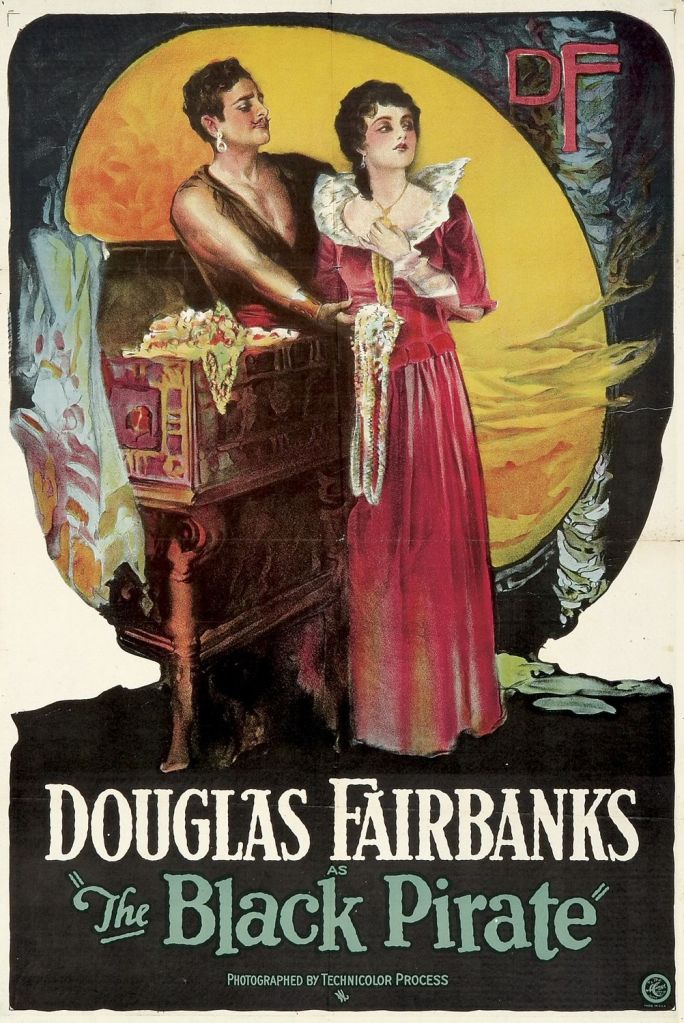
The Plot: In the Golden Age of Piracy, a band of pirates capture, loot, and blow up a ship. One of the survivors (Douglas Fairbanks) vows vengeance for his father, who dies as a result of the raid. Posing as The Black Pirate, the man challenges the Pirate Captain (Anders Randolf) to a swordfight, and after an easy win, becomes the pirates’ new leader. While looting another ship, The Black Pirate decides to hold the ship hostage, including the Princess Isobel (Billie Dove), for a ransom. There’s plenty of adventure and romance to be found in this movie, all of it in revolutionary two-strip Technicolor!

Why It Matters: The NFR calls the film a “swashbuckling tour-de-force” and praises the two-strip Technicolor process. There’s also an essay by Douglas Fairbanks expert/SF Silent Film Festival board member Tracey Goessel.

But Does It Really?: I…guess. “The Black Pirate” is a brisk, enjoyable old-fashioned pirate movie, though this is one of four Douglas Fairbanks movies on the list, which seems a bit much. If nothing else, “The Black Pirate” is a showcase for early two-strip technicolor, and a chance to see what early filmmakers could do with that new technology. My question: If you’re going to include a classic swashbuckler on the NFR, where’s “Captain Blood”?

Everybody Gets One: At first glance, leading lady Billie Dove is your standard silent film ingénue who left the business to raise a family, but there’s a lot more to Dove’s story, including a stint in the Ziegfeld Follies and a broken engagement to Howard Hughes! Billie Dove’s lasting legacy, however, comes from a fan. At some point in the early ’30s, aspiring singer Eleanora Fagan took Billie’s first name as a tribute to the actor, and combined it with her biological father’s last name to become Billie Holiday. And now you know the rest of the story!

Wow, That’s Dated: More a question than a statement: Does this movie take place somewhere in the Spanish Main? If that’s the case, is everyone in this movie guilty of cultural appropriation? Discuss amongst yourselves.

Other notes 

  • As previously mentioned, “The Black Pirate” is notable for its early use of two-strip Technicolor (Take that, Kodachrome!). Despite their excitement towards filming in color, Fairbanks et al did not want to use color simply as a gimmick. The production was inspired by the paintings of Howard Pyle and Carl Oscar Borg, and created a muted palette of colors throughout the film.
  • Apparently Douglas Fairbanks was a good guy to work for; many of the cast appear in his other three NFR entries. Sam De Grasse even plays a similar bad guy to the one he played in “Wild and Woolly” nine years earlier!
  • The Pirate Captain is giving me a real Yul Brynner vibe. Must be the shaved head.
  • Douglas Fairbanks stunts are never not impressive. The man had an agility that bordered on superhuman. Fun Fact: Fairbanks’ swimming coach for this movie was Johnny Weissmuller, Olympic swimmer and future movie Tarzan.
  • I was ready to write a whole critique questioning why the pirates would blow up a perfectly good ship instead of keeping it, but then the Pirate King brings up the same point. Doug gets it.
  • That is future Oscar winner Donald Crisp as the Scottish pirate MacTavish, complete with stereotypical kilt and tam o’shanter. Apparently, Crisp also directed the first few days of this film before having a falling out with Fairbanks and being replaced with Albert Parker. And yet he’s still in the movie?
  • What I enjoyed the most about “The Black Pirate” was that it contains so many pirate movie tropes that you never see anymore. There’s buried treasure and sword fights, and even a scene where the Black Pirate walks the plank! You always hear about these tropes, but it’s fun to actually see them in a movie!
  • Whoa, enough with the under-cranking on that horse riding scene! If that horse goes any faster it will travel back in time a la Superman.
  • Also impressive for a silent film: tracking shots! The camera actually moves with the characters in a few instances, including an impressive (by 1926 standards) shot of the camera backing up as the Pirate Lieutenant walks towards it.
  • Another impressive shot: Fairbanks seemingly being lifted up through the various decks by his crew, with the camera following with Fairbanks the entire time. Cinematographer Henry Sharp was having some fun that day.
  • I also enjoy the fact that the Pirate King avoids stairs and ladders by simply leaping to his destination. He’s the Super Mario of the ’20s!
  • When The Pirate King passionately kisses Princess Isobel at the end, that’s not Billie Dove in the shot, but rather Douglas Fairbanks’ real-life wife Mary Pickford! Some say this was done as an in-joke, others say it’s because Pickford wouldn’t let her husband kiss another woman on camera. Either way, it’s a rare chance to see America’s Sweetheart in color. There are also publicity photos that still exist showing Pickford in Dove’s costume and wig.
  • Okay, we settled all the plot lines; shouldn’t this be over by now? Do we need the extended comic relief bit from MacTavish? And is the rocking of the boat supposed to be a metaphor?

Legacy 

  • “The Black Pirate” was a success with audiences, and marked the apex of Douglas Fairbanks’ career. Fairbanks never quite made the transition from silent to sound, and his health began to deteriorate after a lifetime of smoking. After years of decline, Douglas Fairbanks died in 1939 of a heart attack at age 56. Two months later, Fairbanks posthumously received a lifetime achievement Academy Award for his “unique and outstanding contribution…to the international development of the motion picture”.
  • Although the film’s use of two-strip Technicolor was a well-received breakthrough, the fact that the film was literally two strips cemented together proved a challenge to most projectionists. A black-and-white version of the film was also available, but the color version would reappear in the ’70s following a restoration. Technicolor would perfect the single strip two-color process in 1928, with the more common three-color single strip arriving a year later.
  • I’d love to talk about this movie’s legacy of great pirate movies, but when you think about it, how many great pirate movies are there really? The first “Pirates of the Caribbean”? “Treasure Island”? ….”Muppet Treasure Island”?

#503) Double Indemnity (1944)

#503) Double Indemnity (1944)

OR “You’re in Good Hands with…Murder!”

Directed by Billy Wilder

Written by Wilder & Raymond Chandler. Based on the novel by James M. Cain.

Class of 1992 

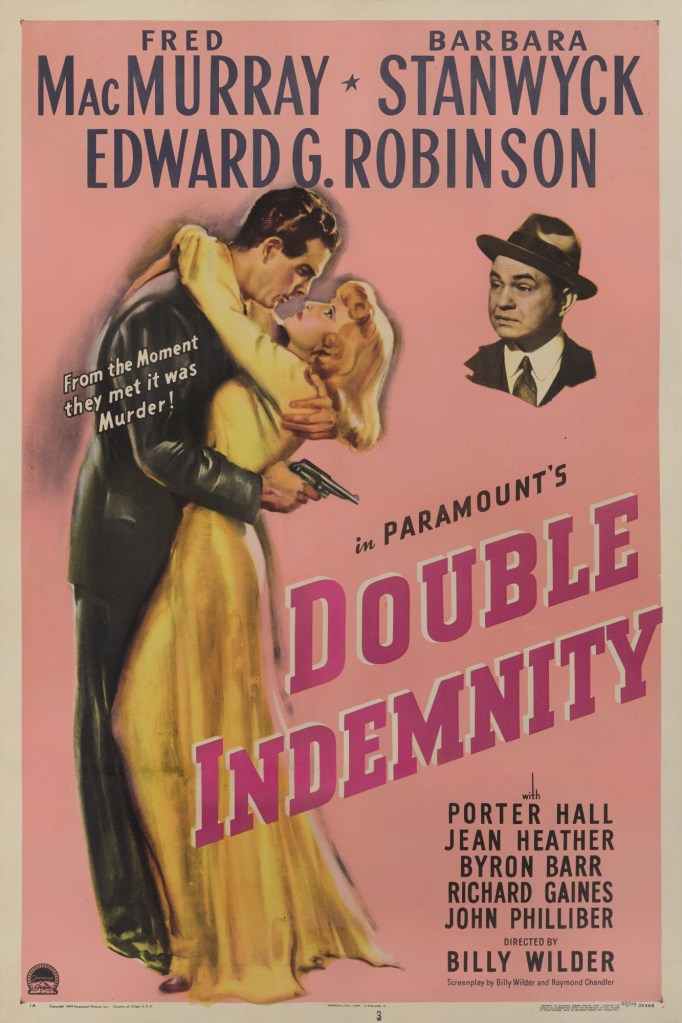
The Plot: While making a routine house call, insurance salesman Walter Neff (Fred MacMurray) meets Phyllis Dietrichson (Barbara Stanwyck), the seductive wife of Neff’s client (Tom Powers). During their conversation/flirtation, Phyllis asks about taking out a policy on Mr. Dietrichson without his knowledge, which Walter knows means murder. Initially reluctant, Walter eventually helps Phyllis devise the perfect murder, including an activation of the “double indemnity” clause: double the payout if Dietrichson dies under unlikely circumstances (such as falling off a train). The plan works perfectly, but Walter’s boss Barton Keyes (Edward G. Robinson) isn’t convinced it was an accident. What follows is some prime film noir.

Why It Matters: The NFR praises this movie to the hilt, citing Wilder’s “cynical sensibility” and “snappy dialogue”, the performances of Stanwyck, MacMurray, and Robinson (“some of their best”), and John Seitz’s “hard-edged” cinematography. An essay by film critic Matt Zoller Seitz (no relation to John) continues the love-fest.

But Does It Really?: “Indemnity” takes a while to crack its very ’40s outer shell, but once you get past the jargon and fast-talking, there’s a wonderfully structured piece of film noir at its core. Perhaps it’s my love of Wilder’s later fare like “Sunset Boulevard” and “The Apartment” that cloud my judgment on “Indemnity”: I enjoyed it, but I still think Wilder’s best work was ahead of him. Regardless, “Double Indemnity” may be filmdom’s quintessential film noir entry, with a strong enough legacy to be an NFR no-brainer.

Everybody Gets One: After reading “The Big Sleep“, “Indemnity” producer Joseph Sistrom recommended that author Raymond Chandler collaborate with Billy Wilder on the “Indemnity” screenplay, after Wilder’s usual partner Charles Brackett dropped out due to his dislike of the subject matter. Although Chandler and Wilder did not get along, Wilder admits that most of the film’s best lines were written by Chandler. And shout out to silent film star Tom Powers as Mr. Dietrichson, aka “the vic”.

Wow, That’s Dated: Umm, everything? This plot hinges on such antiquated things as door-to-door insurance salesmen, dictaphones, and trains as a common mode of transportation. Also that $50,000 insurance claim would be over $900,000 today! Don’t give me any ideas, modern inflation.

Seriously, Oscars?: A hit with audiences and most critics, “Double Indemnity” received seven Oscar nominations, including Best Picture. Unfortunately, “Indemnity” was the only Best Picture nominee to go home empty-handed, losing in most categories to future NFR entry (and fellow Paramount release) “Going My Way“. Billy Wilder was especially irked by these losses, but rallied the next year when he took home two Oscars for “The Lost Weekend“.

Other notes 

  • If this blog has taught me anything, it’s that the insurance business in the ’40s was the most exciting and dangerous business ever. Sabotage! Passion! Murder!
  • Full disclosure: Years ago, I tried and failed to watch “Double Indemnity”, giving up about 10 minutes in. I think what was throwing me was Fred MacMurray’s delivery. Don’t get me wrong, he’s very good in this, but he is coming in hot with the ’40s jargon and Wilder one-liners. Once you get used to it, however, the plot kicks in and the tempo slows to a more comprehensible speed.
  • Also not helping this film: the fact that every film noir element of this movie has been spoofed to death over the last 75 years.
  • Whoa, the chemistry between MacMurray and Stanwyck is palpable. I can still feel it, and they’ve both been dead for 30 years!
  • Oh Edward G. Robinson, what a fun, reliable supporting actor you became. Robinson was initially reluctant to play the third lead, but came around once he realized he was at the age to “start thinking of character roles”. It also helped that Robinson was getting paid the same amount as MacMurray and Stanwyck for less work.
  • This is another movie that would need a major overhaul if a modern remake was attempted. Walter’s plan to pose as Mr. Dietrichson would immediately fall apart if photo ID was required. Plus he’d have to deal with smart phones and security cameras. Side Note: Would it be ironic if Walter had broken his leg from jumping off the train?
  • The first half of the movie is watching Walter and Phyllis form this airtight murder plot and pull it off. The second half is seeing them try to get away with it, with Keyes serving as an accidental ’40s-style Columbo. Keyes’ monologue about suicide rates in America is a wonderful moment of him not only standing up to his boss about his work, but also inadvertently letting Phyllis off the hook.
  • The scene where Phyllis is hiding behind Walter’s door is suspenseful to be sure, except for the fact that no apartment door would ever open outward towards a hallway. Speaking of massive oversights, how did no one notice that Fred MacMurray is wearing his wedding ring during most of the movie?
  • As the plot starts to unravel in the third act, I really started to appreciate Barbara Stanwyck’s performance. Phyllis starts out as cold and calculating, and as the film progresses you see lovely shades of vulnerability and just plain evil. Typical of the era, the Oscars opted to give Best Actress to someone playing a victim (Ingrid Bergman in “Gaslight“) rather than to flawed, dimensional character.
  • [Spoilers] MacMurray gets the Clark Gable prize for best reaction to being shot: “You can do better than that, baby.”
  • The novel’s ending involved Walter and Phyllis committing suicide on a steamship bound for Mexico. The Code prohibited suicide as a plot resolution, so Wilder and Chandler completely rewrote the ending. Amazingly, the new one works; quite the feat considering Wilder cut the last part of this new ending after previews. Even James Cain preferred the new ending to the one he had written!

Legacy 

  • Looking back on his career, Billy Wilder called “Double Indemnity” one of his best films. Author James Cain was quite pleased with the film as well, watching it six times in its initial run!
  • Although Wilder never worked with Raymond Chandler again, he used Chandler’s alcoholism and writer’s block as inspiration to tackle his next movie: “The Lost Weekend”.
  • “Double Indemnity” has been officially remade twice. A 1954 episode of “Lux Video Theatre” earned Frank Lovejoy an Emmy nomination for playing Walter. A 1973 TV movie saw Richard Crenna, Samantha Eggar, and Lee J. Cobb in the leads. After its initial airing, Billy Wilder called Barbara Stanwyck at home and sighed “they just didn’t get it right”.
  • As for unofficial remakes, see “Body Heat”.
  • James Cain would see two more of his novels become classic movies in the next two years: “Mildred Pierce” and “The Postman Always Rings Twice”.
  • “Double Indemnity” is featured extensively in “Dead Men Don’t Wear Plaid”, with Steve Martin filling in for Barbara Stanwyck.
  • And finally, “Double Indemnity” is considered by some to be the template for all film noir that came after it, though Wilder always stated that he was not consciously trying to emulate any genre, and hadn’t even heard the term “film noir” until after the film’s release.

#502) Gigi (1958)

#502) Gigi (1958)

OR “Ooh-La-Wha?”

Directed by Vincente Minnelli

Written by Alan Jay Lerner. Based on the novella by Collette. Original score by Lerner & Frederick Loewe.

Class of 1991 

The Plot: Gigi (Leslie Caron) is a free-spirited young girl in turn-of-the-century Paris, groomed by her grandmother Madame Alvarez (Hermione Gingold) and Aunt Alicia (Isabel Jeans) to be a courtesan (aka mistress) to a wealthy man. Gigi deplores this training, and enjoys playing cards with family friend Gaston Lachaille (Louis Jourdan) instead. Gaston is a wealthy womanizer who is bored with his rakish lifestyle, but comes around to the idea of Gigi becoming his mistress. Providing commentary on the story is Gaston’s equally roguish uncle Honoré (Maurice Chevalier), who once had a fling with Gigi’s grandmother. Oh, and this whole thing is a musical.

Why It Matters: The NFR states that “Gigi” is “often considered to be one of MGM’s best musicals” and gives a rundown on the film’s story and production.

But Does It Really?: “Gigi” is a lavish pageantry of spectacle, but something about it seems off, and not just the outdated storyline and gender politics. From a historical viewpoint, this film works as the evolutionary step between the earlier MGM musicals like “Singin’ in the Rain” and later Broadway adaptations like “West Side Story“: “Gigi” was sophisticated for its time, but quickly eclipsed. “Gigi” is on here for its standing as the last of the great studio system musicals, but through a modern lens, to quote one of the film’s songs, “It’s a Bore”.

Wow, That’s Dated: While the practice of young women being groomed as courtesans in French society was long gone by 1958, the notion that this could serve as the basis for a crowd-pleasing romantic musical is quite problematic. In fact, because of its subject matter, the Production Code initially banned any film version of “Gigi” from being produced, until MGM convinced the code that their version was a condemnation of this lifestyle.

Title Track: The title number “Gigi” was one of the last to be written by Lerner & Loewe for the film. Like the songwriters’ previous leading man, Louis Jourdan speak-sings his way through a number about his newfound adoration for Gigi. Almost like he’s grown accustomed to her face…

Seriously, Oscars?: At the 1959 Oscars, “Gigi” tied with “The Defiant Ones” for most nominations with nine, and won all nine! Among the film’s accolades were Best Picture, Director, Screenplay, Score and Song (for “Gigi”). While none of the cast was nominated, Maurice Chevalier received a lifetime achievement Oscar “for his contributions to the world of entertainment”. “Gigi” broke the record for most Oscars won by a single film, and held the title until 364 days later, when “Ben-Hur” took home 11.

Other notes 

  • Quick shoutout to the previous stage adaptation of “Gigi” written by former Hollywood screenwriter Anita Loos. It played Broadway in 1951, and novella author Collette handpicked a young actress named Audrey Hepburn to play Gigi. And now you know the rest of the story!
  • After only being allowed one on-location establishing shot in “An American in Paris“, Vincente Minnelli was finally permitted to film the bulk of “Gigi” in the City of Lights. Unfortunately, there was so much noise pollution on-location that most of the audio was unusable, resulting in practically every scene being dubbed later. In addition, once the film started going over-budget, MGM demanded that “Gigi” return to California and film the remaining scenes in-studio, which explains the occasional jarring transition from Paris location to Culver City set.
  • A minor character in the 1949 French film adaptation, the role of Honoré was expanded for this movie, and Maurice Chevalier was the first and only choice for the part. Chevalier opens “Gigi” with “Thank Heaven for Little Girls”…because they’ll grow up to be your significantly younger courtesan?
  • Despite Leslie Caron’s natural vocal talents (she really imbues a lot of character into her singing), Freed opted for go-to ghost singer Betty Wand to dub all of Caron’s singing. Fortunately, some of Caron’s original recordings have been released as supplemental material.
  • Each of the individual numbers in the film are fine, but they lose something once you realize that Lerner & Loewe composed this score immediately after their Broadway triumph “My Fair Lady“. The stories have enough overall parallels to give the “Gigi” score a certain sameness to it.
  • One of my problems with this movie is the cinematography. True, MGM veteran Joseph Ruttenberg creates some beautiful CinemaScope compositions, but we’re always at a distance from the characters. With only a handful of close-ups throughout the movie, the majority of “Gigi” is pleasant looking medium shots that favor the spectacle over character intimacy. And if I’m not invested in the characters, it’s just a two hour costume parade.
  • “The Night They Invented Champagne” is a fun number and really lightens up the…wait that’s it? It’s not even two minutes long!
  • After production wrapped, Lerner & Loewe were so dissatisfied with the film, they demanded several cuts and reshoots. MGM initially balked (it would have added $300,000 to the budget), but when Lerner & Loewe offered to pay $3 million to have the film destroyed, the studio acquiesced. One of the numbers completely reshot was “I Remember It Well”, which now jarringly cuts from an overcast location shot to an obvious studio recreation (including a sudden sunset!)
  • My other big problem with this movie is that everyone talks about Gigi, but we never spend a lot of time with her. It’s a true Cinderella story, in the sense that Gigi is a very passive lead; everything happens TO her.
  • If “Say a Prayer for Me Tonight” sounds especially like a “My Fair Lady” reject, that’s because…it is. Eliza Dolittle was supposed to sing this before going to the Embassy Ball, but the song was cut out of town. At least it’s a chance to hear Gigi’s perspective about this whole…wait that’s it? That was even shorter than “Champagne”!
  • So the moral of this movie is: Men, it’s okay to love your mistress. Women, it’s okay to conform to your man’s idealized version of you. Yikes. Well maybe this epilogue will sort things…wait that’s it? What even is this movie?

Legacy 

  • “Gigi” was one of the biggest hits of 1958, and despite being considered one of the best musicals from “The Freed Unit”, Arthur Freed only produced one more movie musical, 1960’s “Bells Are Ringing”. Vincente Minnelli continued being one of MGM’s top directors (including “Bells”) before his career petered out in the mid-60s.
  • Although their professional collaboration officially ended with 1960’s “Camelot”, Lerner & Loewe reunited in the early 70s to write a handful of new songs for a “Gigi” stage adaptation. This new musical opened on Broadway in November 1973…and closed three months later. In 2015, “Gigi” returned to Broadway, and while there were attempts to soften the subject matter (“Thank Heaven for Little Girls” was given to Mamita and Aunt Alicia), this production was even less successful than the first.
  • “Gigi” is one of those movies that endured as a cultural reference point for many decades, but more recently has disappeared from the conversation. References of “Gigi” are more or less reserved for film geeks and Oscar Best Picture montages. Do people even know the songs from this anymore?

#501) Harlan County, U.S.A. (1976)

#501) Harlan County, U.S.A. (1976)

OR “Duke It Out”

Directed by Barbara Kopple

Class of 1990 

The Plot: In 1973, the miners of the Brookside Mine in Harlan County, Kentucky, vote to join the United Mine Workers of America. When Brookside and Duke Power Company refuse to sign a new contract, the miners go on strike. Filmmaker Barbara Kopple documents the thirteen month strike from the perspective of the miners, as well as their wives who join them on the picket line. With management that is refusing to cooperate, memories of the similarly distressing Harlan County War of the 1930s, and the “gun thugs” hired to intimidate the protesters, “Harlan County U.S.A.” only cares about one question: which side are you on?

Why It Matters: The NFR calls the film an “unvarnished examination” of the strike, calling Kopple’s direction “an important digression from ‘direct cinema’ toward a more personal filmmaking style.” There’s also an essay by writer/AMPAS archivist Randy Haberkamp.

But Does It Really?: Like many great documentaries, “Harlan County” covers a specific time and place in U.S. history that could easily go ignored, and reminds us that we are still fighting the same fights supposedly “won” by earlier generations. “Harlan County” is an engaging documentary that, thanks to its continued cultural relevancy (whether that’s a good thing or not), is more than deserving of its spot in the NFR.

Everybody Gets One: Barbara Kopple was studying psychology at Northeastern University, and opted to make a short film about her study of lobotomy patients in lieu of writing a thesis that “no one would read”. After graduating, she studied film at the School of Visual Arts in New York, and did odd jobs working for Albert and David Maysles. While trying to raise funds for “Harlan County”, Kopple worked on other documentaries, including sound for “Hearts and Minds“.

Wow, That’s Dated: In addition to the overall ’70s-ness of the film, “Harlan County” references then-current Secretary of the Treasury William E. Simon, the Impeach Nixon movement, and Jimmy Hoffa (still alive and accounted for in 1973). Oh, and the sexism. Lots of your standard ’70s sexism hurled at these women.

Seriously, Oscars?: “Harlan County” was a critical success, and would go on to win the Oscar for Best Documentary – presented by no less than Lillian Hellman! Immediately after the win, Barbara Kopple called Harlan, and was able to hear car horns honking and shouts of “We won! We won!”

Other notes 

  • Like quite a few documentaries on this list, “Harlan County” began as a completely different movie. Kopple had originally intended to make a film about the Miners for Democracy, and their 1972 effort to unseat Tony Boyle as president of the United Mine Workers of America. While filming in Triangle, Virginia, Kopple learned of the miners strike in Brookside, Kentucky, and made the eight hour drive to get some footage. Once there, she decided the strike was a more interesting subject for a movie, and the Miners for Democracy story became a brief subplot in the final film.
  • While filming the strikers, Kopple initially didn’t tell anyone who she was, which led to rumors of a “hippie crew from New York”. Once Kopple introduced herself to the strikers, they were more trusting and open to her and the crew, and even let them lodge in their homes.
  • “Harlan County” is bookended by footage of coal miners in the actual coal mines. These scenes were a last minute suggestion by cinematographer Hart Perry, who pointed out that they had filmed zero footage of actual coal mining, despite that being at the core of the film. Hart used his knowledge of geology (he majored in geology at Columbia) to convince a local coal mine to let him film the workers.
  • Between this, “Norma Rae“, the “Republic Steel Strike Footage“, I guess I’ve been on a union kick lately. Though thankfully my own involvement with unions have never led to strikes or violence, a lot of the arguments presented in “Harlan” from both sides ring true almost 50 years later. Union always sees management as stubborn exploitative capitalists, and management always sees union workers as free-loading communists.
  • Also from the “Some Things Never Change” file: America being behind other countries in terms of worker safety, and wage increases far lower than the cost of living (and way below wage increase at the top). Turns out America has always really, really sucked at investing in its working class.
  • A majority of the film’s soundtrack is provided by songwriter/activist Hazel Dickens, who wrote four songs specifically for the movie. Turns out there are more songs about Harlan County than love, New York, and garlic combined.
  • The Tony Boyle subplot is still in the movie, and is a reminder of the lengths some corrupt figures will go to to stay in power. In 1969, Boyle’s presidency was challenged by labor leader Joseph Yablonski, who was found murdered in his home (along with his wife and daughter) a few months later. During filming of “Harlan”, Boyle was convicted of first degree murder and sentenced to three consecutive life sentences. Boyle died in prison in 1985.
  • Once the main conflict is established, “Harlan County” uses two people to epitomize either side of the strike: strike organizer Lois Scott, depicted here as a relentless fighter and everyday hero, and strikebreaker Basil Collins, the film’s gun-wielding, slur-spouting heavy. And yes, his name really is Basil Collins, like the drink.
  • Easily the most disturbing moment in the whole film is when the scabs open fire on the strikers at night, followed by a shot of the scabs trying to break Barbara Kopple’s camera. The fourth wall comes breaking down in this moment; making you acknowledge the real danger of the situation for everyone, including the crew. It left me on edge for the rest of the movie.
  • While the strikers’ subsequent “eye for an eye” mentality is equally problematic, it does give us the great image of Lois Scott pulling a gun out of her bra.
  • Despite the amount of violence in this film, Barbara Kopple later stated that she believes her presence at these events helped deescalate these standoffs, stating that no one wanted to be caught shooting someone on film.
  • The strike ends after 13 months with an agreement between the union and management, but the moment comes across as anti-climactic in the final film. This is not helped by the post-script during the credits that mentions two more union strikes in the next two years!

Legacy 

  • Despite the moderate success of “Harlan County”, Barbara Kopple would not make another theatrical documentary for 14 years. 1990’s “American Dream” covers the 1985 Hormel strike that was ultimately unsuccessful for the workers. The film garnered Kopple her second Academy Award, making her the first (and so far only) woman to win Best Documentary twice.
  • The Duke Power strike was eventually dramatized into the 2000 Showtime movie “Harlan County War” starring Holly Hunter as a fictional composite of the various women who helped picket. The Boyle/Yablonski murder story became the 1986 HBO movie “Act of Vengeance” with Charles Bronson and Wilford Brimley.

#500) Citizen Kane (1941) – Part 3 (Legacy)

This is part three of my “Citizen Kane” write-up. You can find Part One here and Part Two here.

Legacy 

  • “Citizen Kane” premiered in New York on May 1st, 1941, and opened in other major cities throughout the year. While the film received mostly good reviews (a few even declared it “the best movie ever” right out the gate), Hearst’s efforts to discredit the picture led to its underperformance at the box office. During the run, Welles’ RKO contract expired, and his new contract did not grant him final cut on his next film, “The Magnificent Ambersons”, leading to some massive re-cutting without Welles’ approval. When George Schaefer resigned from RKO in 1942, Welles lost his cheerleader, and his contract was terminated. As Welles would later say about his filmmaking career, “I started at the top and worked my way down.”
  • The person responsible for the eventual revival and reappraisal of “Kane” is French film critic André Bazin and his 1947 essay “The Technique of Citizen Kane” (“Kane” would not be released in Europe until after the war). Praising the film’s use of mise-en-scène, Bazin’s essay (and subsequent writing) helped sway French opinion that American films could be art instead of just merely “products”.
  • The re-evaluation of “Kane” came stateside in 1956, when a fledgling RKO re-released the film in conjunction with Welles’ return to the New York stage. That same year, RKO sold their film library to television, “Kane” being among the hundreds of films that would receive a second life on TV.
  • I rarely mention a film’s standings on various “greatest films” list, but “Kane” deserves a mention. “Kane” first showed up at #22 in the 1951 Festival Mondial du Film’s director’s poll of greatest movies (generally considered the first Greatest Movies list). From 1962 to 2002, “Kane” ranked #1 in Sight and Sound’s decennial list of greatest movies until being dethroned by “Vertigo” in 2012. In recent years, “Kane” has been hailed as the best film by countless magazines, review aggregator websites, and film organizations, including being voted #1 on both of AFI’s Top 100 Movies lists.
  • It wasn’t just the critics who started gushing about “Kane” in the ‘50s. Pretty much the entire film industry took notice (“Kane” is a prime example of the then-popular auteur theory of film). The filmmakers inspired by “Kane” are too numerous to list, suffice it to say that every white male director (and therefore 99.9% of film history) has cited “Kane” as an influence on their work.
  • While Orson Welles never repeated the pinnacle of filmmaking he reached with “Kane”, he continued to make movies for the next 35 years, including three more NFR entries (“Ambersons”, “The Lady from Shanghai” and “Touch of Evil”). I’m a big fan of his documentary “F for Fake”, as well as “The Other Side of the Wind”, whose troubled production is as fascinating and as generation-spanning as “Citizen Kane”.
  • “Kane” was the first movie score for radio composer Bernard Herrmann, who would spend the next 35 years composing the iconic scores to “Vertigo”, “Psycho”, and “Taxi Driver” (among many others). Although Hermann did not win the Oscar for his “Kane” score, he did win that year for his work in “The Devil and Daniel Webster”.
  • Over thirty years after William Randolph Hearst’s death in 1951, his son William Jr. (or possibly his son William III) admitted to enjoying “Citizen Kane”, and even offered Welles a stay at Hearst Castle “on my tab”. This never happened, but “Kane” was eventually screened at Hearst Castle itself in 2015.
  • While many films have paid homage to “Citizen Kane” by way of deep focus and quick editing, just as many have referenced or parodied specific elements in “Kane”. One of the first was 1941’s “Hellzapoppin’” an absurdist comedy which includes a cameo by…Rosebud? I thought they burned that.
  • “The Simpsons” have parodied “Kane” so often that showrunner Al Jean has claimed you could recreate the entire film using their clips. Most of the “Kane” references are connected to Charles Montgomery Burns, the show’s resident evil billionaire, and his long-lost childhood teddy bear Bobo.
  • “Simpsons” cousin “The Critic” also referenced “Kane” and made good use of Maurice LaMarche’s Orson Welles impression, including a fake commercial Welles allegedly did for “Rosebud Frozen Peas”.
  • Another “Kane” moment that gets referenced a lot: this gif
  • So let me get this straight: After Kane died, Xanadu lay dormant until 1980, when it was converted into a disco roller rink by Olivia Newton-John and ELO?
  • “Kane” is one of the rare movies that warrants its own documentary. “The Battle Over Citizen Kane” focuses on Welles’ clashing with William Randolph Hearst, and was eventually nominated for a Best Documentary Oscar. “Battle” also served as the basis for the 1999 HBO movie “RKO 281” with Liev Schreiber as Welles and James Cromwell as Hearst. Although based on the documentary, the movie takes several liberties regarding the facts surrounding “Kane”.
  • And finally, upon purchasing the RKO film library in 1986, Ted Turner started colorizing classic movies for television, and publicly considered doing the same for “Citizen Kane”. While Welles’ original RKO contract prohibited anyone else from altering his film, the public outcry was enough for the government to take precautionary action. In 1988, the US government passed the National Film Preservation Act, creating the National Film Preservation Board and the National Film Registry. Turns out I owe my obsessive film-blogging to “Citizen Kane”.

Thank you for coming along with me for movie #500 (though technically this is post #551). We’re almost 2/3rds of the way through the list; off to the next one!

Happy Viewing,

Tony

By the way, did anyone end up making that “Heart of Darkness” adaptation?