#463) Down Argentine Way (1940)

#463) Down Argentine Way (1940)

OR “The Unofficial Story”

Directed by Irving Cummings

Written by Darrell Ware and Karl Tunberg

Class of 2014

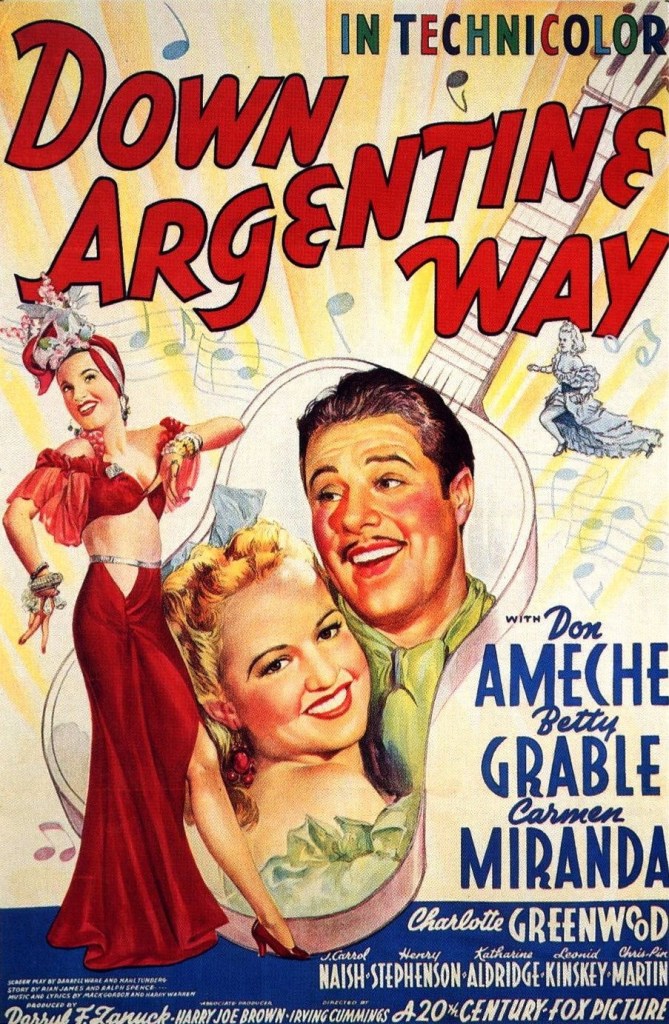
The Plot: While in New York with his prized horse, Argentinian playboy Ricardo Quintano (Don Ameche) hits it off with debutante Glenda Crawford (Betty Grable), not knowing that her father had betrayed Ricardo’s father (Henry Stephenson) years earlier. When Ricardo travels back to Argentina, Glenda follows along with her Aunt Binnie (Charlotte Greenwood). There are musical highlights from Carmen Miranda (in her American film debut) and the Nicholas Brothers, but very little of actual Argentine culture and customs.

Why It Matters: The NFR gives a rundown of Betty Grable, citing this film as the one that “established [Grable] as the pinup queen”. The only part of the movie that gets a superlative is the Nicholas Brohters’ “unparalleled” dance number. An essay by Library of Congress sound technician Carla Arton makes a compelling case for the film’s significance.

But Does It Really?: This is definitely a movie where the cons outweigh the pros. Yes, the film represents the kind of vibrant, Latin-infused “Good Neighbor” musicals that Hollywood was making at the time, but the stereotypes and misappropriation throughout really taint any modern viewing. The aforementioned Arton essay makes the “Good Neighbor” case, as well as one for its star Betty Grable who, while mostly forgotten today, was a major movie star/sex symbol of wartime America. Thanks to Arton’s essay, “Down Argentine Way” gets a pass for NFR inclusion.

Everybody Gets One: The child of what we would now call a “stage mom”, Betty Grable was a regular beauty pageant contestant, and at age 12 she and her mother set off to Hollywood. Grable bounced around from studio to studio throughout the 1930s, finally landing at Fox in 1940. Fox studio head/producer Darryl F. Zanuck was so impressed by Grable’s stage performance in “DuBarry Was a Lady”, he cast her as the lead in “Down Argentine Way” after first choice (and established star) Alice Faye backed out due to appendicitis.

Wow, That’s Dated: BROWNFACE WARNING: Don Ameche plays Ricardo with a stereotypical accent and either really bad makeup or a really good tan. This film also portrays South America as one big country where everyone speaks in ignorant broken English. Even in 1940, Latin American film distributors openly criticized the film and its offensive depictions of Argentina, to the point that Argentina banned any screenings of the film.

Title Track: The Oscar-nominated title song serves as a leitmotif throughout the film; practically everyone sings it at some point, complete with clicking noise.

Seriously, Oscars?: “Down Argentine Way” received three Oscar nominations, and lost all of them. Cinematography and Art Direction went to British import “The Thief of Bagdad”, while Best Song went to a little ditty called “When You Wish Upon a Star“.

Other notes 

  • Betty Grable wasn’t the only actor filling in for this movie’s first choice. Don Ameche stepped in for Desi Arnaz (already under contract with RKO), and Leonid Kinskey replaced Cesar Romero (another illness related cancellation; what was in the water back then?).
  • Speaking of Ameche, none of the credited cast members are actually from Argentina or South America in general. (Carmen Miranda comes closest: she was raised in Brazil, but born in Portugal). J. Carrol Naish is Irish, Henry Stephenson is British, Leonid Kinskey is Russian, and on and on and on.
  • The only performance that’s salvaging my viewing is Charlotte Greenwood as Aunt Binnie. Greenwood’s deadpan delivery of her various one-liners is a consistent delight. She even gets to do some of the high kicks she was known for in her vaudeville days! Greenwood is best remembered for playing another wise-cracking aunt in an NFR musical: Aunt Eller in “Oklahoma!
  • As a general rule, can we stop making fun of non-English speakers’ difficulty with American English syntax? It’s so friggin’ complicated, why do movies always focus on that?
  • The Nicholas Brothers’ dance routine has nothing to do with either this movie or Argentina in general, but it is one of this movie’s few saving graces. I even applauded at the end of their number. Side note: Fayard and Harold Nicholas’ home movies made the NFR some years back, and I cannot for the life of me find the footage online. Any leads?
  • Carmen Miranda was the hottest new star in New York when “Down Argentine Way” was in production. Fox signed her to a contract, but due to her nightclub commitments, Miranda could not leave New York to film in L.A. Her numbers (lifted directly from her nightclub act) were filmed in New York and interspersed throughout the film.
  • Oh, and if Miranda’s song “Mamãe Yo Quero” sounds familiar, you’re thinking of either Tom and Jerry or “Magical Maestro“.
  • Sometimes the subtitle I give a movie for their blog post comes to me during my viewing. I was all set to call this post “Seeing a Man About a Horse”, but then this movie beat me to the punch(line). Well played, movie. Well played.
  • The movie’s second half focuses more on the horse racing and “Romeo and Juliet” plots, and that’s when “Down Argentine Way” lost me. I don’t care about the love story or the countless stereotypes, I was enjoying the musical numbers; and if you’re not going to make everyone sing and dance then what’s the point? Despite its historical significance, “Down Argentine Way” is more flawed than fun.

Legacy 

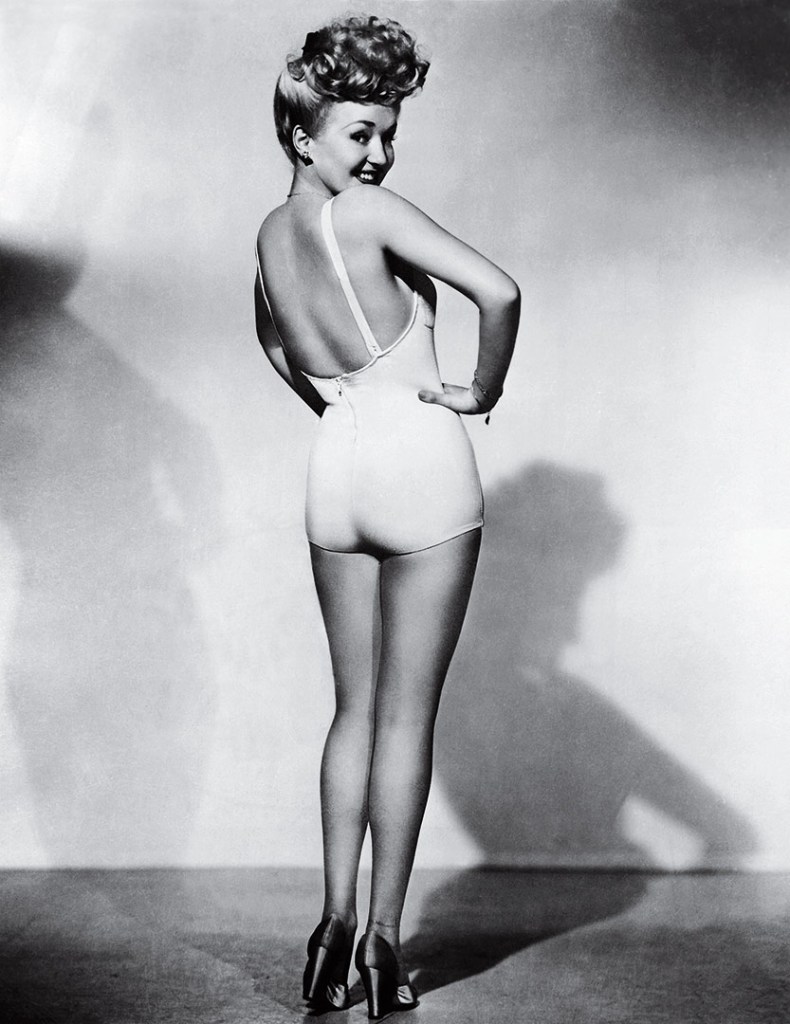
  • “Down Argentine Way” was a hit, and propelled Betty Grable from supporting player to one of the decade’s biggest movie stars. Frank Powolny’s 1943 photo of Grable in a one piece bathing suit became the most requested photo by GIs during WWII. Incidentally, the reason her back is turned in this famous photo is because she was visibly pregnant with her daughter Victoria.
  • Irving Cummings, Don Ameche, and Carmen Miranda would all reunite for 1941’s “That Night in Rio”, along with Alice Faye, who apparently was feeling better. “Rio” is also notable for giving Miranda her trademark fruit hat.
  • “Down Argentine Way” and “That Night in Rio” are just two of the countless “Good Neighbor” films Hollywood studios were making throughout the ’40s. You are probably most familiar with one of Disney’s offerings: “The Three Caballeros”.
  • Weirdly enough, another Carmen Miranda musical – 1943’s “The Gang’s All Here” – was also added to the NFR in 2014, making Miranda one of the few performers to be inducted twice in the same year.

#462) The Lunch Date (1989)

#462) The Lunch Date (1989)

OR “I’ll Have What She’s Having”

Directed & Written by Adam Davidson

Class of 2013

The Plot: An upper-class Woman (Scotty Bloch) misses her train while rushing through Grand Central Station. Her plans dashed and her wallet missing, the Woman orders a salad from a nearby food stand with change from her purse. When she returns to her table after retrieving utensils, she finds a presumably homeless African-American Man (Clebert Ford) eating her salad. What could escalate into a heated argument fueled by bigotry becomes a moment of connection in which the Woman sees through her own bias and perception….or maybe not.

Why It Matters: The NFR gives some background, and calls the film “a simple, yet effective parable on the vicissitudes and pervasiveness of perception, race and stereotypes.” Full disclosure: I had to look up “vicissitudes”; it’s an unwelcome change of circumstances.

But Does It Really?: I can give “The Lunch Date” a pass on my “Everybody Gets One” mandate for its director Adam Davidson. The film overall is still effective, and delves a bit deeper than your typical student film. The NFR is always on the lookout for student films to put on this list, and “The Lunch Date” is a natural choice.

Everybody Gets One: Son of theater director Gordon and entertainment publicist Judi, Adam Davidson knew he wanted to be a filmmaker. He opted to attend Columbia over NYU because of Columbia’s emphasis on storytelling over technique. “The Lunch Date” was a film that Davidson considered a “practice run” while he was still contemplating what his thesis film would be. He covered most of the film’s $7000 budget by selling his motorcycle and trading “short ends” of film for a complete reel.

Wow, That’s Dated: The only giveaway is Grand Central Station’s pre-digital departure board. The clacking of the individual numbers is so satisfying, though.

Seriously, Oscars?: “The Lunch Date” played the festival circuit, and eventually the Cannes Film Festival, where it won the Palme d’Or for short films (The only American short in contention). The same week of the Cannes accolades, the film won a Student Academy Award, making it eligible for Oscar consideration. Nine months later, “The Lunch Date” won the Academy Award for Best Live-Action Short Film. All of this while Davidson was still a student at Columbia!

Other notes 

  • That story again, “The Lunch Date” was a film Davidson tossed off while he was considering his thesis project. And now he’s an Oscar winner with a film on the NFR. May we all be so blessed.
  • Both Scotty Bloch and Clebert Ford were New York character actors and stage veterans by the time “The Lunch Date” came about. And as with any true New York actor, they both have respectable “Law & Order” numbers: Ford with 2, Bloch with 4 (3 regular, 1 “SVU”). Davidson would go on to direct an episode himself in 1998.
  • A noteworthy attention to detail: the Man’s beanie still has a price tag on it.
  • The short sequence of our two characters eating a salad is the film in a nutshell: Simply executed, but conveying deeper layers underneath. Kudos to Davidson, as well as the subtle acting chops of Bloch and Ford.
  • I enjoyed the staging of the moment where the Woman cannot find her bag. It has a nice Hitchcockian quality to it.
  • The thing I most appreciate about “The Lunch Date” is that it’s left up to you to determine if this woman was actually changed by this experience. My answer is no, but that’s also because of the thoroughly depressing, racially charged times we’re currently living in.

Legacy 

  • Although Adam Davidson has only one feature-length film to his credit (2000’s “Way Past Cool”), he has been an in-demand TV director for the past 25 years. Highlights include episodes of “Six Feet Under”, “Grey’s Anatomy”, “Community”, and “Zoey’s Extraordinary Playlist”, which I keep meaning to watch. Is it any good?

#461) Breakfast at Tiffany’s (1961)

#461) Breakfast at Tiffany’s (1961)

OR “Manic Pixie Dream Girl: The Motion Picture”

Directed by Blake Edwards

Written by George Axelrod. Based on the novella by Truman Capote.

Class of 2012 

The Plot: Writer Paul Varjak (George Peppard) moves into his Manhattan apartment, where he meets his new neighbor, socialite and downplayed call girl Holly Golightly (Audrey Hepburn). The two develop a strong relationship, hampered by Holly’s desire to marry rich, and Paul’s status as the “kept man” of decorator 2E (Patricia Neal). Holly and Paul continue to be friends, sharing a series of episodes involving wild parties, Holly’s estranged husband Doc (Buddy Ebsen), and a morning trip to Tiffany & Co. If you’re looking for a movie that respects its source material, keep looking.

Why It Matters: Although the NFR details the film’s departures from the novella (and Truman Capote’s disapproval for casting Audrey Hepburn), the write-up highlights the more modern praise of Hepburn, her characterization of Holly compared to other female leads of the era, director Edwards, composer Henry Mancini, and the song “Moon River”.

But Does It Really?: For every iconic moment in “Breakfast at Tiffany’s”, there’s two that have aged terribly. Audrey Hepburn is giving a justifiably memorable performance, and “Moon River” is an undisputed classic, but this movie continues to get bogged down by its dated views on the sexes, to say nothing of Mickey Rooney’s performance (more on that later). The film survives thanks to Hepburn’s work and its overall positive misinterpretation of the source material. “Breakfast at Tiffany’s” deserves its status in the National Film Registry, but any modern viewing will question that distinction.

Shout Outs: 2E references “Love Finds Andy Hardy“, starring Mickey Rooney, which theoretically should have caused a black hole in this universe.

Everybody Gets One: This is Buddy Ebsen’s only NFR appearance, but that’s not his fault. A veteran of ’30s MGM musicals, Ebsen was originally cast as the Tin Man in “The Wizard of Oz“, but was replaced when his reaction to the makeup led to his hospitalization. Ebsen’s career faltered after that, but his appearances on the “Davy Crockett” TV series, and his excellent turn here, helped get him his most famous role: Jed Clampett on “The Beverly Hillbillies”.

Wow, That’s Dated: Let’s see, this movie has typewriters and landlines and checks and physical library index cards….yep, that’s it. That’s all that’s dated about “Breakfast at Tiffany’s”….

…okay fine. This movie has the YELLOWFACE WARNING to end all Yellowface Warnings. White actor Mickey Rooney plays Holly’s Japanese landlord Mr. Yunioshi with makeup and prosthetics to make him look like a cartoon stereotype. It’s bad, it’s very bad. Blake Edwards was adamant about casting Rooney in the part, and lived to regret the decision.

…oh, and this movie definitely has issues with its depiction of women. How is this still a classic?

Seriously, Oscars?: Despite mixed reviews (especially from those who had read the novella), “Breakfast at Tiffany’s” was a hit, and received five Oscar nominations. The film lost a few categories to NFR entries “West Side Story” and “Judgment at Nuremberg“, but Henry Mancini took home the Oscars for Best Score and (along with Johnny Mercer) Best Song for “Moon River”. “Breakfast at Tiffany’s” is one of the rare non-musicals to win both awards.

Other notes 

  • As George Costanza would not be able to explain, the novella “Breakfast at Tiffany’s” is vastly different from the film. For starters, Paul is an unnamed narrator in the book and there’s no love story (the narrator is a stand-in for Capote). The book goes into more detail about Holly’s dates with men, though it’s made clear she’s not a hooker, but rather an “American Geisha”. The story overall is more a cautionary tale about the café society lifestyle than a celebration of it. Capote gave the film his blessing, but called the final product more “a creation of its own than an adaptation.”
  • Capote lobbied for Marilyn Monroe to play Holly Golightly, but she opted to make “The Misfits” instead. Names like Shirley MacLaine and Joanne Woodward were mentioned, but Audrey Hepburn (always a strong contender) was cast. Side note: Hepburn found the role quite challenging, and admits to losing a lot of weight during production due to stress, so maybe we shouldn’t make her the standard for what all women “should” look like.
  • The $50 Holly gets for “going to the powder room” is about $433 today.
  • Shoutout to the supporting cast, who all do their best with their limited screen time. Patricia Neal excels as a character more commanding than her usual roles at the time. Martin Balsam turns a cameo as Holly’s agent into comedy gold. Even the cat is good!
  • The party scene is definitely Blake Edwards’ brainchild. Many of the comic setups here will appear in his later work, especially the “Pink Panther” series. It’s fun, but does stick out a bit.
  • “Moon River” is, of course, a beautiful song, and almost makes you forget this movie’s problems. Almost. This song also proves that Audrey Hepburn can sing, but she’s no Marni Nixon.
  • Doc says he married Holly in 1955 when she was “going on 14” (!). Assuming the film’s setting is 1960, that makes Holly 18-19; Audrey Hepburn was 31. No knock against Hepburn, but watching a 31-year-old be this flaky and make terrible life decisions is very different from watching a 19-year-old do so. This ultimately explains why I have such difficulty watching this movie. You’re all lucky Audrey Hepburn is so charming.
  • Wow, this movie has a lot of cat abuse. Cat gets tossed around the apartment, Holly pushes it out of a cab into the pouring rain. Where’s PETA? For the record: noted humanitarian Audrey Hepburn later stated how much she hated doing these scenes.
  • Oy, that ending. First of all, Paul saying that Holly belongs to him is very cringe-worthy today (I agree with Holly’s then-radical stance “People don’t belong to people”). Secondly, these two must have gotten some pretty bad pneumonia from making out in the rain. It’s a wonder this scene didn’t make Capote shoot his screen Elvis-style.

Legacy 

  • Everyone benefited from the success of “Breakfast at Tiffany’s”. Blake Edwards would go on to direct (among others) “Days of Wine and Roses” and “The Pink Panther“, while Audrey Hepburn pivoted to more quirky comedies like “Charade” and “How to Steal a Million”. And if you have a problem, if no one else can help, and if you can find him, maybe you can hire…George Peppard.
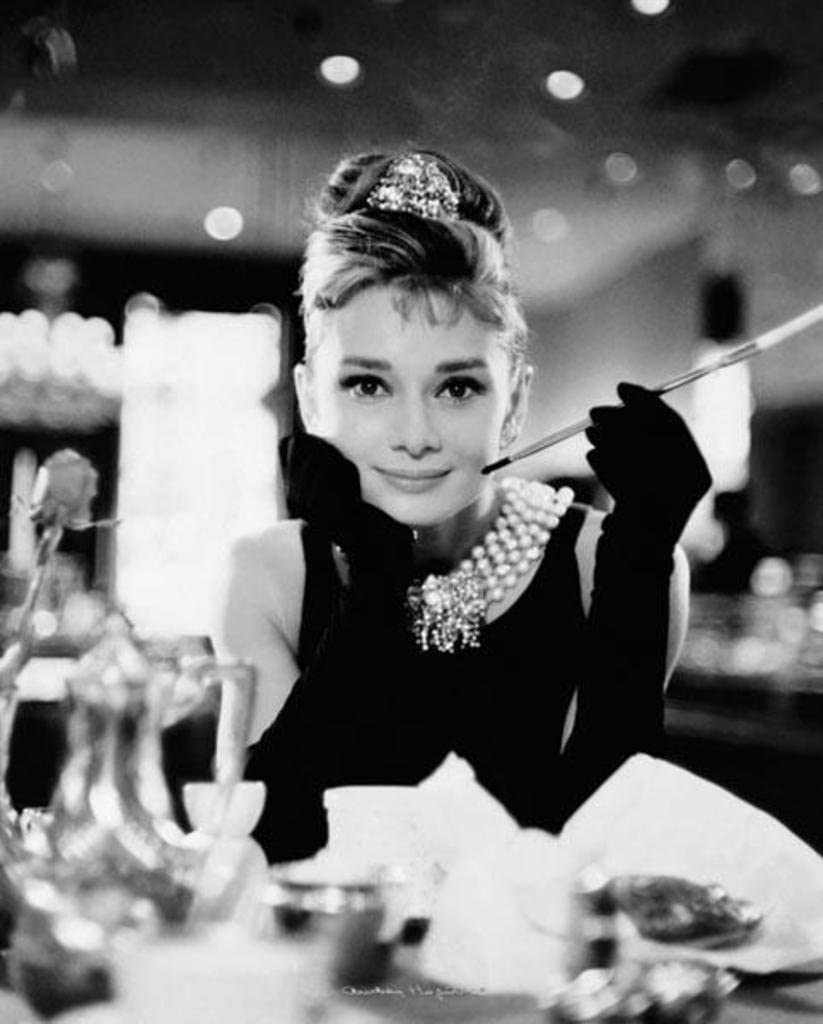
  • Audrey Hepburn’s black dress from this movie sold for $807,000 in 2006, and her shooting script (complete with handwritten notes) sold in 2017 for $846,000, the most ever spent for a script. The winning bidder: Tiffany & Co.
  • “Moon River” has become a standard, though Henry Mancini always called Hepburn’s rendition his favorite. Easily the most famous cover: Andy Williams!
  • There have been a few attempts to turn “Breakfast at Tiffany’s” into a play, most infamously the 1966 musical adaptation. Despite the talents of composer Bob Merrill and stars Mary Tyler Moore and Richard Chamberlain, the show never worked, and producer David Merrick shut it down after four previews, rather than subject an audience to, as he put it, “an excruciatingly boring evening”.
  • And finally: Rock band Deep Blue Something was inspired to write their hit song “Breakfast at Tiffany’s” after watching….”Roman Holiday“? Todd Pipes has stated that while “Roman” served as his inspiration, he felt “Breakfast at Tiffany’s” made for a better song title.

#460) The Iron Horse (1924)

#460) The Iron Horse (1924)

OR “A Rail of a Tale”

Directed by John Ford

Written by Charles Kenyon and John Russell

Class of 2011

The Plot: Set during the construction of the Transcontinental Railroad, “The Iron Horse” is an epic tale of unity in the wild west (well, Utah). While on the job, Union Pacific surveyor Davy Brandon (George O’Brien) reunites with childhood friend Miriam Marsh (Madge Bellamy). Although they still have feelings for each other, Miriam is engaged to civil engineer Peter Jesson (Cyril Chadwick). Davy is also trying to track down the “two-fingered Indian” who killed his father when he was a boy. Not-so-coincidentally, evil landowner Deroux (Fred Kohler) only has two fingers on his right hand, and occasionally poses as a Cheyenne warrior to agitate the local tribes and cause trouble with the townsfolk. It’s all the impressive filmmaking and harmful stereotypes you’ve come to expect from John Ford’s oeuvre, plus Abraham Lincoln (Charles Edward Bull)!

Why It Matters: The NFR calls it “[a] classic silent film” with a “reverential, elegiac mythology that has influenced many subsequent Westerns.” There’s also an essay by silent film expert David Kiehn. Hey, he wrote the essay for my last post too! What are the odds?

But Does It Really?: By today’s standards, this film is bloated and brimming with cliches – both stereotypical and otherwise – but at its core “The Iron Horse” is a well-made drama whose effect can still be felt (albeit faintly) almost 100 years later. “The Iron Horse” is on this list for its historical significance as a hit movie of its day, and its cultural significance as one of John Ford’s earliest successes. A pass for “The Iron Horse”, but this is another one reserved for the film buffs.

Everybody Gets One: Leading lady Madge Bellamy was a star of the silent era, equally known for her on-screen talent as her off-screen temper (fan magazines called her “Miss Firecracker”). Her career declined in the late ’20s when she turned down roles in such films as “Ben-Hur” and “7th Heaven“. Bellamy last made headlines in the early 1940s when she was arrested for firing shots at an ex-lover.

Wow, That’s Dated: Goddamit John Ford, we talk about this every time! Yes, Native Americans were angry when the Transcontinental Railroad took over their land, but that is a far more nuanced situation than the anonymous savages of “The Iron Horse”. And on top of that, the film has a misguided message about the immigrants who helped build the railroad, all of them depicted as one-note racial and ethnic stereotypes.

Other notes 

  • Like so many great movies, “The Iron Horse” was made to cash in on the success of another movie. Paramount’s 1923 western “The Covered Wagon” was a huge success, helping revive interest in the western genre. Fox Film wanted to get in on the action, but was only willing to give “The Iron Horse” half the budget of “Covered Wagon” ($280,000 vs. $500,000). John Ford was hired to direct because of his reputation for bringing his films in on-time and under budget (a streak he continued with “The Iron Horse”).
  • The first takeaway from “The Iron Horse” is just how reverential it is to Abraham Lincoln and a major event from the 1860s. It’s like “The Birth of a Nation“, but racist in a different way. Keep in mind this film was made 60 years after the fact. Today it would be like doing a movie about the moon landing and praising JFK to the hilt.
  • Along with Honest Abe, Buffalo Bill and Wild Bill Hickok also make appearances. In terms of brushes with history, this movie is less “Forrest Gump” and more “Titanic“.
  • The bulk of “The Iron Horse” was shot on location just outside of Reno, Nevada. The entire town of North Platte was built for the movie, and local justice of the peace Charles Edward Bull was cast as Lincoln based on his uncanny resemblance. The shoot did, however, face some unexpected snowfall, which Ford was able to quickly incorporate into a few scenes before having his cast and crew of hundreds shovel it all up in a matter of hours to continue filming.
  • And then the adult Davy shows up and this movie falls into its pattern: scenes of the railroad and its significance, followed by scenes of the Davy/Miriam love story, and then scenes of the comic relief railroad workers. It’s all fine, but I worry for Miriam’s well-being; Davy’s just gonna cheat on her with The Woman from the City. That joke was for you silent film buffs out there; you’re the real heroes!
  • A couple of things: first of all, the “two-fingered Indian” is the forefather to such notable criminals as the One-Armed Man from “The Fugitive” and Count Rugen from “The Princess Bride“. Secondly, it’s so obviously Deroux. Like, this should have been wrapped up in the first act. Side note: When Deroux goes to the saloon I assume he only orders two ounces of whiskey. What’s the term for that?
  • [Spoilers] My favorite unintentionally funny moment is Miriam’s response to Davy murdering her fiancée: “David, you promised.” Even in the 1860s, men failed to clear the exceptionally low standards set by the women who love them.
  • The movie’s finale is quite epic, and a harbinger of the kind of mammoth finales Ford would later hone in such films as “Stagecoach“. Plus, this has got to be one of the rare Westerns where the female characters get to fight alongside their male counterparts with no questions asked.
  • The final scene is, of course, the driving of the golden spike into the completed railway track. The intertitles go out of their way to mention that the Union Pacific’s No. 119 and the Central Pacific’s Jupiter used for the scene were the original engines. This is unquestionably false; the originals had been dismantled and scrapped some 15 years before this film’s production. Nice try, though.
  • Some John Ford western this is: Where’s Monument Valley?

Legacy 

  • “The Iron Horse” was the highest grossing film of 1924, and helped propel the career of John Ford. Over the next 40 years, Ford directed dozens of films, including 10 more that would make the National Film Registry (well, 9 1/2, he only directed part of “How the West Was Won“).
  • Among Ford’s later NFR films: Abraham Lincoln goes from glorified cameo to leading man in 1939’s “Young Mr. Lincoln“, which technically is a prequel to this movie.
  • The real life Transcontinental Railroad still exists, though large portions of the track have been rerouted and abandoned, and of course the original track has long been replaced and upgraded. The closest approximation to the original still running is the California Zephyr from Chicago to Emeryville.

#459) A Trip Down Market Street (1906)

#459) A Trip Down Market Street (1906)

OR “A San Francisco Treat”

Directed by Harry Miles

Class of 2010

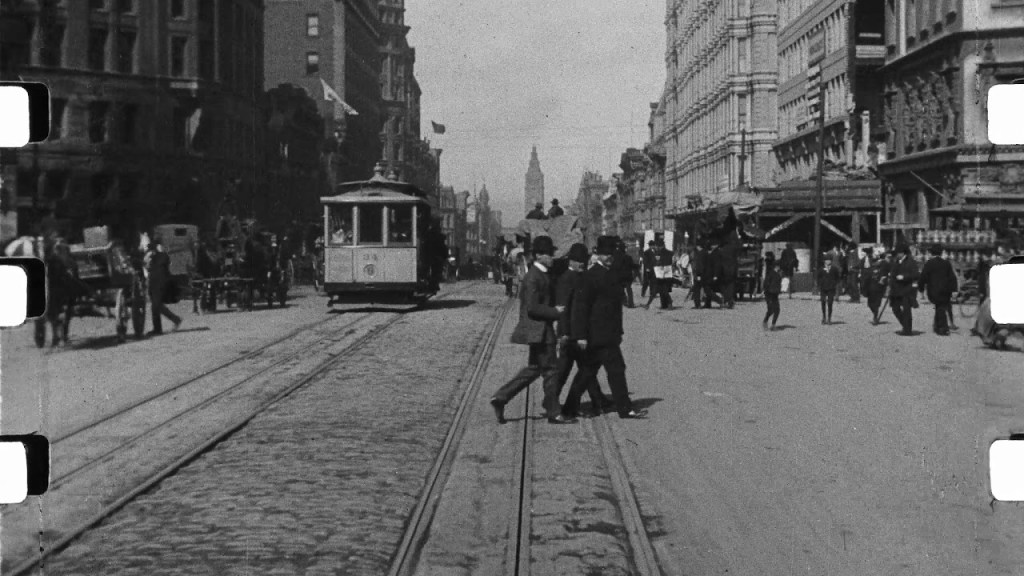
The Plot: In 1906 San Francisco, independent filmmaker Harry Miles took a camera, placed it in front of a cable car, and hand-cranked the camera during its trip down Market Street, from 8th Street to the Embarcadero Ferry Building. Along the way Miles captures the hustle and bustle of California’s (then) most prosperous city, capturing sights of horse drawn carriages, pedestrians in formal attire (complete with bowler hats), as well as plenty of those new-fangled automobiles. What started out as an experimental film documenting San Francisco suddenly became a sought-after historical artifact when, just four days later, the infamous 1906 earthquake struck.

Why It Matters: The NFR writeup gives a historical rundown, and an essay by historian David Kiehn details how Kiehn successfully determined the film’s production date.

But Does It Really?: Obviously my closeness to the subject matter gives me a bit of a bias, but “A Trip Down Market Street” is an invaluable historical document. The film’s innovative cinematography helps differentiate it from other actuality films of the era. Filming an entire street on a moving vehicle helps preserve so many details of turn-of-the-century living. And the film’s unintentional date with destiny adds an extra layer to the viewing experience. No argument here for the NFR induction of “Market Street”.

Everybody Gets One: The Miles brothers (Harry, Herbert, Earl, and Joe) started off with Biograph Studios before branching out into their own independent film company. They kept an office in New York, but moved their business to San Francisco, making theirs the first film company with offices on both coasts. After successfully filming an entire prize fight between “Battling” Nelson and Jimmy Britt in 1905, the brothers opted to film Market Street on a cable car. This wasn’t too big a stretch for the brothers; this film’s starting point is half a block away from their Market Street studio.

Wow, That’s Dated: As a San Francisco citizen I’ll point out the most important now-outdated aspect: Cars being allowed to drive down Market Street.

Other notes

  • For many years, the Library of Congress determined that the film was shot in September 1905, based on the buildings in the background. Something about that date didn’t ring true for film historian David Kiehn, who went about doing his own research on the film. Using newspapers and other artifacts in the San Francisco Library, Kiehn learned that several of the cars’ license plates weren’t registered until January and February of 1906. Puddles spotted on the tracks placed filming in late March or early April (San Francisco had no rain in September 1905). Finally, he found newspaper articles regarding production, and could pinpoint the actual shoot to Saturday, April 14th 1906, a little after 3pm. Kiehn chronicles his journey in his aforementioned essay, as well as this “60 Minutes” piece.
  • Also worth noting from Kiehn’s research: while Market Street appears to be bustling with cars, automobiles were still quite a novelty in America. The Miles Brothers hired a few chauffeurs to drive past the camera, circle back, and drive past them again. One car passes the camera six different times during the 12 minute film.
  • Because the camera is mounted on the front of a cable car, you can spot several people “hailing” the camera as it comes towards them.
  • Wow, everyone is cutting this cable car off. There’s also several close calls between cars, pedestrians, and horses. It helps that cars of the era had a top speed of around 30mph, no one’s getting hurt by these things.
  • My favorite detail: A giant sign of the side of one of the buildings advertising “Pianos”. Makes sense, every home had one back then.
  • Another prominent sign: M. Blaskower’s Cigar Shop with its “Nathan Hale” five cent Cuban style cigar. “If you have one life to live for this country, smoke ’em if you got ’em!”
  • The film ends with the cable car approaching the Ferry Building, then moving on a turntable to head back up Market Street. The final few frames are children waving at the camera, an occurrence that takes place in every era of American filmmaking.

Legacy

  • Of course, the film’s legacy was solidified only four days later when San Francisco was destroyed by the 1906 earthquake and fires. Among the many buildings destroyed was the Miles Brothers’ Market Street studio. “A Trip Down Market Street” was loaded onto a train for New York the day before the earthquake hit, and only three prints of the movie are known to exist.
  • While the brothers continued their business (their film of a pre-earthquake San Francisco became in-demand), they still never came out of the financial hole the studio’s destruction left them with. Following Harry’s death in 1908, and the company being forced into bankruptcy in 1910, the remaining Miles brothers went their separate ways, working for other small film companies.

Further Viewing: In 2005 (back when this film was believed to be from 1905), filmmaker Melinda Stone set out to recreate this film for its centennial. Even in only 15 years, the Market Street in this updated film differs from its present day iteration. One of the film’s producers/researchers is film curator Liz Keim, who I can say from personal experience is one of the nicest, most insightful people I’ve ever had the pleasure of knowing.