The Plot: Armed with his 16mm camera and a ton of paper, animator Robert Breer rotoscopes his train ride in Japan that overlooks Mount Fuji. Instead of realistic animation, Breer opts for something more abstract, focusing on the minimum of lines and colors it takes to convey his trip. Punctuated by a real life train recording, “Fuji” distills the illusion of movement in film, and highlights what experimental animation is capable of.
Why It Matters: The NFR gives a rundown of Breer and how “Fuji” came to be. The write-up also cribs from avant-garde expert Amos Vogelm who called the film “poetic, rhythmic, [and] riveting”.
But Does It Really?: Oh sure. Robert Breer is just as deserving of NFR recognition as any of the other experimental filmmakers/animators on this list. And as a bonus, I always enjoy when an NFR movie takes me somewhere outside the United States. An appreciative pass for “Fuji” and Robert Breer.
Everybody Gets One: Robert Breer started off as an engineering major at Stanford, but turned to painting while in Paris in the early 1950s. Around the same time, Breer experimented with making stop-motion films based on his paintings. The film medium allowed Breer the freedom to continue tweaking with a piece, unlike the “rigid” absolute of painting. Breer was experimenting with rotoscoping when he visited Expo ‘70 in Osaka, Japan, and filmed his train ride near Mount Fuji.
Seriously, Oscars?: No Oscar love for “Fuji”. Best Animated Short that year went to “Closed Mondays”, a stop-motion short from the people that would one day bring you the California Raisins. None of Breer’s shorts ever received Oscar attention.
As is often the case with more experimental animation, my notes are irrelevant, so instead let’s play “Things I Thought I Saw in ‘Fuji’”:
Mount Fuji
A train
People
Birds
…oh. This one’s pretty straightforward, actually.
Legacy
Robert Breer continued making films (and teaching film and animation at Cooper Union) up until his retirement in the early 2000s. Breer died in 2011 at the age of 84.
As for Mount Fuji, it’s still going strong as the highest peak in Japan. An active volcano, Fuji last erupted in the early 1700s, which means we’re probably due for another one, right?
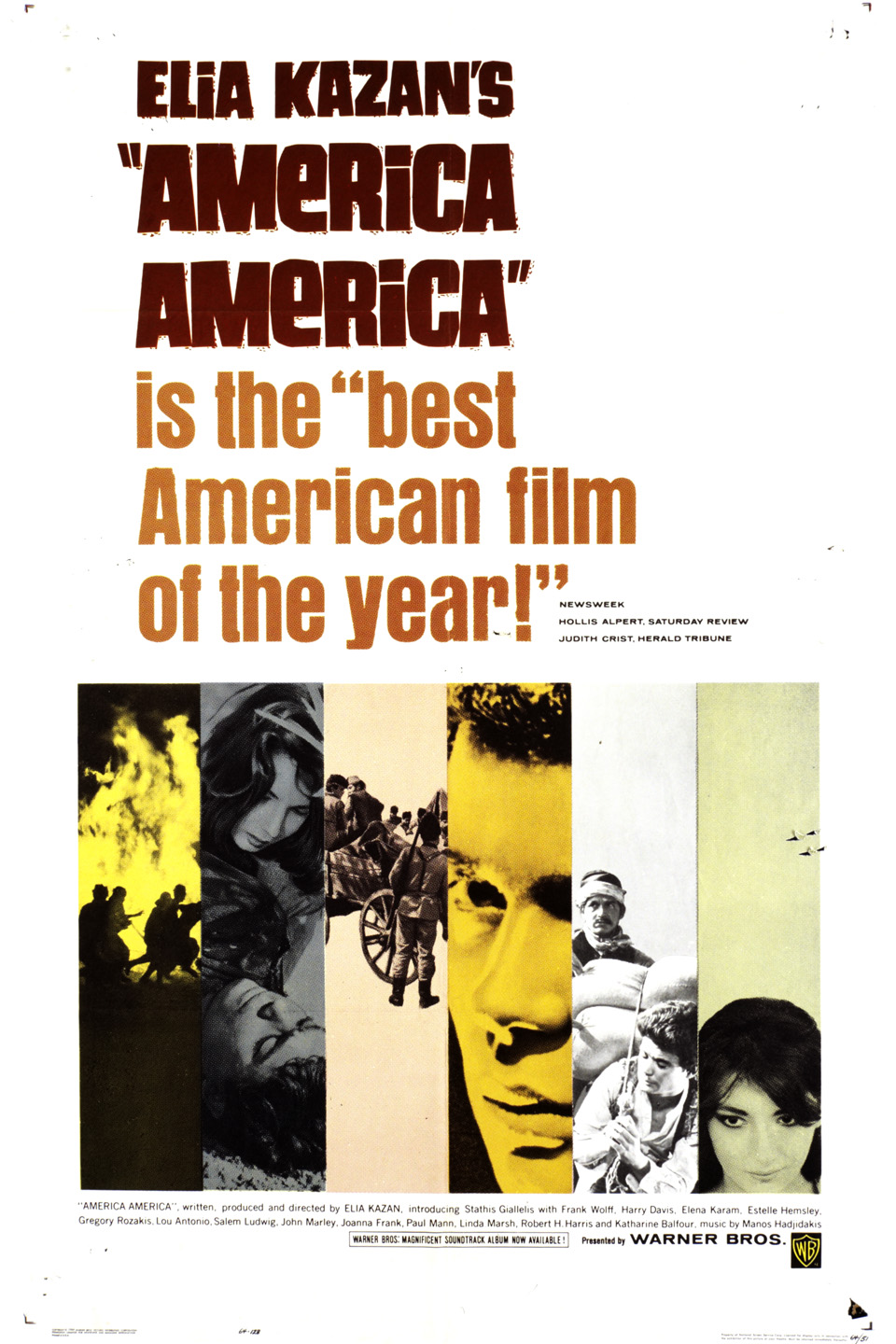
The Plot: Based on the true story of Elia Kazan’s family, “America America” chronicles a young man’s journey from his oppressed Greek family living under the Ottoman Empire to his arrival in America. Shortly after the Armenian genocide of the late 1890s, Stavros Topouzoglou (Stathis Giallelis) is entrusted with his family’s fortune to travel to Constantinople and work for his cousin (Harry Davis). Stavros, however, secretly wishes to go to America and send for his family once he’s made enough money. Kazan paints a portrait of the sacrifices every immigrant makes to live in the land of opportunity, or, as many of the Greeks referred to it, America America.
Why It Matters: The NFR cites the film as Kazan’s “personal favorite”, and gives a shoutout to cinematographer Haskell Wexler and art director Gene Callahan.
But Does It Really?: “America America” isn’t Elia Kazan’s greatest film, nor his most memorable, but it is definitely his most personal. Not only does Kazan as a filmmaker get to explore his own roots, but he does so on a grand scale, from the on-location shooting to the detailed authenticity of the costumes and sets. You could never make this kind of movie without a director of Kazan’s clout, and the results, while a bit tedious at times, is still an impressive, admirable feat. A respectful pass for “America America” and its NFR inclusion.
Everybody Gets One: After months of trying to find a young unknown actor to play Stavros (including a young unknown Peter Falk!), Elia Kazan tried a new approach: he went to Athens, visited the office of director Daniel Bourla, and singled out an apprentice sweeping Bourla’s office floor. The apprentice was Stathis Giallellis, who, despite speaking virtually no English, possessed the “desperation” Kazan was looking for in Stavros. Kazan brought Giallellis to New York, spent a month coaching him in acting and English, and eventually gave him the lead after his successful audition reading a scene from “Golden Boy”.
Wow, That’s Dated: While some of the cast (primarily Stathis Giallelis) are Greek or of Greek descent, others are definitely not. Frank Wolff is of German descent, John Marley is Russian-Jewish, and Estelle Hemsley is African-American. I’ll repeat that last part: Kazan cast an African-American woman in his Greek movie and thought no one would notice.
Seriously, Oscars?: A critical hit upon release, “America America” received four Academy Award nominations. The film lost Picture and Director to the night’s big winner “Tom Jones”, and Original Screenplay to fellow NFR entry “How the West Was Won”. “America America” did, however, win the Oscar for Art Direction.
Other notes
“America America” is based on Kazan’s family, specifically the tribulations of his uncle, Avraam Elia. Kazan was born in Constantinople in 1909, roughly 10 years after the events of this movie, and immigrated to America circa 1917. To prepare for the film, Kazan interviewed his parents to ensure accuracy in his portrayal of the family. Kazan was so determined to make this film, he resigned as director of the Acting Studio to focus entirely on production.
I wonder how much the foreign film craze of the late ‘50s/early ‘60s had on influencing this movie. After the Foreign Language Oscar was officially made a category in 1956, there was a definite uptick in foreign films getting wider American releases, among them the 1960 Greek film “Never on Sunday”. This all must have made “America America” an easier sell to Warner Bros.
The movie’s big claim to fame is that it was shot almost entirely on location in Turkey and Greece. It definitely helps with the overall scope of the movie. A handful of scenes were shot in California, most notably the Sierra Nevada Mountains near Bishop.
Perhaps it’s the on-location shooting, but everyone in this movie is dubbed all the time. Was the sound equipment loaded onto the wrong plane?
Shoutout to Estelle Hemsley, the African-American actress who, and I can’t stress this enough, is cast as a Greek woman in this movie. Fun Fact: She was also in “The Leech Woman”!
Obviously, a movie like this is going to be episodic, but man does the Abdul plot line go on forever. We get it, he’s conning Stavros. Move on please. I actually applauded when they finally killed him off.
As the author of a film blog named after the horse’s head scene in “The Godfather”, I am required by law to point out any movie that features John Marley. Here, Marley plays Garabet, the man Stavros meets while living on the streets who tells him about “small money” and “big money”. Marley’s naturally craggy features blend in with the surroundings of Constantinople.
In this movie Paul Mann plays Aleko Sinnikoglou, who arranges for the main character to marry his daughter. You know him best for his performance in “Fiddler on the Roof” as Lazar Wolf, who arranges to marry the main character’s daughter. What an oddly specific type Mann excelled at playing.
Side note: Paul Mann looks a lot like Robert Altman, doesn’t he?
I must say Stathis Giallelis is very good in this. His Stavros goes from youthful optimism to older cynicism in a naturally subtle way. I suspect this is how Giallelis missed out on an Oscar nomination: it’s too subtle, you can’t “see” the acting.
This is another movie where I didn’t take a lot of notes; I was just watching the movie and seeing where it took me. I was willing to forgive the film’s slower moments because it is apparent throughout that “America America” is Kazan’s passion project.
Kazan pulls an Orson Welles and narrates the end credits, giving shoutouts to his main crew members, as well as the cast.
Legacy
Allegedly, “America America” was part one of a trilogy Kazan planned on making. As best I can tell neither of those two remaining parts were ever written or filmed, though Kazan’s next feature – 1969’s “The Arrangement” – also center on a Greek-American character. Kazan even uses footage from “America America” to show his main character coming to America.
Kazan’s film career was near an end by the mid-60s, and he only made a few more films, most notably the 1976 adaptation of “The Last Tycoon” with Robert De Niro.
Directed by Charles Bryant (and an uncredited Alla Nazimova)
Written by Alla Nazimova and Natacha Rambova. Based on the play by Oscar Wilde.
Class of 2000
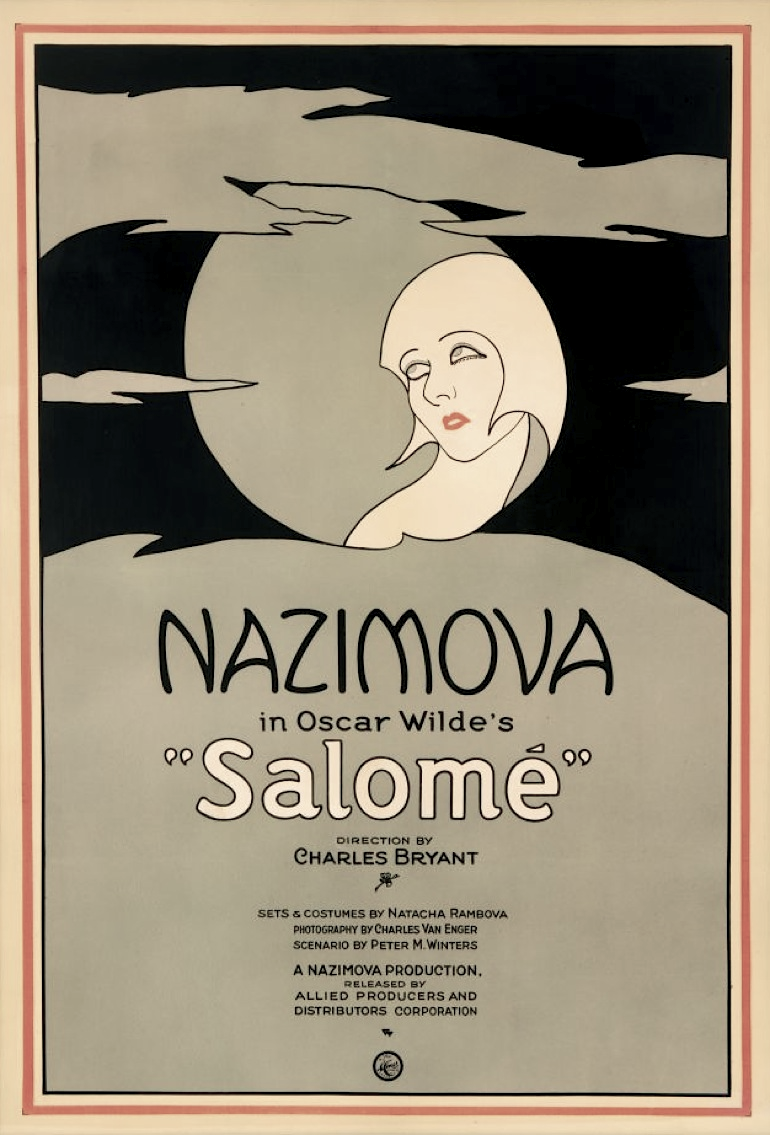
The Plot: Loosely based on the Oscar Wilde play (which in turn is loosely based on the New Testament story), Salome (Alla Nazimova) is the daughter of Herodias (Rose Dion) and stepdaughter of Herod the Tetrarch (Mitchell Lewis). During a royal banquet, Salome encounters Jokanaan the Prophet, aka John the Baptist (Nigel De Brulier), imprisoned for his criticism of Herod’s marriage to Herodias (the ex-wife of Herod’s half-brother). Salome declares her love for Jokanaan, who quickly rebuffs her. When Herod requests that Salome dance the provocative Dance of the Seven Veils, Salome agrees on the condition that Jokanaan’s head be brought to her on a silver platter! Hell hath no fury like a biblical figure scorned.
Why It Matters: The NFR calls the film “one of the earliest examples of surrealism in film” and praises the sets and “flamboyant” costume design. An essay by film expert Martin Turnbull argues that Alla Nazimova was an artist ahead of her time.
But Does It Really?: After feeling decidedly “meh” after watching this film, it was the aforementioned Turnbull essay that convinced me to give “Salome” a pass. As a whole, the film’s emphasis on surrealism mixed with its glacially slow pacing makes for a challenging watch, but it does represent Alla Nazimova, an artist whose brief Hollywood tenure deserves a mention. Neither Nazimova nor “Salome” are integral to film history, but, like many others on this list, they are “figures in the carpet” that provide more details to a specific era of filmmaking.
Everybody Gets One: A student of Constantin Stanislavski, Alla Nazimova was the toast of the European theater scene of the early 1900s. Her move to New York and Broadway were equally successful, and it wasn’t long before Hollywood became interested in film adaptations of Alla’s stage work. By the late 1910s, Nazimova had moved to Hollywood and was one of the highest paid actors of the day. Eventually, she sought more creative control over projects, “Salome” being a prime example: she is credited for acting and writing, did uncredited directing, distributed the film through her own Nazimova Productions, and even financed the entire project ($350,000, roughly 5 million today).
Other notes
The film’s director Charles Bryant was not only an actor-turned-director, but he was also Alla Nazimova’s husband. The two appeared together in a series of films for Metro before both jumped ship for Nazimova Productions. It was revealed years later that theirs was a lavender marriage, most likely to help mask Alla’s bisexuality. The couple separated shortly after the financial failure of “Salome”.
For the record, the story of John the Baptist’s beheading is covered in only a few passages in the Book of Mark. They don’t even mention Salome by name! The Oscar Wilde play is one act, his major contribution to the story being the Dance of the Seven Veils. And that’s about as much padding as this story can handle.
The first chunk of this movie is intertitles explaining the story of Salome and introducing all the characters. It eats up a lot of screentime. This is why no one watches silent films anymore; who wants to read their movie?
Shoutout to Natacha Rambova, the film’s costume and production designer. Rambova was inspired by the illustrations of Aubrey Beardsley in the original publication of Oscar Wilde’s “Salome”. The result is quite outlandish, but not soon to be forgotten: from the film’s minimalist set (shot entirely indoors for maximum lighting effects) to its elaborate, Roman-Empire-by-way-of-Art-Deco costumes. Fun Fact: Rambova was briefly married to Rudolph Valentino.
“Salome” has joined the elite group of NFR films for which one of my notes simply reads “What is happening?” Part of that is this film’s assumption that you’re familiar with the story of “Salome”, and the other part is the film’s pacing being epically slow. Everything is such an ordeal: John takes forever to reject Salome, Salome takes forever telling Herod what her wish is, everyone takes forever doing everything! I know the emphasis is on the visuals rather than the story, but please have mercy on the little bit of plot there is.
In case you missed it, the film’s main thesis plays at both the beginning and the end: “The Mystery of Love is Greater Than the Mystery of Death”.
Legacy
“Salome” was a critical and commercial flop when it opened and, combined with her other big-budget failures, led to Nazimova’s bankruptcy and departure from Hollywood. She briefly returned in the early 1940s as a supporting actor in sound films, ironically living in a hotel that had once been her mansion (the infamous “Garden of Allah”). Alla Nazimova died in 1945, several decades before her movies would be rediscovered and reappraised.
Oscar Wilde’s “Salome” has been revived and referenced from time to time, most recently in 2011’s docudrama “Wilde Salome” directed by Al Pacino and starring Jessica Chastain.
There have been a few film remakes of “Salome” over the years, but the most notable is an ultimately abandoned epic circa 1950 that was meant as a comeback vehicle for silent film star Norma Desmond.
#417) King: A Filmed Record…Montgomery to Memphis (1970)
Directed by Sidney Lumet and Joseph L. Mankiewicz (uncredited)
Class of 1999
Here’s a trailer from the film’s BluRay release
Martin Luther King and the Civil Rights Era are enormously complex, especially considering how much of my education on the subjects is oversimplified to the point of inaccuracy. As always, I am only commenting on what is being presented in this film, and how it’s being presented. You owe it to yourself to learn more and go beyond what you think you know about this man and his times.
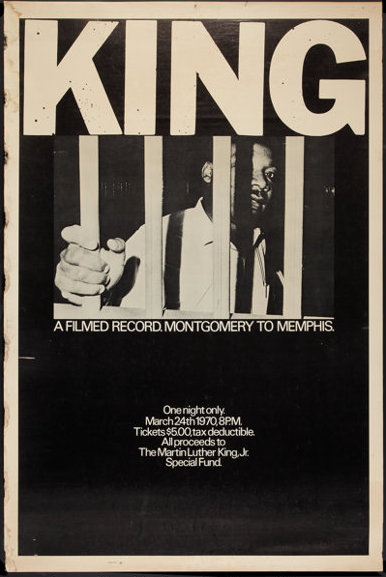
The Plot: As the title suggests, “King” chronicles the rise of Dr. Martin Luther King Jr., Christian minister and the face of the Civil Rights Movement. Culled from hundreds of hours of film and television footage, we follow Dr. King from his first public exposure leading the Montgomery bus boycott in 1955, to his iconic “I Have a Dream” speech at the 1963 March on Washington, to his tragic assassination during the Memphis Poor People’s Campaign in 1968. Also featured are brief filmed sequences from such stars as Paul Newman, Ruby Dee, Harry Belafonte, and Burt Lancaster.
Why It Matters: The NFR gives a rundown of the film’s production and Dr. King’s media savvy, calling him “an astute judge of the media” and someone who knew “how to exploit his celebrity to further his cause.”
But Does It Really?: I’ve spent my entire life learning about Martin Luther King as a lionized martyr who preached peace and racial unity, so it’s refreshing to see a movie that treats him as a human with a strong moral backbone. While not an all-encompassing profile of the man, “King” provides the history of the civil rights movement and Dr. King’s influence on his times. The film still paints King in a positive light (no allegations of plagiarism or extra-marital affairs here), but helps give a sense of the conservative ‘50s giving way to the optimistic early ‘60s before turning into the politically unstable late ‘60s. “King” is an era’s tribute to one of its finest, and its NFR inclusion is welcomed.
Shout Outs: Look quickly during the Memphis march for a marquee advertising “The Graduate”.
Everybody Gets One: Ely Landau was a TV producer who, by the mid-1960s, had pivoted to producing films based on plays, most notably 1962’s “Long Day’s Journey Into Night”. Following Dr. King’s assassination, Landau planned a short film tribute, but enough material was found to create a feature length film. Of the film’s celebrity appearances, this is the only NFR appearance for Oscar winner/humanitarian Joanne Woodward. Here, Ms. Woodward briefly comments on the 16th Street Baptist Church bombing, which we’ll cover in more detail with Spike Lee’s “4 Little Girls”.
Wow, That’s Dated: Subject matter aside, the main giveaway that this is the late ‘60s is an appearance by Clarence Williams III, aka Linc from “The Mod Squad”.
Seriously, Oscars?: “King” played in theaters across the country one night only: March 24th 1970. In cooperation with the National Association of Theatre Owners of America and the Motion Picture Association of America, all proceeds from the evening went to The Martin Luther King Jr. Special Fund. Whether or not the film played additional dates in Los Angeles is unknown, but regardless, the film received an Oscar nomination for Best Documentary. The Oscars opted to vote for something a little closer to the zeitgeist, and gave the prize to “Woodstock”.
Other notes
To the best of my knowledge, the archival footage was assembled by Ely Landau and co-producer Richard Kaplan. Sidney Lumet & Joseph Mankiewicz filmed the celebrity interstitials, though I couldn’t find anything that confirms who shot what.
The film opens with a montage of King speaking publicly about non-violence, juxtaposed with other civil rights activists preaching violence. As much as we’d like to focus on the peaceful protests, it’s important to see the anger of the era as well.
The first of the celebrity appearances is singer/activist Harry Belafonte, also seen in news footage alongside Dr. King at several events. As of this writing, Harry Belafonte is still going strong at age 92! He was in “BlacKkKlansman”!
My one complaint about the film in general is that we don’t really get to know Martin Luther King beyond his public persona. His speeches are still powerful and stirring over 60 years later, but who is the man behind the speeches? Much like “The Times of Harvey Milk”, this film focuses more on the era and the movement than the person at its center.
Those who remember Charlton Heston’s NRA “cold dead hands” brand of politics may be surprised to see him in this movie. In his younger days Heston was a vocal Civil Rights activist, and even participated in the March on Washington. Like many disenchanted liberals of the early ‘70s, Heston pivoted towards neoconservatism and the Republican Party.
The great thing about having one of the world’s greatest orators at your church: no problem filling up that collection plate.
With the Montgomery bus boycott of 1955 and the Albany movement of 1961, King demonstrates an important point of protesting in America: the most effective form of protest involves the other side losing money, hence why boycotting buses and segregated businesses was ultimately successful.
The Birmingham campaign of 1963 is perhaps best remembered for the police’s use of high-pressure hoses and dogs on the African-American protesters. It’s unsettling to watch, but an important viewing nonetheless.
Longtime readers will note that this is the second film I’ve covered on the list that documents The March on Washington, but it helps that this one actually has the audio for “I Have a Dream” (thanks, King estate!) Seeing the march within this film’s context highlights this event as the apex of King’s career. Also, listen for Joan Baez singing “We Shall Overcome”, bumping up Joan’s NFR filmography to 3 ½!
The Selma to Montgomery march of 1964 is a reminder that I still need to get around to watching the Ava DuVernay movie. Like Washington, the Selma march is loaded with celebrities, including a reunion of comedy duo Nichols & May.
Jesse Jackson was involved in the Chicago Freedom Movement of 1966? Who isn’t in this movie?
The thing that surprised me most was how aware King was of his impending death. The one off-the-cuff interview we get in this film is King discussing the gunshots fired near him in Chicago, and how much that put him in touch with his own mortality.
Martin Luther King is one of the rare people who got to speak at their own funeral. At Coretta Scott King’s request, a recording of Dr. King’s final sermon was played at his funeral. Appropriately enough, his “Drum Major Instinct” speech was about how he wished to be remembered after his death. This audio is followed by footage of his funeral procession, accompanied by Nina Simone’s rendition of “Why?”
Legacy
“King” played its one night screening, and besides an occasional TV broadcast, more or less disappeared. In 2010, producer Richard Kaplan commissioned a restoration of “King” using his own personal film elements, and released the film on DVD. Thank god I waited until the digital streaming era before attempting this blog.
As for the man himself, Dr. Martin Luther King Jr. is one of the most celebrated figures of the 20th century; his countless honors include several civil rights foundations, streets in over 900 American cities, and even a Federal holiday! And with any luck, we’ll see him and Harriet Tubman on our currency in the near future.
Written by William R. Lipman and Sam Hellman and Gladys Lehman. Based on the short story by Damon Runyon.
Class of 1998
No trailer. In fact, the only footage I could embed was one of those YouTube tribute videos.
The Plot: Bookie Sorrowful Jones (Adolphe Menjou) reluctantly agrees to take collateral (a “marker”) for a horse race when one of the betters (Edward Earle) places a $20 marker on his daughter Marthy (Shirley Temple). When the man loses the bet, he runs out and commits suicide, and Sorrowful and his gang take in Marthy, nicknaming her “Marky”. The gangsters become an extended family to Marky, with Sorrowful as her put-upon new father and nightclub singer Bangles Carson (Dorothy Dell) as a more agreeable surrogate mother. There are a few songs and loads of sweetness in one of Hollywood’s first attempts at a “Shirley Temple picture”.
Why It Matters: The NFR gives a quick rundown of Shirley Temple, calling her “[o]ne of the most popular stars of the 1930s” and “the biggest child star the world had ever seen”. There’s also an essay by film professor/Shirley Temple expert John F. Kasson.
But Does It Really?: It’s clear the NFR inducted “Little Miss Marker” as representation of Shirley Temple’s career, but when I think Shirley Temple, this is not the movie that comes to mind. Mention Shirley Temple to any film buff and they’ll picture her dancing up the stairway with Bill Robinson, or singing the likes of “Animal Crackers” and “Good Ship Lollipop”. Those moments are from three different movies, and none of them are “Little Miss Marker”. On its own, “Marker” is a quick, enjoyable, harmless movie, but compared to the other films that could represent Miss Temple on the list, it is found wanting.
Everybody Gets One: Shirley Temple started making movies when she was three years old! After being spotted by a casting director in her dance class, Temple signed a contract with Educational Pictures and starred in “Baby Burlesks”, a series of shorts that spoofed modern movies. Her success in those shorts led to a featured role in the Fox film “Baby, Take a Bow”, and later a Fox contract with a seven-year option. Temple quickly became a nationwide sensation, and her films the epitome of Depression-era escapism. “Little Miss Marker” was her only non-Fox film of the era, on loan to Paramount.
Wow, That’s Dated: Besides the obvious ‘30s slang, “Little Miss Marker” resorts to some of the negative African-American and Asian-American stereotypes of the day. The most visible example is Willie Best, who spent the bulk of his career playing a stereotypically lazy, slow black man, to the point where in some films he is credited as “Sleep ‘n’ Eat”. Yikes.
Seriously, Oscars?: No Oscar love for “Little Miss Marker”, but the Academy recognized Shirley Temple with the first ever Juvenile Oscar. Temple starred in six films in 1934, and this body of work earned her an honorary statuette. At six years old, Shirley Temple is still the youngest person to ever receive an Oscar.
Other notes
Right from the start, this thing is pure Damon Runyon: lowlifes with names like Sorrowful Jones and Benny the Gouge putting all their money on a horse race. I keep expecting Stubby Kaye to walk by.
It’s always hard to accurately judge a child’s acting ability, but what Shirley Temple lacks in polish, she more than makes up for in star quality. From her first moment on screen you know that she will melt the heart of every gangster in this movie.
Adjusted for inflation, the $20 marker on Marky would be about $380 today.
Adolphe Menjou is one of those actors who was not on my radar until this blog, and it’s a shame he’s not as well remembered today. From his lead comic turn in “The Front Page” to his later dramatic work in “Paths of Glory”, Menjou has quite the range, and provides a good foil for Shirley Temple here.
This film is also the only NFR representation of singer/actress Dorothy Dell. Sadly, “Little Miss Marker” was one of Ms. Dell’s final films; she was killed in a car accident at age 19 one week after this film’s premiere. Shirley Temple formed a close bond with Dell during filming, and her death devastated the young actor.
Finally, Shirley gets to sing! “Laugh You Son of a Gun” is a brief duet between Markie and Bangles, and it definitely leaves you wanting more.
Watching this ‘30s movie about an adorable orphan makes me suspect that “Annie” (the musical and subsequent films) has replaced “Little Miss Marker” in our cultural heritage. They are just similar enough properties, but “Annie” has all those songs!
Best exchange in the movie: “Wanna kiss me?” “Well, I ain’t runnin’ for mayor.”
Not only does the movie take a sudden dramatic turn at the end, but then Charles Bickford’s Big Steve returns and…he’s the hero? What a weird movie.
Legacy
After the success of “Little Miss Marker”, Paramount tried to buy out Shirley Temple’s contract with Fox, but she returned to her home studio and started making her best-known films. Temple’s star diminished in the 1940s, and she retired from acting at age 22. Ms. Temple had a successful second career as a diplomat, eventually becoming the US Ambassador to Ghana and Czechoslovakia.
“Little Miss Marker” has been remade for film three times: 1949’s “Sorrowful Jones” with Bob Hope and Lucille Ball, 1962’s modern update “40 Pounds of Trouble” with Tony Curtis, and 1980’s “Little Miss Marker” with Walter Matthau, Julie Andrews, and a poster that definitely rips off “The Sting”.
Ginger ale, a splash of grenadine, and a maraschino cherry is all you need to make the non-alcoholic drink named after Ms. Temple. Ironically, in her adult years Shirley admitted to hating the drink.
Further Viewing: I’m currently obsessed with the short-lived ‘80s TV show “Mad Movies”, in which Los Angeles improv group LA Connection overdubs public domain films. One episode turns Shirley Temple’s 1939 vehicle “The Little Princess” into an “Exorcist” parody. It’s a bit dumb and slightly dated, but it tickles me just right.
Listen to This: In 1950, Damon Runyon’s short stories “The Idyll of Miss Sarah Brown” and “Blood Pressure” were combined to become the book for the Broadway musical “Guys and Dolls” by Frank Loesser. The original cast album made the National Recording Registry in 2004.



 The Horse's Head