#736) Knute Rockne, All American (1940)

#736) Knute Rockne, All American (1940)

OR “Reagan’s Song”

Directed by Lloyd Bacon
Written by Robert Buckner

Class of 1997

The Plot: Pat O’Brien IS Knute Rockne, the famed football coach that led Notre Dame to five undefeated seasons and three national championships in the 1920s. Emigrating to America as a child from his native Norway, Rockne grows up in Chicago, eventually enrolling at the prestigious University of Notre Dame. While playing on their football team The Fighting Irish, Rockne successfully uses the rare forward pass play to win in an upset over Army at West Point, giving the team newfound popularity. After graduation, Rockne works as the Fighting Irish’s assistant coach, and then as their head coach, shepherding the aforementioned championships and training several promising athletes, including tragic wunderkind George Gipp aka The Gipper (Ronald Reagan). The life of an extraordinary man gets run through the Hollywood wringer and comes out a sanitized, saintly biopic.

Why It Matters: The NFR gives an overview of Knute Rockne and the film, calling it “less a factual document than a loving tribute”. And of course, the film’s connection to Ronald Regan’s later political career gets a mention (see “Legacy”).

But Does It Really?: “Knute Rockne, All American” is the kind of crowd pleasing “cradle to grave” biopic that, while noteworthy in its day, has been all but forgotten. Apart from some hardcore football fans or Notre Dame alumni, I don’t think people remember Knute Rockne, making this film’s cultural relevancy an uphill battle. The film’s by-the-numbers approach to its subject matter doesn’t help, and its uber-patriotism seems out of place in a modern viewing (think “Yankee Doodle Dandy” without the songs). Thanks to one line of dialogue, delivered by an actor whose biggest professional achievement would be 40 years later in another arena, “Knute Rockne” has maintained just enough of a pop culture footprint to warrant NFR induction (at least by 1997 standards).

Title Track: This film went by several working titles before settling on “Knute Rockne, All American”. Let the record show that despite his countless honors and memorials, Knute Rockne has never been officially named a College Football All-American, a designation bestowed on players, not coaches.

Seriously, Oscars?: No nominations for “Knute Rockne”. Warner Bros.’ big Oscar contenders in 1940 were two Bette Davis vehicles: “All This, and Heaven Too” and “The Letter”. And although Pat O’Brien never received an Oscar (or a nomination) in his 50-year showbiz career, he did receive an honorary degree from Notre Dame in 1981 alongside, you guessed it, Ronald Reagan.

Other notes

  • “Knute Rockne” began production with director William K. Howard at the helm, but Howard was replaced during production due to creative differences. Allegedly the differences came over a scene where Rockne converts to Catholicism which, while not depicted in the final film, did happen in real life. Howard was replaced by Lloyd Bacon, a mainstay of Warner Bros. who directed in a variety of genres, including two backstage musicals on the NFR: “42nd Street” and “Footlight Parade”. It is unknown how much (if any) of Howard’s footage remains in the final cut.
  • The opening credits mention the screenplay as being “Based upon the private papers of Mrs. [Bonnie] Rockne and the reports of Rockne’s associates and friends”, so you know going in this will be a favorable, lionized portrayal of Knute. The credits also thank the University of Notre Dame for their “gratuitous cooperation”. Did they mean “gracious” cooperation?
  • Despite my apprehension about this film’s historical accuracy, my research shows it skews close to Knute’s real story. A few dramatic liberties here and there, but for the most part this is how it all went down. It just goes to show how even the most interesting life can be doused in the artificiality of the Hollywood biopic.
  • I hate to say it, but Pat O’Brien is just okay in this. He goes to great lengths to look and sound like the real Knute Rockne (including prosthetic makeup that allegedly took three hours to apply), but ultimately, I didn’t buy his performance. There’s a couple of factors at play here; for one thing the movie version of Rockne isn’t a dimensional human but rather a Mr. Smith-esque series of ideals, which is tough for any actor to play. The other factor: While I’ve enjoyed Pat O’Brien’s other NFR performances, he’s always best as a supporting player or co-lead; He just can’t carry this whole movie by himself. Also, and I don’t know if this is true to how the real Knute Rockne spoke, but O’Brien talks way too damn fast in this. At times he sounds like he’s doing an impression of his buddy James Cagney, who was coincidentally also considered to play Rockne.
  • This post gave me an excuse to go down a Notre Dame research rabbit hole. My grandpa (he of my “Public Enemies” story) got his BA in journalism at Notre Dame (Class of 1947), so I enjoyed the opportunity to learn more about the school. Among my findings: “Knute Rockne” is one of only two movies that has been allowed to film on the Notre Dame campus; the other is perennial favorite “Rudy”. Also, the full name of the school is “University of Notre Dame du Lac”, or “Our Lady of the Lake”. And while the school was founded by French missionaries, the American faculty and students started pronouncing it “note-er daym” as opposed to the French “no-tra dahm”, leading to this Americanized pronunciation bleeding over into France’s Notre Dame de Paris. This is why the French hate us.
  • Speaking of pronunciations, prior to this viewing I had only heard Knute’s name pronounced as one syllable with a silent k (like “newt”). This movie says his name with two syllables and the k (as in “Ka-newt”). I’m told both are acceptable, but I’m sticking with the latter going forward.
  • If you’re a football novice like me you can still get through “Knute Rockne” without any problems, although I had to look up what exactly a forward pass is. Where’s John Facenda when you need him?
  • Several pivotal games in the movie are between Notre Dame and their rivals at the United States Military Academy in West Point, New York. While the West Point team is officially the Army Black Knights (aka Army Cadets), everyone in this movie just calls them Army, which makes it all sound like “Arrested Development”. “These are my awards, mother. From Army.”
  • I knew Ronald Reagan was in this, but I didn’t know it was such a brief episode. He shows up as Rockne’s golden boy, gives a nice loud Chekhov’s cough in his next scene, and then it’s straight to his deathbed monologue urging Rockne to “Win just one for the Gipper”. It’s also hard to separate Reagan’s performance from his later political career: when Reagan first appeared on screen, I booed.
  • Side note about “Win one for the Gipper”: Due to a dispute with the Gipp family, this scene was cut from some of the film’s TV airings and home video releases. I don’t know what exactly the dispute was over, but I guess the Gipp estate and Warner Bros. settled their differences because the uncut film has been available for the last 20 years.
  • Towards the end, we get cameos from four of Rockne’s fellow college football coaches: Howard Jones, William Spaulding, Alonzo Stagg, and Glenn “Pop” Warner (no relation to the Warner Brothers). All of them are very stiff non-actors, which I’m sure was a source of entertainment and ridicule for many of their former students. Fun Fact: Alonzo Stagg spent his last years coaching football in my hometown of Stockton, California. I used to live right by the high school named after him.
  • Everyone in this movie who isn’t Knute Rockne or George Gipp gets, forgive me, sidelined. Despite thanking the real Bonnie Rockne in the opening credits, her movie counterpart and the rest of the Rockne family are just set decorations. In fact, I’m convinced Rockne’s kids stay the same age throughout the movie, despite the decade-plus time jump. Also completely wasted here is Donald Crisp as Father John Cavanaugh. Come on, give him something to do; he’s Donald friggin’ Crisp! At least he’s got “How Green Was My Valley” to look forward to after this.
  • Knowing nothing about Knute Rockne going in, I was blindsided by this film’s ending covering Rockne’s fatal plane crash in 1931. I thought the references to Knute’s phlebitis were set-up for a premature death, but then we spend so much screentime on him boarding a plane to California I started getting “La Bamba” flashbacks. Damn those Fokkers. Side note: While the film depicts Rockne as flying to California to defend college football at a hearing on scholastic favoritism, in reality he was flying there to serve as technical advisor for the 1931 movie “The Spirit of Notre Dame”. Perhaps Warner Bros. didn’t want to remind people that the movies played a part in Rockne’s death, or just didn’t want to give Universal the free publicity.

Legacy

  • While “Knute Rockne” was a critical and commercial hit upon its initial release, in the ensuing decades it started to fade from public consciousness, with its cultural footprint solely resting on the line “Win one for the Gipper”.  In 1980, Ronald Regan, who had left acting in the 1960s to pursue politics, was elected President of the United States, which led to renewed interest in his filmography. “Knute Rockne” reaped the benefits of this revival, with several journalists referring to Reagan in print as “the Gipper”, a nickname that stayed with Reagan for the rest of his life. And that’s all I really want to say about the Reagan administration at this time.
  • I’d be remiss if I didn’t mention the “Win one for the Zipper” parody speech given by Leslie Nielsen in “Airplane!”, complete with Notre Dame fight music. “I don’t know where I’ll be then…but I won’t smell too good, that’s for sure.”

#735) American Me (1992)

#735) American Me (1992)

OR “Inside Out”

Directed by Edward James Olmos

Written by Floyd Mutrux and Desmond Nakano

Class of 2024

The Plot: “American Me” is a semi-fictional, decade-spanning epic about the rise to power of an L.A.-based Mexican Mafia. In 1959, teenager Montoya Santana (Panchito Gomez) starts a neighborhood gang with his friends, and quickly finds himself in juvenile hall. Upon murdering a fellow prisoner who assaults him, Santana gains the respect of the other inmates while simultaneously guaranteeing a transfer to Folsom once he turns 18. As an adult (Edward James Olmos), Santana is the leader of La Eme, a prison gang that has expanded into a full-blown criminal organization selling drugs throughout California. Upon Santana’s release and return to his old neighborhood, he meets Julie (Evelina Fernández), who shows him what a life outside of the criminal world can be like. Will Santana change his ways and break the vicious cycle of gang life? In his film directorial debut, Edward James Olmos tells a monumental story that is definitely not based on real-life Mexican Mafia boss Rodolfo Cadena. Not at all. Please don’t kill me.

Why It Matters: The NFR praises the film’s portrayal of the “dark, brutal realities” of L.A. gang life, and goes out of its way to remind you that this film is a work of fiction. There’s also a quote from Edward James Olmos about his struggle to get the film made.

But Does It Really?: In the NFR’s mission to induct every Edward James Olmos movie ever made, it was only a matter of time before we got one of his directing efforts. As an indictment of L.A. gang warfare, “American Me” succeeds at presenting a gritty, unflinching depiction of gangster life which, while seemingly accurate, is also quite distressing and hard to watch. While the film hasn’t really stuck around in our pop culture, it is the kind of quality filmmaking by and about Latinos that the NFR has made a conscious effort to induct in recent years. I’ll give “American Me” an NFR pass for its content and controversy (see “Legacy”), but I’m in no rush to watch it again.

Everybody Gets One: Not a lot of information out there about Floyd Mutrux, whose sporadic screenwriting credits include “Freebie and the Bean” and “Dick Tracy”. For “American Me”, Floyd Mutrux wrote the story and screenplay, and served as an executive producer. Coincidentally (or not), Mutrux also wrote the 1993 film “Blood In, Blood Out”, which covers a lot of the same ground as “American Me”.

Seriously, Oscars?: No nominations for “American Me” from the Oscars or practically any other awards body. Universal’s major awards contender that year was the much more conventional “Scent of a Woman” Hoo-ha!

Other notes

  • The screenplay for “American Me” had been floating around since the 1970s, at one point with Al Pacino attached to star and Hal Ashby directing (which would have been a very different but very intriguing movie). Once Pacino and Ashby dropped out, screenwriter Floyd Mutrux planned to direct the film himself, casting an unknown in the lead. He was in talks with a young actor named Edward James Olmos before the project stalled indefinitely. Cut to a decade later when Olmos, now a highly acclaimed actor riding high on his Oscar nomination for “Stand and Deliver”, reached out to Universal about taking on the project himself. “American Me” was Olmos’ feature directing debut; his only previous directing credit was an episode of “Miami Vice” (which unsurprisingly focuses on his character Lt. Castillo).
  • The film’s opening disclaimer is twofold: to remind the audience that this is “inspired by a true story” (heavy emphasis on “inspired by”), and that the violent altercations within the film are “strong and brutal, but they happen every day”. The violence in this movie is indeed tough to stomach, but the whole point in showcasing it is to raise awareness and hopefully end it permanently. While I respect Olmos’ choice not to glamorize the gangster lifestyle, it leads to an unfortunate Catch-22 scenario. Because the film portrays everything in a negative light, it’s a very depressing viewing experience. But of course, if Olmos had done anything to make the film more entertaining it would have compromised his vision. So you’re stuck with a movie that, while powerful in its presentation, doesn’t lend itself to repeat viewings.
  • The first scene is a prologue set during the Zoot Suit riots of the 1940s, an event Edward James Olmos knows a little something about. The attack on Santana’s parents by a group of racist sailors does a good job of setting up the rest of this movie: this is not going to shy away from the darker aspects of criminal life and race relations.
  • The screenplay is co-written by Desmond Nakano, who you may remember as the screenwriter for “Boulevard Nights”. Thankfully, this film is much better written than “Boulevard”, falling into far less cliché traps than its predecessor (though what the hell is going on with Santana’s rhyming narration?). Also greatly improved since “Boulevard Nights”; the acting of Danny De La Paz, the troublesome younger brother Chuco in “Boulevard”, seen here as La Eme devotee “Puppet”, who gets a great final scene.
  • The most off-putting thing about this movie is that it includes four, FOUR, rape scenes. The scene in which Santana is assaulted by a male inmate at Juvie sparked the most controversy within the real-life La Eme. The scene was created especially for the film, but several members saw it as a slander on the late Rodolfo Cadena.
  • “American Me” filmed on location in Folsom Prison for three weeks. Professional extras were used for prisoners in some scenes, though allegedly most of them were mistaken for actual Folsom prisoners and treated poorly, with several of them quitting after one day. In addition to its location shooting, there’s something about the presentation of prison life in “American Me” that feels more authentic than your typical movie prison. Perhaps it’s the unapologetic violence, but you get a sense that this is what prison must really be like.
  • One of the movie’s prison murders takes place during a screening of a Woody Woodpecker short. In terms of cinematic prison movie screenings this ain’t exactly Rita Hayworth in “Gilda”, but I respect them for keeping it in the Universal family. Side note: The Woody Woodpecker short is 1953’s “Hypnotic Hick”, the first Woody Woodpecker short in 3-D, something I’m very glad this movie wasn’t filmed in.
  • Once Santana is released from prison, we get a few endearing scenes of him bonding with Julia and trying to adjust to life on the outside (I particularly enjoyed the brief scene of Santana learning to drive). But of course, this can’t last too long, as a sex scene between Santana and Julie not only takes a turn for the worst but is intercut with one of the aforementioned rape scenes, easily the toughest watch in the movie.
  • Another Universal property randomly showing up here: “Abbott and Costello Goes to Mars”, which a few gang members watch on TV (dubbed in Spanish) while preparing a drug shipment. Despite the title, Abbott and Costello travel to Venus, not Mars. The fact that I’m willing to devote this much of the post to “Abbott and Costello Goes to Mars” should give you an idea of how little I have to say about “American Me”.
  • When you make an epic gangster picture like “American Me”, comparisons to “The Godfather” are unavoidable (it doesn’t help that actor Tony Giorgio plays a powerful member of the Italian mafia in both films). Despite the similarities, these are two gangster movies with very different goals. Most of the more iconic gangster pictures show gangster life as exciting and desirable with the protagonist’s downfall the result of some internal struggle, while “American Me” is more interested in the systemic issues of gang life, which may be too wide a scope for any movie (or its audience) to fully comprehend.
  • Despite my problems with this movie, I will give it points for how well it’s shot. Kudos to cinematographer Reynaldo Villalobos, who is also represented on the NFR with “Love & Basketball”.
  • [Spoilers] The film’s ending is powerful, though it spends a lot of time taxiing on the runway before it finally takes off. The “Julius Caesar” ending was another point of contention with La Eme upon the film’s release. Rodolfo Cadena was murdered by a rival prison gang and not, as depicted here with Santana, by his own men. Following this scene, and a final sequence of children being initiated into a gang, the film ends the way it began with another “Inspired by a true story” disclaimer, which as we’ll see, didn’t appease the real La Eme.

Legacy

  • “American Me” was released in spring 1992 and was a moderate hit and critical success. But as I’ve mentioned throughout this post, La Eme was not amused. Within a year of the film’s release, at least three current or former members of La Eme who served as consultants on “American Me” were murdered by La Eme, although Olmos has denied any connection between his film and these murders. Also unhappy with this film was Joseph “Pegleg” Morgan, a La Eme member who the major character of J.D. is obviously based on. Morgan sued Olmos and Universal for their portrayal of him without his permission, but sadly died from inoperable liver cancer shortly after filing the suit.
  • Among the film’s admirers was the late Tupac Shakur, and apparently this was his favorite movie. He even sampled a line in the chorus of his song “Death Around the Corner”. “When we were kids, belonging felt good. But having respect, that feels even better.”
  • While Edward James Olmos’ primary domain continues to be acting, he has directed a handful of other projects since “American Me”, most recently the 2019 film “The Devil Has a Name”. Olmos also directed four episodes of that “Battlestar Galactica” revival he starred in.

#734) The Informer (1935)

#734) The Informer (1935)

OR “Irish Risky”

Directed by John Ford

Written by Dudley Nichols. Based on the novel by Liam O’Flaherty.

Class of 2018

No trailer, but here’s a clip

The Plot: In Dublin following the tumultuous Irish War of Independence, Gypo Nolan (Victor McLaglen) is broke, unemployed, recently expelled from the IRA, and perpetually drunk. Trying to figure out a fresh start for himself and his girlfriend Katie (Margot Grahame), Gypo runs into his old friend Frankie McPhillip (Wallace Ford), who Gypo has recently learned is wanted by the Black and Tans, with a 20-pound reward for information on his whereabouts. With a half-baked plan to use the money to get him and Katie to America, Gypo informs on Frankie, who is gunned down in a confrontation with the Black and Tans shortly thereafter. Distraught and guilt-ridden, Gypo blows the money on drinks and other distractions, but learns he can rejoin the IRA if he can find out who informed on Frankie. There’s plenty of Irish guilt to go around in this early offering from John Ford.

Why It Matters: The NFR gives a rundown of the film’s story, as well as historical context on John Ford’s career. Joseph August’s cinematography is highlighted, as is Ford’s status as the most represented director in the NFR with 11 films (though one of those is a segment of “How the West Was Won”).

But Does It Really?: “The Informer” is one of those “Important Movies” that, while considered one of the greatest movies ever made in the decades following its release, has been eclipsed over the years by other movies. Heck, “The Informer” even gets left out among highlights of John Ford’s own filmography. It’s still a very good movie 90 years later, and I get what a breakthrough this must have been in 1935, but “The Informer” no longer has that je ne sais quoi that all the great movies seem to possess. Still, it gets mentioned often enough (mostly in conjunction with the John Ford canon) that its NFR recognition is understandable, even if no one was in a rush to get it on the list.

Shout Outs: Not a direct reference, but John Ford was greatly inspired by F. W. Murnau’s “Sunrise”, especially its cinematography, and he and Joseph August infused “The Informer” with the kind of shadowy camerawork associated with German expressionism.

Wow, That’s Dated: The nickname “Gypo” is of course derived from “gypsy”, so that wouldn’t fly today. We never learn Nolan’s real first name, though with that nickname I assume it’s Rose Louise.

Seriously, Oscars?: The 8th Oscars had their share of interesting occurrences, almost all of them concerning this movie. “The Informer” entered the race with six nominations, winning four of them, the most wins at that ceremony. Both John Ford and Max Steiner received their first Oscars (for, respectively, Best Director and Best Scoring), and although “Informer” lost Best Picture to “Mutiny on the Bounty”, Victor McLaglen beat out all three of the “Mutiny” leads for Best Actor. The most noteworthy of the film’s wins was writer Dudley Nichols for Best Adaptation, who became the first person to ever refuse an Oscar, in response to the tensions between the Academy and the newly formed Writers Guild (this is back when the Academy was a union-busting front first and an awards organization second). Nichols accepted his Oscar three years later when the Academy was completely restructured and added a bylaw prohibiting any union interference.

Other notes

  • At this point in his career, John Ford had been cranking out critically acclaimed hit movies for a decade, starting with “The Iron Horse” in 1924. While at Fox in 1933, Ford and screenwriter Dudley Nichols pitched a film adaptation of “The Informer” (Ford was friends with Liam O’Flaherty), but the studio wouldn’t acquire the film rights. When Ford moved to RKO, he tried to sell them on “Informer” as well, but they were skeptical about the story’s box office potential, as well as concerns about comparisons to a 1929 film adaptation. The success of Ford’s 1934 film “The Lost Patrol”, which also had a risky subject matter and a previous film version, gave RKO the confidence to greenlight the project, but only gave Ford a budget of about $243,000 (some sources claim even less). Ford continued his streak of bringing his films in on time and under budget by shooting “The Informer” in three weeks and wrapping production with $50,000 to spare.
  • “The Informer” may have held the record for most Irish opening credits ever, with an abundance of Fitzgerald’s, Corrigan’s, Kerrigan’s, and O’Whatever’s (despite being headlined by the English/Scottish McLaglen). The credits conclude with a Bible passage from the Book of Matthew: “Then Judas repented himself – and cast down the thirty pieces of silver – and departed.” Umm…spoiler?
  • If you are going to watch this movie, definitely brush up on your Irish history, particularly their fights for independence from the British in the early 1920s. To appease film censor boards (both in the US and England), “The Informer” downplays the War of Independence, not explicitly mentioning the IRA by name (though there are a few references to “Tans”). If you know this historical context going in, the film makes sense, but it’s all spoken in such vague terms (not to mention with thick Irish accents) that someone like me with zero prior knowledge will be lost.
  • I didn’t know a lot about Victor McLaglen going into this movie (I forgot he was in “Gunga Din”) and I enjoyed his work here. Gypo is one of the dumbest protagonists in movie history, but McLaglen keeps him human, never resorting to the obvious Irish stereotypes. Stories of John Ford’s treatment of McLaglen during production to “trick” him into a good performance – changing the shooting schedule on him at the last minute, berating him in front of the crew, etc. – are most likely apocryphal, though Ford did reveal at the time that McLaglen purposefully waited until the last minute to learn his lines so that they would sound more spontaneous. 
  • As Frankie’s grieving mother Mrs. McPhillip, this has got to be Una O’Connor’s least grating film performance. It helps that this is not a horror movie, so Una doesn’t have to scream and be hysterical, though given that her son is gunned down in her own house you’d think she would.
  • Longtime readers know that I love calculating inflation, so of course I needed to know how much 20 pounds in 1922 Ireland would be in 2024 US dollars. The conversion rates are a bit tricky (Ireland uses the Euro now), but my math comes out to about $1400. Imagine getting $1400 and blowing the whole thing in one night, mainly on alcohol. No wonder everyone’s suspicious of Gypo.
  • I was not counting on this film to have not one but two romance subplots. In addition to Gypo and Kate, there’s revolutionist leader Dan Gallagher (Preston Foster) and his relationship with Frankie’s sister Mary (Heather Angel). I don’t know if this secondary relationship is in the book, but it feels like a studio mandate. Fun Fact: Heather Angel (who gets second billing here despite her short screentime) would go on to voice two Disney characters: Alice’s older sister in “Alice in Wonderland” and Wendy’s mother in “Peter Pan”. I guess she sounds like she must be related to Kathryn Beaumont.
  • [Spoiler] As “The Informer” went along it started to feel more like homework. Again, there’s nothing wrong with the movie, but it isn’t the piece of entertainment it would have been in 1935. That all being said, I did enjoy the final scene with Gypo at the church. That is one of the great Hollywood death scenes; one of those where our protagonist can live as long as he needs to after getting shot in order to have a dramatic final scene.

Legacy

  • While “The Informer” was a critical success upon its release, the film barely made its budget back at the box office. Following its Oscar wins, however, the film was re-released and was a much bigger hit with audiences.
  • I have nowhere else to put this bit of trivia, but “The Informer” is the only movie to win the New York Film Critics Circle award for Best Picture by a unanimous vote on the first ballot. I found that interesting, and it’s my blog so it’s going in!
  • “The Informer” received the remake treatment in 1968 as “Uptight”, which transported the story to a Black neighborhood in modern-day Cleveland. Despite being directed by Jules Dassin and starring Julian Mayfield and Ruby Dee, “Uptight” still sits in the shadow of its predecessor. Ironically, several crew members informed on the production of “Uptight” to the FBI, who had “concerns” about a film centered around Black revolutionists.
  • References to “The Informer” are primarily reserved for discussions about John Ford, though a clip of the ending does show up in “The Departed” during a scene where a character learns that another character is…wait for it…an informer! Marty, you’ve done it again!
  • Perhaps the film’s biggest influence: Shortly after production wrapped, John Ford learned that RKO was doing re-shoots without his approval or input. This incident, among many, many others, inspired Ford to join the group of Hollywood directors who were considering unionizing. The result was the foundation in 1936 of the Screen Directors Guild, now known as the Directors Guild of America (DGA).

The NFR Class of 1996: Hey Macarena!

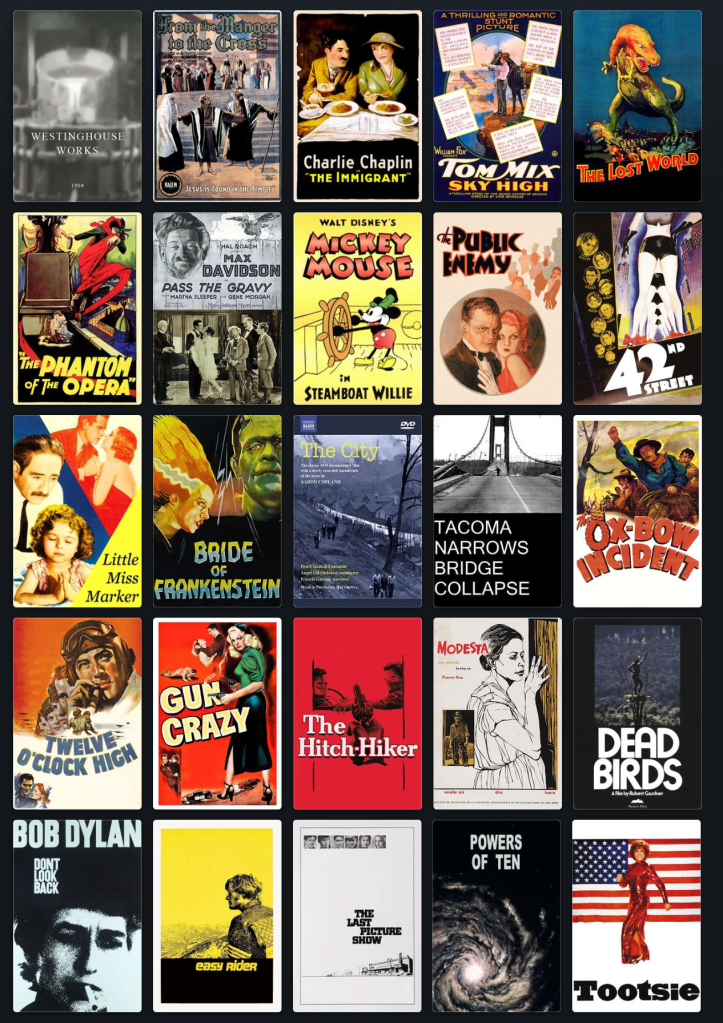
December 2nd 1996: As Americans were fighting each other Battle Royale style to buy any remaining Tickle Me Elmos, the NFR announced their next batch of inducted movies, bringing their total to 200 significant American films. Here are those 25, plus a few blurbs from my write-ups:

Other notes

  • As mentioned in my Class of ’95 post, the National Film Preservation Act got renewed in May 1996 through 2003. This reauthorization also established the National Film Preservation Foundation, with an initial goal to preserve smaller films like educational shorts, “orphan” films, and films in the public domain. According to a Variety article at the time, the first donation to the National Film Preservation Foundation was from Martin Scorsese for $25,000. Speaking of finances, part of the NFR’s 1996 reauthorization cut its funding down from two million dollars a year to $250,000 a year (and bumped down the proposed extension from 10 years to 7). This is back when Republicans were blaming Hollywood for all of society’s ills, so I’m sure that didn’t help matters. Damn you, Senator Bob Dole!
  • Taking in all 25 of these movies, the emphasis seems to be on movies of their time, especially if those times are during World War II or the late ‘60s/early ’70s. Most of these films have a real sense of time and place, from the recreated time and place of period pieces to the literal time and place of documentaries. Yes, a lot of these films cover the same time periods, but like so many of these early NFR inductions, you have less than a century of American film to cull from, and the essentials have almost all been selected by the eighth round. As the years go on, both the timespan and subject matter of these films will diversify.
  • My writings on these films are mostly positive; I can justify each one’s Registry status without too many caveats, even the ones I didn’t like. What struck me in re-reading my posts was how political these write-ups are. Part of that is the political nature of some of these movies (1996 was an election year, so I guess politics were on the Board’s mind), but a lot of it is the political times I was writing them in. We have lived through a lot of history since 2017 – the Trump presidency, the Me Too movement, COVID, the Trump presidency again – so some of that is going to bleed into my writing. Heck at one point I even reference “bone spurs”. Deep cut, 2017 Me, deep cut.
  • When the Class of 1996 was announced, the live-action remake of “101 Dalmatians” was #1 at the US box office. Other noteworthy films playing in theaters that week include “Space Jam”, “The English Patient”, “Romeo + Juliet”, “The First Wives Club”, “Independence Day”, and “Mission: Impossible”. This is the first year where, as of this writing, no film playing in theaters the week of an NFR induction have entered the NFR (“Fargo” had already played theaters that spring and “The Watermelon Woman” wouldn’t receive a theatrical release until 1997).
  • This year’s Double-Dippers include actors Jack Carson, Irene Dunne, Cary Grant, and Charles Winninger, costume designer Edith Head, and cinematographer Hal Mohr. My notes also include “Queen of the Background Extras” Bess Flowers, but she’s on this list practically every year.
  • Thematic Double-Dippers: The aforementioned eras of WWII and the late ‘60s, radio comedians turned movie stars, Olympic athletes turned actors, extra-marital affairs, future sitcom stars, beatniks/hippies, plays making fun of Hitler, tense family dynamics, whitewashed casting, intermittent loudspeaker announcements, shoehorned musical numbers, and a whole lotta race issues grossly mishandled by White creatives.
  • Favorites of my own subtitles: Come What Mae, Battle of the Exes, Bad Harem Day, Spying is Easy Comedy is Hard, Bridge Over Troubled Daughter, That’s Not Filming It’s Typing, How Do You Solve a Problem Like Korea?, and The Best Fucking Years of Our Fucking Lives

Alright, whattya got, Class of 1997? You’re next.

Happy Viewing,

Tony

#733) Shock Corridor (1963)

#733) Shock Corridor (1963)

OR “A Committed Relationship”

Directed and Written by Samuel Fuller

Class of 1996

The Plot: Determined to win a Pulitzer Prize, reporter Johnny Barrett (Peter Brent) gets himself committed to a psychiatric hospital to solve the murder of one of its inmates. Once Johnny adjusts to life on the inside, he befriends three patients/witnesses (James Best, Hari Rhodes, and Gene Evans), but struggles to get their accounts of the murder while navigating their respective mental illnesses. As Johnny’s investigation continues, his girlfriend Cathy (Constance Towers) worries about the toll this is all taking on Johnny’s mental health. It’s an edgy examination of the collective mental illness that is America from one of Hollywood’s maverick filmmakers.

Why It Matters: The NFR describes Samuel Fuller’s filmography as “edgy and unseemly” with “breakneck storytelling and central characters who defy easy categorization.” As for the film itself, the NFR highlights the work of cinematographer Stanley Cortez and editor Jerome Thoms.

But Does It Really?: Every so often, the NFR likes to induct what I call a curveball movie: a movie that is such a drastic departure from the kind of films normally associated with the NFR that all I can do after my viewing is say “What the fuck did I just watch?” “Pink Flamingos” is a good example, as are a number of the Registry’s more avant-garde shorts, but before any of them, there was “Shock Corridor”. I didn’t necessarily like “Shock Corridor”, but its unapologetic outrageousness definitely left an impression on me, which is more than some of the movies I’ve covered here can say. In addition to its – well – shocking subject matter, “Shock Corridor” joins the NFR as representation of legendary director Samuel Fuller. A yes for “Shock Corridor” on the NFR, but will someone please tell me what the fuck I just watched?

Everybody Gets One: Samuel Fuller started off as a copyboy and eventually crime reporter for the New York Evening Graphic. This experience, along with his Army service during World War II, would heavily influence his later film work. Initially starting his showbiz career as a writer, Fuller was not happy with Douglas Sirk’s direction of his script “Shockproof” and wanted to direct his own movies, a level of creative control he could only get from the cheaper Poverty Row studios in Hollywood. We’ll see more of Samuel Fuller’s gritty, offbeat filmography when I finally get around to watching “Pickup on South Street” and whenever I can track down “V-E + 1”. This is also the only NFR appearance for pretty much the entire cast, who were primarily TV actors. Peter Breck was best known at the time for playing Doc Holliday on “Maverick”, while Constance Towers would eventually gain fame as Helena Cassadine on “General Hospital”.

Wow, That’s Dated: Everything. Ev-er-y-thing about this movie, from its medical jargon to its Cold War paranoia, is so dated it’s a wonder it still works at all. You could not, nor should you, remake “Shock Corridor” today.

Title Track: Fuller wrote the original screenplay of “Shock Corridor” back in the 1940s under the title “Straitjacket” (not to be confused with the unrelated 1964 Joan Crawford movie “Strait-Jacket”). Filming began as “The Long Corridor” before Fuller changed the title to the more provocative “Shock Corridor”.

Seriously, Oscars?: No Oscar nominations for “Shock Corridor”, but it did win a handful of international film festival prizes. Despite his lengthy filmmaking career, and probably due to his outsider status, Samuel Fuller never received an Oscar nomination.

Other notes

  • The film opens and closes with a quote from Euripides; “Whom God wishes to destroy he first makes mad.” Good stuff, only one problem: Euripides never said that. While some historians attribute the quote to Sophocles, this phrase wouldn’t appear as written above until the 17th century. Also, even if it was Euripides, he would have said “The gods”, not just “God”.
  • Outside of some interesting noir-esque elements like shadowy cinematography and jaded narration, this opening scene is a straightforward exposition dump. Case in point, this actual exchange between Cathy and Johnny:

Cathy: “Johnny, you’ve got to be crazy to want to be committed to an insane asylum to solve a murder!”

Johnny: “Every man wants to get to the top of his profession. Mine is winning the Pulitzer Prize.”

There’s your set-up and your motivation in two lines of clunky dialogue.

  • What an odd concept for a movie. I can’t really elaborate on that: it’s just weird. Like, how in hell do you even come up with that idea? Also, I know that poking holes in this movie is a pointless exercise, but I’m doing it anyway: If you are going to infiltrate a mental institution, why not work with the institution and let them in on it rather than trying to fool them too? Granted, if Johnny had done that either a) they wouldn’t have cooperated or b) the movie would be far less interesting.
  • Yes, Peter Brent has a generic ‘50s leading man look about him, and when he’s pretending to be insane his acting is borderline Shatnerian, but he is clearly relishing his chance to star in a movie. Breck might have been too dedicated to this film because shortly after filming wrapped, he was hospitalized for exhaustion.
  • As for the film’s leading lady, Constance Towers doesn’t have a lot to do but stand on the sidelines and exclaim things like “Johnny, no!” It’s a bit much, but with this kind of over-the-top material you can see how Towers succeeded in the world of daytime drama. Side Note: Every time, and I mean every single time, a character in a movie is named Cathy, all I can think is “Aack!
  • Say what you will about this movie, at least Fuller was ahead of the game with diverse casting. Right up front we get Korean American actor Philip Ahn as Dr. Fong. Longtime readers may remember Ahn for starring alongside Anna May Wong in fellow NFR entry “Daughter of Shanghai”.
  • Whatever I was expecting from this movie, it didn’t include a musical number. Between Cathy’s striptease performance (the aptly named “Cathy’s Song”) and her later fantasy appearances in Johnny’s dreams, parts of this movie feel like they were directed by David Lynch.
  • I don’t know anything about mental institutions, but I assume “One Flew Over the Cuckoo’s Nest” is a more accurate depiction.
  • Shoutout to the actors playing the two orderlies: Chuck Roberson (John Wayne’s longtime stunt double finally showing his face to the camera) and John Craig (who kinda looks like if Bill Hader played a young Orson Welles)
  • Johnny’s roommate Pagliacci is played by Larry Tucker, who would go on to co-write “Bob & Carol & Ted & Alice” with his comedy partner Paul Mazursky, which earned them both an Oscar nomination. Also, despite his character being named Pagliacci, the song he sings throughout the film is “Largo al factotum” from “The Barber of Seville”.
  • Another future TV star in the cast is James Best as Stuart, the patient who thinks he’s Confederate General J.E.B. Stuart. Best would go on to play Sheriff Coltrane on “The Dukes of Hazzard”, which, like this movie, also prominently features the song “Dixie”.
  • There’s a weird scene where Johnny accidentally enters the women’s ward and is attacked by, in this movie’s parlance, “nymphos”. I get the minor plot point that this scene serves, but I found it all unsettling. Though I’m sure that was the point.
  • Another thing I was not expecting to see in this movie: Color! Two of the patient’s flashbacks are color footage Samuel Fuller shot for earlier film projects: the footage of Japan is from his 1955 film “House of Bamboo”, while the Brazil footage is from his unfinished film “Tigrero”. The color footage was clearly shot for a widescreen process (in this case, Cinemascope), with the image being squished to fit this film’s smaller aspect ratio. I don’t recall the Great Buddha being so skinny.
  • Hari Rhodes deserves a medal for his performance as Trent, a Black patient who think he’s a White supremacist. Rhodes somehow maintains his dignity even as his character spouts some nasty racial slurs. It’s like if Chappelle’s “Clayton Bigsby” sketch wasn’t played for laughs. With this hateful rhetoric, however, Trent could successfully run for elected office today.
  • One thing I’ve learned about movies is that if your protagonist is trying to find a mystery figure, odds are it’s someone who has already been introduced in the movie. In this case: the murderer is someone in the hospital we’ve already met. No spoilers, but during my viewing I narrowed it down to two characters: One obvious choice and one less obvious but more interesting choice. Thankfully, Fuller went with my latter guess, although I wasn’t keeping track of character names, so when Johnny learns the name of the murderer, my first thought was “Which one were they again?”
  • For the record, the 1963 Pulitzer Prize for Investigative Reporting went to Oscar Griffith Jr., editor of the Pecos Independent and Enterprise for its expose on Billie Sol Estes, a businessman whose fraud schemes were connected to the US Department of Agriculture. To the best of my knowledge, neither Oscar Griffith Jr. nor any of his reporters got a job with the Department of Agriculture to write the articles.

Legacy

  • According to Samuel Fuller, “Shock Corridor” was mis-marketed as an exploitation film upon its original release; and while it made a little bit of money, thanks to the shady dealings of Allied Artists producer Leon Fromkess, Fuller never saw a residual check for this or his next movie, 1964’s “The Naked Kiss”.
  • Along with the rest of Samuel Fuller’s filmography, “Shock Corridor” got a reevaluation in the late 1960s, where it gained traction with the European auteur crowd. Fuller continued to write and direct his own movies, as well as act in films by such luminaries as Jean-Luc Godard and Wim Wenders, through the 1980s, and enjoyed mentoring younger generations of filmmakers. Samuel Fuller died in 1997 at age 85.
  • Among the list of film directors who cite Samuel Fuller as an influence are Steven Spielberg, Quentin Tarantino, Jim Jarmusch, and Martin Scorsese, who paid homage to “Shock Corridor” with his 2010 film “Shutter Island”.
  • According to IMDb, there’s a 1997 movie called “Asylum” with Robert Patrick and Malcolm McDowell that, while not a direct remake of “Shock Corridor”, seems to follow the same major story beats. I’m guessing there’s a reason you’ve never heard of “Asylum”.
  • But seriously, what the fuck did I just watch?