#79) Twentieth Century (1934)

MV5BMWFlMjNkZGQtZDAxNS00Nzg1LTkyYmYtZDUwNDdkMTIxMzFhXkEyXkFqcGdeQXVyMjUxODE0MDY@._V1_

#79) Twentieth Century (1934)

OR “Hawks Goes Off the Rails”

Directed by Howard Hawks

Written by Ben Hecht and Charles MacArthur. Based on their play, as well as the unproduced play “Napoleon of Broadway” by Charles Bruce Millholland. [With possible uncredited contributions by Gene Fowler and Preston Sturges]

Class of 2011

Sadly, no trailer for this one. Please enjoy this brief clip of Carole Lombard.

The Plot: Theatrical impresario Oscar Jaffe (John Barrymore) takes young untalented lingerie model Mildred Plotka (Carole Lombard) and turns her into Broadway star Lily Garland. They have several hit plays and a passionate affair over the next few years, but when things turn sour professionally and personally, Lily heads to Hollywood to become an even bigger star. After a string of flops, Oscar makes one last Hail Mary (no, the other one) when both he and Lily end up onboard the Twentieth Century limited from Chicago to New York. There’s slamming doors, mistaken identity, and no piece of scenery left unchewed.

Why It Matters: The NFR calls it a “sophisticated farce” and credits the film with being the breakout for director Hawks and actor Lombard, as well as Barrymore’s final victory lap as a screen actor. An essay by Michael Schlesinger is a love-letter to the film and its status as the first true “screwball comedy”.

But Does It Really?: Historically yes. It may not be the best screwball comedy, but it’s definitely the first with the genre’s staples. As entertainment, it creaks a little bit, and the source material definitely plays better on stage (Barrymore in particular is playing to a back of the house that isn’t there). “Twentieth Century” gets a pass if just for its place in screwball comedy history, and a star-making turn by Lombard.

Wow, That’s Dated: All kinds of ‘30s phrases and references in this one, plus an incredibly unhealthy dosage of ethnic slurs that wouldn’t fly today. Let’s just say “Uncle Remus” gets more than one shout-out.

Seriously, Oscars?: No nominations of any kind for “Twentieth Century”. I guess Colombia was putting all their eggs in the “It Happened One Night” basket that year.

Other notes

  • If they waited a year, “Twentieth Century” could have been produced by 20th Century Fox.
  • Why the artificial zoom when O’Malley is on the phone with Oscar? Was one of the background players doing something they shouldn’t?
  • Genii? As in plural of genie? You don’t hear that one every day.
  • I do love that chalk gag. Though at one point they complain about not being able to find more chalk in New York at midnight. I feel like there’s an app for that nowadays.
  • There are some shots where John Barrymore looks a bit like Christopher Plummer. This bodes well.
  • Special mention to Walter Connolly and Roscoe Karns as Oscar’s sidekicks Webb & O’Malley. They are both perfectly screwball ‘30s.
  • And yes, throughout the film Oscar’s cohorts call him simply “OJ”.
  • There are a handful of process shots while aboard the train, and one of them is geographically impossible. It appears that the train is riding perpendicular to the track!
  • Does anyone else notice the occasional flies buzzing around the set? It is especially noticeable once we board the Twentieth Century.
  • At one point Oscar is compared to Svengali. And he ought to know.
  • Towards the end they mention calling up Ringling. I guess that’s a “Wow, That’s Dated” now.
  • The great thing about Carole Lombard, and the reason why she’s still remembered today, is that she is still one of the handful of Hollywood leading ladies who was allowed to be sexy and funny at the same time. To this day, Hollywood typically will only let its female stars be one or the other.

Legacy

  • This film gave us the beginning of the Howard Hawks’ run of screwball comedies as we know it, as well as the short but legendary career of Carole Lombard. We’ll see more of both later on in the Registry.
  • The play of “Twentieth Century” has been revived on Broadway from time to time, most recently in 2004 with Alec Baldwin and Anne Heche.
  • The play was also turned into the operetta-style Broadway musical “On the Twentieth Century” in 1978, starring John Cullum, Madeline Kahn Judy Kaye, and a young Kevin Kline. The show was revived in 2015 as a vehicle for Kristin Chenoweth.
#78) Newark Athlete (1891) [Original 2017 Post]

MV5BZGJiZTkwODEtOTg1MS00OTZkLWI0MGUtMTM3YjZhNzQ5ODg0L2ltYWdlXkEyXkFqcGdeQXVyNTc0NjY1ODk@._V1_

#78) Newark Athlete (1891)

OR “Jersey Boy”

Directed by William Dickson

Class of 2010

This is the original write-up I did for “Newark Athlete”, but please read this revised, expanded version instead. Please, I am begging you.

The Plot: A young man swings two Indian clubs in unison. That’s the entire film. In fact, it’ll take you longer to read this description than it will to just watch the film.

Why It Matters: “Newark Athlete” is one of the earliest American films. It is not only the oldest film on the National Film Registry, but also possibly the oldest surviving American film ever.

But Does It Really?: For the above, absolutely. Beyond that, I got nothing.

Everybody Gets One: Whoever that kid is.

Wow, That’s Dated: Indian clubs (which, it turns out, are actually from Persia).

Other notes

  • This was filmed in Edison’s studio in West Orange, New Jersey, which means that somewhere there’s a nearly identical earlier film shot by Tesla.
  • The weirdness of the athletics combined with the bad film print makes the whole thing look like a scene out of a David Lynch film.

Legacy

Further Viewing: Here’s 10 easy exercises that you can do with your own Indian Clubs! (Goofy looking goatee not included)

#77) The Exiles (1961)

39099.large

#77) The Exiles (1961)

OR “A Night in the Bunker”

Directed & Written by Ken Mackenzie

Class of 2009

The Plot: Based on interviews and dramatic recreations, “The Exiles” covers a group of Native Americans who left their respective reservations, making them “exiles” of their community, but forming a new community of their own. Yvonne (Yvonne Williams) wishes for a better life for her children, while her husband Homer (Homer Nish) goes out drinking and playing poker. Meanwhile Tommy (Tommy Reynolds) joins Homer in his drinking and tries to pick up pretty much any woman in sight. All of this occurs over a few hours on a dark, very film-noir night in L.A.’s Bunker Hill district.

Why It Matters: The NFR salutes the film as “one of the few non-stereotypical films that honestly depict Native Americans.” An essay by film professor Catherine Russell offers more insight on the film and its significance.

But Does It Really?: As is often the case with docudramas like this and “Nanook of the North”, I’m always a little concerned about recommending a film that might not be the most accurate depiction of a specific culture. But enough people with far more credibility than I have called this film true to life, and that’s good enough for me. I just wish the film were a little more polished. There are long stretches where nothing happens, and it’s only 72 minutes! Regardless, “The Exiles” takes a unique approach to a largely ignored culture, and that’s what film preservation is all about.

Shout Outs: Among the films playing at the theater Yvonne visits is the 1959 remake of “Imitation of Life”.

Everybody Gets One: Not surprisingly, this is the only NFR film (and in most cases the only film period) for the cast of “The Exiles”, as well as Kent Mackenzie.

Wow, That’s Dated: Gas is only 29 cents a gallon!? Also one of the barbershops they pass by offers a shave and a haircut for 40 cents (approximately 3 and 1/5th bits).

Seriously, Oscars?: Well you can’t blame the Oscars for not nominating a film that had no major theatrical release until 47 years after its completion. Or maybe you can.

Other notes

  • The Native American photos at the beginning are from Edward S. Curtis, who you may recall as the filmmaker who gave us “In the Land of the Head Hunters”.
  • Bunker Hill’s historic “Angels Flight” makes an appearance throughout the film. I guess it’s reopening again in a few months?
  • Oh, these folks are not actors.
  • Other films playing at Yvonne’s theater are “Escape to Burma” and “The Iron Sheriff”.
  • Either everyone in this film is dubbed or they are all excellent ventriloquists.
  • I do find the decision to make “The Exiles” a docudrama an interesting choice. If you’re going to include the subjects in the film, why make them act?
  • Ah yes, a simpler time when it was expected of you to sexually harass your waitress. Truly this is the kind of clean ‘50s American lifestyle we all yearn for again.
  • Homer suggests that white people have more problems than the Indians. Don’t tell white people that, you’ll never hear the end of it.
  • It’s around the point when Tommy and Cliff are talking to their dates and trying to pick a song from the jukebox where I started to wonder why this wasn’t a short.
  • Under no circumstances should you ever rush a woman when she’s in the bathroom.
  • That dancer towards the end is a surprisingly open “confirmed bachelor” given the era. For some reason he’s dubbed by someone who sounds a lot like Jerry Lewis.
  • Okay, one of the guys at the 49 Dance definitely makes the Goofy Holler.
  • It’s not perfect, but “The Exiles” is definitely a warts-and-all look at this lifestyle. Why would you let cameras film some of this unflattering behavior?

Legacy

  • Bunker Hill as seen in the film no longer exists. The district was at the beginning of a major redevelopment during filming and “The Exiles” captured many of these buildings shortly before their demolition. Bunker Hill is now comprised mainly of skyscrapers and office buildings.
  • Kent Mackenzie continued to direct and edit films until his premature death in 1980 at the age of 50. One wonders how his career would have gone had “The Exiles” gotten a proper film distribution in 1961.

Further Listening: Ladies and gentlemen, The Revels!

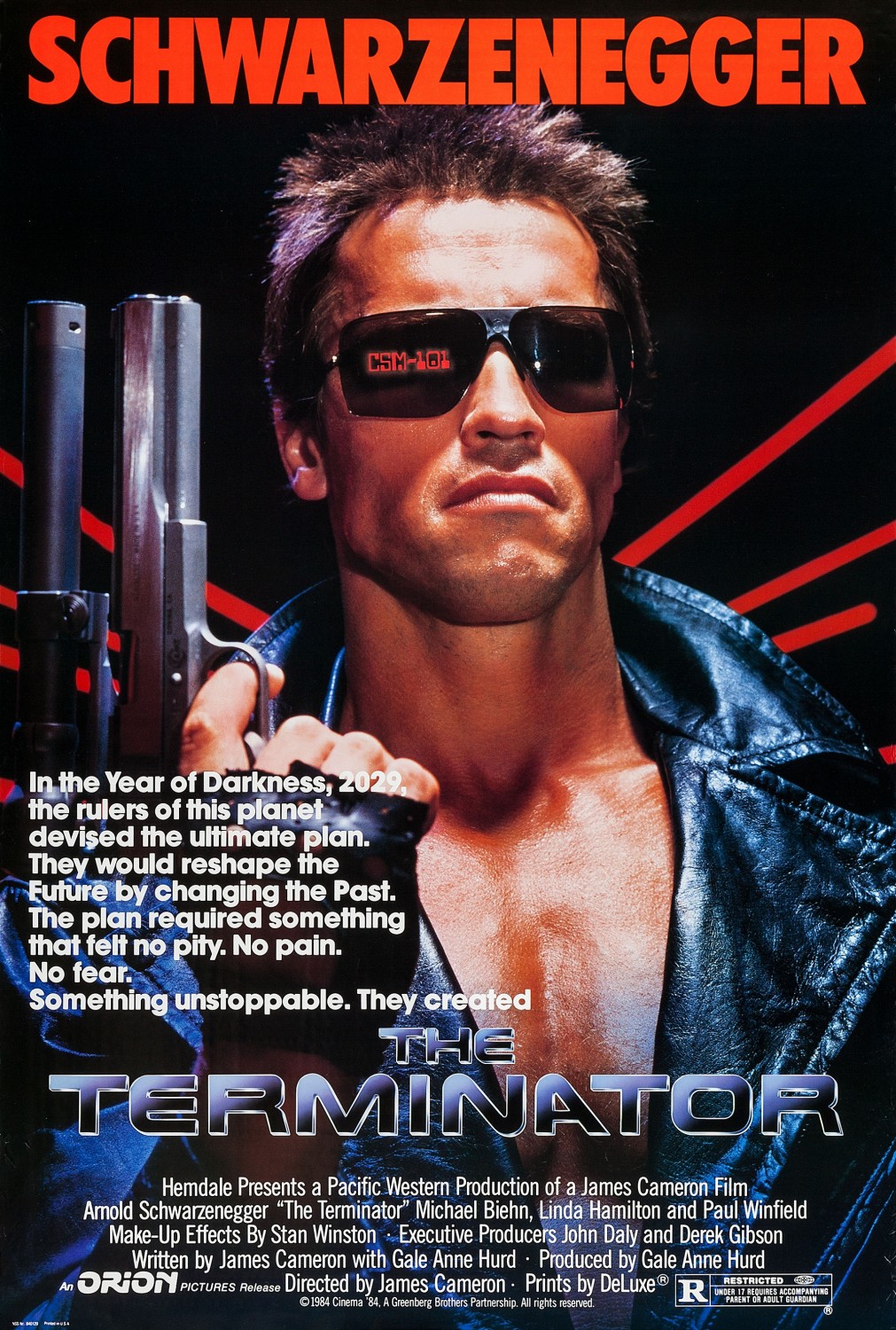
#76) The Terminator (1984)

terminator_xlg

#76) The Terminator (1984)

OR “Die, Robot”

Directed by James Cameron

Written by Cameron & Gale Anne Hurd. Based on the works of Harlan Ellison?

Class of 2008

The Plot: In the not-too-distant future of 2029, a war between machines and humans comes near an end when the human resistance finally takes control. To prevent this, the machines’ company Skynet sends a Terminator robot (Arnold Schwarzenegger) back in time to 1984 to kill Sarah Connor (Linda Hamilton), whose unborn son will lead the resistance. Also arriving from the 2020s is Reese (Michael Biehn), a human who will protect Sarah at all costs.

Why It Matters: The NFR calls it “among the finest science-fiction films in many decades” and praises Cameron, Schwarzenegger, Stan Winston and even the soundtrack. An essay by John Willis is a pretty thorough overview of the film, its creation, and its legacy.

But Does It Really?: The film’s lasting influence cannot be denied. As science-fiction, it’s inventive but at times illogical. As action, it’s endlessly riveting if excessively violent. Regardless of genre, “The Terminator” clips along at an exciting pace and creates a real and terrifying world for the characters to run around in. This is all grounded by Linda Hamilton’s fine performance (though I don’t believe for a second she’s only 18) and of course, the Schwarzenegger performance to end all Schwarzenegger performances.

Everybody Gets One: Amazingly this is the only film on the NFR for pretty much everyone, from Arnold and Linda Hamilton to Michael Biehn and Paul Winfield. Most surprisingly, despite directing 11 films, including two that were/are the highest grossing films ever, this is James Cameron’s only representation on the Registry…for now**.

Wow, That’s Dated: The usual ‘80s fare, like answering machines and compact laserdiscs – not to mention that score! But perhaps the most dated reference of them all: it’s an Orion picture.

Take a Shot: They actually don’t say the name “Terminator” that often. I say you do you.

Seriously, Oscars?: Perhaps due to its low-budget status and Orion’s overall lack of support for the film, “The Terminator” received zero Oscar nominations. Its sequel would help rectify this oversight with four Oscars in the tech categories.

Other notes

  • I’ll go ahead and predict that 2029 will end up being exactly how the film depicts it.
  • Wow, that’s two different sets of male buttocks in the first 10 minutes of this film. And who says there’s nothing in these kind of films for the ladies?
  • That’s the late great Bill Paxton (in his only NFR appearance as well++) as one of the street thugs at the beginning.
  • This really is the best use of Arnold Schwarzenegger in a film. Don’t give him a lot of lines, just let him stand there and look cool kicking ass. And to think the producers passed on O.J. Simpson.
  • To be fair, the scene of Reese grabbing clothes is an accurate depiction of how most men go shopping. Just grab what you need and run.
  • Technically Reese’s memories of the war are a flash-forward.
  • This film raises a lot of issues involving time-travel. For starters, I feel like killing those other two Sarah Connors would lead to some pretty massive Butterfly Effect shit.
  • So 12 years in the future, graphics devolve back into early ‘80s mode? Or does Skynet have a retro app?
  • Reese’s description of the Terminator (“It can’t be bargained with, it can’t be reasoned with…”, etc.) sounds a lot like our president.
  • Can the police arrest a man who hasn’t been born yet?
  • All I can say about those effect shots with the Terminator is “Stan Winston, you are missed.”
  • Like so many action films, this one falls victim to “You still don’t get it, do you?”
  • Sarah and Reese running for their lives in the police station is not the right time for a keyboard solo, Brad Fiedel!
  • This film has so much wibbly wobbly timey wimey going on with Sarah Connor and her role in the uprising that if I think about it too much I’ll go cross-eyed.
  • I’m glad that when a homicidal robot is hunting you down, there’s still plenty of time for doing it.
  • Surprise guest star Ron Swanson as the truck driver.
  • If my math is correct, Sarah Connor is 42 years older than Reese.
  • Some of these effects really don’t hold up. Next time fellas, use ILM.
  • The final chase sequence may be the first one in all of film that is comprised solely of crawling.

Legacy

  • So many sequels, the first being considered equal to the original. The rest, not so much.
  • A TV series focusing on Sarah Connor and her son, starring a pre-“Game of Thrones” Lena Headey.
  • A Universal Studios attraction that is technically based on the first sequel, but we’ll include it here for the time being.
  • Everyone, EVERYONE, has spoofed this film. Jesus Christ so many people have said, “I’ll be back.”
  • Shortly after the events of the film, Sarah Connor went into hiding in Manhattan and fell in love with a guy who looks like Ron Perlman.
  • This launched both Schwarzenegger and James Cameron into stardom, so go ahead and pick your least favorite Schwarzenegger film while I play Cameron’s self-indulgent Oscar speech.
  • Bonus Clip: It was during the filming of “Terminator: Salvation” that Christian Bale delivered this little gem that took a naïve America by storm in 2009 (though it’s fun to hear him slip into his native English accent).

** 2017 Update: Well that was fast. Five months later and “Titanic” shows up on the Registry. Ask and you shall receive.

++2017 Update: Nope, he’s got “Titanic” too!

#75) The Sex Life of the Polyp (1928)

Screen Shot 2017-06-29 at 9.28.57 PM

#75) The Sex Life of the Polyp (1928)

OR “Benchley Warmer”

Directed by Thomas Chalmers

Written by Robert Benchley

Class of 2007

The Plot: A somewhat inept doctor (Robert Benchley) lectures a women’s club about his studies regarding the polyp’s reproductive practice, hemming and hawing his way through the more delicate details.

Why It Matters: The NFR cites no specific reason, but an essay by silent comedy expert Steve Massa tells us about the brief but memorable film career of Robert Benchley.

But Does It Really?: I give this the slightest of passes only as a representation of Robert Benchley. The film is intentionally droll, but some of the jokes still land. And hey, at least it’s short.

Everybody Gets One: A celebrated essayist and member of the famed Algonquin Round Table, Robert Benchley had been performing his comic lectures on stage for years before Hollywood came a-callin’. He went back and forth between acting in and writing for films before his alcoholism took his life at the age of 56.

Wow, That’s Dated: This film briefly depicts women’s clubs at the height of their movement.

Title Track: Benchley says the title once near the beginning of the film.

Other notes

  • What is the deal with the framing on this short? Am I just watching a bad print?
  • Such frank sex talk for 1928, how scandalous back now.
  • By talking around a polyp’s natural asexuality, Benchley inadvertently promotes transgender rights about 85 years before it was fashionable. Right on!
  • Shout out to Ethel Barrymore.
  • Nice animation. Very “Origins of Love”.
  • How much of this will be on the final?

Legacy

  • The success of “The Sex Life of the Polyp” led to several of Robert Benchley’s other comic lectures being filmed, eventually leading to Benchley getting his own series of humorous shorts with MGM.
  • Such people as humorist Dave Barry, author James Thurber, and fellow NFR filmmaker Sid Laverents have cited Benchley as an influence.
  • Benchley’s years with the Algonquin Round Table were fictionalized in the 1994 film “Mrs. Parker and the Vicious Circle”. Campbell Scott plays Benchley while wooing Jennifer Jason Leigh’s Dorothy Parker and wearing the hell out of a pencil moustache.

Further Viewing: A loving documentary on the Algonquin Round Table, “The Ten-Year Lunch” won the Academy Award for Best Documentary, one of the rare times a film not tackling a contemporary social issue won the prize.