“It’s ‘The Muppet Show’ with our very special guest stars, Ira Glass and Janet Jackson! Yaaaaaay!”
It’s that time of year again when the National Recording Registry announces its 25 newest inductees. This year’s recordings range the gamut from “Oh yeah, that song” to “I’ll take your word for it” to “Another fucking Edison recording?” Here is the complete list, with links embedded whenever possible.
“This American Life: The Giant Pool of Money” (May 9th, 2008)
The NRR has also included this playlist so you can listen to this year’s inductees wherever you stream your music. Personally, I’m thrilled that the NRR now includes a talent whose singing skills have been long missing from this list: former NFL defensive tackle Rosey Grier.
The Plot: While attending a lecture about “reddest Russia”, several ladies fall asleep and dream what their lives would be like under Communist rule. In this extended nightmare, life is under the constant watch of Russia’s secret police, mothers are sent to jail for being “too affectionate” to their children, and any attempt to take more than your share is punishable by death. It’s a brief political satire courtesy of an amateur filmmaker in Wisconsin Dells, Wisconsin.
But Does It Really?: I’ll be honest, I couldn’t get into this one. Part of that is having just covered an amateur film with a more resonant subject matter for me, and part of that is the lack of a solid argument for NFR inclusion, apart from “it’s an amateur film!” That being said, I always appreciate the NFR for including these bits of amateur filmmaking, and I applaud this movie’s director for filming something other than a showcase of her home and family. A teeny-tiny slimmest of slim passes for “A Study in Reds”, for those of you who care about rankings.
Everybody Gets One: Like many an amateur filmmaker, most of my information regarding Miriam Bennett comes from an essay on the Center for Home Movies website. Born in Kilbourn City, Wisconsin (now known as Wisconsin Dells), Miriam Bennett was the daughter of photographer H.H. Bennett, and it is speculated that Bennett’s polished filmmaking style stems from her observing her father. Miriam was also a member of the Tuesday Club, a ladies club that covered current affairs over tea (recreated for “Reds”). In addition, Bennett was a member of the Amateur Cinema League, which held an annual amateur film competition, which possibly prompted Bennett to make this film.
Wow, That’s Dated: With the Great Depression in full swing in the early 1930s, more Americans became disillusioned with capitalism (can’t imagine why) and started supporting the American Communist Party, with membership increasing significantly throughout the decade. While not necessarily a “red scare” of the same level as the one in the late ’40s/early ’50s, Communism was still strongly identified with Russia, as this film exemplifies.
Other notes
It’s plain to see that despite her amateur status, Miriam Bennett possessed some natural skills as a filmmaker. For starters. she was already experimenting with time lapse photography and animation. In “Reds”, footage of real clock hands rapidly moving around the face help convey the passage of time. Simple, sure, but by 1932 amateur standards she might as well be Stanley Kubrick.
With the exception of a few boys, this movie sports an all-female cast. Even the authority figures in this imagined Russia are women. They may be Communists, but at least they’re equal opportunity Communists.
One reference I had to look up: a shoutout to the GPU, Russia’s secret police, which had dissolved a full decade before “A Study in Reds” was made. Among their successors was the KGB and other ominous letters.
What does it say about Wisconsin when their snowy woods effectively double as the barren nature of Russia?
Are the pigs on the farm supposed to be a metaphor?
I’m also enjoying that one of the older performers (playing a Soviet official) is quietly corpsing during one of her big scenes. I guess there was no time for retakes.
Oh god, an egg pun. The farmer who is caught stealing an egg is sentenced to “eggsecution”, the kind of wordplay that “Batman” would perfect 35 years later.
The version I watched (found on the Library of Congress’ YouTube page, embedded above) includes a series of outtakes. Not a gag reel, just a collection of shots that Bennett apparently trimmed from the final version.
Legacy
“A Study in Reds” was completed in 1932, but did not crack the ACL’s annual top ten list of amateur films. Miriam Bennett would continue to screen “Reds” for ACL club members over the years before her death in 1971. It is unknown if Miriam Bennett made any other films.
While the Amateur Cinema League disbanded in 1954, the Tuesday Club is still going strong in Wisconsin Dells.
And Communism was never a problem in America ever again. Moving on…
Written by Kenneth Kolb. Based on the Sinbad stories in “One Thousand and One Nights”.
Class of 2008
The Plot: While on the island of Colossa, Sinbad the Sailor (Kerwin Mathews) battles a giant cyclops, saving Sokurah the Magician (Torin Tatcher) in the process. Sokurah’s request to return to the island and retrieve a magic lamp is denied by Sinbad, who wishes to return to Bagdad and marry the Princess Parisa (Kathryn Grant). Sokurah uses his evil magic to shrink the Princess and create a war between Chandra and Bagdad, forcing Sinbad to acquiese and take the sorcerer back to Colossa. Their journey is fraught with such perils as the giant Roc bird, a fire-breathing dragon, and a skeleton warrior, all brought to life through Ray Harryhausen’s Dynamation!
Why It Matters: The NFR calls it “one of the finest fantasy films of all time”, praising Ray Harryhausen’s “stunning” animation and Bernard Herrmann’s “thrilling” score. An essay by Harryhausen expert Tony Dalton provides many production details.
But Does It Really?: Like “Lost World” and “King Kong” before it, “Sinbad” is on this list by virtue of its kick-ass stop-motion technology, from no less than animation legend Ray Harryhausen. The rest of the movie is fine: ultimately harmless and kind of forgettable. The real star is the effects animation, which is strong enough to warrant NFR recognition. Some scholars will argue that “Jason and the Argonauts” should be the Harryhausen representation on this list, but “Sinbad” is an acceptable alternative.
Everybody Gets One: Like many of his generation, Ray Harryhausen was inspired to become an animator after seeing the original “King Kong”. Following the advice of “Kong” animator Willis O’Brien, Harryhausen studied sculpture and graphic art to hone his craft. After a brief stint with George Pal’s “Puppetoons”, Harryhausen got his big break as an assistant animator on “Mighty Joe Young”. From there he worked on stop-motion effects for such sci-fi films as “It Came from Beneath the Sea” and “Earth vs. the Flying Saucers”. “Sinbad” was Harryhausen’s first venture into the fantasy genre, and his first animation in color.
Wow, That’s Dated: I’m gonna go ahead and assume all of this is cultural appropriation of Arabic culture. There’s no brownface or god-awful accents, but it’s still a bunch of White people walking around in turbans and pantaloons. This whole thing is about as Middle Eastern as Carnac the Magnificent.
Title Track: Despite the title, “7th Voyage” takes more of its story elements from the 3rd and 5th voyages of Sinbad in the Arabian Nights tales. And like “Plan 9”, this title leads me to believe there are six movies I should have watched beforehand.
Seriously, Oscars?: No Oscar love for “Sinbad”. For the curious, 1958’s Best Special Effects winner was another fantasy movie: “tom thumb”.
Other notes
A lot of the marketing for “Sinbad” gave praise to the film process of “Dynamation”, Ray Harryhausen’s process of combining stop-motion and live-action. A portmanteu of “dynamic animation”, the term was coined by Harryhausen and producer Charles Schneer as a way to make stop-motion animation sound sophisticated. The name was partially inspired by Schneer’s Buick, which had a Dynaflow transmission.
I was ready to call out the hills of southern California in the background of a few shots, but it turns out “Sinbad” was filmed on location in Spain, primarily in Granada and Costa Brava.
I don’t know a lot about Ray Harryhausen, and it did not occur to me that he did not direct or write the movies we associate as his. In the case of “Sinbad”, Harryhausen was the special visual effects creator, and an uncredited associate producer. Despite being the creative muscle behind these movies, Harryhausen always shared credit with his colleagues in interviews, particularly his directors and writers, as well as Charles Schneer.
I was not expecting Bernard Herrmann to be the composer of a claymation movie. Apparently he scored a lot of Harryhausen’s movies. And he was already working with Hitchcock at this point, the man must have loved to work.
There’s nothing too exciting about how Kerwin Mathews or Kathryn Grant got cast as the leads: they were both under contract with Columbia at the time. Side note: “Sinbad” was released a year after leading lady Kathryn Grant married legendary crooner Bing Crosby. She would eventually start using his last name professionally.
I do not feel comfortable having the genie being played by a child. I don’t care if he’s immortal, this is child labor.
Sokurah is giving me some Albert Finney in “Annie” vibes. I hope they don’t make him sing.
Speaking of cultural appropriations, you can’t show me a shrunken Kathryn Grant in Arabian garb and a tiny living space and not make me think of “I Dream of Jeannie”. In fact, I wouldn’t be surprised if Sidney Sheldon caught a matinee of “Sinbad” and started taking notes.
There are a few instances where the claymation figures double for the live actors, and it somehow looks more convincing than when they try to do that with computers today.
Yes, the Princess is sidelined for most of the movie, but at least she actually contributes to one of the plot points, and improves upon the ideas of the male hero.
The highlight of this movie is definitely Sinbad fighting a skeleton soldier. No wonder Harryhausen recreated it for “Argonauts”. Watching a bit of claymation fight a flesh-and-blood actor – and give him a legitimate run for his money – is still a sight to behold 60 years later.
More movies should end with a dragon fighting a cyclops. Just saying. Imagine “Kramer vs. Kramer” if it was a custody battle between a dragon and a cyclops.
“Sinbad” was a surprise hit in the theaters, and the sequels started rolling out…fifteen years later. Harryhausen and his team returned to the Sinbad tales with 1973’s “The Golden Voyage of Sinbad” and 1977’s “Sinbad and the Eye of the Tiger”. I believe Survivor did the score for the latter.
Ray Harryhausen would follow-up “Sinbad” with such fantasy movies as “Mysterious Island”, “One Million Years B.C.”, and the aforementioned “Jason and the Argonauts”. Harryhausen’s last stop-motion animation can be seen in 1981’s “Clash of the Titans”.
Proof of this film’s popularity: The 1953 Soviet film “Sadko” has nothing to do with the Sinbad legend (it’s based on a Russian folk tale), but when the film was re-released in America in the early ’60s, it was re-titled “The Magic Voyage of Sinbad” and completely re-dubbed as an attempt to cash-in on this movie. This dubbed version is the one shown on “Mystery Science Theater 3000”.
Like Willis O’Brien before him, Ray Harryhausen influenced a generation of filmmakers who would use visual effects to tell their stories. Among them, George Lucas, John Landis, Peter Jackson, and Rick Baker. As Harryhausen said later in life, “there is no greater accolade than that.”
And finally, comedian David Adkins goes by the professional name Sinbad as an homage to the sailor. And no, he never played a genie in a movie. Stop asking!
Directed & Written by Steven Spielberg (with screenplay assistance from several uncredited writers)
Class of 2007
This post about “Close Encounters” is based on my viewing of the Director’s Cut.
The Plot: A series of strange phenomena occur in and around Muncie, Indiana, culminating in a massive power outage. When electrician Roy Neary (Richard Dreyfuss) investigates, he has an encounter with an unidentified flying object. The event makes Roy obsessed with UFOs, driving his wife Ronnie (Teri Garr) crazy with his detailed model of a mysterious rock formation. Roy finds sympathy with Gillian (Melinda Dillon), a single mother who believes the UFO abducted her son Barry (Cary Guffey) and sketches the same rock formation as Roy, which turns out to be Devils Tower in Wyoming. Roy and Gillian arrive in Wyoming and meet Claude Lacombe (François Truffaut), a French scientist who believes the reappearance of several wartime vessels may be connected with these UFOs. It all comes together with a spectacular celestial light and sound display that means…something.
Why It Matters: The NFR frames “Close Encounters” as Spielberg’s follow-up to “Jaws“, and calls John Williams’ five-tone motif “as memorable as any line of movie dialogue”. An essay by film critic Matt Zoller Seitz breaks down the movie’s symbolism.
But Does It Really?: About 15 years ago, I watched “Close Encounters” for the first time, and hated it. Watching it again all these years later, I don’t hate it, but I still can’t get into it. Spielberg is, of course, incapable of making a bad movie, but he has made a few flawed ones, and I count “Close” among them. I enjoyed the film’s scope and “2001“-esque sense of awe, and I appreciate any sci-fi where both the humans and the aliens come in peace, but ultimately I just didn’t care about these characters and their life-changing experience. But hey, any movie that manages to make five notes and mashed potatoes iconic is gonna end up on the NFR regardless of my opinion, and “Close Encounters” has maintained enough of a place in our popular culture to warrant eventual NFR inclusion.
Everybody Gets One: If this were the French Film Registry, François Truffaut would be well-represented as the director/screenwriter of “The 400 Blows”, “Jules and Jim” and “Day for Night”, to name just a few of his classics. But the father of French New Wave and the Auteur Theory made his sole American film with his performance in “Close Encounters”. Spielberg was surprised when Truffaut accepted an acting role, and Truffaut seemed to enjoy the whole experience and working with Spielberg (though he did have a few choice words for co-producer Julia Phillips).
Title Track: The movie gets its name from astronomer and ufologist J. Allen Hynek’s book “The UFO Experience: A Scientific Inquiry“. For those who didn’t read the poster, a close encounter of the first kind is a UFO sighting, the second kind is physical evidence, and the third kind is contact.
Seriously, Oscars?: A critical and commercial hit, “Close Encounters” received eight Oscar nominations, including Spielberg’s first Best Director nod. The film lost in most of its categories to “Star Wars”, but Vilmos Zsigmond won his only Oscar for Best Cinematography, while Frank Warner won a Special Oscar for his sound effects editing.
Other notes
It’s interesting to watch “Close Encounters” as a follow-up/companion piece to “Jaws”: they both have that ’70s mellowness to them, and give only brief glimpses of the “other” before the big third act reveal. And, true to his word, Spielberg’s next movie does not take place anywhere near a large body of water.
Kudos to cinematographer Vilmos Zsigmond, who balances out his expert landscape compositions with some wonderful blocking that enhances the dialogue scenes. “Every Frame a Painting” did a whole video on Spielberg’s under-appreciated single take scenes.
Speaking of great shots, this movie is filled to brim with Spielberg’s trademark “Zoom in as someone looks meaningfully off-camera” shots. There’s your drinking game.
John Williams wrote 300 variations of the UFO’s five-tone phrase before Spielberg picked the one used in the movie. Williams lost the Oscar to himself for “Star Wars” but did win two Grammys for “Close Encounters”.
So here’s why “Close Encounters” doesn’t work for me: I never buy into the obsession Roy and Jillian have for these aliens. It’s perfectly fine to not spell everything out for me, but I never understood why Roy would abandon his family. At least Jillian is motivated to find her son, but even that seems secondary to her fascination with Devils Tower. I didn’t get to know these characters well enough before their encounter to empathize, nor does the movie ever stop and tell us what is motivating their behavior. You don’t have to explain everything, just give me a scene where they’re singing “Show Me the Way to Go Home” and sharing war stories.
The farmer with the “Stop and be friendly” sign is Roberts Blossom, best known to my generation as Old Man Marley from “Home Alone”.
What a waste of Teri Garr. Of course she’s always best in a good comic role, but Garr’s dramatic work is lost here as the shrill wife who doesn’t support her husband. Maybe her best scenes got cut?
If nothing else, “Close Encounters” showed us that Spielberg could handle a budget. “Close” had twice the budget of “Jaws”, and it’s all in service to Spielberg’s vision, and not just a pile of money thrown at the screen. It’s a delicate balance very few promising young filmmakers can manage.
I love mashed potatoes, so watching a whole scene where Roy sculpts Devils Tower out of a giant dollop of them just gave me some serious cravings. Heck I’m salivating as I’m typing this.
The other thing that bothers me about “Close Encounters”: No one’s having any fun. It’s all taken so seriously. The only character enjoying himself is Barry, but his naive innocence is cancelled out by my concerns of child endangerment (a common Spielberg trope before he had kids).
And then we get to the finale at Devils Tower which is…what, a laser show? Maybe I need to see this on a big screen. I’ll say this much: once the mothership starts communicating, the real hero is the keyboardist who keeps up with the inhumanly fast tempo. This is why we need to keep funding arts programs in schools!
And then the creepy alien children in rubber suits take Richard Dreyfuss away as everyone stares off-camera in amazement. Can I just chalk up this whole movie to “The ’70s” and shrug my shoulders?
Legacy
“Close Encounters” was a massive hit, and talks of a sequel began immediately. The somewhat darker “Night Skies” never made it past the script stage, but elements of the screenplay were utilized in future Spielberg projects “E.T.” and “Poltergeist”.
In 1980, “Close Encounters” was re-released as a Special Edition, which trimmed a few existing scenes and added several newly filmed ones, including a few much-buzzed-about shots that show us the inside of the mothership. In 1998, Spielberg revisited the film one more time, reinstating some of the deleted material, and removing the spaceship’s interior to give us his Director’s Cut. While the Director’s Cut is the most common release, all three versions are available on Blu-ray.
Most references to “Close Encounters” today are limited to the title and the fact that there are aliens, with the occasional homage to the mashed potatoes scene. Other than that, “Close Encounters” has been more or less eclipsed by the pantheon of great movies Spielberg has given us since 1977.
Listen to This: A few months before “Close Encounters” hit theaters, NASA sent out Voyager 1 and Voyager 2 for its own close encounters out in space. Included was a vinyl record containing a variety of audio for aliens to learn about Earth, including greetings in different languages and music from across the centuries. The Voyager record – sometimes referred to as “Murmurs of the Earth – was added to the National Recording Registry in 2007. The NRR write-up includes an essay by Cary O’Dell.
This is another tough one to track down, but “Think of Me First as a Person” is available for purchase on George Ingmire’s Vimeo page.
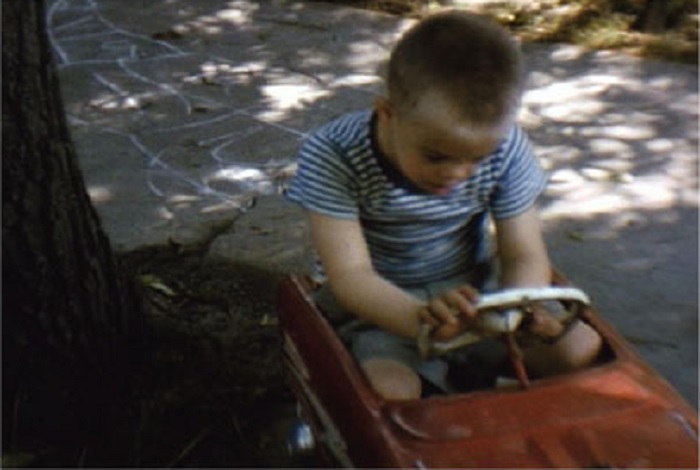
The Plot: The NFR’s love for well-crafted home movies by amateur filmmakers continues with the touching “Think of Me First as a Person”. Filmed throughout the 1960s and ’70s, Dwight Core Sr. tells us about his son Dwight Core Jr. (nicknamed “Dee”), who was born with Down syndrome. Using his own words, as well as an essay written by Dee’s sister Carolyn, Dwight Sr. wants you to see past Dee’s disability, and think of him first as a person.
Why It Matters: The NFR calls the film “a loving portrait” that “represents the creativity and craftsmanship of the American amateur filmmaker”.
But Does It Really?: I’m genuinely surprised we’ve gone this long on the NFR without a movie about the developmentally disabled. Given my own personal experience with a developmentally disabled family member, I know the world the Core’s live in, and I appreciate how Dwight (with assistance from George) has chosen to tell his personal story. “Think of Me” strikes the right tone with its delicate subject matter: It’s never too sentimental or manipulative, just a plain-spoken man asking for a kinder world for his child. Although I question this film’s NFR eligibility on a technicality (more on that later), I absolutely recommend “Think of Me First as a Person” for viewing and future preservation.
Everybody Gets One: Most of my information regarding George Ingmire comes from an essay he wrote about this film for the Center for Home Movies. “Think of Me First as a Person” came to be when Ingmire was approached by fellow future NFR filmmaker Helen Hill about the CHM’s annual Home Movie Day screening in New Orleans. Ingmire recalled a collection of home movies from his recently deceased grandfather Dwight Core Sr., and recommended one of them be screened. Among his grandfather’s home movies, Ingmire found Dwight Sr.’s rough cut of “Think of Me First as a Person”, as well as his recorded narration and notes. Ingmire then went about digitizing the material and completed his grandfather’s film.
Wow, That’s Dated: Of course, treatment and services for people with developmental disabilities have come a long way since the 1960s, particularly for those with Down syndrome. Easily the film’s most dated quality is the use of the term “mentally retarded”, which is used here in its proper (if antiquated) medical context.
Title Track: The title comes from the Rita Dranginis poem of the same name, also from the perspective of a developmentally disabled person. “Think of me first as a person/who hurts and loves and feels joy”.
Other notes
As much as I endorse having “Think of Me” on the NFR, I have to ask if it was inducted too soon. Yes, the footage used in “Think of Me” was filmed in the ’60s and ’70s, therefore surpassing the 10 year eligibility for any film in the NFR, but the final film wasn’t completed until 2006, the same year of its NFR induction. It shouldn’t have made the cut until 2016 at the earliest. I’d be curious to hear more about how the NFR justified this decision.
Unsurprising given George Ingmire’s background in sound production, the silent home movies now include an appropriate (and unintrusive) soundtrack. Dwight Sr.’s footage is now underscored by corresponding sound effects (the squeaking of the backyard swing, the laughter of children at play, etc.).
As previously mentioned, this movie is not an attempt to elicit false sympathy for Dee and his family. Dwight Sr. focuses on Dee’s strengths (his energetic curiosity and love for dancing) rather than the detriments caused by Down syndrome. This also comes across in Dee’s sister Carolyn’s essay, interestingly titled “My Favorite Child”.
Dee spent most of his childhood at the Lynchburg Training School in Lynchburg, Virginia. Originally designed to treat those with epilepsy, Lynchburg underwent several changes throughout the decades, before becoming a home for the developmentally disabled in the 1950s. In 2012, the Department of Justice determined that these larger institutional training centers did more harm than help, and the renamed Central Virginia Training Center closed permanently in 2020.
During my viewing I realized that, unless I’m missing something, “Think of Me” is the only film on the NFR to discuss a developmental disability at length (I’m excluding titles such as “Forrest Gump” and “Being There“, where although the lead character obviously has some sort of developmental disability, it is not the focus of the film). When considering similar titles for NFR consideration all I could think of was “Rain Man” and all the Oscar-bait crap we got in its wake. And we have another eight years before we can add “The Peanut Butter Falcon” to the conversation.
Legacy
“Think of Me First as a Person” premiered at the Zeitgeist Multidisciplinary Arts Center in New Orleans in August 2006. Center for Home Movies co-founder Dwight Swanson was in attendance, and coincidentally was a member of the National Film Preservation Board at the time. Swanson led the campaign that would ultimately get “Think of Me” on the National Film Registry a few months later. The version I watched was a 2008 restoration that includes the film’s NFR designation in the end credits.
According to George Ingmire, Dwight “Dee” Core Jr. enjoyed being the subject of a movie, and after the release of “Think of Me”, he always carried a sharpie with him in case someone wanted his autograph. Dwight Core Jr. died in 2008 at age 48.
George Ingmire has spent the last 20 years as a producer and sound mixer, among many other things. He is the host of two radio programs for WWOZ in New Orleans, and is currently working on podcasts and videos regarding COVID-19. You can learn more about him at his official website.




 The Horse's Head