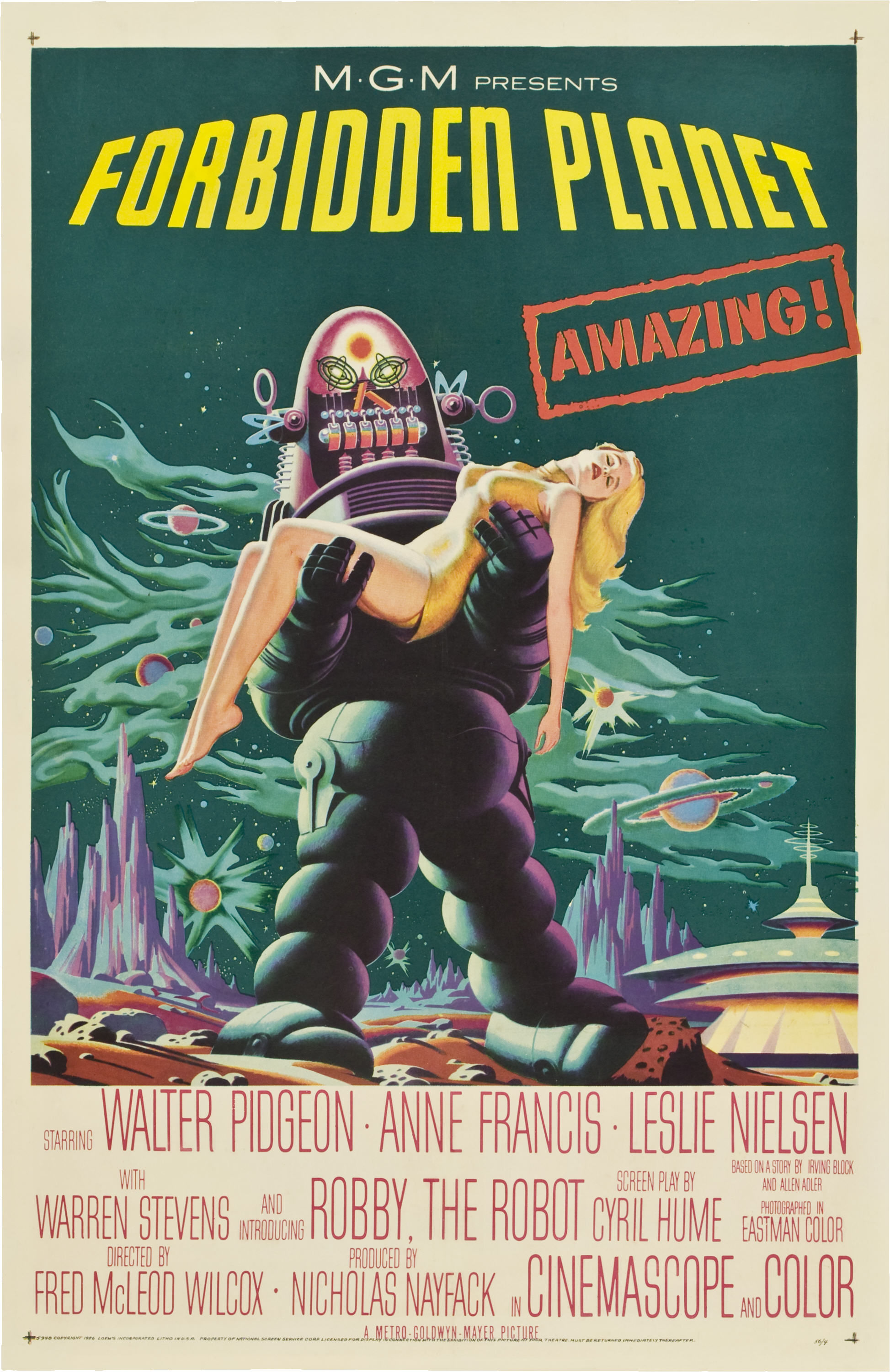
#431) Forbidden Planet (1956)

Forbiddenplanetposter

#431) Forbidden Planet (1956)

OR “Tempest in a Spaceship”

Directed by Fred McLeod Wilcox

Written by Cyril Hume. Story by Irving Block and Allen Adler. Kinda sorta based on “The Tempest” by William Shakespeare.

Class of 2013

The Plot: In the early 2200s, a team of astronauts led by Commander J.J. Adams (Leslie Nielsen) is sent to the planet Altair IV to find the survivors of an expedition that disappeared 20 years earlier. They find the sole survivors: Dr. Edward Morbius (Walter Pidgeon) and his daughter Altaira (Anne Francis). The two live peacefully in exile, their needs met by their servant Robby the Robot (Himself). Despite pleas from Adams, Morbius refuses to return to Earth, opting instead to study the highly advanced technology of the Krell, the planet’s native race. But an invisible monster that’s been attacking the crew might change everyone’s mind in one of the biggest sci-fi films of the era.

Why It Matters: The NFR calls it no less than “one of the seminal science-fiction films of the 1950s”, praising the film’s cultural impact, special effects, score and cast. There’s also a loving essay by film professor Ian Olney.

But Does It Really?: “Forbidden Planet” is not the greatest science fiction film ever made, and is bogged down by some ‘50s trappings, but it is just as iconic a film (and therefore NFR worthy) as any of its contemporaries. Hell, Robby the Robot is enough to get this movie on the list. “Forbidden Planet” stands on its own piece of ground as the rare sci-fi film of the era with an actual budget, with impressive visual effects that fill the CinemaScope screen. Its open sexism and antiquated politics may doom the film for future generations, but the story of Hollywood sci-fi would be incomplete without “Forbidden Planet”.

Everybody Gets One: Most of the film’s major creatives (including director Fred Wilcox and screenwriter Cyril Hume) were longtime MGM utility players, and “Forbidden Planet” was another assignment. Wilcox also directed fellow NFR entry “Lassie Come Home”. Also making their sole appearance is producer Nicholas Nayfack. That name again: Nayfack.

Wow, That’s Dated: You mean besides the frequent sexism hurled at Anne Francis? Like many a ‘50s film (sci-fi or otherwise), “Forbidden Planet” is chiefly concerned with our abuse of nuclear power, and treating the one woman in the cast as a sexual plaything. I am not looking forward to the 2200s.

Seriously, Oscars?: A hit upon its release, “Forbidden Planet” received one well deserved nomination for its Visual Effects, losing to the equally impressive miracles of “The Ten Commandments”. Couldn’t there have been a tie?

Other notes

  • “Forbidden Planet” was MGM’s first foray into science fiction since the late 1920’s, and they pulled out all the stops. Up until then, sci-fi was delegated to B-picture status, but MGM made it an A feature with a budget of 1.9 million dollars (roughly 187 million today). Robby the Robot alone cost $125,000 (over 1 million today).
  • In lieu of a traditional score, “Forbidden Planet” opted for an electronic soundscape by New York avant garde artists Bebe and Louis Barron. Like its massive scope and budget, the score aids in the film’s unique status among sci-fi films. Due to a complaint from the Musicians Union (of which the Barrons were not members), their credit reads “Electronic Tonalities” rather than Score, therefore making their work ineligible for an Oscar.
  • Although “Ransom!” was released first, this was Leslie Nielsen’s first film! His youthful appearance helps differentiate this performance from his later parody work. Surely, he can be serious.
  • If nothing else, this film is saved by getting to hear the rich tones of Walter Pidgeon. Even listening to him spout off techno babble is a treat.
  • Robby the Robot was voiced by an uncredited Marvin Miller, a prolific narrator and announcer throughout the ‘50s and ‘60s. The person operating the suit itself was originally stuntman Frankie Darro (one of the “Wild Boys of the Road”), but he was fired after coming back from lunch under the influence.
  • Anne Francis is doing the best she can with what she is given. She handles Alta’s naiveté quite effectively, but it’s still overshadowed by every man on the crew lusting after her. That’s no way to treat Honey West!
  • I will admit, in terms of future technology, “Forbidden Planet” does predict quite a bit. Not only is Robby the Robot the first 3D printer, but the Morbius family seems to own the first Alexa-type AI assistant.
  • Morbius’ shuttle appears to take riders through the last scene of “2001”.
  • I bet that invisible creature is just Elliot the Dragon up to his old mischief again. Also, an invisible monster? They must have run out of the effects budget.
  • The film’s animated effects (including the Id monster) were created by Joshua Meador. Meador had been an effects animator for Disney for over 20 years, fresh off his successful work on “20,000 Leagues Under the Sea”, and is one of the rare Disney employees to ever be loaned out to another studio. Yes, the animation sticks out a bit, but it’s still an impressive feat of movie magic.
  • Wait, when did Alta choose Adams? Did I miss something?
  • “It will remind us that we are, after all, not God.” That’s what this whole movie was working towards? Seems kinda late to bring theology into all of this.

Legacy

  • “Forbidden Planet” has been a major influence on practically every piece of sci-fi in film and TV since 1956. As the Olney essay stresses, every big-budget sci-fi movie owes a debt of gratitude to “Forbidden Planet”.
  • Gene Roddenberry cited “Forbidden Planet” as one of the inspirations for “Star Trek”. So…live long and carry on, or whatever the hell they say.
  • Always out to save money, MGM reused the props and costumes from “Forbidden Planet” many times over the years. Look for Robby the Robot in “The Invisible Boy” and several episodes of… “The Twilight Zone”.
  • On a related note, Robby designer Robert Kinoshita also designed the robot from “Lost in Space”, which explains why I always get those two mixed up.
  • Here’s a weird one: the musical “Return to the Forbidden Planet” is part “Forbidden Planet” leaning more on the “Tempest” parallels, and part ‘50s jukebox musical. Odd, but it did play Off-Broadway. And the West End production won the Olivier for Best New Musical of 1990!
  • “Why? Why was I programmed to feel pain?”

#430) The Wishing Ring: An Idyll of Old England (1914)

MV5BYTM1OWY1NmUtYTA1OS00MjlhLWE4ODctZjQxZGMyYjIxZDFjXkEyXkFqcGdeQXVyMTY2MDM3MTk@._V1_

#430) The Wishing Ring: An Idyll of Old England (1914)

OR “Punting on the River Hudson”

Directed & Written by Maurice Tourneur. Based on the play by Owen Davis.

Class of 2012

The Plot: Pastor’s daughter Sally (Vivian Martin) falls for the neighbor’s gardener Giles (Chester Barnett) when she is caught stealing flowers for her father’s altar. Sally eventually learns that Giles is the son of The Earl of Bateson (Alec B. Francis), and recently disowned by his father following his expulsion from school. While on one of their dates, Sally is gifted a magic ring from a band of gypsies, guaranteed to make her every wish come true. Can Sally use the ring to reunite Giles and his father? Filmed on location in the merry old English town of…Fort Lee, New Jersey?

Why It Matters: The NFR write-up gives a history of the film’s rediscovery and restoration, and admits that the film has been “lionized” in recent years. An essay by NFR stalwart Kyle Westphal is a love letter to the movie and Maurice Tourneur.

But Does It Really?: Okay, let’s cut to the chase here: “Wishing Ring” is on this list because it’s a silent movie that was presumed lost and then rediscovered. That’s. It. As for entertainment value, it’s fine, but I doubt a modern audience would enjoy it. “Wishing Ring” gets a brief pass for NFR inclusion, but it’s on here simply for the preservation of another lost silent film.

Everybody Gets One: Leading lady Vivian Martin made her film debut in “Wishing Ring”. Her success in subsequent films is said to have rivaled Mary Pickford. Like Pickford, Martin started her own production company, but a series of lawsuits led to her downfall. Like many of the silent era, Martin did not transition to talkies.

Wow, That’s Dated: As always, the depiction of the Romani people as fortune telling criminals is quite outdated. Side note: Did you know that Tracey Ullman and the late Bob Hoskins are of Romani descent? Think about it, won’t you?

Other notes

  • All we know about the original stage version of “The Wishing Ring” is that it opened in 1910, was directed by Cecil B. DeMille, and starred silent film actor Marguerite Clark. The theater it premiered in – Daly’s Theatre – was demolished in 1920, and is currently…under construction?
  • This was another silent movie that was presented to me without a synchronized soundtrack. My attempt at a score came courtesy of a Spotify playlist comprised of turn-of-the-century music hall songs. Thanks Tom Powell! They sure enjoyed covers of “It’s a Long Way to Tipperary” back then.
  • Perhaps in tribute to the film’s stage origins, “Wishing Ring” opens with a group of chorus girls on a stage opening the curtains.
  • “Wishing Ring” was filmed at the short-lived World Film Company’s studio in Fort Lee, New Jersey. Is it any wonder Jersey isn’t considered New England?
  • If the name of director Maurice Tourneur sounds familiar, you’re either thinking of his other NFR entries “The Blue Bird” and “Last of the Mohicans”, or those of his son, fellow film director Jacques: “Cat People” and “Out of the Past”.
  • Oh, and according to the opening title card, Maurice didn’t direct this film and adapt it for the screen, oh no: he “picturized” it.
  • Ebenezer Squeers is the most British name of any person in any point in history. I’m glad I’ve been doing this blog long enough to discover it.
  • This is one of the few silent movies that I feel needs more intertitles. There are only a handful, but the visuals don’t fill in the rest of the exposition. A good chunk of this movie is Sally and Giles talking and holding flowers.
  • They wander by a gypsy camp on the first date? Interesting choice.
  • Whoa, Sally definitely needs a new pair of shoes. Perhaps she’s in need of a cautionary tale from Lois Weber.
  • Did we establish how many wishes Sally gets with this ring? Is it the standard three? And what’s the ring’s policy on wishing for more wishes? Check the inside for the fine print!
  • Well things definitely took an unexpected turn near the end. It was my impression that an “idyll” was a happy and peaceful episode. Luckily it all works out for our two leads, and their wedding is attended by…pirates?

Legacy

  • As previously mentioned, “Wishing Ring” was deemed lost for years, until a 16mm print was discovered by film historian Kevin Brownlow in a defunct film library. This 16mm print is believed to be the only print of “Wishing Ring” in existence, and 35mm copies were created from this print.
  • It was discoveries like “Wishing Ring” that led to Brownlow receiving an honorary Oscar in 2010, alongside Jean-Luc Godard, Eli Wallach, and Francis Ford Coppola. Brownlow is the first, and so far only, film preservationist to receive an Oscar.

#429) Bambi (1942)

MV5BMTc5NjY3ODQyNl5BMl5BanBnXkFtZTgwOTE1MTkzMjE@._V1_

#429) Bambi (1942)

OR “So Deer to My Heart”

Directed by David Hand (but as always, this is Walt Disney’s show)

Written by Perce Pearce and Larry Morey. Based on the novel “Bambi, a Life in the Woods” by Felix Salten.

Class of 2011

The Plot: Bambi (voiced by Donnie Dunagan) is a newborn deer who will one day succeed his father (voiced by Fred Shields) as the Great Prince of the Forest. We watch Bambi as he grows up, learns about the world from his mother (voiced by Paula Winslowe), and becomes friends with Thumper the Rabbit and Flower the Skunk (voiced respectively by Peter Behn and Stan Alexander). But Bambi is also made aware of the looming threat of Man, and if you don’t know where this is going, I welcome you to our planet.

Why It Matters: The NFR praises the film’s “beautiful images”, “iconic characters and moments”, and “emotional power”. There’s also an essay by Disney expert and environmentalist John Wills.

But Does It Really?: “Bambi” tends to get lost in the shuffle of Disney classics (no magic or catchy songs to be found), but is definitely worthy of its place as top-tier Disney. Like “Fantasia”, Walt is pushing the animated medium beyond cartoons and towards more creative forms of realism, and his animators are clearly relishing the opportunity. “The Lion King” may be my generation’s definitive “animal coming-of-age” movie, but “Bambi” still holds a special place in our popular culture to warrant NFR inclusion.

Everybody Gets One: Voice credits for “Bambi” are a bit sketchy, but we know the young prince himself was voiced by at least three actors: child actor Donnie Dunagan (who kept his participation in the film quiet when he joined the Marines), actor Hardie Albright, and possibly producer John Sutherland, who claimed to have voiced adult Bambi. Sutherland was married to Paula Winslowe – the voice of Bambi’s mother!

Seriously, Oscars?: While “Bambi” suffered at the box office due to WWII, it still managed to receive three Oscar nominations. It lost all three bids to more worthy contenders: Sound to “Yankee Doodle Dandy”, Original Score to Max Steiner’s “Now, Voyager” composition, and Original Song (for “Love is a Song”) to “White Christmas” from “Holiday Inn”.

Other notes

  • MGM producer Sidney Franklin gets a shoutout in the opening credits. Franklin had purchased the film rights to “Bambi” before the book was published, but couldn’t translate the film to live-action, and sold the rights to Disney.
  • The original novel is much darker in tone, and believe it or not Disney actually did lighten things up. The major change was the addition of Thumper and Flower, who do not appear in the novel.
  • In a push for realism, Walt brought in actual deer to the studios for his animators to study. The depiction of animal behavior in “Bambi” is very close to the real thing, aside from the obvious animated liberties (more human expression, the ability to talk, etc.). This attention to detail caused the film’s production to be delayed for three years!
  • Revolutionary for 1942: casting actual children to voice the younger characters. At times “Bambi” sounds like a Charlie Brown special.
  • Wow, Bambi gives Flower a major identity crisis during their first meeting. Didn’t he have a name before meeting Bambi? And where are his parents?
  • “Little April Shower” is the closest this film has to a memorable song. Also, a reminder that every drop in that scene is drawn by hand.
  • I do not recall Thumper being this annoying.
  • Perhaps the film’s best decision: Man is never seen on screen. In a bold step for environmentalism on film, the hunter is not some cartoon stereotype an audience can dismiss; his anonymity forces the viewer to reflect on their own treatment of animals. Needless to say, real-life hunters hated this movie upon its release.
  • The ice skating sequence is always a highlight, and may be the first known iteration of “Disney on Ice”.
  • For the record: Skunks don’t hibernate. Yes, they tend to be inactive in the winter (and live off of their stored fat), but they don’t hibernate as seen in this movie.
  • Am I a bad person because I didn’t cry when Bambi’s mother died? I was touched by it (it’s the innocent line reading of “Mother?”), but it didn’t move me to actual tears. I was surprised too.
  • The “Twitterpated” sequence is definitely the film’s most cartoonish. The detailed realism takes a break in favor of some squash-and-stretch slapstick. Someone fell asleep at the wheel.
  • For those of you keeping count; Number of NFR entries with Lauren Bacall: 1. Number of NFR entries with Sterling Holloway: 5.
  • I appreciate that the hunting dogs avoid the standard movie henchmen cliché and attack Bambi more than one at a time.
  • The forest fire sequence is all the proof you need that humans are indeed the worst. Where’s Smokey the Bear when you need him?
  • I need the Great Prince’s repeated plea of “Get up!” as my alarm tone.
  • Welp, Circle of Life, I guess.

Legacy

  • While not a critical or commercial success upon its initial release, a 1947 re-release led to some serious re-evaluations, and “Bambi” has remained a classic ever since. Walt repeatedly called it his favorite out of all his features.
  • Disney would make two movies based on Felix Salten’s other work: 1957’s “Perri” and 1959’s “The Shaggy Dog”.
  • Because of its plentiful wildlife animation, Bambi and his forest friends tended to get recycled quite a bit when Disney was cost-cutting their animation process.
  • Like a lone deer in the meadow, “Bambi” and its inherent sweetness leaves itself wide open to darker parodies. We’ll stick with “Bambi Meets Godzilla” for now.
  • Even a classic like “Bambi” was not immune to the direct-to-video sequel phase of the 90s/00s. 2006’s “Bambi II” was a midquel, focusing on The Great Prince raising Bambi after his mother’s death. It means well, but it’s no “Bambi 2002”.
  • Oh good, “Bambi” is getting one of those CGI “live-action” remakes that Disney is so fond of these days.
  • My favorite bit of this film’s legacy: Anytime a Disney employee needed to alert their co-workers that Walt was coming, they would simply say, “Man is in the forest.”

Further Viewing: This seems like a good time to recommend “Frank & Ollie”, a wonderful documentary about the inspiring animation/life-long friendship of Disney animators Frank Thomas and Ollie Johnston. No school like the old school.

#428) A Tree Grows in Brooklyn (1945)

MV5BMWY5MWU5YjItYzRkMi00Mzg0LTg5MDktNjExNjcxMTU0YzUzXkEyXkFqcGdeQXVyMzk3NTUwOQ@@._V1_

#428) A Tree Grows in Brooklyn (1945)

OR “Oh! My Papa”

Directed by Elia Kazan

Written by Tess Slesinger and Frank Davis. Based on the novel by Betty Smith.

Class of 2010

No trailer, but here’s your title

The Plot: 13-year-old Francie (Peggy Ann Garner) lives in an apartment in Williamsburg in the 1910s with her family: younger brother Neeley (Ted Donaldson), hardworking mother Katie (Dorothy McGuire), and alcoholic father Johnny (James Dunn). Despite his drinking problem and chronic unemployment, Johnny is a doting father, encouraging Francie to write down her stories and pursue her education. There are plenty of hardships in store for Francie and her family, but like the Tree of Heaven growing through the concrete outside her house, Francie will continue to grow despite the setbacks of her surroundings.

Why It Matters: The NFR calls it “a sensitive film with strong performances”, and quotes from Bosley Crowther’s review of Kazan’s “easy naturalness” and “vastly affecting film.”

But Does It Really?: “A Tree Grows in Brooklyn” is definitely a minor classic. The film is Kazan’s directorial debut, and we’ve got plenty of his later films on the list, but “Brooklyn” prevails thanks to its endlessly endearing presentation. Kazan’s naturalistic direction keeps the film from becoming saccharine, and the entire cast is giving warm, engaging performances. A pass for “Brooklyn”, which appropriately yielded its turn to the rest of the Kazan filmography before taking its rightful place in the Registry.

Everybody Gets One: Like his character in “Brooklyn”, James Dunn was by all accounts a charming, friendly man, who unfortunately struggled with alcoholism. “Brooklyn” was a bit of a comeback for Dunn, his career having stalled since his success playing Shirley Temple’s father in a string of ‘30s films. This is also the only NFR appearance for longtime character actor Lloyd Nolan.

Wow, That’s Dated: As with many films of the era, there’s a post-credits reminder to buy your war bonds at this theater.

Seriously, Oscars?: “A Tree Grows in Brooklyn” was well received in its day and garnered two Oscar nominations. Slesinger and Davis lost Best Adapted Screenplay to “The Lost Weekend”, but James Dunn took home Best Supporting Actor. In addition, Peggy Ann Garner received a special Oscar for being the “outstanding child actress of 1945”.

Other notes

  • Just a reminder that “A Tree Grows in Brooklyn” is now a Disney movie. Any chance of making Brooklyn a mini-pavilion at World Showcase?
  • Betty Smith’s original novel is written in five parts, with the film focusing on Books One and Three. Book Two focuses on Johnny and Katie meeting and getting married, while Books Four and Five continue to follow Francie’s coming-of-age. Some of the events of Four and Five are condensed and shoehorned into the final scenes of the movie.
  • This was Elia Kazan’s feature film debut as a director, and it’s interesting watching the master of The Method direct a movie with zero method actors. No Marlon Brandos or Karl Maldens to help him out here. This all begs the question: how was Kazan with kids? I suspect he did well with Garner, given his preference for young unknowns over established personalities.
  • First off, I could give this entire cast a heap of praise. This is an ensemble of actors all on the same page. But I want to single out Peggy Ann Garner’s work. In an era filled with Margaret O’Brien “cute-as-a-button” types, Garner is not one of your conventional child actors, but she is giving a charming, totally believable performance. Rare is the child who can hold a whole movie together, but Garner does it, and it’s a shame her career never took off.
  • Also noteworthy is Joan Blondell, the former ‘30s sex symbol gracefully transitioning to less glamorous supporting turns, proving she’s had an impressive set of acting chops this whole time. Her Aunt Sissy gets to be the fun aunt, but also lays down the law in her more dramatic scenes.
  • Grandparents telling the story of how they emigrated to America? File that one away for later, Kazan.
  • There’s an interesting dynamic between James Dunn and Dorothy McGuire. There’s obviously some love left in this marriage, but Dunn and McGuire have this great uncertainty about their chemistry; you see flashes of that initial spark that brought them together weighed down by years of hardship. Side note: McGuire is a tad too young for the role of Katie, and Kazan chose to forgo any age makeup, believing that McGuire’s performance would dismiss any concerns. He was right.
  • Wow, Christmas at the Nolan house is quite depressing. I’m expecting Clarence to appear and show Johnny an alternate universe where he doesn’t exist.
  • You know what I hate about the Code era? All childbirth scenes depict the mother as quiet and stoic. How is that realistic at all? But then again, you can’t have Dorothy McGuire yell “You did this to me, you bastard!” in the middle of your ‘40s movie.
  • The film’s ending wraps things up in a bow, but it feels deserved. I actually teared up a bit at the ending; not because of its sweetness, but because I realized my time with Francie and the Nolans was coming to an end. Turns out I grew quite attached to this family over the last two hours. Not bad for a 75 year old movie.

Legacy

  • “Brooklyn” was the beginning of Elia Kazan’s 30-year run as a film director. Seven of Kazan’s later films have made the National Film Registry, starting with 1954’s “On the Waterfront”.
  • Sadly, screenwriter Tess Slesinger passed away one week before the film’s premiere. Her son Peter Davis is also a filmmaker, best known for the Vietnam documentary/fellow NFR entry “Hearts and Minds”.
  • There have been a handful of other “Brooklyn” adaptations over the years, including a Broadway musical that incorrectly emphasized Aunt Sissy, and a 1974 TV movie that served as a pilot for a potential series.
  • “A Tree Grows in Brooklyn” is one of those pieces of pop culture that’s remembered primarily for its title. While still considered one of the best American novels of the 20th century, most people probably couldn’t tell you what it’s about.
  • And in an interesting bit of foreshadowing, “A Tree Grows in Brooklyn” was among the first films inducted into the Library of Congress when they started preserving films in 1945. It didn’t even have to wait 10 years!

#427) Dog Day Afternoon (1975)

dog_day_afternoon_1975_styleA_original_film_art_f00fcf7c-6c72-4e60-95a3-1ca7328e4fbf_2000x

#427) Dog Day Afternoon (1975)

OR “For Love or Sonny”

Directed by Sidney Lumet

Written by Frank Pierson. Inspired by the LIFE magazine article “The Boys in the Bank” by P.F. Kluge.

Class of 2009

The Plot: “Dog Day Afternoon” is a faithful-enough recreation of a real life Brooklyn bank robbery in August 1972. An attempt by Vietnam vet Sonny Wortzik (Al Pacino) and his pal Sal Naturale (John Cazale) to rob a local bank goes awry in minutes, when the two learn they arrived after the bank’s daily pickup, with only $1100 left to be taken. When the police, led by Sgt. Eugene Moretti (Charles Durning), arrive and surround the building, Sonny quickly turns the robbery into a hostage situation, holding nine bank employees at gunpoint. During the negotiations, it is revealed that Sonny was robbing the bank to pay for his wife Leon’s (Chris Sarandon) gender confirmation surgery. The battle between an everyman in over his head and “the establishment” boils with the heat of a…dog day afternoon.

Why It Matters: The NFR praises director Lumet, screenwriter Pierson, and a “talented cast” led by an “engaging” Pacino.

But Does It, Really?: “Dog Day Afternoon” is definitely one of those “wasn’t that already on the list?” kind of movies. While not one of the essentials of film history, “Dog Day” is an expertly crafted movie where the tension and drama comes from the characters rather than any tacked-on violence. Lumet and Pierson’s dedication to realism adds to the film’s appeal, as does Pacino in one of his last great non-parody performances, complete with his instantly iconic “Attica!” outburst. How it took “Dog Day Afternoon” 20 years to make the NFR cut is anyone’s guess.

Wow, That’s Dated: Perhaps filmdom’s most famous topical reference: “Attica! Attica!” is a reference to the 1971 prisoner riot at the Attica Correctional Facility. Sonny correctly points out that the police force at Attica shot and killed “the innocent with the guilty.”

Title Track: Sidney Lumet hated the film’s working title “The Boys in the Bank” and requested a new title that evoked “a hot, stuffy day near the end of summer”: the “dog days”, if you will.

Seriously, Oscars?: One of the biggest hits of 1975, “Dog Day Afternoon” received six Oscar nominations, including Best Picture, Director, and Actor. “One Flew Over the Cuckoo’s Nest” was the big winner that night, but “Dog Day” won in the category “Cuckoo” was ineligible for: Best Original Screenplay. Frank Pierson was unable to attend because he was directing the Barbra Streisand “A Star is Born” and couldn’t get the time off.

Other notes

  • “Dog Day Afternoon” takes place on my birthday! The movie accurately depicts August 22nd as the unnecessarily warm day it always is. For the record, August 22nd, 1972 was a Tuesday.
  • Obviously a film version of any real-life event is going to take some dramatic license, and in the case of “Dog Day”, the main discrepancy is the age of the main characters. At the time of the robbery, John Wojtowicz (the real-life Sonny) was 27, Sal Naturale 18. During production of “Dog Day”, Al Pacino was 35, John Cazale was 40! Lumet was initially against casting Cazale, but after persistence from Pacino, was won over by the actor’s vulnerability.
  • Yes, “Dog Day Afternoon” was improvised, but not in the way you’re thinking. Sidney Lumet typically opposed improvisation on his films, but allowed it here to achieve realistic dialogue. The cast was allowed to improvise their lines during rehearsals, with Frank Pierson recording and transcribing. These additions were then added into the official shooting script.
  • Carol Kane is one of the hostages? Run, Lillian!
  • Let us take a moment to admire Charles Durning’s performance. Durning’s inherit gruffness lends itself well to the part, as does his natural vulnerability. He’s the only person I’d want negotiating for me in a hostage situation.
  • Shoutout to Penelope Allen as Sylvia the head teller. Like “Pelham 123”, “Dog Day” is aided by being a tense situation populated by smartass New Yorkers. I presume Allen beat out the likes of Anne Meara and Tyne Daly for this part.
  • The moment where the police almost open fire on Howard, the bank’s African-American guard, is sadly more relevant today than it was 45 years ago.
  • There’s a wonderful tension that builds throughout the entire movie. Its first climactic moment is the aforementioned “Attica!”, which, despite years of parody, is still a chill-inducing moment within the film’s context.
  • Sonny laments that TV news has become entertainment. File that one away for later, Lumet.
  • “Dog Day Afternoon” is my favorite sub-genre of movie: Great actors yelling at each other. It was Lumet’s niche, which is why he’s one of my favorites.
  • Ah, the sad irony of John Cazale’s character not wanting to get lung cancer. We miss you, John.
  • Adjusted for inflation; the $2500 needed for Leon’s surgery would be over $15,000 today.
  • Chris Sarandon is quite effective as Leon, in his film debut no less! I can’t imagine giving that touching, nuanced a performance, and then losing the Oscar to George Burns in “The Sunshine Boys”.
  • Though never a major focus in the film, this is a big step forward for depictions of homosexuality in film. Although Sonny’s bisexuality is never commented on, both he and Leon are treated like regular people rather than any offensive stereotypes.
  • James Broderick plays the FBI agent who takes over the negotiations. You’re more familiar with his son, Matthew Broderick, who as a young man got to visit the set and meet Al Pacino.
  • What do you suppose the next office Christmas party at that bank was like? Awkward? I’m gonna say awkward.
  • I will take this time to recommend “Making Movies” by Sidney Lumet, one of my all-time favorite books. Lumet goes into more detail about his approach to “Dog Day Afternoon”, from script analysis to working with Pacino to his lifelong dislike of teamsters.

Legacy

  • John Wojtowicz only served five years of his twenty year sentence, and served two more brief sentences for parole violation. Wojtowicz felt that the final film was “only 30% true”, but praised the performances of both Pacino and Sarandon. Ironically, it was the money Wojtowicz received from selling the film rights to his story that paid for his wife’s gender confirmation surgery. Wojtowicz died in 2006 at the age of 60.
  • Everyone at some point in pop culture has shouted “Attica! Attica!”, though I suspect that most of those people are unaware of either the movie or the historical event they’re referencing.
  • Several documentaries have been made chronicling the real life bank robbery. There’s “The Dog” and “Based on a True Story”, but the most interesting one is “The Third Memory” by Pierre Huyghe, which suggests that John Wojtowicz’s memory of the actual event was being conflated with moments created specifically for the movie.