#394) The Women (1939)

MV5BMjk2NzU4ZTQtYmYxZi00ZjI0LWEzZDMtZDY4OGY2YTI2MDcxXkEyXkFqcGdeQXVyMTMxMTY0OTQ@._V1_

#394) The Women (1939)

OR “Hollywood’s Ladies Night”

Directed by George Cukor

Written by Anita Loos and Jane Murfin. Based on the play by Clare Boothe Luce.

Class of 2007

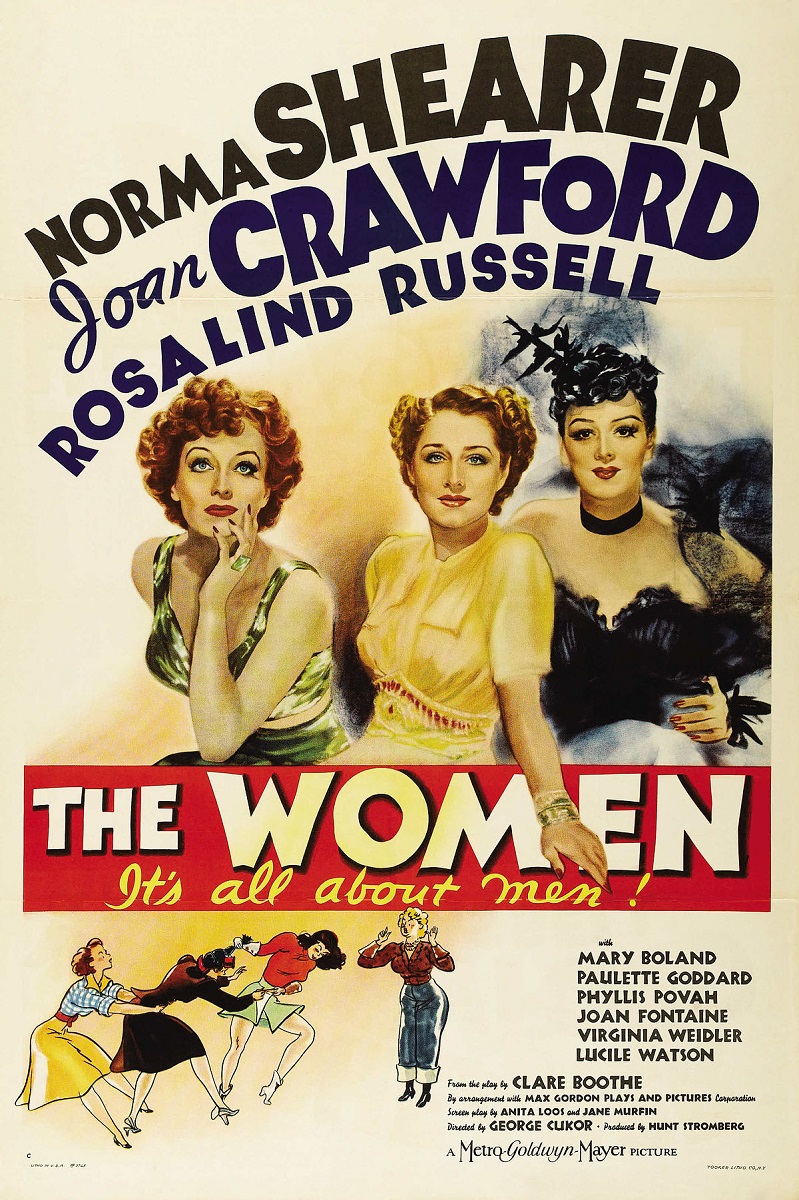
The Plot: Mary Haines (Norma Shearer) is a Manhattan socialite content with her marriage, until she learns from her busybody cousin Sylvia (Rosalind Russell) that her husband is having an affair with counter girl Crystal Allen (Joan Crawford). After a series of catty encounters with Crystal and other society women, Mary travels to Reno for a quickie divorce, where she bonds with fellow divorcees (Mary Boland, Paulette Goddard and Joan Fontaine). Over the next two years, Mary grows from the experience, and learns to fight for what she truly wants. Featuring a cast of 130 speaking roles, all of them women.

Why It Matters: The NFR cites the film’s bevy of leading ladies, as well as its historical significance due to “explor[ing] the new options open to women with the possibility of divorce”. The write-up also praises George Cukor and “his reputation as a woman’s director”.

But Does It Really?: This movie is definitely a minor classic. “The Women” works as a time capsule of gender politics of the ‘30s, and boasts a legendary roster of talent (most of them put to good use), but overall the film shows its dated qualities more than its timelessness. Trapped in the male-dominated classic Hollywood studio system, “The Women” is by no means a bad movie by today’s standards, but does pale in comparison to the more liberated female-driven films that have come in the last 80 years.

Everybody Gets One: Playwright Clare Boothe Luce first gained recognition in 1931 for writing the short story anthology “Stuffed Shirts”. This led to freelance magazine work, editing Vanity Fair for a time, and a series of successful plays, including “The Women”. Her post-“Women” career focused on her conservative politics, becoming a congresswoman for Connecticut’s 4th District, and eventually the U.S. Ambassador to Italy under Dwight Eisenhower.

Wow, That’s Dated: Despite an all-female cast, the poster still exclaims, “It’s all about the men!” The film’s overall attitude towards women and their toxic friendships was considered sexist and misogynistic even in 1939!

Seriously, Oscars?: “The Women” did well with critics, but only okay with audiences, not making a profit until its 1947 re-release. Like many of the second-tier 1939 films on this list, “The Women” received zero Oscar nominations.

Other notes

  • Noted “woman’s director” George Cukor became available to helm “The Women” a month before filming began, when he was infamously fired from “Gone with the Wind” (frequent clashing with David O. Selznick, possibly Clark Gable too).
  • The film begins with a reference in the credits to the original Broadway production’s “triumphant run” of 666 performances! This is followed by each of the main characters being depicted as various animals: Mary’s a fawn, Crystal’s a leopard, Sylvia’s a cat, etc. We’re three minutes in and I’m already calling this movie’s female agenda into question.
  • Rosalind Russell is definitely auditioning for “His Girl Friday”. Her Sylvia shoots out pithy quips like a machine gun.
  • Norma Shearer was one of the few silent film stars to make the transition to sound, and “The Women” is her only sound film on the Registry. Shearer is mostly forgotten today, but was one of the biggest movie stars of the 1930s, and is a confident, engaging central figure in this ensemble.
  • Sadly, Virginia Weidler does not get to spout too many sassy one-liners as Mary’s daughter, but she’s only one year away from playing Katharine Hepburn’s feisty kid sister in “The Philadelphia Story”.
  • I don’t care for this movie’s attitude on infidelity. “It comes to most wives.” In fact, this whole movie’s attitude towards women in general is concerning. Every woman in this movie is either manipulative and catty, or virginal and defenseless. And this is coming from a female playwright and two female screenwriters!
  • Obviously Joan Crawford’s the woman Stephen’s having the affair with: she’s the only one of the perfume girls who gets a closeup.
  • This is Butterfly McQueen’s film debut! “The Women” premiered just three months before “Gone with the Wind” and McQueen’s public declaration of midwifery inexperience.
  • The fashion show sequence was originally filmed in black & white (like the rest of the movie), but MGM insisted on reshooting the sequence in color to cash in on the Technicolor craze. George Cukor hated these reshoots and successfully got the sequence removed from rereleases. The original footage has since been restored, and the change to color makes the scene more acceptable as what it is: superfluous, aesthetically pleasing spectacle.
  • It’s great seeing Joan Fontaine in a role where she’s not a victim of gaslighting. She even gets to do some physical shtick with Rosalind Russell!
  • Having no men in the cast feels very organic, except for the scene in which Mary and Stephen have their final argument and decide to divorce. There’s a clever workaround with the Haines’ domestics eavesdropping on the conversation, but it’s very much a scene in which the drama is told rather than shown.
  • Also dated: ‘30s divorce proceedings in which “children must go with their mothers”. It’s a long time until “Kramer vs. Kramer”.
  • Reno, Nevada gained notoriety in the ’30s for its very liberal divorce laws, making it the most popular “divorce mill” in the country. Eventually, the rest of the country caught up to Reno’s divorce standards, but the Biggest Little City in the World maintained its popularity thanks to its other ‘30s revolution: legalized gambling.
  • This is the movie where Paulette Goddard and Rosalind Russell catfight. That must do it for someone.
  • As we all know, Joan Crawford is great with kids.
  • Gossip columnist Dolly Drupuyster is played by Hedda Hopper, less than two years into her 30 year reign as one of Hollywood’s legendary gossip columnist.
  • Most of the film’s Production Code workarounds are harmless and par for the course, but Crystal’s final tell-off of the women packs a much appreciated punch: “There’s a name for you ladies, but it isn’t used in high society…outside of a kennel.”

Legacy

  • There have been two film remakes of “The Women”. The 1956 musical “The Opposite Sex” stars June Allyson and makes the mistake of featuring the male characters. Diane English’s 2008 remake modernizes the story, and did well with audiences, despite being a critical disaster.
  • The original play of “The Women” has returned to Broadway twice: a 1973 revival with Kim Hunter and Myrna Loy, and a 2001 production starring Cynthia Nixon. The latter was filmed for PBS.
#393) Uksuum Cauyai: The Drums of Winter (1989)

562027883_1280x720

#393) Uksuum Cauyai: The Drums of Winter (1989)

Directed by Sarah Elder and Leonard Kamerling

Class of 2006

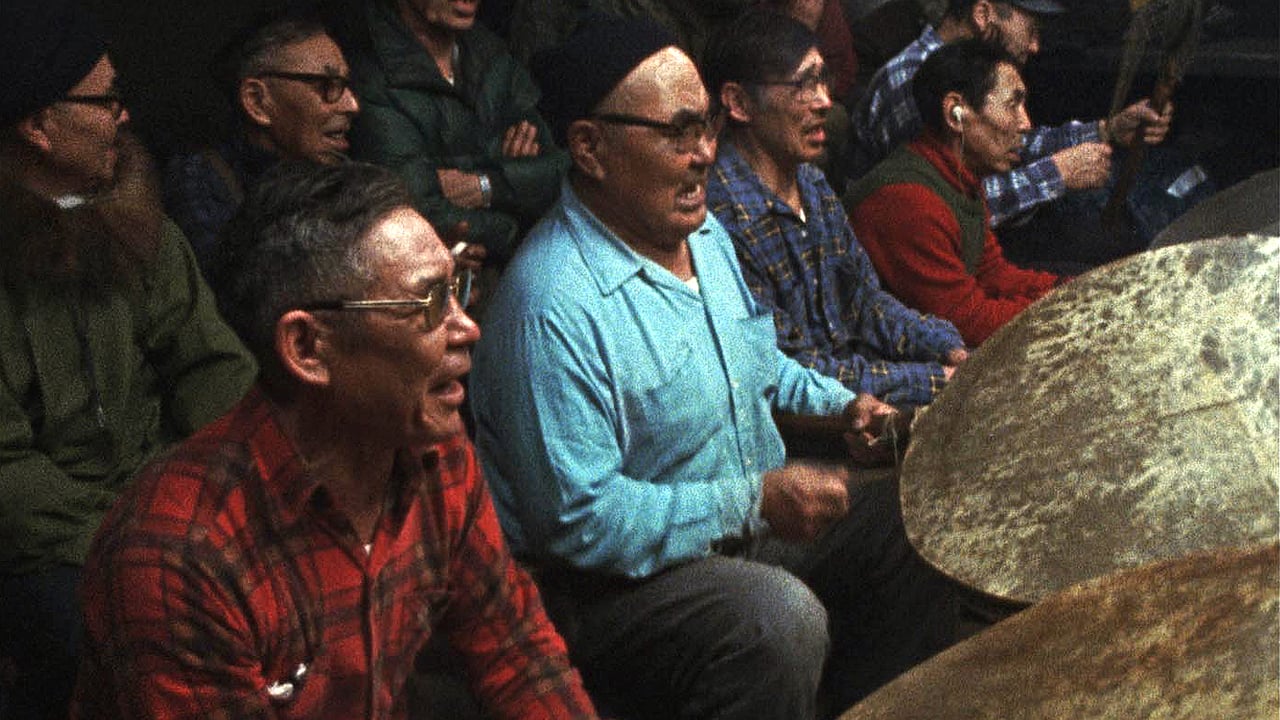
The Plot: “Drums of Winter” chronicles the Yup’ik, an indigenous people in the small town of Emmonak, Alaska, specifically the traditional Yuraq dances during their potlatch ceremonies. In their trademark collaborative film style, Elder and Kamerling let their subjects describe their own lives and customs without interference from either of the directors. The types of Yup’ik dances are discussed and showcased, as is the history of these dances being banned by American missionaries, to the point of near extinction. Through the power of film, and the oral history of the Yup’ik, these dances survive.

Why It Matters: The NFR gives a brief rundown and description of the Yup’ik. The only superlative given to the film itself is that it is “beautiful”.

But Does It Really?: Within minutes of my viewing I knew why “Drums of Winter” was inducted into the NFR: by preserving this film, they are preserving a culture. In addition, “Drums of Winter” represents Sarah Elder and Leonard Kamerling, two filmmakers who have spent their lives chronicling the Alaskan people and their evolving culture. “Drums of Winter” is an engaging glimpse at an oft-ignored culture, and I’m glad the NFR has chosen to preserve and highlight this film.

Everybody Gets One: Sarah Elder and Leonard Kamerling spent most of the ‘70s and ‘80s making documentaries about various Native Alaskan cultures, and the hardships they endured to keep their traditions free from outside influences. The two filmmakers had a unique approach to their films, in that the subjects themselves had a creative say in what was presented (and how) in the final film. Other Elder/Kamerling/Native Alaskan collaborations include “At the Time of Whaling” and “On the Spring Ice”, both chronicling another Yup’ik community on St. Lawrence Island.

Wow, That’s Dated: The bulk of this movie was shot in 1977, and even citizens on a remote Alaskan coastline have those brown lens prescription glasses I associate with the late ‘70s.

Seriously, Oscars?: “Drums of Winter” played the festival circuit, so I don’t know if it ever got an Oscar qualifying run. The 1989 Best Documentary winner was the Ron Epstein and Bill Couturié classic “Common Threads: Stories from the Quilt”. None of Elder and Kamering’s documentaries have received any Oscar love.

Other notes

  • The bulk of this movie concerns the potlatch ceremonies associated with indigenous peoples of both Alaska and northwestern Canada. Long time readers may recall the history of the potlatch being discussed in my write-up for “In the Land of the Head Hunters”, a 1914 docudrama made during a ban on potlatches implemented by Jesuit missionaries. It was fascinating to revisit this practice over 60 years later and find it still surviving, albeit in a far less extravagant manner (assuming the depiction in “Head Hunters” is accurate).
  • The importance of documentaries like this cannot be overstated. These dances have been passed down through the centuries orally, with various customs changing based on memory and perception. To have a filmed document of how and why these dances were performed (at least in the 1970s) is indispensable. It also confirms one of my film professor’s theories on how to make a great documentary: “Point a camera at the oldest person in the room and start asking questions.”
  • One of the interviewees stories involves her grandfather fighting off a polar bear by spearing the bear where the sun don’t shine. And I thought “The Hunters” was too cruel to animals…
  • “Drums of Winter” films several scenes inside one of Emmonak’s dance houses (Qargi), a sacred space that required the approval of the Emmonak citizens to be filmed. Interestingly enough, it was the elders that were most supportive of the filming, knowing it was important to document the Qarqi.
  • “Now we’re on film. After we die they can see us.” That guy gets it.
  • Shoutout to Walkie Charles, one of several translators used in the film, but the only one actually from Emmonak. His local experience helped him translate the more unique phrases and colloquialisms of the Yup’ik. After their first meeting, Leonard Kamerling asked, “Where have you been?”
  • There’s a lot of talk about the western influence on the Yup’ik in the late 1800s/early 1900s. This was due to America purchasing Alaska from Russia in 1867. Alaska was mostly ignored for the first 40-50 years as an American territory, other than from those exploiting its resources and Jesuit missionaries telling the natives that their beliefs were “wrong”. Qarqis were completely demolished, and dance ceremonies eliminated. While these practices have been mostly reversed in the last 100 years, western technology has definitely changed the Yup’ik and their way of life.
  • I appreciate Elder and Kamerling’s hands-off approach with their subjects: No narration, minimal text, everyone speaks for themselves. It makes the dance sequences in this film much more powerful, knowing the specific stories behind why these people are dancing.
  • So if you want your documentary to make it into the NFR, you need an NEA grant. Got it.

Legacy

  • Sarah Elder and Leonard Kamerling have only made a handful of films in the years since “Drums of Winter”: Kamerling with 1997’s “Heart of the Country” and 2016’s “Changa Revisited”, Elder with 2015’s “Remains to Be Seen”. Kamerling was also recently profiled on something called “Alaska Filmmakers”.
  • Both Elder and Kamerling now teach documentary filmmaking: Kamerling at the University of Alaska, Elder at the University of Buffalo. According to the Documentary Educational Resources website, Elder still has a log cabin just outside of Fairbanks, Alaska, where she resided for 25 years. Don’t know if that still holds true, but it makes for good copy.
  • Thankfully, the Yup’ik started actively trying to preserve the Yuraq dances throughout the mid-80s, and today their dances are more commonly known and practiced. Annual dance festivals have also made a comeback throughout Alaska.

#392) The Cameraman (1928)

MV5BNjYxMzBkYzUtZTQ5Yi00YTkxLTk5NjAtZWQxODk1YWE3YzBhXkEyXkFqcGdeQXVyMDI2NDg0NQ@@._V1_

#392) The Cameraman (1928)

OR “Blocked Buster”

Directed by Edward Sedgwick (with uncredited assistance from Buster Keaton)

Written by Clyde Bruckman and Lew Lipton

Class of 2005

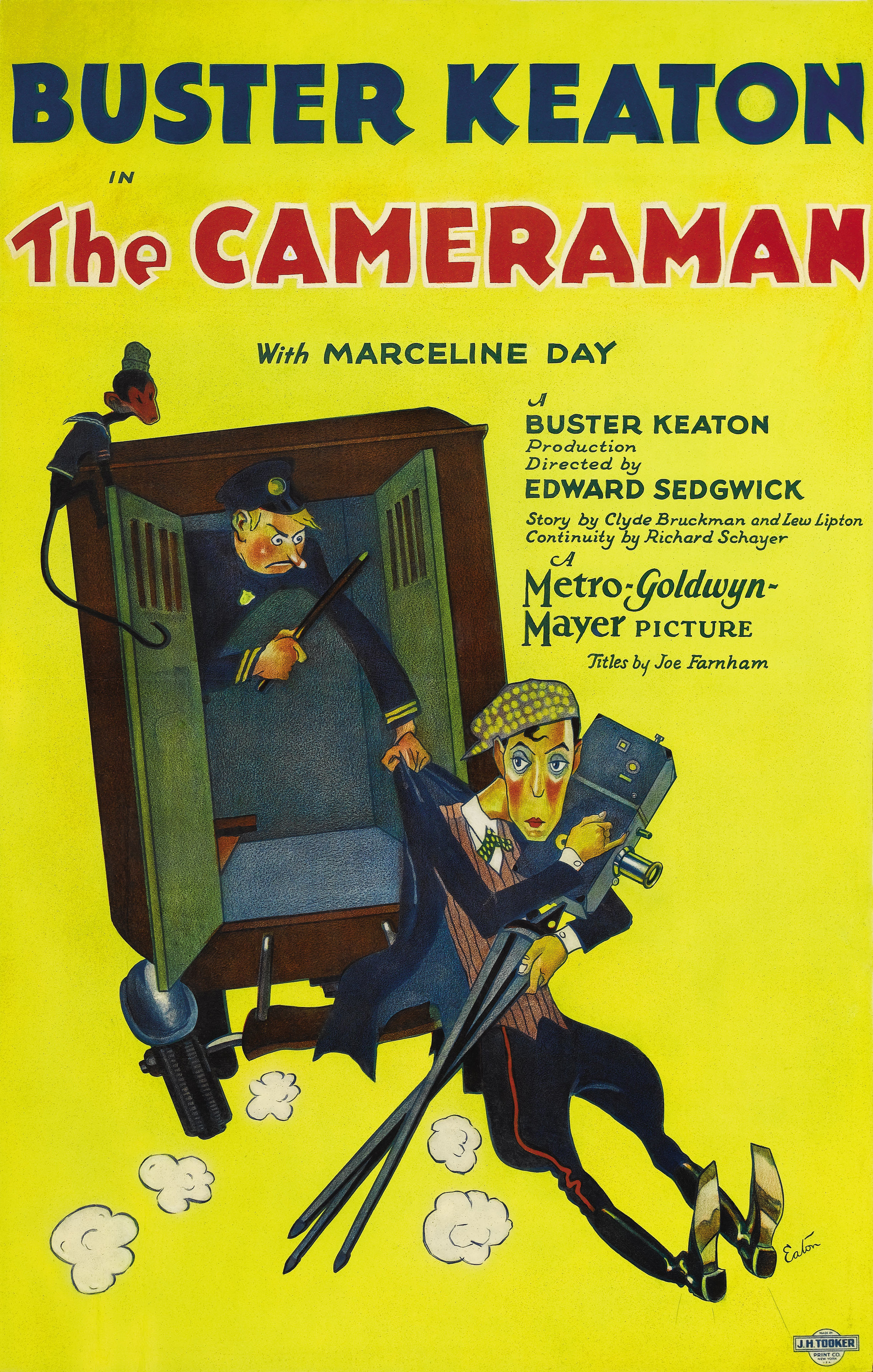
The Plot: Photographer Buster (Buster Keaton) falls for Sally (Marceline Day), who works as a secretary for MGM Newsreels. Buster buys a used film camera and applies for a job, while simultaneously trying to ask out Sally, both leading to hilarious results. All the while, Buster must also contend with Sally’s rival beau Harold (Harold Goodwin) and a police officer (Harry Gribbon) who thinks Buster is nuts. Also there’s a monkey.

Why It Matters: Wow, someone at the NFR really likes this movie. Their write-up calls “The Cameraman” “seamless [and] ingenious”, and that the film features “some of the best treatises on the techniques and psychology of shooting motion pictures.” That’s a fancy way of saying it has lots of ha-has in it.

But Does It Really?: Oh man, this is a tough one. Historically, the film represents Keaton’s last creative hurrah in a decade long hot streak: “The Cameraman” was his final silent film, as well as his first movie under contract at MGM. The film has plenty of quality Keaton gags that hold up quite well, but overall it’s more a series of well-constructed bits than a cohesive movie. Still, second-tier Keaton is better (and funnier) than first-tier almost anybody else. I can give “The Cameraman” a very slight pass, but if you’re short on time, stick with Keaton’s undisputed classics like “Sherlock Jr.” and “The General”.

Wow, That’s Dated: Besides Keaton’s cumbersome camera, the film also highlights movie newsreels, tintypes, ticker tape parades, rumble seats, and organ grinders. Plus shoutouts to aviator Charles Lindbergh and English Channel swimmer Gertrude Ederle.

Seriously, Oscars?: MGM had the Best Picture winner of 1929 with “The Broadway Melody”, but “Cameraman” received zero nominations at the 2nd Oscars. None of Keaton’s subsequent films received any Oscar love, either. A new generation rediscovered Keaton’s filmography in the 1950s, and in 1960 Keaton received an honorary Oscar for lifetime achievement.

Other notes

  • Why would a filmmaker of Keaton’s stature give up his creative independence by signing up with MGM? Not by choice. Turns out “The General” was a critical and commercial failure upon its release, and United Artists forced Keaton to work with a production manager who interfered with his creative process. Once Keaton’s contract with United Artists ended, he jumped ship to MGM, with a promise from executive and friend Joseph Schenck that he would still maintain creative control. As this episode of “You Must Remember This” details, that was ultimately not the case.
  • Keaton found his new home stifling from the beginning. A typical Keaton screenplay had three or four writers, MGM assigned 22 script doctors to “The Cameraman”. In addition, Keaton had a hard time being “just an actor” and letting Edward Sedgwick direct the film. Sedgwick would eventually call on Keaton’s expertise throughout production, and the two got along after that.
  • The aforementioned shoutouts to Lindbergh and Ederle come with their inclusion in the film via archival footage, mixed in with shots implying Buster witnessed these events. “The Cameraman” presaged “Forrest Gump”!
  • The meet-cute between Buster and Sally involves Buster brushing up against her in a crowd. Gross gross gross.
  • Keaton gets a lot of comedy mileage out of that clunky camera. He does every gag you can by swinging that thing around and hitting everything in sight, and it works!
  • The baseball scene has nothing to do with anything, but it’s fun watching one of the comedy greats pantomiming an entire game by himself.
  • The relationship between Buster and Sally is a variation on a theme called “He’s very awkward and she’s okay with it”.
  • The most impressive shot in the whole movie is Buster running up and down the stairway of an entire building, from the roof to the cellar. The shot was filmed on a massive set using an elevator crane. What I wouldn’t give to see that behind-the-scenes footage.
  • Keaton’s trademark stoneface conveys so much with so little. Keaton uses the same facial expression to convey sadness, confusion, indifference, frustration, etc. I guess you just read into it whatever you want.
  • The swimming pool scene is another highlight, from the inspired (and possibly improvised) changing room sequence, to some brief rear nudity from Keaton (this was pre-code after all). Speaking of, I was not expecting Keaton to be so ripped. Someone didn’t skip ab day.
  • And then we go to Chinatown and this film takes a turn. For starters, Buster seemingly kills the organ grinder’s monkey! Services will be held at Norma Desmond’s house.
  • Don’t worry, the monkey is fine, and becomes Buster’s sidekick for the film’s third act. It’s…a choice.
  • If you’re trying to crack down on gang activity in Chinatown, might I suggest a young Jake Gittes? It’d be a good, traumatizing lesson for him.
  • “The Cameraman” loses some steam towards the end, though there are still a few remarkable stunts from Keaton, and the ending has what appears to be the ‘20s version of the “Weird Al’s on the plane” joke from “Naked Gun”.

Legacy

  • Keaton would later call his decision to sign with MGM the worst in his life. The studio saw Keaton not as a creative independent filmmaker, but rather as a commodity that had to be protected. He clashed often with studio heads, and was fired from MGM in 1933. This, mixed with his divorce from his first wife in 1932, led to Keaton’s slump into alcoholism.
  • By the 1940s, a happily remarried and sober Buster Keaton returned to MGM as a freelance gag writer. He gave comedy advice to a young Lucille Ball, and contributed jokes and bits of business to several Red Skelton movies. Among them, 1950’s “Watch the Birdie”, which is considered by many an unofficial remake of “The Cameraman”.
  • As mentioned above, Keaton’s work was rediscovered thanks to television, and he spent the last 15 years of his life as a bona-fide, oft-employed comedy icon.

#391) The Nutty Professor (1963)

81-hnhRea1L._SL1458_

#391) The Nutty Professor (1963)

OR “Jerry & Hyde”

Directed by Jerry Lewis

Written by Lewis and Bill Richmond

Class of 2004

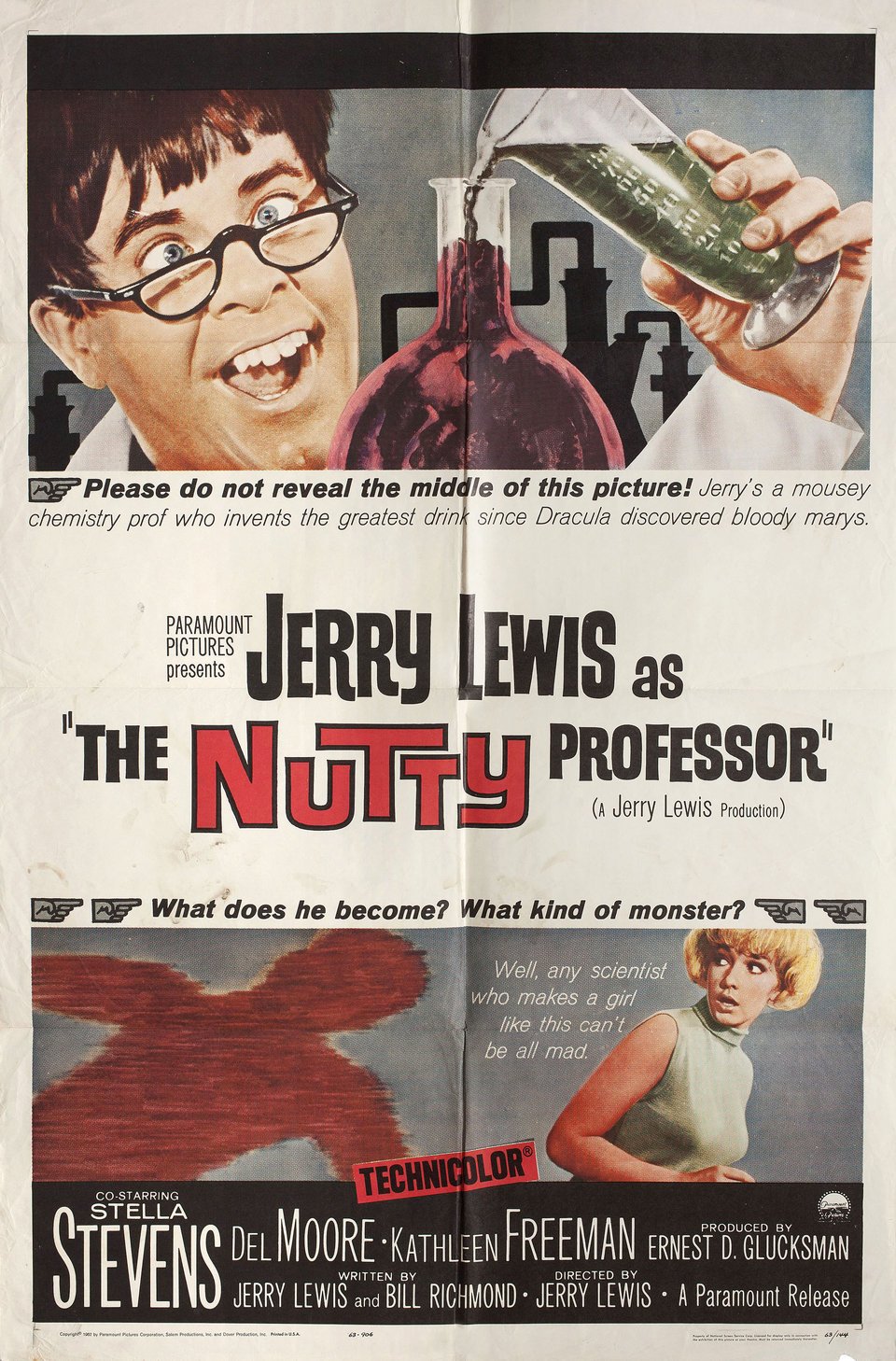
The Plot: Chemistry Professor Julius Kelp (Jerry Lewis) is a friendly and well-loved faculty member, but also quite meek and accident-prone. Kelp creates a serum that will help him overcome his nuttiness, and temporarily becomes confident, obnoxious hipster Buddy Love. Love puts the moves on one of Kelp’s students (Stella Stevens), who begins to suspect that Buddy and Kelp are one and the same. All of this comes to a head at the school dance with the dancing and the changing and the hey laaaaaaddyyyyyy!

Why It Matters: The NFR calls the film a “comical character study tinged with pathos” and praises Lewis for his directing and his “not inconsiderable acting talent.” A double negative makes it seem kinda back-handed doesn’t it?

But Does It Really?: Jerry Lewis’ multi-faceted career should be represented somewhere on the list, and “Nutty Professor” is a logical, recognizable choice. “Nutty Professor” still has plenty of very funny moments, and while a tad predictable and childish, highlights the comic precision that Jerry Lewis brought us in front of and behind the camera. It also helps that the film has a modern remake whose popularity has help keep this film in the conversation (see “Legacy” below). No argument for NFR inclusion from me for “The Nutty Professor”.

Shout Outs: Stella comments on Buddy’s constant drinking by calling him “Lost Weekend Junior”. What a fun, unsettling spin-off that would make.

Everybody Gets One: Jerry Lewis started as a young comedian in the Borscht Belt, mugging and pantomiming to popular records. One night he was paired with up-and-coming singer Dean Martin, and a legendary comedy duo was born. Lewis & Martin performed in nightclubs, on television, and eventually in the movies, becoming Paramount’s biggest box office draw of the 1950s. The duo split in 1956, and Jerry used his box office standing as leverage with Paramount to let him direct and write his own movies.

Wow, That’s Dated: Mostly Buddy’s hipster slang, as well as the casual smoking that happens throughout the film.

Seriously, Oscars?: No Oscar love for “Nutty Professor”. In fact, none of Jerry Lewis’ films received any Oscar nominations, though the man himself received the Jean Hersholt Humanitarian Award in 2009.

Other notes

  • First and foremost, let’s talk about the whole “the French love Jerry Lewis” thing. It’s not so much that the French have an inexplicable fondness for Lewis’ broad comedy; it has more to do with their love of the auteur. Lewis wrote, directed, produced, and starred in his own movies, making him a solid example of a film auteur, and therefore an admirable figure in European cinema.
  • While not the first Jerry Lewis movie to utilize this technique, “The Nutty Professor” was among the first productions to use video assist. Because Jerry was acting in most of the shots he was directing, video assist allowed him to see a take immediately afterwards on a closed circuit television, enabling him to fine-tune immediately without waiting for the film to be processed days later. Video assist has become the industry standard thanks to Jerry Lewis. Now if only he had held the patent on it…
  • Is being a “nutty” professor the same as being an “absent-minded” professor?
  • While never explicitly mentioned, “The Nutty Professor” is set (and shot on-location) at Arizona State University in Tempe, Arizona. Mom, any recollections about that?
  • This movie has a bounty of character actors. Lewis staple Kathleen Freeman is spot-on as less than helpful secretary Millie Lemon, and I particularly enjoyed the flamboyant work of Del Moore as Dean Warfield. Also be on the lookout for “before-they-were-famous” appearances by Henry Gibson and Richard Kiel.
  • Professor Kelp attempting to join a gym is pretty much how I imagine my gym experience would go. Either that or like this lady.
  • The transformation scene is quite an offbeat sequence, but even knowing how it would pan out, the big reveal is still laugh-out-loud funny.
  • Buddy Love is rumored to be Jerry’s swipe at Dean Martin, but that doesn’t ring true to me. At the very least, it’s certainly not an imitation of Dean’s on-screen persona. Jerry always claimed Buddy was an amalgam of various jerk hipsters he had encountered in show business. That scans.
  • Stella Stevens’ character is one of the more advanced “He’s a jerk and she’s okay with it” clichés. Stella calls Buddy out on his rude behavior, but she’s still attracted to him, and the movie constantly objectifies and fantasizes about her. For crying out loud, “The Poseidon Adventure” treats her with more dignity!
  • Colleges had proms? When did those go away? Can I blame “Animal House”?
  • Ultimately, this movie has a very sweet moral. As Kelp says in his final monologue, “You might as well like yourself…If you don’t think much of yourself, how can others?” Can I get a amen?
  • The movie ends with a curtain call in which the primary cast comes out one by one and takes a bow. A bit odd, but at least it makes more sense here than in “The Bad Seed”.

Legacy

  • Jerry Lewis continued to write, direct, and star in his own movies for the next 20 years, but audiences weren’t willing to go along with Lewis’ increasingly serious work. Anyone with a complete copy of “The Day the Clown Cried” to the front, please.
  • “The Nutty Professor was, of course, remade in 1996 with Eddie Murphy playing the overweight Sherman Klump, his skinny alter-ego Buddy, and Klump’s entire foul-mouthed family. Jerry Lewis was an executive producer on the film, but later regretted his decision to green light a remake. But never mind that: “Hercules! Hercules! Hercules!”
  • Lewis finally made his long-desired sequel to “The Nutty Professor” 45 years after the original. 2008’s “The Nutty Professor: Facing the Fear” is an animated follow-up with Lewis reprising his dual role, along with Drake Bell (of “& Josh” fame) as his grandson.
  • I guess there’s a musical version? Lewis directed a 2012 production in Nashville with a score by the late great Marvin Hamlisch.
  • And if Professor Kelp’s voice and overall demeanor sounds familiar, you’re thinking of Hank Azaria’s impression as Professor Frink from “The Simpsons”. They even got Jerry Lewis to voice the character’s father in one of their “Treehouse of Horror” episodes.

#390) The Hunters (1957)

the-hunters

#390) The Hunters (1957)

Directed by John Marshall (In collaboration with Robert Gardner)

Class of 2003

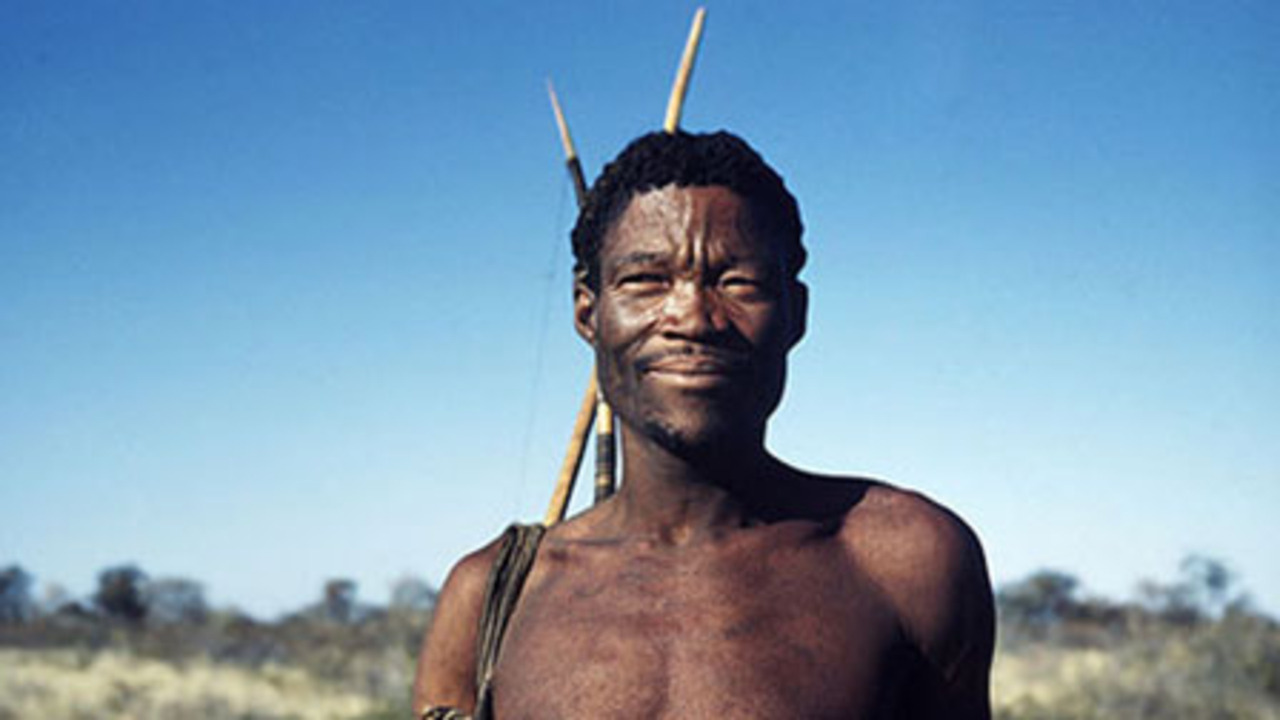
The Plot: “The Hunters” chronicles the !Kung people (aka the Ju/’hoansi) of Namibia as they were in the early ‘50s. As the title suggests, this film specifically follows a group of hunters in the tribe as they stalk various prey for food. And when they do finally capture their prey, be warned that things get pretty graphic. Brought to you by your friends at the Film Study Center at Harvard University.

Why It Matters: The NFR gives a brief description, and gives mention to the film’s win at the BAFTAs (more on that later). There’s also a link to the Documentary Educational Resources page where you can purchase the DVD of “The Hunters” for as low as $34.95!

But Does It Really?: I was initially hesitant to include a second Robert Gardner ethnographic film on this list (we already have “Dead Birds”). During my research, however, I realized that despite Gardner’s involvement, the film was actually shot by John Marshall, who is not represented elsewhere on the list. So, despite being very similar to “Dead Birds” in terms of subject and approach, “The Hunters” gets in on a technicality. You win this round, Robert Gardner.

Everybody Gets One: The son of two anthropologists, John Marshall first traveled to the Nyae Nyae region of the Kalahari in 1950. For his second trip in 1951, John’s father Laurence gave him a 16mm camera and advised him to not be artistic with his filming, but rather “just film what you see”. “The Hunters” is John’s first film, and is comprised of footage from several trips throughout the ‘50s.

Seriously, Oscars Baftas The Internet?: Here’s a weird one: several articles (including the NFR write-up) mention that “The Hunters” won Best Documentary at the 1958 BAFTAs, but I can’t find any information from the official BAFTA website that can corroborate this. There was a Documentary category in 1958, but the winner was a film called “Glass”. Where are people getting this information?

Other notes

  • The aspect of !Kung life that fascinated me most was its advanced gender equality. While it is still primarily men that hunt and women who tend to the children, “The Hunters” documents these roles being gender-swapped without difficulty.
  • This film is definitely not for those with a weak stomach or who are sensitive to animal cruelty. Near the beginning of the film we watch a mongoose get trapped and killed, followed by a warthog being poisoned to death. And it only gets worse from there.
  • Something I had never considered: judging the moistness of animal feces to determine if said animal is close by. “Scrubs” was right: everything comes down to poo.
  • Now I’m no expert in ethnographic filmmaking, but wouldn’t a white guy with a big camera be a giveaway to the animals that hunters are nearby?
  • And now we arrive at, for lack of a better term, the meat of this film. Our hunters spend the bulk of the movie pursuing giraffes, climaxing with successfully impaling one giraffe with a poisoned spear, followed by the skinning of its hide and cutting of its meat. This gets real depressing real fast. I did not start this blog so I could watch a giraffe snuff film. Sure it’s accurate to the !Kung way of life, but that doesn’t mean I need to see every second of it. I will gladly take your word for it, Marshall.
  • The only thing that would make watching a dead giraffe worse is if Eric and Don Jr. were posing in front of it. If rich people need an expensive hobby, might I suggest prolific generous philanthropy?

Legacy

  • Upon seeing the final cut of “The Hunters”, John Marshall was worried he had romanticized the !Kung, and was determined to make more realistic films about their culture. These plans were thwarted, however, when Marshall was banned from additional filming by the South African government, who felt the film was “a threat to the status quo”. John Marshall managed to make a few films using outtakes from “The Hunters”, and was finally allowed to return to Namibia once the country became free of South African influence. Marshall also helped create the Nyae Nyae Development Foundation of Namibia, and continued to be a vocal advocate for the !Kung for the rest of his life.