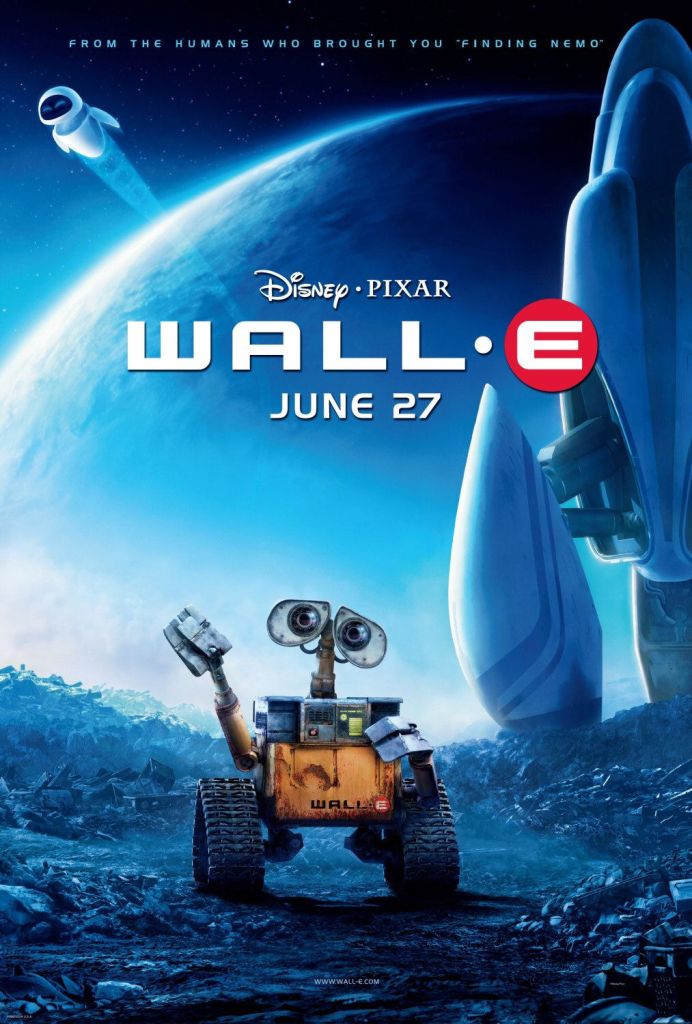
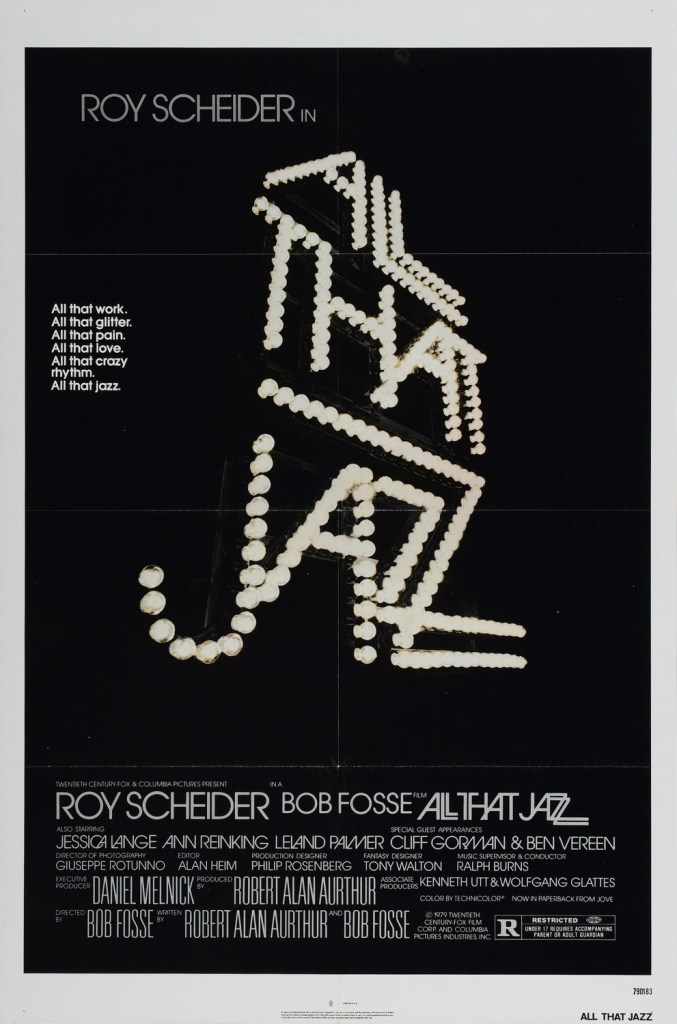
#41) All That Jazz (1979)

#41) All That Jazz (1979)

OR “Joe Biz”

Directed by Bob Fosse

Written by Fosse and Robert Alan Aurthur

Class of 2001 

This is a revised and expanded version of my original “All That Jazz” post, which you can read here.

The Plot: Joe Gideon (Roy Scheider) is an acclaimed Broadway choreographer turned film director, standing in for this movie’s real-life acclaimed Broadway choreographer turned film director Bob Fosse. An obsessive workaholic, Joe spends his days simultaneously rehearsing his new Broadway show and assembling a final cut of his new movie. Joe is also juggling quality time with his estranged wife/leading lady Audrey Paris (Leland Palmer), his daughter Michelle (Erzsébet Földi), and his girlfriend Kate (Ann Reinking), in addition to his occasional one-night-stands, a pill addiction, a smoking habit, and a flirtation with the mysterious Angelique (Jessica Lange). All of this takes its toll on Joe, who suffers a heart attack one day during rehearsal. “All That Jazz” meditates on death, the price of success, and the lies we tell ourselves and others. Oh, and there’s a bunch of songs in it too.

Why It Matters: The NFR calls it “Felliniesque” and praises the film for “mercilessly reversing the feel-good mood of classical movie musicals.”

But Does It Really?: Oh boy, this is tough. As much as I love “All That Jazz”, I recognize it is an acquired taste, with its morbid energy and inside-baseball look at show business, as well as the cries of narcissism often hurled at this movie. In true Fosse fashion, there’s a lot of “razzle dazzle” to distract the viewer from getting to know the real Joe/Bob, which can alienate viewers looking for a deeper dive. As for its cultural legacy, you rarely see “All That Jazz” get mentioned in modern media, with mainstream references to Fosse distilled down to his signature “jazz hands”. While its NFR standing is somewhat shaky, I’ll give “All That Jazz” a pass as an insight into Bob Fosse (more about that later), and also because despite its flaws, “Jazz” still manages to engage and entertain 40 years later.

Everybody Gets One: Most of the supporting cast were Broadway performers/previous Fosse collaborators. Among them: Ben Vereen (the original Leading Player in “Pippin“), Leland Palmer (also from “Pippin”), Cliff Gorman (seen here as a Lenny Bruce-esque stand-up a la Fosse’s “Lenny“), and Ann Reinking (several Fosse productions, as well as his girlfriend for most of the ’70s).

Seriously, Oscars?: While “All That Jazz” divided critics and audiences, the Academy ate it up, with “Jazz” tying “Kramer vs. Kramer” for most nominations at the 1980 Oscars (9). “Kramer” was the night’s big winner, but “Jazz” took home four trophies: Art Direction, Costume Design, Film Editing, and Adapted Score.

Other notes 

  • In late 1974, Bob Fosse suffered a heart attack while editing his film “Lenny” and rehearsing the musical “Chicago”. After recuperating, Fosse began work with writer Robert Alan Aurthur on a script based on the Hilma Wolitzer novel “Ending”. The novel’s themes of death and grief served as the inspiration for what eventually became “All That Jazz”.
  • This film’s production was filled with setbacks. Richard Dreyfuss was originally cast as Joe Gideon, but bowed out shortly after rehearsals began. At the time, Dreyfuss cited exhaustion as his reason for departing, though later admitted he had creative differences with Fosse. Roy Scheider was brought in as a replacement, and production was pushed back a few months. During filming, co-writer/co-producer Robert Alan Aurthur died of lung cancer. Before filming wrapped, the film went over-budget (from $6 million to $9.5 million), and Columbia refused to give the film the additional $500,000 it needed to film its finale. In a Hail Mary move, executive producer Daniel Melnick showed a rough cut to 20th Century Fox, who agreed to co-finance the film in exchange for distribution rights and sharing the profits with Columbia. Surprisingly, Fosse seemed in good health during all of this, joking that he had cut his smoking habit down to “five packs a day”.
  • On paper, Roy Scheider seems an odd choice for Joe (even Fosse had to be convinced), but once you see the final film, it makes sense. In a departure from his more action-oriented filmography, Scheider is quite charming and personable, two necessary traits if your audience is to sympathize with a workaholic womanizer. And of course Fosse’s autobiographical proxy has a full head of hair.
  • I’ve theorized that most movie quotes become famous because they are repeated throughout their film. “It’s showtime, folks” may be the exception. Joe says it several times while looking in his bathroom mirror, but does anyone ever recreate that moment in their own home nowadays? Just me?
  • The opening montage of Joe’s dance audition is pretty wonderful, masterfully cut to George Benson’s cover of “On Broadway”. It ends with my favorite line in the movie: “That’s how you get a job.”
  • Jessica Lange’s film career was just starting when she did “All That Jazz” (though she had already been raked across the coals for the “King Kong” remake). She is everything Angelique calls for: using her beauty and seduction to lure Joe towards the darkness. Lange was also occasionally romantically linked to Fosse around this time. Speaking of…
  • Shout out to Ann Reinking, who is not only playing a character in a relationship similar to her real-life one with Fosse, but was willing to play the part after they had broken up AND still had to audition for it.
  • One of the reasons I’m going easy on “All That Jazz” is because theater, by its very nature, is difficult to preserve. The National Recording Registry has many iconic cast albums among its ranks, and the NFR has several film adaptations of theater pieces, but a genuine theatrical experience is near impossible to preserve (bootlegs be damned). The next best thing is to preserve the creative process, and “All That Jazz” represents Fosse and his method. It’s not a one-to-one encapsulation (Ann Reinking repeatedly commented over the years that Joe Gideon was far worse than the real Fosse), but it’s as close as we’ll ever get to understanding one of the most influential figures in 20th century theater.
  • “All That Jazz” is one of the rare NFR movies to be nominated for a Stinkers Bad Movie Award: Worst Supporting Actor for Max Wright. Sure, the character’s a bit grating, but among the worst performances of the year? Please, the dad from “ALF” deserves better.
  • Erzsébet Földi makes a strong film debut as Joe’s daughter Michelle. She succeeds at being an actual kid rather than an adult’s approximation of a kid. She’s like if Quinn Cummings from “The Goodbye Girl” had ballet training. Side note: Fosse’s real life daughter Nicole makes a quick cameo as one of the dancers in “NY/LA”.
  • Leland Palmer makes a good stand-in for Fosse’s real life wife Gwen Verdon, although she’s about 15 years too young for the part. Palmer even sounds like Verdon in a few instances, especially when she sings.
  • “Take Off With Us” is what Fosse does best: turning a simple, catchy song into an overly sexual production number. And it goes on a lot longer than I remember; a full eight minutes!
  • Hot take: I’m on the fence about whether or not this movie is actually a musical. Initially, my argument was that the songs don’t progress the story the way they would in a traditional musical, and that before the finale there are only two numbers performed by the characters. On the other hand, if my argument is that the songs are too diegetic to be a musical, where does that put Fosse’s “Cabaret“, in which every song is performed as it would in real life? I’m still undecided, but I’m leaning towards classifying “All That Jazz” as a “movie with music” rather than a full-blown musical.
  • The film’s other pre-finale number: Kate and Michelle dancing to Peter Allen’s “Everything Old Is New Again”. It’s a sweet moment in the movie, and the only time Joe actually allows himself to experience joy.
  • I get the sense that Joe/Fosse doesn’t hate show business, but rather the people in it. Everyone outside his close circle is a nuisance: Ben Vereen’s fake entertainer, Max Wright’s demanding movie producer, Anthony Holland’s showy composer, John Lithgow’s envious director. That’s a lot of one-note caricatures for such a nuanced character study.
  • In the subgenre of NFR movies you shouldn’t watch after eating: Fosse filmed an actual open heart surgery to show Joe’s operation, and it is unsparingly graphic. This is interspersed with a scene of the producers discussing the financial implications if Joe were to die on the operating table. And…is that Wallace Shawn as the insurance man? Huh. Forgot about that.
  • And CCH Pounder too? Who isn’t in this movie?
  • Oh man, that finale. Ann and Leland (as well as Erzsébet) finally show off some big dance moves, culminating with Roy Scheider and Ben Vereen’s duet of “Bye Bye Life” (a minimally rewritten “Bye Bye Love”). It is one of filmdom’s longer finales, but Fosse ties everything together nicely. My main gripe: you spend the whole movie without seeing Roy Scheider sing or dance and when he finally does, it’s kind of a letdown. At least Sam Rockwell busted a few moves in “Fosse/Verdon”.
  • I dunno Fosse, I don’t think I believe that “all characters are fictitious” disclaimer during the credits. Seems a little too coincidental for my tastes…

Legacy 

  • After its initial theatrical run, “All That Jazz” took a backseat to Fosse’s more famous work (“Cabaret” et al). The film, however, is not without its fans (apparently Stanley Kubrick loved it), and still gets the occasional shout out from movie buffs like me.
  • Whenever “All That Jazz” is directly referenced in pop culture, it’s usually just the title, or a quoting of the aforementioned “It’s showtime” line. The latter has been repeated in such shows as “Better Call Saul”, “Family Guy”, and “American Horror Story” (do you think Jessica Lange noticed?).
  • The making of “All That Jazz” is touched upon in the limited series “Fosse/Verdon” (though mainly just how self-referential it was). Series producer Lin-Manuel Miranda makes a cameo as Roy Scheider.
  • Bob Fosse only directed one more film after “All That Jazz”: the 1983 drama “Star 80”. This made “Jazz” Fosse’s last musical film. Fosse died in 1987 of a heart attack on his way to the opening of his “Sweet Charity” revival. Fosse’s legacy has carried on since his passing, and a revival of “Chicago” (choreographed by Ann Reinking in Fosse’s style) has been playing on Broadway for the last 25 years.

Further Reading: Robert Alan Aurthur was posthumously nominated for two Oscars for “All That Jazz”, and his daughter Kate wrote this article recounting her experience attending the ceremony with her mother as his proxy.


#598) Love Me Tonight (1932)

#598) Love Me Tonight (1932)

OR “Tailor’s Delight”

Directed by Rouben Mamoulian

Written by Samuel Hoffenstein & George Marion Jr. and Waldemar Young. Based on the play “The Tailor at the Castle” by Léopold Marchand and Paul Armont. Score by Richard Rodgers and Lorenz Hart.

Class of 1990 

The Plot: Maurice Courtelin (Maurice Chevalier) is a tailor in Paris who always has a song in his heart. While trying to collect money from his client, the fast-talking Vicomte Gilbert de Varèze (Charlie Ruggles), Maurice tracks him down at the chateau of Gilbert’s uncle the Duc d’Artelines (C. Aubrey Smith). Complications arise when Gilbert introduces Maurice as the “Baron Courtelin”, and Maurice falls for the Duc’s niece Princess Jeanette (Jeanette MacDonald). There’s music, romance, comedy, and Myrna Loy as a thirsty Comtesse.

Why It Matters: The NFR calls it “one of the most original of 1930s musicals”, praising Mamoulian’s direction, the “effervescent” script, and the two leads (apparently Chevalier has “saucy charm”). An essay by movie musical expert Richard Barrios is a love letter to the film’s creativity.

But Does It Really?: While not the most iconic of early movie musicals, “Love Me Tonight” may have been the first musical to crack the code. Previous musicals of the era were typically revues of unrelated songs and acts, but “Love Me Tonight” effectively weaves its songs into the story and characters, creating an enjoyable experience that holds up reasonably well 90 years later. There are more famous musicals on this list for sure, but none of them would be here without the stepping stone of “Love Me Tonight”.

Everybody Gets One: Lyricist Lorenz Hart was introduced to composer Richard Rodgers in 1919, and the two spent the next 24 years writing 26 musicals. Among the songs these shows spawned were such staples as “The Lady Is a Tramp“, “Blue Moon” and “My Funny Valentine“. Unfortunatley, Hart’s frequent bouts with alcoholism led to some tensions with Rodgers, and the two parted ways shortly before Hart’s death in 1943. “Love Me Tonight” was one of several movie musicals Rodgers & Hart were commissioned to write during the 1930s.

Title Track: We’ll talk more about the title number later, but I will take this time to voice my disappointment that nobody in this movie sings the Tom Jones song also called “Love Me Tonight”.

Seriously, Oscars?: “Love Me Tonight” was released in August 1932 which, due to the Oscar’s off-calendar eligibility period, meant it couldn’t compete until the 1933 Oscars. Ultimately, “Love Me Tonight” received zero nominations. Paramount’s Best Picture contenders that year were “A Farewell to Arms” and fellow NFR entry “She Done Him Wrong“.

Other notes 

  • Leave it to the man who directed “Applause” to bring something new to the movie musical. You can see Mamoulian’s influence in the first scene, a non-verbal sequence in which the entire town begins its day in a rhythmic routine crescendoing to the opening number. It’s like they all live in the town from “Beauty and the Beast“.
  • Interestingly enough, I think movie musicals needed the Great Depression to survive and evolve. Moviegoers were looking for escapism once the Depression hit, and who wouldn’t want to escape to a story of romance and royalty in Paris?
  • Maurice Chevalier had been a sensation in both France and America in the 1920s, and became interested in film acting once sound came along. His early films with Paramount were box office hits, with “The Love Parade” and “The Big Pond” even earning him Oscar nominations. His 1932 film “One Hour With You” paired him with Jeanette MacDonald (a stage performer making her film debut) and was the biggest hit of his career. “Love Me Tonight” was tailored to both Chevalier and MacDonald’s talents, hence why they share first names with the lead characters. Side note: Whenever he performed in English, Maurice Chevalier always used a more pronounced embellishment of his natural French accent. He didn’t actually sound like that all the time.
  • I’ve read that all the singing in this film was pre-recorded, but it sounds live to me. Maybe it’s a combo of the two?
  • Charlie Ruggles is one of those actors who I’m more familiar with because of this blog. Before this, I only knew him as the Grandpa from “The Parent Trap”, turns out he had a long career as a comic character actor.
  • Easily the most memorable song from this movie is “Isn’t It Romantic?”, presented in a novel approach. It begins with Chevalier singing in his tailor shop (with the camera showing his multiple reflections in the dressing room mirrors), and the song’s infectious melody travels from character to character until it reaches Jeanette MacDonald in her chateau. Very ahead of its time, and still a memorable number.
  • This is my first experience with Jeanette MacDonald, one of the biggest movie singers of the day. She has that ’30s operatic sound I associate with early films: it’s beautiful, but I have no idea what she’s saying. Also, Jeanette MacDonald kinda looks like Gracie Allen, doesn’t she?
  • I’m enjoying Charles Butterworth as Jeanette’s well-meaning but boring suitor. Apparently Butterworth was Daws Butler’s inspiration for the original voice of Cap’n Crunch. I definitely didn’t see that coming.
  • What’s the deal with the three elderly aunts? Did this become “MacBeth” all of a sudden?
  • Myrna Loy is always worth the trip out, especially here as the man-hungry ingenue, a far cry from the more sophisticated, mature women of her later career.
  • Gabby Hayes is in this? I didn’t realize he made movies where he wasn’t a grizzled prospector in the old west.
  • I’m enjoying the usage of “Lover”, a very romantic song, being sung to a horse.
  • “Mimi” is performed in what I call the “Jonathan Demme Shot”; whenever we cut to Chevalier or MacDonald they are staring directly at the camera. It’s a bit unsettling.
  • “Love Me Tonight” was filmed pre-Code, meaning that the film could be a little more suggestive with its dialogue (I’m still shocked someone says “nymphomaniac”). A re-release of the film in the 1940s (under the Code) saw the deletion of about 10 minutes of the more provocative dialogue and scenes – including Myrna Loy in some risqué negligee. Sadly, these moments have never been seen since their deletion.
  • First rule of ’30s musicals: if someone says a line that rhymes, they’re about to start singing.
  • Thunderbolt, the horse initially selected for Maurice to ride, is described as “fast and furious”. Hopefully that horse knows how to Tokyo Drift.
  • This movie’s romance is a variation of “He’s a jerk but she’s okay with it” called “They’re both jerks but we’re all okay with it I guess”. It must be the music.
  • Ooh, a joke that plays with the film’s frame rate. Rouben you clever bastard.
  • “I’m an Apache” is another simple number filmed artistically: Chevalier regales the crowd while his shadow looms tall in the background. I don’t know what it means, but it looks great!
  • Why do so many movies have a guy kissing a sleeping woman? What is this, a Disneyland dark ride?
  • Interesting choice for the title number; “Love Me Tonight” is an inner monologue song! Maurice dreams the song while he lies in bed, imagining his confession to Jeanette. It makes lip-synching a lot easier, that’s for sure. The last shot is a split screen of Maurice and Jeanette asleep in their separate beds, but composed in a way that it looks like they’re sharing a bed. We won’t see something this suggestive again until “Pillow Talk” in 25 years.
  • “The Son of a Gun Is Nothing But a Tailor” goes on way too long, but wins for best rhyme in the movie: “I’d rather throw a bomb on her/than have her wed a commoner.” Hart earned his paycheck that week.
  • The finale is exciting, and the engineer who refuses to stop the train is my favorite character. “What’s the trouble?” “I love him.” “That’s not a real trouble.”

Legacy 

  • “Love Me Tonight” plays today as the next step in the evolution of 1930s movie musicals. I’d argue that the step immediately after this movie was the Astaire/Rogers musicals RKO cranked out in the coming years.
  • Several of the songs from “Love Me Tonight” became standards, including “Lover”, “Mimi”, and “Isn’t It Romantic?”
  • Jeanette MacDonald and Maurice Chevalier would make a few more musicals in the ’30s, and we’ll see MacDonald again when she teams up with Nelson Eddy in “Naughty Marietta“.
  • Maurice Chevalier left Hollywood in 1935, returning to his native France. After some (cough) controversies during the war, Chevalier returned to Hollywood (albeit on-location in France) in 1957 to star in Billy Wilder’s “Love in the Afternoon”. Chevalier’s film career peaked in 1958 with “Gigi” and an Oscar for lifetime achievement.
  • Rouben Mamoulian would reunite with Richard Rodgers (following the latter’s teaming with Oscar Hammerstein) not in film, but on the stage. In 1943, Mamoulian directed Rodgers and Hammerstein’s first collaboration for Broadway, “Oklahoma!”, which revolutionized musical theater in a manner not unlike what we see in “Love Me Tonight”.
  • Perhaps this film’s most amusing legacy: Paramount took the film’s most iconic song and used it for the 1948 musical comedy “Isn’t It Romantic?” with Veronica Lake and Billy De Wolfe. Poorly received upon release, Leonard Maltin’s more-recent critique holds the record for shortest movie review: “‘Isn’t It Romantic?’ No.”

Listen to This: The only Rodgers and Hart song on the National Recording Registry is Ruth Etting’s 1930 rendition of “Ten Cents a Dance”. Interestingly enough, neither Maurice Chevalier or Jeanette MacDonald has made the list.

The Horse’s Head Fifth Anniversary!

In honor of the traditional fifth anniversary gift (wood), please enjoy this abomination of God.

Five years ago I had a dream: a dream to watch a bunch of movies and to write a blog about them. Back then I had no idea how far I’d make it, “but the prospect of the attempt sounds like a lot of fun”. Well, here we are, five years and almost 600 movies later, and I must admit it’s still a lot of fun.

As always, I want to give a shoutout to my fellow NFR binge-watchers: NFR Completist, The Film Patrol, Merry Watches Movies, and Registering the Registry. Bonus shoutout to Merry Watches Movies, who is simultaneously listening to every entry in the National Recording Registry at her second page Merry Merry Listens. I don’t know what prompted this, but godspeed Merry.

I also want to give mention to The National Film Registry Fan Site. Rather than watching and chronicling every film on the list, the NFRFS is a fanmade directory of all 825 movies, and where to view/purchase them online. A very valuable resource for anyone attempting this endeavor. Where were you five years ago?

And finally, thank you, dear reader. Thanks for checking in these last five years and indulging me in my never-ending movie marathon. And as always, let’s keep taking care of each other.

Happy viewing,

Tony

#597) The Maltese Falcon (1941)

#597) The Maltese Falcon (1941)

OR “Follow That Bird”

Directed & Written by John Huston. Based on the novel by Dashiell Hammett.

Class of 1989

The Plot: San Francisco private investigator Sam Spade (Humphrey Bogart) is approached by Ruth Wonderly (Mary Astor) to track down her missing sister. When Spade’s partner Miles Archer (Jerome Cowan) is shot dead while investigating, the suspiciously stoic Spade takes the case (despite being a prime suspect). Spade soon learns that Wonderly is actually Brigid O’Shaughnessy, in town as part of the search for “The Maltese Falcon”, a jewel-encrusted 16th century statuette expected to be worth a fortune. During his investigation, Spade also crosses paths with two other crooks looking for the Falcon: the effeminate Joel Cairo (Peter Lorre), and the intimidating Kasper Gutman, aka “The Fat Man” (Sydney Greenstreet). The ensuing suspense is, for lack of a better word, priceless. 

Why It Matters: The NFR ranks “The Maltese Falcon” as “[a]mong the most influential movies to emerge from the Hollywood studio system”, praising Huston and Bogart for “captur[ing] the true essence of Hammett’s story”. An essay by film critic Richard T. Jameson successfully encapsulates the film and its production.

But Does It Really?: Now that’s a damn good movie. “The Maltese Falcon” is many things – a thrilling mystery, a faithful page-to-screen adaptation, the prototype for all film noir- but above all it is a thoroughly entertaining movie from beginning to end. In his directorial debut, Huston successfully translates the novel’s spirit, while maintaining a relentless pace that always keeps you on your toes. The ensemble is led by a never-better Bogart, to say nothing of the other outstanding cast members, all of whom add to the film’s excitement and mystery. “Falcon” holds up remarkably well 80 years later, and will continue to endure for years to come.

Wow, That’s Dated: Just the usual sexism that I’ve come to expect from the golden age of Hollywood. It’s not overwhelming here, but it’s definitely there. And I still don’t know what to make of Sam’s line to Cairo “When you’re slapped, you’ll take it and like it.”

Title Track: Perhaps to help differentiate this “Maltese Falcon” from its earlier film adaptations, Warner Bros. wanted to retitle this film “The Gent from Frisco”. Thankfully, Huston was able to persuade the powers that be to keep the original title.

Seriously, Oscars?: A hit upon release, “The Maltese Falcon” received three Oscar nominations: Picture, Screenplay, and Supporting Actor for Sydney Greenstreet. In a field of such strong contenders as “Citizen Kane” and “Sergeant York“, “Maltese” lost all three nominations – two to “How Green Was My Valley“. Although Mary Astor was not even nominated for her work in “Falcon”, she did win Best Supporting Actress that year for her role in the melodrama “The Great Lie”.

Other notes

  • John Huston began his show business career as a screenwriter, writing and polishing screenplays for Warner Bros. starting in 1937. When Huston wanted to start directing his own scripts, Jack L. Warner agreed on the condition that Huston’s next screenplay was successful. The script was “High Sierra”, a hit upon its release in January 1941. Huston chose to adapt “The Maltese Falcon” as his first movie, a risky choice given that Warner Bros. had adapted the novel to film twice in the last decade (a pre-code version in 1931, and again in 1936 as the comedy “Satan Met a Lady”). The story goes that Huston’s first draft of the screenplay (a straightforward write-up of the novel’s events) was prematurely sent to Warner and the film’s producer Henry Blanke. To Huston’s surprise, the script was immediately approved and put into production.
  • With the budget of a B-movie and only six weeks to film everything, Huston maximized his shoot by storyboarding the entire movie in advance, and writing detailed camera instructions into the script. The shoot was by all accounts an enjoyable one, with Huston and the cast engaging in practical jokes between set-ups. Thanks to Huston’s preparedness, shooting wrapped under budget and two days ahead of schedule.
  • George Raft was the first choice to play Sam Spade, and turned it down (allegedly he did not want to work with a novice director). Thankfully, second choice Humphrey Bogart accepted the role. With a string of supporting parts in gangster pics under his belt, you can see how Bogart became a star after this: Sam Spade is the ruler of all he surveys in this movie. Totally in control, cryptic yet always charismatic, a star turn if ever there was one. Plus the character’s constant jadedness provides an entertaining running commentary.
  • The corner of Bush and Stockton where Archer is shot is a real-life San Francisco location, and today is commemorated with a plaque featuring a major spoiler.
  • I always forget how fast everybody talks in old movies. It’s not at an overlapping Hawksian speed, but it’s still fast. No wonder this movie is so short. Despite this, Huston already knew a pivotal rule of filmmaking from the beginning: shoot the most important dialogue either in close-up or from a new angle; this subliminally tells your audience to pay attention.
  • Mary Astor’s great in this. Her Brigid is a complex spinning coin who never truly lands heads or tails until it’s too late. You can see the gears turning in Brigid’s head as each of her lies is called out. It’s method acting before the term existed. 
  • And then we get to Peter Lorre, one of filmdom’s greatest character actors. You never forget a Peter Lorre performance, especially here as a sophisticated, neurotic criminal. The character’s homosexuality had to be toned down, but come on; the gardenia scented card, the phallic umbrella handle. We all know what’s up.
  • I’ve always wondered if you could ever replicate taxi cab chases in a modern movie. It’s not like you can tell your Lyft driver to “follow that car and step on it!” Too many insurance risks. And oh, the awkward small talk.
  • He doesn’t show up until halfway through the movie, but Sydney Greenstreet is worth the wait. A stage actor making his film debut, Greenstreet nearly steals the show with his menacing theatricality. He’s so good you forget that his story of the Falcon’s history is just him talking for seven minutes!
  • My favorite moment is when Spade, while being interrogated by the district attorney, rattles off what he knows about the case at a break-neck pace, stopping only to check in with the stenographer to ensure he’s getting it all down. It’s hilarious.
  • I spent a lot of this movie trying to remember where I know Elisha Cook Jr. from, his boyish good looks standing out against his angular features. After some research, my conclusion is that I’m recognizing him from other NFR films I covered early on, including “The Big Sleep” and “Rosemary’s Baby“.
  • Perhaps the greatest walk-on cameo in film history: John Huston’s father Walter (already a well-known stage and film actor in 1941) as the ill-fated Captain Jacoby. The elder Huston stumbles into Spade’s office, his hat tucked down to obscure his face, delivers the package, mutters his line, and falls down dead. 
  • I realized that “Maltese Falcon” shares a lot with “Treasure of the Sierra Madre“, Huston’s later film that I admired but couldn’t fully get into. Both are movies about a group of strangers on a quest for an alleged fortune. While both show the dangerous extents greedy people will go to, “Falcon” meditates more on perceived value vs. actual value. Of course, now that I think about this, you can apply that to pretty much all of Huston’s movies.
  • The only weak link in this ensemble is Gladys George, sporadically popping up as Archer’s widow, an overdramatic Miss Havisham-type clad in black. It’s a very one-note performance, not aided by the deletion of most of Ida’s characterization from the novel.
  • [Spoilers] The last act of the movie is a surprisingly intense summation of events, expertly handled by Huston and his ensemble. The highlight is – of course – the awaited arrival of the Falcon, and the revelation that it is fake. This is followed by Cairo going full Peter Lorre on Gutman. With his bulging eyes and gritted pronunciation (“You bloated eediaht! You styupid fat-head!”), it’s like he’s turning into Ren from “Ren and Stimpy” right in front of us.
  • The film’s most iconic line is a paraphrase from “The Tempest” (“We are such stuff as dreams are made on”), and is original to the movie. My favorite part is that “The stuff that dreams are made of” is technically not the last line. That distinction goes to Ward Bond’s follow-up: “Huh?”

Legacy

  • “The Maltese Falcon” was a hit and jumpstarted the careers of both John Huston and Humphrey Bogart. While it predates true film noir by a few years, “The Maltese Falcon” is often cited as the genesis of the genre.
  • Warner Bros.’ proposed sequel, “The Further Adventures of the Maltese Falcon”, quickly stalled due to Huston’s salary demands and the cast’s unavailability. Huston would write a pseudo-sequel a few years later called “Three Strangers”. When it was discovered that the film rights to the character of Sam Spade had reverted back to Dashiell Hammett, the script was re-written as a separate entity (though the final film does star Sydney Greenstreet and Peter Lorre).
  • John Huston would continue to direct movies for the next 46 years! His filmography has plenty of classics in it, and span a wide array of genres. He even directed “Annie”!
  • “Maltese” was the beginning of a beautiful friendship (if you will) for Huston and Bogart. The two collaborated on five additional films, including “The African Queen“, which earned Bogie his long overdue Oscar.
  • Film noir got a bit of a resurgence in the ’70s (I blame “The Long Goodbye”), which ultimately devolved into parody. The 1975 comedy “The Black Bird” saw George Segal as Sam Spade Jr., inheriting his father’s detective business and getting mixed with criminals still trying to find that damn bird. Despite appearances by original “Falcon” actors Lee Patrick and Elisha Cook Jr. reprising their roles, “The Black Bird” failed to take off.
  • As for the prop Maltese Falcon itself, the statuette used in the film has become – somewhat ironically – one of the most valued and sought after movie props in history. At least three Falcon statuettes made for the film are known to exist, and have had their share of owners over the last 80 years. The only one verified to have been in the final film (noted for its bent tail after Bogart dropped it) was sold at auction in 2013 for over four million dollars! That’s over 10 times the budget of the original film!

#596) WALL-E (2008)

#596) WALL-E (2008)

OR “Robot-son Crusoe”

Directed by Andrew Stanton

Written by Stanton & Jim Reardon. Story by Stanton & Pete Docter.

Class of 2021

The Plot: In the early 2800s, Earth has become a massive garbage dump, abandoned by humans 700 years earlier. While a series of robots were sent to clean up the mess in anticipation of humanity’s return, only one has survived, a Waste Allocation Load-Lifter: Earth class – or WALL-E for short (voiced by Ben Burtt). WALL-E spends his days collecting junk he finds interesting and rewatching his VHS copy of “Hello, Dolly!”. Upon the arrival of an Extraterrestrial Vegetation Evaluator – EVE (voiced by Elissa Knight), WALL-E is immediately smitten. Once EVE discovers a single seedling in the dirt, she returns to the humans’ starliner the Axiom, with WALL-E secretly tagging along. From there we get a warning about the negative effects of consumerism and our impact on the environment, mixed with a surprisingly touching and optimistic love story.

Why It Matters: The NFR calls the film “[a] triumph even by Pixar standards”, praising the film’s “skillful animation” and “imaginative set design”.

But Does It Really?: Ever since seeing this film in the theater in 2008, I have considered “WALL-E” one of the best movies ever made, animated or otherwise. At a time when Pixar was creatively infallible, “WALL-E” pushed the envelope by being cautionary without condemning, sweet without being over-sentimental, and funny without relying on crudity or pop-culture. I agree with the AFI’s summation of “WALL-E”, which declared this film proof that “the film medium’s only true boundaries are the human imagination.” Although I would have selected Stanton’s earlier Pixar hit “Finding Nemo” to make the Registry first, “WALL-E” is a near-perfect movie and no less deserving of its NFR induction.

Shout Outs: References throughout to “2001“, plus an allusion to “Alien” (Sigourney Weaver voices a Mother-esque computer). And keep your eyes peeled for a clip from “A Corner in Wheat“, as well as a few nods to “Toy Story“.

Everybody Gets One: Co-screenwriter Jim Reardon is best known for helming over 30 episodes of “The Simpsons” during its early years. Reardon left “The Simpsons” in the early 2000s to work on “WALL-E”, and has since co-written “Wreck-It Ralph” and “Zootopia”. Pixar employee Elissa Knight often voiced character temp tracks to help animators before the official voice-actor had been recorded, but Andrew Stanton loved her temp track for EVE so much that she became the final voice for the character. Knight still works for Pixar as a producer’s assistant.

Wow, That’s Dated: Among WALL-E’s possessions are such mid-2000s technology as the iPod mini and the Big Mouth Billy Bass. Speaking of the mid-2000s: President Forthright uses the phrase “stay the course”, used by then-President George W. Bush in reference to the war in Iraq.

Seriously, Oscars?: A critical and box office hit upon release, “WALL-E” received six Academy Award nominations, tying “Beauty and the Beast” for the most nods by an animated film. “WALL-E” took home Best Animated Feature as expected, and lost its other five nominations to “Slumdog Millionaire”, “Milk”, and fellow NFR inductee “The Dark Knight“. The exclusion of both “WALL-E” and “Dark Knight” from Best Picture is rumored to have inspired the expansion of that category from five nominees to ten the following year.

Other notes 

  • Andrew Stanton first came up with “WALL-E” during a lunch meeting in 1994 that also spawned the creations of “A Bug’s Life”, “Monsters Inc.” and “Finding Nemo”. Stanton and Pete Docter worked on the script for two months, but hit a roadblock and moved on to other projects. Following the success of “Finding Nemo” in 2003, Stanton returned to “WALL-E”, adding the love story and its environmental message. The project was green-lit shortly thereafter.
  • While the film’s concerns for our environment definitely rang true in 2008 (this was two years after “An Inconvenient Truth” after all), these cries definitely stick out more in a COVID-era viewing. We are so royally screwed.
  • As much as I love movie musicals, I have tried and failed twice in my life to watch “Hello, Dolly!” all the way through. You’d think something with Gene Kelly at the helm wouldn’t be so flat and boring, yet here we are. The film’s archival inclusion within “WALL-E” is as close to the Registry as that movie will ever get. And for the record, “Dolly” composer Jerry Herman loved the use of his songs in “WALL-E”.
  • After finishing his work on the “Star Wars” prequels, legendary sound designer Ben Burtt vowed to never work on another movie with robots, but changed his mind after being inspired by Stanton’s pitch of “WALL-E”. Burtt used the same sound design techniques he had implemented 30 years earlier for R2-D2 (vocal intonation processed through a synthesizer), as well as many in-house items from Disney’s sound department. He even bought a 1950s electrical generator on eBay to get the right sound for WALL-E’s movements.
  • WALL-E kinda looks like Johnny 5 from “Short Circuit” – though Andrew Stanton has always stated that this was coincidental.
  • “WALL-E” showcases some of the best visual storytelling in film since the silent era. The first 30 minutes or so are near-flawless, with every movement aiding in developing the story and/or characters, with sparse dialogue supporting these visuals. Each composition is so clean and precise, you get the sense that no stone was left unturned in the filmmaking process.
  • Originally WALL-E was to encounter a race of gelatinous aliens in space, but this evolved into the equally gelatinous humans of the final film. I fully acknowledge the irony of me sitting in a reclining chair watching a screen showing a movie of people sitting in reclining chairs watching their screens.
  • Is it me, or does the inside of the Axiom look a lot like the Dallas/Fort Worth Airport?
  • John Ratzenberger makes his trademark Pixar appearance, this time as the aptly named John. It’s nice to see that Bostonian accents survive centuries of human evolution in space. Also lending their voice to one of the humans is comedian Kathy Najimy as Mary. That story again: Peggy Hill’s on the NFR.
  • It wouldn’t be a Pixar movie without a reference to A113, the CalArts classroom from which many top animators got their education. “WALL-E” marks the first time A113 is a major plot point, rather than a throwaway easter egg.
  • Man do I miss Fred Willard. Even as the inept Buy-n-Large CEO/President of Earth he’s just so endearing.
  • Original “SNL” cast member Laraine Newman provides several “additional voices” in the film (some sources credit her as the “Beauty-Bot”). I was once in a car with her, but that’s another story.
  • Easily my favorite scene in the movie (as it is for many others) is WALL-E and EVE dancing in space. It follows the logic of old movie musicals: when you feel so much that you can’t express it in words, dance. These two robots harmoniously moving through space is just beautiful, though the “define dancing” moment at the end is a bit on the nose.
  • Also technically making their only NFR appearance: MacInTalk, Apple’s text-to-speech program, as the voice of AUTO. The acting unions must have been pissed about that one.
  • Honestly, I didn’t write a lot of notes for this one. I’ve seen “WALL-E” several times over the years, and every time I’m just so entranced by it. Much like the film’s “irrational love defeats life’s programming” thesis, my attempts to deconstruct this film are always upended by my appreciation for its artistry.
  • Cool, Peter Gabriel! The former Genesis frontman was apparently a big fan of “Finding Nemo”, and co-wrote and performs the song “Down to Earth” during this film’s closing credits. The song is paired with animation covering the rehabilitation of Earth after test audiences were concerned that the humans of “WALL-E” would destroy the planet again.
  • As always, the Pixar credits are filled with nuggets of trivia, including “Production Babies”, who are now all in their awkward teen years. Stick around at the very end when WALL-E updates Luxo Jr. with a CFL bulb.

Legacy 

  • “WALL-E” was a success right from the start, earning a heap of critical praise and year-end trophies, ultimately becoming the 5th highest grossing film of the year at the U.S. box office. In the ensuing years, “WALL-E” routinely shows up on lists of the best films of the 21st century (so far).
  • Andrew Stanton followed up “WALL-E” with his first live-action film: 2012’s “John Carter”; one of the most expensive movies ever made, and one of the biggest box office bombs. Stanton returned to animation with 2016’s “Finding Dory”, and continues to serve as part of Pixar’s Senior Creative Team.
  • Like many a Pixar film before it, “WALL-E” doesn’t so much get parodied as it does get referenced in other Pixar movies. That being said, I did track down this amusing parody from 2010 that combines “WALL-E” with “The Terminator“. A bit sophomoric, but it’s “Mad”, what did you expect?
  • You don’t see too much “WALL-E” representation throughout the Disney synergy machine. WALL-E is produced more often as a figurine than a playable action figure, but he does occasionally show up as an interactive animatronic character in the theme parks.
  • When NASA launched “Mars Cube One” (a flyby of the red planet) in 2018, the two nano-spacecraft were nicknamed “WALL-E” and “EVE” as a tribute to the film. After losing contact with the two craft in January 2019, NASA officially ended the mission. Like their namesakes, “WALL-E” and “EVE” are still floating out in space somewhere.

Prior Viewing: “WALL-E” was preceded in its theatrical run by the short “Presto” by Doug Sweetland. With its quick pace and magic-inspired lunacy, “Presto” is like “Magical Maestro“, minus the racial insensitivity.