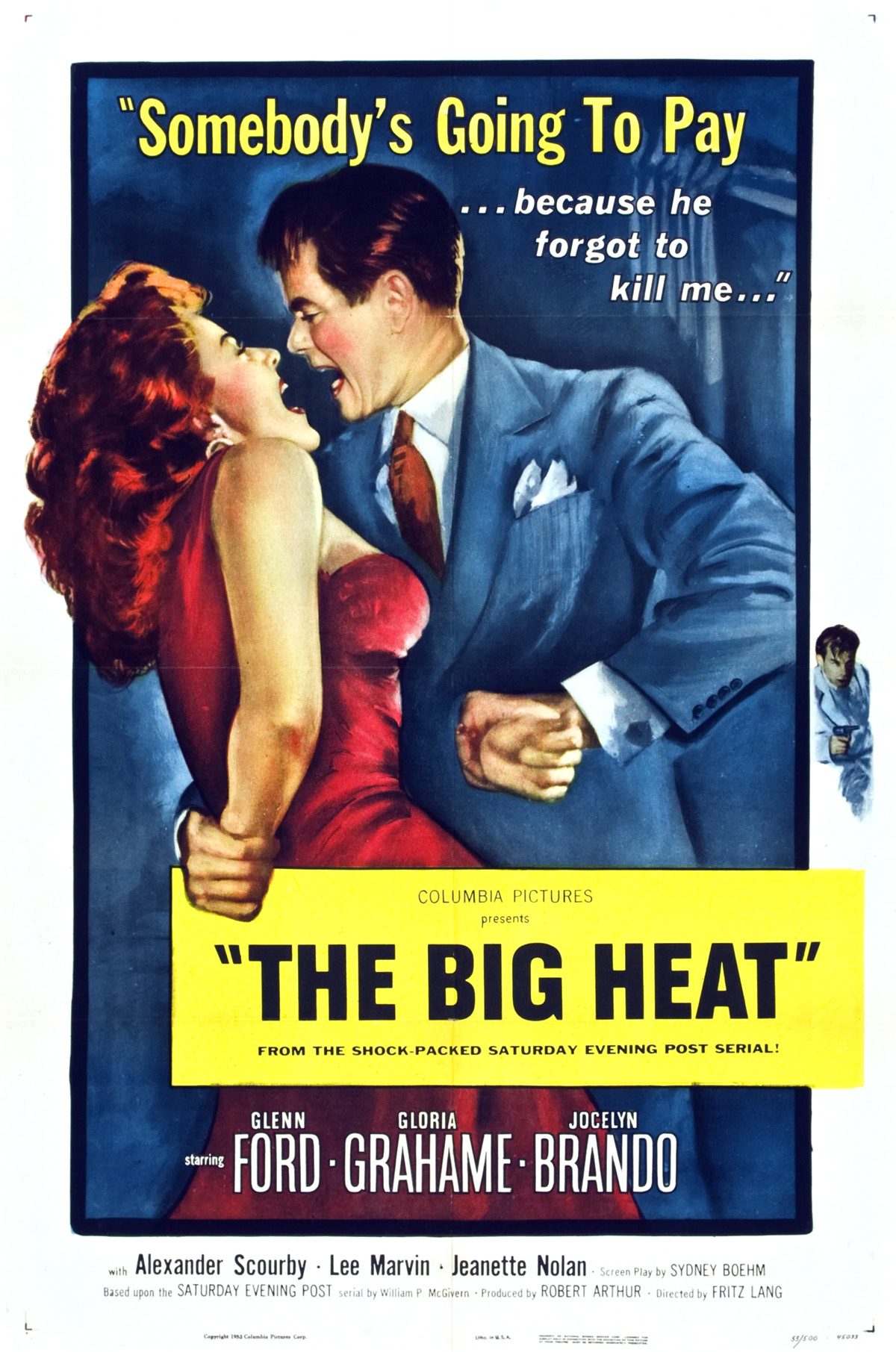
#368) The Big Heat (1953)

MV5BMmY1YzRmZDgtMTU4NS00NTcwLWE3N2EtNDc0MTk1ODg2YTA2XkEyXkFqcGdeQXVyMTYzMTY1MjQ@._V1_

#368) The Big Heat (1953)

OR “Good to the Last Drop”

Directed by Fritz Lang

Written by Sydney Boehm. Based on the serial and novel by William P. McGivern.

The Plot: Officer Tom Duncan has taken his own life, and Detective Dave Bannion (Glenn Ford) investigates. Duncan’s widow (Jeanette Nolan) says Tom was in poor health, but a woman claiming to be Duncan’s mistress (Dorothy Green) refutes this, and winds up murdered the next day. Bannion continues to inquire, despite objections from his superiors and death threats directed at his wife Katie (Jocelyn Brando). With assistance from Debby Marsh (Gloria Grahame), the girlfriend of gangster Vince Stone (Lee Marvin), Bannion uncovers a crime syndicate whose influence reaches far beyond the town’s underworld.

Why It Matters: The NFR calls it “[o]ne of the great post-war noir films” and “both stylized and brutally realistic”.

But Does It Really?: Sometimes I designate films on this list as “minor classics”, but “The Big Heat” made me question if there was a label below that. There’s nothing wrong with “The Big Heat”; it has all the hallmarks of film noir without resorting to cliché, and its female characters are allowed to be far more dimensional than others of the era, but overall the film was just “meh” for me. “Big Heat” is a well-made pulp drama that has aged quite well, but its standing as a classic has definitely diminished over time. “The Big Heat” is great noir viewing, but I question its standing as a significant American film.

Shout Outs: When Bannion encounters Stone at The Retreat, the background music is “Put the Blame on Mame” from “Gilda”, also starring Glenn Ford.

Everybody Gets One: While not as successful as younger brother Marlon, Jocelyn Brando had a stage and screen career that spanned over 35 years. “The Big Heat” was one of Jocelyn’s first films. Other highlights include the original stage production of “Mister Roberts” with Henry Fonda, and the 1981 cult classic “Mommie Dearest”. Ever the older sibling, Jocelyn was incredibly supportive of Marlon and always quick to publicly defend his behavior.

Wow, That’s Dated: Your standard ‘50s crime elements, like police blotter on an automatic typewriter, and pre-Miranda suspect beatings. And today on “We Are the Worst at Inflation”: a 35-cent drink in 1953 would be $3.35 today, and that’s only at the happiest of happy hours, let me tell you.

Seriously, Oscars?: No nominations for “The Big Heat”, but it did win the Edgar Allan Poe Award for its screenplay. At least someone was paying attention.

Other notes

  • Before becoming a novel (and a major motion picture), “The Big Heat” was a serial from Philadelphia Bulletin reporter William P. McGivern. The story was serialized in the Saturday Evening Post from December 1952 to February 1953. The novel was published shortly thereafter, with the film version hitting theaters that October.
  • Like many novels turned movies, certain liberties were taken with “The Big Heat”. Bannion and Debby’s implied relationship was toned down, as was, believe it or not, most of the violence. The film’s locale was also changed from Philadelphia to the fictitious Kenport, because God forbid a real city is implied to have crime of any kind.
  • I’ve never seen Lee Marvin looking so young. Lee was 29 when he filmed “Big Heat”, and this was one of seven films he made in 1953 alone!
  • The Widow Duncan is played by veteran film actor Jeanette Nolan. Any woman who can play a corrupt widow and everyone’s ailing sweet-natured grandmother has automatically earned my respect.
  • One major element separates “Big Heat” from other film noir: because it’s a later entry in the genre, “Big Heat” can reflect on the suburban boom of the early ’50s. Bannion still treks the darkly lit alleys of a criminal underworld, but this is in counterpoint to his picket-fence homelife.
  • Like “Fury”, Fritz Lang is really struggling to bring his German expressionism sensibilities to an American studio film. He and Old Hollywood cinematographer Charles Lang (no relation) get no opportunities to do any inventive camerawork, other than the occasional 90-degree dolly tracks.
  • Today on Code-Era Profanity: “In a pig’s eye”, and the uninspired “You can fill in the four-letter words better than I can.”
  • [Spoiler] A quick film lesson I call the Gwyneth Paltrow Rule: the more harmonious a movie cop’s home life is, the more gruesome the murder of his wife will be. “The Big Heat” features an extreme example. It’s tame by today’s standards, but still unsettling.
  • Maybe it’s the inherent tropes associated with a gangster’s moll, but a lot of Gloria Grahame’s scenes with Lee Marvin play out like “Born Yesterday: The Drama”.
  • What am I missing about Glenn Ford? I’ve seen three of his movies and I’m just not getting the appeal. He’s giving me the same restrained anger in every performance. I don’t recall Pa Kent being this pissed all the time.
  • This is one of several movies on the list that features Carolyn Jones (aka Morticia Addams) with her natural blonde hair, therefore making her unrecognizable to a modern audience.
  • Why does Gloria Grahame keep getting herself mixed up with tough guys haunted by their dark past? Glenn Ford, Humphrey Bogart, Will Parker…
  • “The Big Heat” will see the grapefruit-smashing scene of “The Public Enemy”, and raise it one coffee-throwing scene. I hesitate to call the moment iconic, but Gloria Grahame getting a face of Folgers is the scene that gets the most mentions when “The Big Heat” is referenced.
  • Speaking of, shoutout to makeup artist Clay Campbell and his uncredited team. Debby’s burn marks look amazing.
  • Wow, the bodies really start piling up in the last 10 minutes. Did this movie need to fill a quota?
  • In a sweet bit of cinematic payoff, Bannion finally monologues about his dead wife at the end. It’s the ‘50s equivalent to the “She Used to Fart in Her Sleep” monologue from “Good Will Hunting”.

Legacy

  • Fritz Lang made a handful of noir movies in the ‘50s with such titles as “While the City Sleeps” and “Beyond a Reasonable Doubt”, before returning to his native Germany. Maybe some day when I’ve finally completed this list we can look at some of Fritz Lang’s more iconic, NFR-ineligible work.

#367) Preservation of the Sign Language (1913)

maxresdefault

#367) Preservation of the Sign Language (1913)

OR “Grandparents of a Lesser God”

Written by George Veditz

Class of 2010

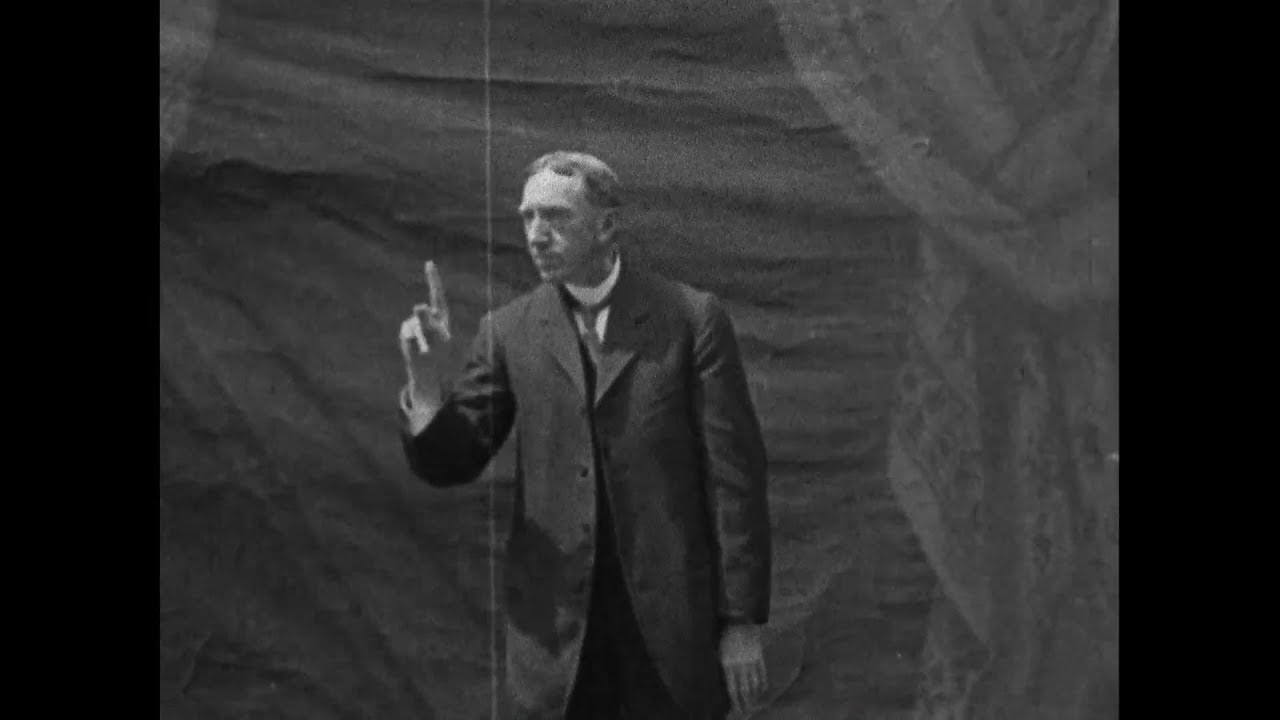
The Plot: National Association of the Deaf’s president George Veditz signs an impassioned speech about preserving sign language at a time when such countries as France and Germany were eradicating the practice. Veditz promotes signing’s superiority to lip-reading, as well as his mission to preserve sign language through a series of films.

Why It Matters: The NFR gives no superlatives, but their write-up includes a healthy dosage of historical context. There’s also a detailed essay by Christopher Shea, archivist at Gallaudet University (whose namesake gets a shout-out in the film).

But Does It Really?: Many films on this list document a culture or a specific time period, but “Preservation of the Sign Language” may be the only one to preserve a language. I’m always looking for NFR entries that stand on their own unique piece of land, and “Preservation” achieves that from its first moments. An important inclusion to the NFR, and yet another reminder for me to brush up on my ASL.

Everybody Gets One: George Veditz was fluent in both English and German (both his parents were immigrants) before losing his hearing at age eight to scarlet fever. He studied at the aforementioned Gallaudet University (then known as the Columbia Institute for the Instruction of the Deaf). After being elected president of the National Association of the Deaf, Veditz was the first to recognize film as a medium to preserve ASL, raising the necessary funds for a proposed film series. “Preservation of the Sign Language” is the first of the NAD’s films.

Wow, That’s Dated: Though ASL is common practice now, it was not widely accepted 100 years ago. The Milan Conference of 1880 put an official emphasis on the oralist method of deaf communication, focusing on speech and lip reading. Sign language was on the brink of being totally eliminated throughout Europe. The National Association of the Deaf was founded in America to combat the oralist method and promote sign as the more effective practice.

Other notes

  • “Preservation of the Sign Language” is presented without subtitles, but I was able to track down a transcript done a few years back by UC San Diego Professor Carol Padden. It differs in some areas from George Veditz’s handwritten translation, proving that, like any other language, ASL has a complexity of vocabulary that greatly depends on interpretation.
  • Knowing his audience, Veditz begins with a respectful reference to Charles-Michel de l’Épée. While he didn’t invent sign language, l’Épée was responsible for sharing it with the world, earning him the moniker “Father of the Deaf”.
  • It should be noted that of the 164 delegates of the Milan Conference of 1880, only two of them were deaf.
  • Among the many prominent deaf figures that get a mention in this film are the aforementioned Thomas Hopkins Gallaudet, Gallaudet University football coach John B. Hotchkiss, Professor Edward Allen Fay, and first NAD president Robert P. McGregor (nicknamed “Rob Roy” by George Veditz).
  • The $5,000 raised by George Veditz is the equivalent of about $129,000 today.
  • ASL may have been the first language that used film as a form of preservation. Think about it: any other language would have had to wait for sound to properly document their cadence and pronunciation. Veditz makes a point to sign slowly, spelling out several words; ensuring that both the language and the alphabet would be preserved.
  • “Fifty years from now, these moving picture films will be priceless.” You gotta respect someone with that kind of foresight.

Legacy

  • George Veditz helped make several films preserving sign language, with topics ranging from poems, songs, jokes, and the Gettysburg Address. Many of these films no longer survive, but the remaining few have been preserved by Gallaudet University and, you guessed it, the Library of Congress.
  • The National Association of the Deaf is still going strong 140 years after its founding. You can find more information about the NAD here.

#366) Pillow Talk (1959)

MV5BMTQ5NDg1NzU1OV5BMl5BanBnXkFtZTgwMDQyODgxMTE@._V1_

#366) Pillow Talk (1959)

OR “Bad Day with Tack Rock”

Directed by Michael Gordon

Written by Stanley Shapiro and Maurice Richlin. Story by Russell Rouse and Clarence Greene.

Class of 2009

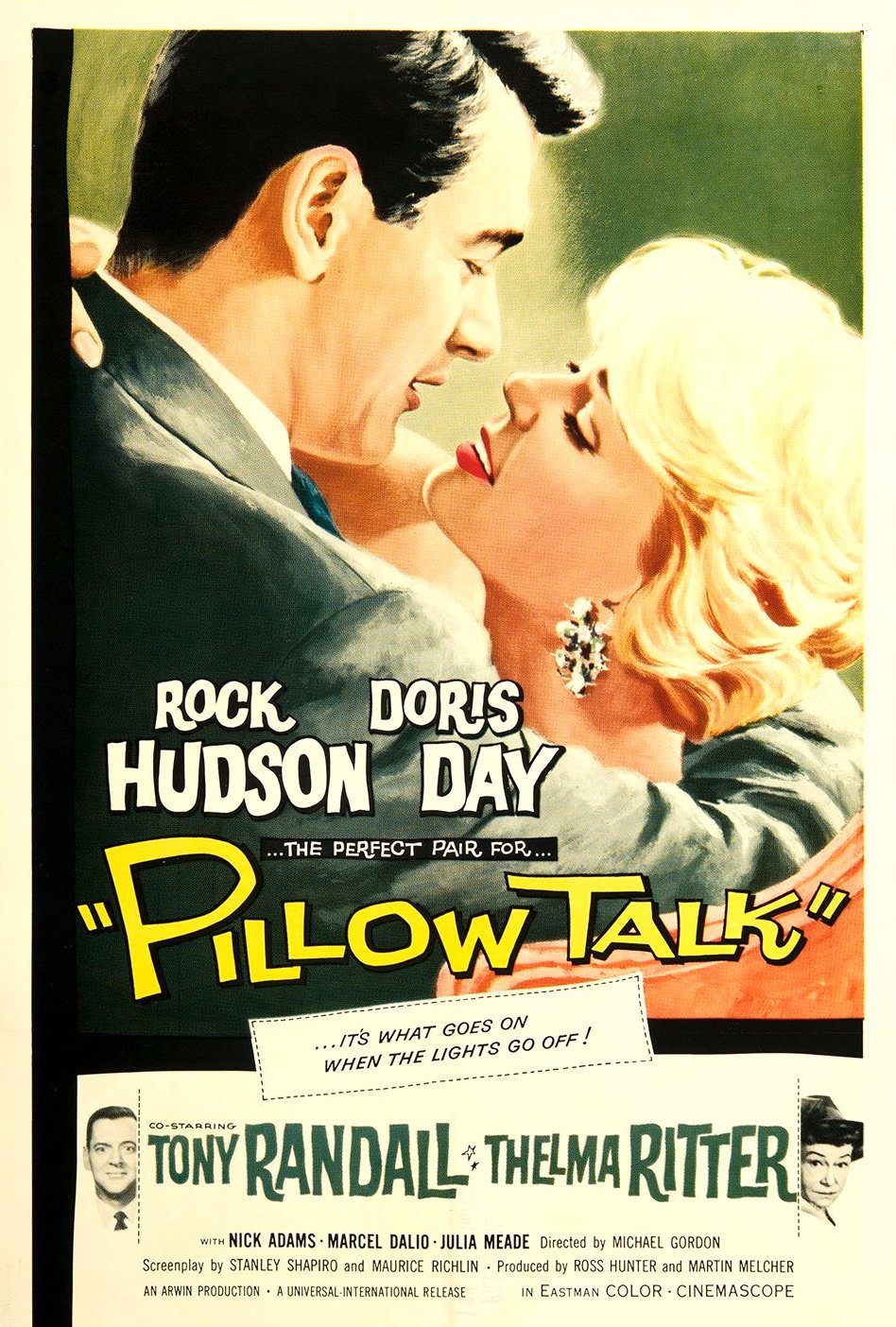
The Plot: Manhattan interior decorator Jan Morrow (Doris Day) is unlucky in love, a point emphasized by sharing a telephone party line with bachelor composer Brad Allen (Rock Hudson), who seems to have a new woman every time Jan picks up the receiver. Through their mutual friend – stuffy millionaire Jonathan Forbes (Tony Randall) – Brad finally meets Jan in person, posing as Texan rancher “Rex Stetson”. Jan immediately falls for “Rex”, while simultaneously continuing her phone squabbles with Brad. Complications arise, hilarity ensues, and Thelma Ritter cracks wise as Jan’s maid, as God intended.

Why It Matters: Someone at the NFR really likes this movie, calling it, “one of the screen’s most definitive, influential and timeless romantic comedies” and praising its “two charismatic stars, especially the effervescent Day”. An essay by film historian/NFR speed-dial Matthew Kennedy gives the movie plenty of historical context.

But Does It Really?: It’s definitely a movie of its time, but “Pillow Talk” is still one of filmdom’s top-notch romantic comedies. Like many a rom-com on this list, the film’s more dated aspects are balanced out by the illuminating charm of its two stars. Whether or not we’ll be talking about “Pillow Talk” in another 60 years is up for debate, but the film’s well-structured screenplay and pitch perfect cast will make a compelling argument.

Everybody Gets One: Singer Doris Kappelhoff got her stage name from bandleader Barney Rapp, who admired her cover of the song “Day After Day”. Doris had a string of post-war hits (most notably “Sentimental Journey”) and quickly transitioned to movie musicals. She showed her range in the Hitchcock thriller “The Man Who Knew Too Much” (still not on the list, FYI), but it was “Pillow Talk” in which Day finally got to play a truly comic lead.

Wow, That’s Dated: Umm…everything? Knowing the concept of a party line is a pre-req (see “Other Notes”), and despite all of this movie’s pros, there’s still a lot of sexism that definitely wouldn’t fly today.

Title Track: “Pillow Talk” was originally deemed too risqué a title, with “Any Way the Wind Blows” being a proposed alternate. Producer Ross Hunter stood his ground, and “Pillow Talk” (the title as well as the song) remained.

Seriously, Oscars?: A big hit for Universal, “Pillow Talk” received five Oscar nominations. Its one win for Original Screenplay was deserving, but is it really better than fellow nominees “The 400 Blows”, “Wild Strawberries”, and “North by Northwest”? Doris Day received her only Best Actress nomination, and Thelma Ritter lost her 5th Best Supporting Actress nod. Allegedly, Ms. Ritter stayed home that night and threw a “Come and Watch Me Lose Again” viewing party.

Other notes

  • What is a party line? For most of the 20th century, multiple households would share the same phone line to save money. The tradeoff was the lack of privacy, and the compromises of sharing a line with strangers. You can see how hilarity would ensue from this situation.
  • Turns out this screenplay had been kicking around Hollywood since 1942! It was originally to be produced at RKO, and after several revisions landed at Universal in 1958.
  • Director Michael Gordon was a controversial choice; it was his first gig after being blacklisted in 1951.
  • For its multiple phone calls, “Pillow Talk” makes excellent use of the widescreen camera, as well as impressive split-screen photography. Shout out to the boys in the lab!
  • Are Doris Day and Rock Hudson great in this or what? Day has her comic delivery down to a science, and Hudson lets you see the wheels turning as Brad gets in over his head. Everything clicks when these two share the screen.
  • Once Tony Randall shows up we really get into the Madison Avenue, psychoanalyzing aspects of ‘50s urban living. Between this and “Rock Hunter”, Tony Randall was the poster boy for the ‘50s businessman.
  • Oh right, the sexism. In quick succession, we get Jonathan kissing Jan without permission, Brad demonstrating the “Matt Lauer button” in his apartment, and Nick Adams telling Jan after she rejects his advances, “It’s your word against mine.” The #MeToo movement may have sealed this movie’s fate.
  • Good to see Rock Hudson making use of the Texan accent he picked up from “Giant”.
  • Half the fun is watching everyone talk around such taboo subjects as intercourse, pregnancy, and homosexuality. A sign of the Hays Code’s long-lasting effect on film, as well as the starts of the liberation movies would get once the Code dissolved in the ‘60s.
  • “There are some men who don’t end every sentence with a proposition.” Screw Truffaut, I’ll give these writers the Oscar right now!
  • Perry Blackwell sings three songs, and gets several prominent close-ups throughout her one scene, but I cannot find any information on her. Friend of the producer? Up and comer on the Decca label?
  • “Roly Poly” may be the first song in history to be appropriated by white people mid-song. Any excuse to get Doris to sing, I guess.
  • Speaking of, Jan’s inner monologue gets a song! At least that was an easy shoot day; no lip-synching required.
  • At first I was skeptical about the idea of a playboy composer, but now I’m convinced the writers did that just to do the “scoring” joke.
  • Thelma Ritter is severely underutilized in this movie. Alma is the kind of role she could do in her sleep.
  • If “Pillow Talk” reminds me of one thing, it’s that men are the worst. This movie compels me to apologize to everyone my gender has wronged.

Legacy

  • Neither Rock Hudson nor Doris Day were known for their comedy skills prior to “Pillow Talk”, but the film’s success solidified their standing in the genre. Day and Hudson (and Tony Randall) reunited for two more comedies: 1961’s “Lover, Come Back”, and 1964’s “Send Me No Flowers”. In addition, Day and Hudson bonded closely during production, and their friendship lasted until Hudson’s death in 1985.
  • A “Pillow Talk” sequel was in the works around 1980, with Day, Hudson, and Randall all willing to return, with Kristy McNichol playing Jan and Brad’s grownup daughter. Day, however, decided she preferred retirement, and the film never materialized.
  • “Pillow Talk” spawned its share of imitators, and is still the template for sophisticated romantic comedies. The genre received a tribute with 2003’s “Down with Love”, featuring a cameo by Tony Randall!

#365) Foolish Wives (1922)

Foolish_Wives_ad

#365) Foolish Wives (1922)

OR “You Can Count on Me”

Directed & Written by Erich von Stroheim

Class of 2008

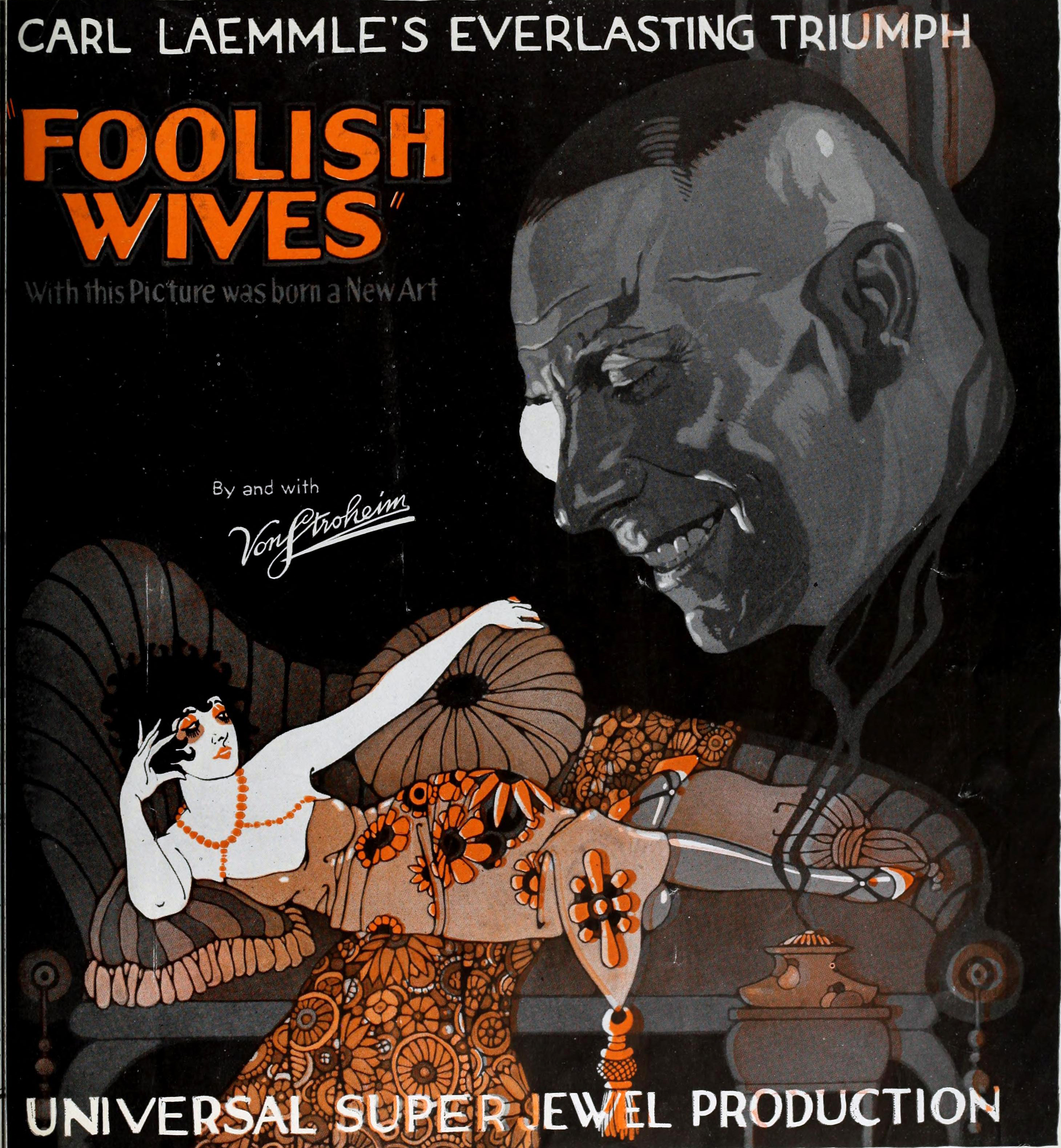
The Plot: A trio of con artists (Erich von Stroheim, Maude George, Mae Busch) arrive in Monte Carlo posing as aristocracy. “Count Sergius Karamzin” is tasked with their next target: Helen Hughes (Miss DuPont), the young, gullible wife of American Monaco Envoy Andrew Hughes (Rudolph Christians). The Count seduces Helen, as well as the hotel’s maid Maruschka (Dale Fuller) and Marietta (Malvina Polo), the handicapped daughter of one his associates (Caesare Gravina). If nothing about this plot sounds redeeming, don’t worry, it gets worse.

Why It Matters: The NFR calls the film “brilliant and, at the time, controversial”, plus gives a quick mention to von Stroheim’s “challenging” reputation. There’s also an essay by silent film expert Daniel Eagan, who wrote the book on the National Film Registry (literally).

But Does It Really?: When I started this blog, a friend asked if I was going to watch these films in chronological order. When I said no, he replied, “Good call. You’d never make it past von Stroheim.” And now I know what he meant. “Foolish Wives” is a cut above the average silent film, but man what a slog it is. While I admire the film’s scope, as well as von Stroheim’s justified place in film history, nothing about “Foolish Wives” needs to be 2 ½ hours, or longer (more on that later). “Foolish Wives” is excess for the sake of excess, and while deserving of NFR recognition, this one may just be for the film buffs.

Everybody Gets One: Many of the creatives behind “Foolish Wives” would be back for von Stroheim’s other NFR titles: “Greed” and “The Wedding March”. Special mention to model Miss DuPont (who summed up her time with von Stroheim by stating, “Put not your trust in directors.”) and actor Rudolph Christians, who died seven months into the film’s extensive production and was replaced with a double.

Wow, That’s Dated: The unfortunate standard gender politics I’ve come to expect from this era. Sergius has to borrow money from a woman? Scandalous!

Title Track: Well here’s an odd one for you: a book called “Foolish Wives” pops up throughout the movie. Its author: Erich von Stroheim. And the weirdest part? This is an original screenplay; there is no novel of “Foolish Wives”!

Other notes

  • A quick word on the film’s length. Erich von Stroheim’s original cut was allegedly anywhere from 6 to 10 hours long! Universal cut the film down to a more manageable 3 ½ hours for its premiere, but various state censor boards objected to the subject matter, and by the time “Foolish Wives” had its general release, the film was running 2 hours (in some states, 75 minutes). Needless to say, von Stroheim hated these shorter prints. Currently, the most readily available version is a 2003 restoration that reinstates as much footage as possible, with a runtime of 140 minutes. Cuts and re-cuts will become a recurring theme with von Stroheim’s other NFR entries.
  • After seeing the establishing shots of Monte Carlo, I presumed they were filmed on location. It turns out, however, that Monte Carlo was a set recreation on the Universal lot. It was the most expensive and detailed set at the time, costing over $420,000 (roughly $6.4 million today). It’s an impressive undertaking, and the most obvious influence from von Stroheim’s mentor: D.W. Griffith.
  • While we’re on the subject, part of von Stroheim’s temperamental attitude came from his insistence on accuracy. His actors wore real clothes (not costumes), drank real champagne and ate real caviar. He even had real French money printed, to the point where he was briefly arrested for counterfeit! Von Stroheim justified his obsessive attention to detail by saying “the camera will know the difference”. Is it any wonder the film went over budget?
  • The sense I’m getting here is that “Foolish Wives” is the ‘20s version of “Dirty Rotten Scoundrels”, only not as funny and much, much longer.
  • This is one of the few movies on this list that openly acknowledges its Michael Douglas Scale readout. Hughes and Helen reveal they are 20 years apart. In real life, these two actors were 25 years apart. Yeesh.
  • Ooh, cool lightning effect during the storm. I’m always surprised when silent movies have special effects.
  • I can see why the censors had issues with “Foolish Wives”: the Count is not only unlikable, but quite salacious with the women in his life. That story again: this movie’s writer, director, and star spends most of his screentime staring at and groping women. You need help, Erich.
  • There’s an extended sequence where Helen, on her way out of the hotel, sees a WWI veteran with no arms (presumably lost in the war). She has an empathetic moment with him while “Over There” and “My Country Tis of Thee” play in the background. Pretty heavy-handed stuff, but the Great War had only been over for less than four years. The scene is a thoughtful inclusion, but it has nothing to do with anything.
  • There’s a poignant moment where the camera moves in on Maruschka from a medium shot to a close-up. Did von Stroheim just invent the zoom? Or at least the idea that you can move the camera in a shot?
  • Sergius tells someone to “Go to hell”. Pretty strong language by 1922 standards. I presume many a pearl necklace was clutched during screenings.
  • [Spoilers] And then our auteur is murdered and his body dumped into a sewer; which is kind of what happened to von Stroheim in Hollywood if you think about it.

Legacy

  • “Foolish Wives” was the first film to be made for over $1,000,000, and was advertised as such. While the film was a hit, its price tag guaranteed it wouldn’t make a profit. At the same time, word had gotten out about von Stroheim’s reputation of being tyrannical and going over-budget, and his directing opportunities dwindled. Von Stroheim eventually transitioned into acting, and is best remembered for his performance in “Sunset Boulevard” as – what else – a former silent film director.
  • Erich von Stroheim and Carl Laemmle appear as characters in an episode of “The Young Indiana Jones Chronicles”. Turns out Indy was an uncredited PA on “Foolish Wives”.

#364) Peege (1972)

MV5BODAxYTEzMmQtOWZlOC00YmY2LWJmNzUtYzEzMTJjOTJiZjI2XkEyXkFqcGdeQXVyNjk1NjkxMzM@._V1_UY1200_CR99,0,630,1200_AL_

#364) Peege (1972)

OR “Last Christmas”

Directed & Written by Randal Kleiser

Class of 2007

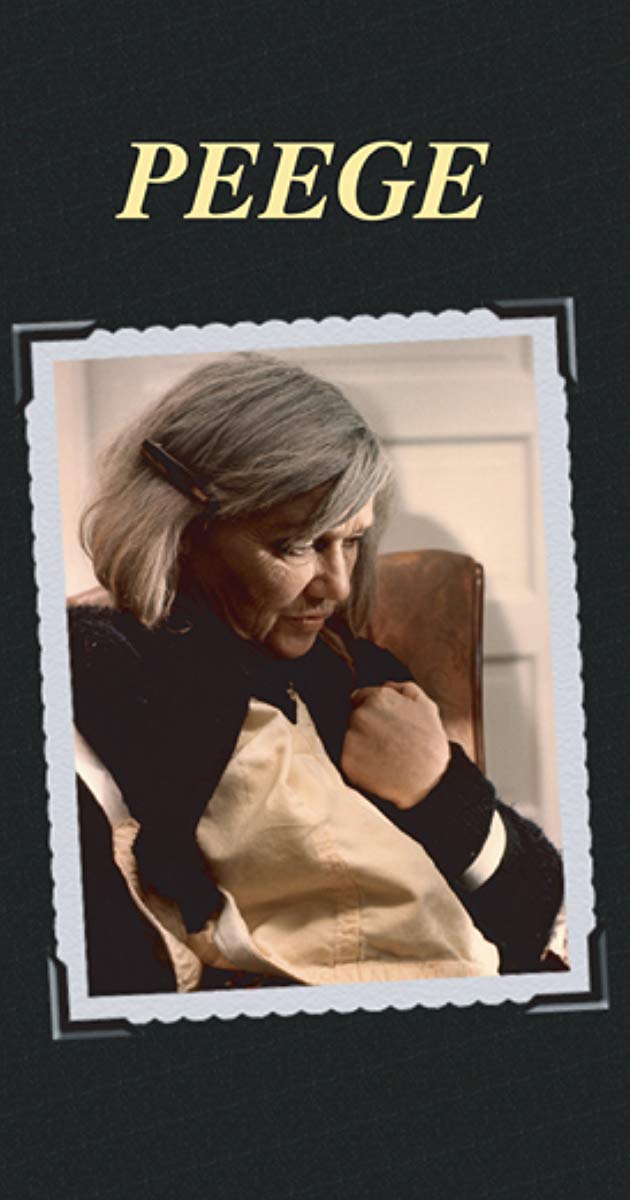
The Plot: Christmastime means one family’s annual visit to their grandmother Ethel, nickname “Peege” (Jeanette Nolan), in her nursing home. The entire family dreads this trip, unable to accept Peege’s deteriorating health. Mom’s (Barbara Rush) discomfort manifests itself as condescending remarks, Dad (William Schallert) fills the awkward silences with meaningless small talk, and grandsons Jerry and Damion (David Alan Bailey and Barry Livingston) seem disinterested and joke around. Only eldest grandson Greg (Bruce Davison) connects with Peege, reminding her of the happy times he spent with her growing up. I’m not crying you’re crying.

Why It Matters: The NFR calls the film “extremely moving” and gives a brief synopsis.

But Does It Really?: While not the most recognizable of the NFR entries, “Peege” is certainly one of the most effective. As my friend Ryan put it, “[“Peege”] must be the movie they screen at Pixar when they teach how to make people cry.” The film hits its emotional core so honestly and directly you can’t help but be moved by it. I discovered “Peege” a few years before starting this blog (more on that later), and was happy to learn that another screening would be in my future. A yes for NFR inclusion from me, and definitely worth a viewing. Just keep the tissue handy.

Everybody Gets One: Randal Kleiser knew he wanted to be a film director after seeing “The Ten Commandments” as a child. As a grad student at USC, his original idea for his thesis film was about a theater troupe and time travel (don’t ask). Wanting to retain the film’s copyright (which would have gone to USC had he used their equipment), Kleiser opted for a less expensive, more personal film based on his annual visits to his grandmother (also nicknamed “Peege”) at her nursing home in Pennsylvania.

Wow, That’s Dated: The only majorly dated aspect of the film is Charles Albertine’s score, which has a real “Hallmark Hall of Fame” vibe to it. I imagine it’s the use of the flute for the film’s melancholy main theme that makes me feel this way.

Seriously, Oscars?: Completed in 1972, “Peege” played the festival circuit in search of a distributor, and found one in the recently created Phoenix Films (now Phoenix Learning Group). “Peege” started making the university and library rounds in late 1973, but whether or not it made an Oscar qualifying run in LA is unknown. That year’s winner for Live Action Short was something called “The Bolero”. Great, now I have that stuck in my head.

Other notes

  • Bruce Davison was already well known by 1972 for the film “Willard”. He loved the script for “Peege” so much he did the film for scale (plus a percentage of any profits). Jeanette Nolan was cast by chance: she was filming an episode of “Gunsmoke” at CBS Studios on the soundstage next door to the “Peege” production office (on loan from a TV movie that wrapped early). Ms. Nolan was 60 during production.
  • The rest of the “Peege” family is populated with recognizable TV actors. Barbara Rush was Marsha Russell on “Peyton Place”, William Schallert was Poppo on “The Patty Duke Show”, and Barry Livingston was Ernie on “My Three Sons”. All three excel at getting to play more range here than on their respective TV shows.
  • I’m a little confused as to which of the two parents is Peege’s child. I’m pretty sure it’s the dad, but they both call her Peege. Am I missing something?
  • This family has the awkward part down pat. I have visited my share of dying relatives and it is always this uncomfortable. Not all of us have the luxury of escaping into sepia-tone flashbacks.
  • Speaking of, did Greg grow up in the ‘30s? Every flashback looks like it comes from a “Waltons” episode.
  • After years of character work on film and radio (most notably as Mrs. Bates), Jeanette Nolan finally shines as Peege. Rarely does an actress “of a certain age” get to play the main character, let alone at different stages of her life. Quite simply, Nolan is perfect as everyone’s grandmother (it helps that she looks remarkably like my maternal grandmother).
  • My introduction to “Peege” was a 2015 screening of an original 16mm print at the Exploratorium (“Peege” shared the bill with “Cipher in the Snow” and “Stoned”). Curator Jesse Hawthorne introduced the film by stating: “You are not ready for ‘Peege’”. And boy was he right. Like my viewing for this post, I was a mess of tears by the end. My crying got its second wind when I went home and reflected on those I have lost in my life and how I did or didn’t connect with them at the end. It’s a cathartic experience, and I hope that “Peege” and I cross paths again further down the line.

Legacy

  • Randal Kleiser’s directing career took off after “Peege”; culminating in him landing the plum job of directing the film adaptation of “Grease”. His subsequent filmography includes such oddities as “The Blue Lagoon”, “Big Top Pee-Wee” and “Honey, I Blew Up the Kid”. With this many commercial films on his resume, it would be easy to write off Kleiser as a Hollywood day laborer, but then you see a film like “Peege” and recognize that he, like so many others on this list, is an artist. The next time you watch a big Hollywood “product”, check the director’s resume and find those smaller films that ignited their passion to tell stories.