#345) Brokeback Mountain (2005)

brokeback_mountain_xlg

#345) Brokeback Mountain (2005)

OR “The Cowboys in the Band”

Directed by Ang Lee

Written by Larry McMurtry & Diana Ossana. Based on the short story by Annie Proulx.

Class of 2018

The Plot: Ranch hands Ennis Del Mar and Jack Twist (Heath Ledger and Jake Gyllenhaal) are hired to herd sheep across Brokeback Mountain in 1963 Wyoming. Over the summer, the two form a close bond, ultimately leading to a sexual relationship. The two men part ways, returning to their heterosexual lifestyles; Ennis marries longtime fiancée Alma (Michelle Williams), Jack marries rodeo star Lureen (Anne Hathaway). Over the next 20 years, Ennis and Jack reconnect every so often to continue exploring their relationship, even as their respective marriages fall apart. It’s an emotionally complex study of human sexuality, set against the rugged toxic masculinity of the American west. But hey, wouldn’t you rather watch an overly manipulative movie about L.A.’s racial tension?

Why It Matters: After spoiling the ending in its plot synopsis, the NFR calls the film “[h]aunting” and “an enduring classic” (yeah, that’s why it’s on the list). Heath Ledger’s performance gets a very descriptive shoutout.

But Does It Really?: “Brokeback Mountain” is the first NFR entry that I witnessed become a classic in real time. It’s one thing for me to grow up with countless films already being designated “classics”, but to watch that happen to a film from my adulthood is quite amazing. In addition to its ongoing impact on queer cinema, “Brokeback” is by its own merits a well-crafted character study lifted by Ang Lee’s delicate direction and wonderfully subtle performances from its four leads. “Crash” may have taken home the Best Picture Oscar, but as the NFR has shown us, “Brokeback” got the real prize in the end.

Shout Outs: No direct references in the movie proper, but the poster’s design was intentionally based on the poster for “Titanic”.

Everybody Gets One: Pretty much everyone except Randy Quaid. “Brokeback Mountain” is currently the most recent film on the NFR and therefore your one stop for Ang Lee, Heath Ledger, Jake Gyllenhaal, Michelle Williams, Anne Hathaway, and all of those sheep.

Seriously, Oscars?: Oh boy, buckle up kids. “Brokeback Mountain” started in limited release, and expanded once the critical praise and awards recognition got going. By the time the 2006 Oscars rolled around, “Brokeback” lead the pack with eight nominations and had won more Best Picture precursor awards than any other movie in history. The film took home well deserved Oscars for Directing, Adapted Screenplay and Original Score. And then, this happened…

Other notes

  • For those of you who stand firm that the 21st century didn’t begin until 2001, “Brokeback Mountain” is the first narrative feature from this century to make the National Film Registry.
  • Just a reminder that Ang Lee’s previous film was 2003’s “Hulk”, an experience so exhausting Lee even considered retiring. Thank goodness “Brokeback” came along.
  • Both Heath Ledger and Jake Gyllenhaal are graduates of the James Dean School of Mumbling. What’s the point of only saying 10 words if I can’t hear any of them?
  • I was going to comment on how stunning the landscapes in this movie are, and then I learned that several of these shots were digitally touched up. Damn you, movie magic!
  • So many animals in this film: sheep, horses, a bear; Did PETA members outnumber the crew on this shoot? Apparently the American Humane Association did not…
  • The first half hour or so is a nice gradual build-up to Ennis and Jack’s relationship. There’s a natural restraint on dialogue in their scenes; most of their characterization is conveyed visually.
  • Confession: I’ve never seen “Brokeback Mountain” until now. I didn’t realize you actually see the first sex scene. No dissolve over candles or curtains billowing in the wind for these two?
  • Michelle Williams can do no wrong in my book. My heart always goes out to the women she portrays, and her Alma is no exception. Can’t wait to see her Gwen Verdon.
  • Surely by the time the film hits the late ‘70s Jack and Ennis would have considered moving to San Francisco. Harvey Milk was a thing back then.
  • Near the end of the movie we get a string of then-unknown actors who have since gone on to bigger (and stranger) things: Linda Cardellini, Anna Faris, David Harbour, and…one of the Maras. Kate? Rooney. No, it’s Kate, final answer.
  • Shoutout to Jake Gyllenhaal, who manages to underplay Jack’s emotional outburst. No Oscar-bait hysterics here, he just plays the reality of the scene.
  • “I wish I knew how to quit you” is the best movie line delivered by a character with their back to the camera. Take that, “Louis, I think this is the beginning of a beautiful friendship.
  • Anne Hathaway has never done it for me, but I will admit that she nails the final phone call with Ennis. That’s a wealth of emotion with minimal facial movement. I guess Hathaway’s forte is intense, uninterrupted close-ups.
  • My main takeaway from this film is not a surprise: what a loss we all suffered when Heath Ledger died. He is giving a beautifully restrained performance as Ennis; there is so much going on just under the surface of the character. It made me think of all the great Heath Ledger performances we’ll never get.
  • Another “Everybody Gets One”: Willie Nelson & Rufus Wainwright, who both perform songs during the end credits.

Legacy

  • “Brokeback Mountain” was a turning point for queer cinema, and the last decade has seen an array of gay, bisexual, and/or queer media. Happily, there are too many for me to list here, but I will bring attention to “Call Me By Your Name”, a gay-romance Oscar contender that came and went with none of the controversy “Brokeback” endured under the same circumstances.
  • Speaking of controversy, “Brokeback Mountain” had its share of critics in its day: conservative media pundits, the American Humane Association, even co-star Randy Quaid, who sued the filmmakers for allegedly tricking him into taking a pay cut for the film.
  • “Brokeback” and its subsequent Oscar buzz turned all four of its stars into movie stars/awards contenders. Gyllenhaal, Williams, and Hathaway are still cranking out movies/collecting trophies, and Ledger got his share of posthumous accolades for “The Dark Knight”.
  • “Brokeback” had its moment in the cultural zeitgeist, with everyone spoofing “that gay cowboy movie” and wishing they knew how to quit things. Don’t know if any of it would fly now, but I do have a soft spot for “Brokeback to the Future”.
  • The original short story was adapted into, of all things, an opera in 2014 by Charles Wuorinen. I just don’t understand why two repressed characters would ever break out into song, let alone all the time.
  • Anne Proulx loved the movie, but really hates all the fan fiction she gets sent from male writers who “fix” the story for her. Please stop.
  • And if you want to visit the real Brokeback Mountain, good luck because it doesn’t exist! In reality, Brokeback Mountain is a composite of Mount Lougheed and Moose Mountain in Alberta, Canada.

#344) Time and Dreams (1976)

nfr-gallery-time-and-dreams

#344) Time and Dreams (1976)

OR “Black and White in Greene”

Directed by Mort Jordan

Class of 2017

The Plot: By the early ‘70s, Greene County, Alabama is among the first to have a predominantly African-American elected school board and city council. Temple University film student Mort Jordan focuses on Greene County’s citizens in this time of social change in “Time and Dreams”. In an unusual move, all of the interviewees are white. Some dismiss slavery and Reconstruction era racism as “the way it was”, others fully embrace the county’s new direction, and still others are fearful that this change will result with the white population being treated unfairly by African-Americans in power. Aided by Jordan’s narration, “Time and Dreams” is an examination of a piece of America on the verge of permanent change, as well as those who use time and dreams to hide from the reality of the present.

Why It Matters: The NFR calls the film “a unique and personal elegiac approach to the civil rights movement.”

But Does It Really?: The nice thing about the Registry is that it can still surprise me with a movie that comes seemingly out of nowhere. “Time and Dreams”/Mort Jordan was not on my radar (or anyone’s) before its induction to the Registry in 2017. I went into this screening knowing nothing about the film or its content, but an hour later I found myself surprisingly moved by what I had seen. “Time and Dreams” can be a bit heavy-handed in its presentation, and having an all-white panel gives the film a certain lopsidedness, but ultimately I was captivated by the film’s open look at the pitfalls of tradition and the fear of uncertainty. “Time and Dreams” may be one of the Registry’s more obscure titles, but it’s definitely worth checking out, and I’m glad the NFR found a place for it.

Everybody Gets One: Not a lot of information out there about Mort Jordan, other than he is a native Alabamian and was a student at Temple University, earning his MFA from the School of Theater, Film and Media Arts in 1975. “Time and Dreams” was part of his senior thesis project required to complete his degree. Once again, someone’s student film made it into the National Film Registry.

Wow, That’s Dated: Besides the obvious racial situation, be on the lookout for such ‘70s telltales as indoor smoking and sideburns that double as mutton chops.

Seriously, Oscars?: No Best Documentary nomination, but “Time and Dreams” was a finalist for a Student Academy Award. The Documentary winner that year was something called “What the Notes Say”, but Mort Jordan was the very first Student Oscar winner for Documentary with 1973’s “You See, I’ve Had a Life”, about a 13-year-old boy’s battle with leukemia. Jeez, Mort really doesn’t go for feel-good subject matter, does he?

Other notes

  • The interviews in “Time and Dreams” are a culmination of a year that Mort Jordan spent in Greene County, getting to know a variety of citizens in the process. Mort’s overall finding was that despite the racial tension in Greene County, “when it got down to the one-on-one relationships, things were fine.”
  • The first minute or so consists of a ticking clock. They are definitely hitting the ground running with the “Time” part of the title.
  • Uh-oh, these are some thick Alabamian accents. I may need subtitles.
  • “For years, rivers meant isolation.” I have never truly considered the role geography has played in dividing cultures (though I guess mountains are the most obvious ones).
  • So here’s the thing: I get the point Jordan is trying to make by only interviewing white citizens, but it definitely narrows this complex issue’s perspective. The interviews with these specific people can only go so long before “white people were victims too” gets brought up. And no matter how sincere or well thought out that viewpoint is, it will always pale in comparison to our treatment of African-Americans because, ya know, slavery.
  • The section devoted to the rise of private schools in Alabama following desegregation intrigued me. Turns out most of the white population wouldn’t even entertain the idea of sending their kids to the same school as African-American kids, for fear they wouldn’t get the best education. So they built private schools and sent their kids there. Even the most defensive of the interviewees can’t successfully spin this one.
  • Kids mugging for a documentary camera will never not be endearing. And they’re all so carefree, probably not even aware of the documentary’s subject matter. I’m just going to leave “You’ve Got to Be Carefully Taught” riiiiiight here.
  • There are a lot of observations made by the interviewees that I found quite profound. Perhaps the one that most resonated with me was peoples’ desire to hold on to the solid views of the past rather than risk the abstract views of the future. Though I do wonder how long before each interviewee started spouting such pearls of wisdom. Surely it took a few warm-up questions to get to these gems.
  • And one more “that’s racist towards white people” argument for the road. Again, he’s not wrong, but you’re really missing the point.
  • A final reminder that this movie – deemed historically significant in the same class as “Guess Who’s Coming to Dinner” and “Titanic” – was a student film made to fulfill a class requirement.

Legacy

  • According to Mort Jordan, “Time and Dreams” “went back into the vaults” after its initial screenings. The film languished in obscurity until it was selected for the National Film Registry in 2017. This selection came to be when the National Film Preservation Foundation launched a subcommittee to find student films for Registry consideration. Committee member and former Temple Professor Ben Levin contacted Leonard Guercio, head of the Temple Digital Cinema Lab. Guerico recommended “Time and Dreams” for its “straightforward honesty”, and Levin et al advocated the film to the rest of the committee. Mort Jordan was “absolutely floored” upon learning his film had not only been resurrected, but would be preserved by the Library of Congress.
  • Also worth noting: Greene County’s current population is roughly 80% African-American.

#343) Twenty Thousand Leagues Under the Sea (1916)

20000_leagues_under_the_sea1

#343) Twenty Thousand Leagues Under the Sea (1916)

OR “Out of Their Depth”

Directed & Written by Stuart Paton. Based on the novel by Jules Verne (with Verne’s “The Mysterious Island” thrown in for fun).

Class of 2016

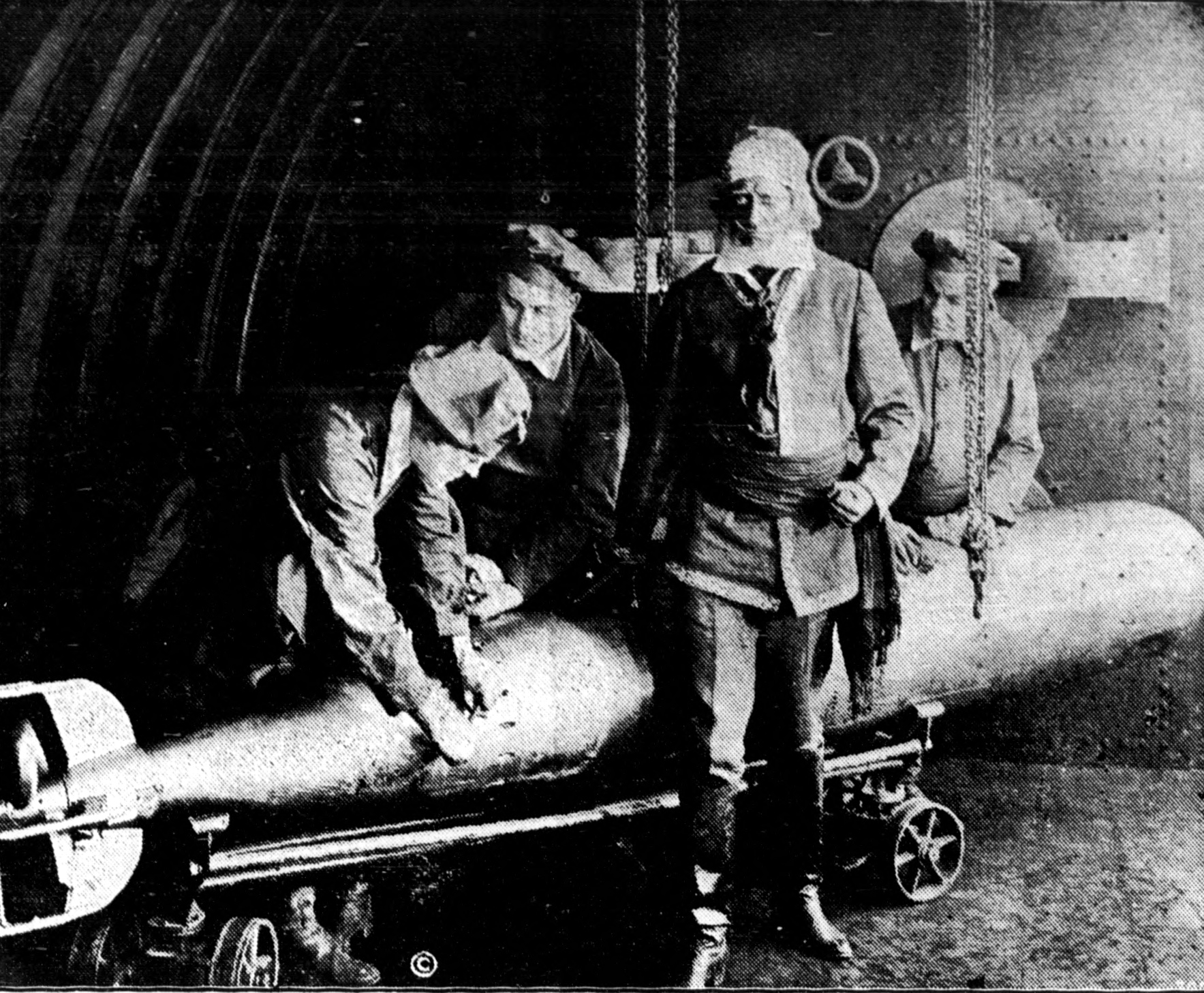
The Plot: A group of scientists, including Professor Aronnax (Dan Hanlon) and harpoonist Ned Land (Curtis Benton), are recruited by the U.S. Government to investigate a mysterious sea creature that has been attacking ships. While on board the “Abraham Lincoln”, the team witnesses one of these attacks, only to discover that the “creature” is the submarine Nautilus, helmed by the mysterious Captain Nemo (Allen Holubar). Nemo holds the team prisoner, but treats them as his guests, offering awe-inspiring views of the ocean floor. The movie then jettisons most of the original novel’s plot in favor of characters and situations from “The Mysterious Island”…for some reason.

Why It Matters: The NFR references the film’s production, popularity, and that “[t]he real star of the film is its special effects.”

But Does It Really?: This is another one of those movies that should be partially preserved. The underwater sequences are a technological breakthrough, but everything before and after just kind of sits there. It doesn’t help that this adaptation feels the need to borrow from another Jules Verne novel: other adaptations have proven the original novel provides more than enough material for a full-length movie. “Twenty Thousand Leagues” is on the NFR for 10 minutes in the middle that revolutionized film, and that’s about it.

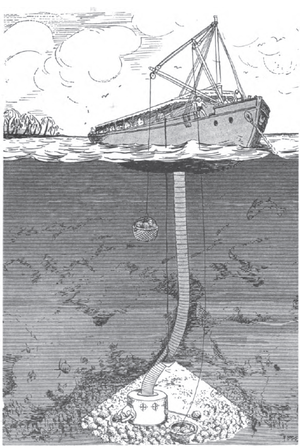
Everybody Gets One: Shoutout to George and Ernest Williamson, the innovators behind the film’s underwater footage. The two invented the “photosphere”, a dome that could sit on the ocean floor, connected to its ship by an accordion-like tube (see image below). This production used a regular film camera and a mirror to film the reverse image of the underwater scenes.

300px-Williamson_drawing

Wow, That’s Dated: The good news: this adaptation acknowledges Nemo’s Indian heritage from the original novel. The bad news: BROWNFACE WARNING.

Other notes

  • Many have felt the need to make this point, but for the record: leagues are a unit of length, not depth. 20,000 leagues is roughly 50,000 miles, more than twice the circumference of the Earth.
  • We have a title dispute! All publicity material (including the poster and NFR entry) lists the number “20,000”, but the title card at the beginning spells out the word “Twenty Thousand”. When in doubt, I go with what the movie tells me.
  • Knowing full well that this is spectacle and not an actual movie, the opening intertitles celebrate the Williamson brothers and their submarine photography. The boys make a brief on-camera appearance, as does a photo of the late Jules Verne.
  • Professor Aronnax’s assistant Conseil does not appear in this version. Instead we get Aronnax’s daughter, who is not in the book and adds nothing to the proceedings. I’m gonna guess “Director’s Girlfriend” for this one.
  • The top of the Nautilus was a practical set built for the scenes of the ship surfacing. It seems tame, but it was a big deal back then.
  • Why is Captain Nemo dressed like Santa?
  • I did not realize “frustrate” is also a verb. In this case, to prevent or thwart an action.
  • Hey, you got your “Mysterious Island” in my “Twenty Thousand Leagues”! So here’s the thing, “Mysterious Island” is a pseudo-sequel to “Twenty Thousand Leagues”, as the character of Captain Nemo is featured in both stories. The problem is, this film acknowledges the connection, but then goes into a completely different direction with it. Nemo’s backstory is fleshed out in “Mysterious Island”, but it’s not the story we get here.
  • Once again, the added female character of A Child in Nature adds nothing. I’m gonna guess “Producer’s Girlfriend” this time.
  • And now we get to the real meat and potatoes: Captain Nemo showing off his view of the ocean floor. It goes on for about 10 minutes and has nothing to do with anything, but man what a revolutionary watch this would have been in 1916, especially on a big screen.
  • I love that each sea creature gets an intertitle with different factoids, followed by “Look! Sharks!” Speaking of, sharks are “the tigers of the sea”? Between this and “Nanook of the North” silent movies loved comparing other animals to tigers.
  • The oxygen tanks and compressed air powered guns were both created by Jules Verne for the original novel, and were deemed science fiction at the time. The man was a visionary.
  • Underwater sequence aside, this film doesn’t really capture the visual aesthetic of a Jules Verne novel. Really disappointing considering the man more-or-less invented the steampunk look.
  • And now we get a third plotline involving someone named Charles Denver, an original character not found in either novel. Denver is shoehorned into Nemo’s flashback from “Mysterious Island”. Once again, they could have stuck with the source material and been fine; there was no need to add this guy. Especially since he “forced his attentions” on the princess. Do we really need to add sexual assault to a Jules Verne movie?
  • I know they spent a lot of the budget on effects, but you can more or less sense the model of the Nautilus being passed from one hand to another off-camera.
  • According to the intertitle, the climax is when Captain Nemo “reveals the tragic secret of his life, which Jules Verne never told.” HE DID TELL IT. YOU ARE CHOOSING TO MAKE UP YOUR OWN THING. WHY ARE YOU DOING THIS TO ME?
  • The film’s epilogue is titled “The Benediction”, features a brief shot of two characters (Ned Land and the Girl?) watching the sunset, and a quick fade out. What even is this movie?

Legacy

  • There have been several adaptations of “20,000 Leagues” through the years, most ignoring Captain Nemo’s Indian roots and making him European. The most famous version, the 1954 Richard Fleischer epic, filmed some of their underwater scenes in the Bahamas, as did the 1916 version.
  • Underwater footage may have been revolutionary in 1916, but nowadays it’s so common I bet there’s some playing on Nat Geo right now.
  • Esther Williams owes her film career to this movie.
  • Was any of “Aquaman” filmed underwater? Can I mention it anyway?

#342) A Fool There Was (1915)

MPW-106952

#342) A Fool There Was (1915)

OR “Interlude with the Vampire”

Directed by Frank Powell

Written by Powell and Roy L. McCardell. Based on the play by Porter Emerson Browne and the poem “The Vampire” by Rudyard Kipling.

Class of 2015

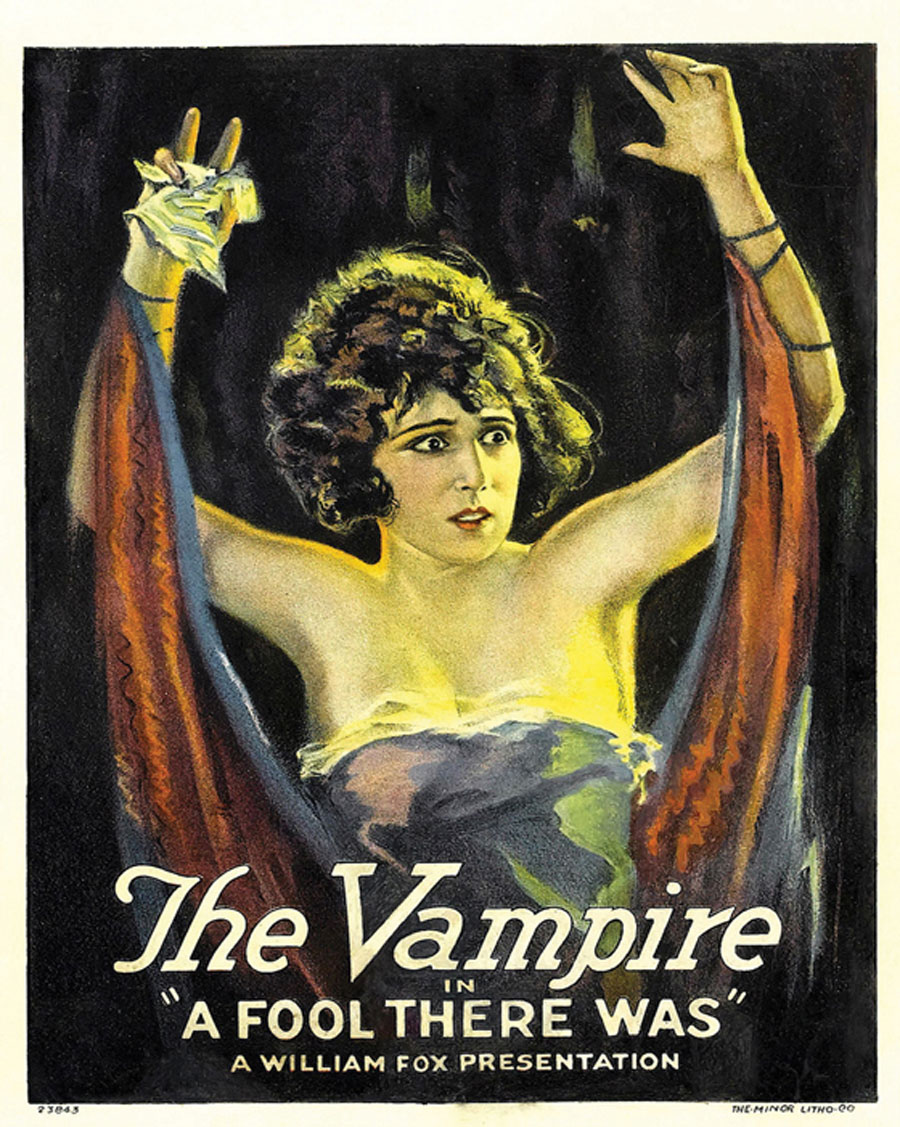
The Plot: John Schuyler (Edward José) has everything you could want from life: a loving wife (Mabel Frenyear), an adorable daughter (Runa Hodges), and a successful career as a lawyer and diplomat. While on a ship bound for England, he meets a seductive young woman (Theda Bara) known only in the film as “The Vampire”. Known for seducing men, making them sacrifice everything to be with her, and then abandoning them, The Vampire zeroes in on John, and within two months they are living a sinful life in Italy. Upon his return home, John tries to ingratiate The Vampire into his home life, with the expected disastrous results. Can John salvage his marriage? Or will The Vampire claim another victim?

Why It Matters: Despite a lengthy write-up from the NFR, “A Fool There Was” receives no superlatives, just a quick rundown of Theda Bara’s screen persona and career, as well as information on her surviving filmography.

But Does It, Really?: Having endured my share of silent movies that are on this list for their historical merit rather than entertainment value, I am happy to say that “A Fool There Was” still holds up over 100 years later. Theda Bara has that “it” quality you need for the role of The Vampire, and overall the film is expertly directed. Ms. Bara is not well known today (that’s not entirely her fault, see “Legacy”) but the NFR should have at least one of her films on the list, and “A Fool There Was” is the natural (and pretty much only) choice.

Everybody Gets One: Despite the countless puff pieces of the day that claimed Theda Bara was the daughter of an Arab sheik or an Italian sculptor, Theodosia Burr Goodman was born in Cincinnati to a Polish tailor and a Swiss housewife. Theda attended the University of Cincinnati, acted in local productions, and moved to New York to pursue acting (the major studios hadn’t moved to Hollywood yet). Fun Fact: Theda’s birth name is a tribute to Aaron Burr’s daughter (like the song!).

Wow, That’s Dated: Ships as a major mode of transportation, and receiving important news via telegram or newspaper.

Other notes

  • Many have cited “A Fool There Was” as one of the early vampire movies, and they are wrong. While the film is based on the poem “The Vampire”, Kipling is using the term in a metaphorical sense.
  • We’re only five minutes in and this movie is throwing a lot of characters at me. It doesn’t help that almost no one has a name and are referenced in the intertitles instead by profession or relation (The Friend, The Doctor, The Skipper, The Millionaire and His Wife, The Scientist, The Magician…).
  • I was today years old when I realized that vamp is short for vampire.
  • “A Fool There Was” is a prime example of “We didn’t need dialogue; we had faces.” There are not a lot of intertitles in this film, and Bara and José successfully carry the bulk of the movie with their emoting.
  • Interestingly, the frames in which The Vampire actually kisses One Of Her Victims are missing. I suspect either the footage was excised for being too scandalous, or that piece of film was removed from the original negative by a fan/perv.
  • I don’t care if we were born 102 years apart; Theda Bara is cute. This is why time travelling should be avoided. Otherwise I’d be donning my seersucker and pitching the woo to Theda or the Gish sisters.
  • John is setting sail for England on an ocean liner called the “Gigantic”. Get it?
  • A movie about an extra-marital affair in 1915? This must have been downright revolutionary. Obviously this film is staunchly anti-affair, but this is some risqué subject matter regardless. “Faces” would cover much of the same territory 53 years later.
  • The director is clearly just letting The Child do whatever she wants, and if it works, print it! One wonders how many takes they had to do.
  • The Doctor’s Wife correctly points out the double standard of a husband cheating on his wife vs. a wife cheating on her husband. Right on, woman!
  • I was expecting a large readout from the Michael Douglas scale, but it turns out Edward José is only five years older than Theda Bara. That being said, Jesus is that a rough 35.
  • And she smokes too? There aren’t enough scarlet letters for this woman!
  • I assume that even though The Wife decides not to go through with the divorce, her Sister’s Lawyer still billed her for the full hour.
  • This movie had me until the very end. I have no problem with its put-upon morals, but I do take issue with Edward José’s overacting.

Legacy

  • “A Fool There Was” was a major hit for Fox, and Theda Bara became an overnight star. She eventually grew tired of the vamp persona, but Fox would not cast her in any other role. When her contract with Fox expired in 1919, she did not renew. Bara’s film career and stardom never again reached her apex at Fox, so she retired from film, marrying director Charles Brabin in the process.
  • Sadly, most of Theda Bara’s filmography was destroyed in the 1937 Fox fire. All that survives is this film, two others from the era, and one from her attempted comeback in the mid-1920s. Of her other films, only a few seconds survive from a handful of titles. Among them: her 1917 turn as “Cleopatra”.
  • Although Theda Bara is largely forgotten today, she is still occasionally referenced as a shorthand for early Hollywood sex symbols and vamps. I first heard her name as a throwaway line in “The Happiest Millionaire”.
  • Allegedly this is the movie that gave us “Kiss me, you fool!”, even though The Vampire actually says “Kiss me, my fool!” This may be filmdom’s first oft-misquoted line.

#341) Moon Breath Beat (1980)

la-et-national-film-registry-2015-20141217-014

#341) Moon Breath Beat (1980)

OR “Feline Drawing”

Directed by Lisze Bechtold

Class of 2014

This video is a private link from Lisze Bechtold’s website, which you can visit here!

The Plot: In a five minute animated stream of consciousness, “Moon Breath Beat” is an exploration of lines and colors turning into, among other things, two cats, their shape shifting owner, dangerous birds, and the moon as it inhales the entire scene. All of this is synchronized to an abstract beat.

Why It Matters: The NFR gives a rundown of the short’s production and praises Lisze Bechtold’s “fluidity and whimsy”.

But Does It Really?: I’m always on board with the NFR recognizing experimental animation, and “Moon Breath Beat” is an excellent choice. The film is an entertaining view if you allow yourself to just go with wherever it takes you. “Moon Breath Beat” gets a pass for its fluid animation and its representation of Lisze Bechtold, an animator I’m glad the NFR brought to my attention.

Everybody Gets One: For starters, most of this information comes from Lisze Bechtold’s website, and if you like what you see, you should check out her other work. Bechtold spent most of her childhood drawing, which didn’t translate into pursuing animation until she went to college. She transferred to CalArts, and made several short films, including one in which her animation was projected onto dancers. “Moon Breath Beat” came to be when the CalArts experimental animation instructor – former Disney and UPA animator Jules Engel – challenged his students to follow “a line, a patch of color, or a shape into the unconscious”.

Seriously, Oscars?: I couldn’t find any evidence that “Moon Breath Beat” was on the Oscars’ shortlist for Best Animated Short in 1980. The winner that year was the Hungarian short “The Fly”, not related to “The Fly” or “The Fly”.

Other notes

  • In Lisze’s own words on this film’s process, “I animated straight ahead from bottom page to top, with only a pre-composed rhythm as the film’s framework….We’re talking 35mm magnetic track and tape, kiddos! No ctrl Z undos.”
  • My assumption is that this is how most cat people see their cats.
  • I will never see a personified crescent moon and not think of Mac Tonight. That may be the most obscure reference I’ve ever made on this blog.

Legacy

  • Bechtold continued in effects animation for many years, including the effects for ‘90s kids favorite “FernGully: The Last Rainforest”. She pivoted to illustration for children’s books (far less time-consuming than film), and is the author of the “Buster the Very Shy Dog” series.
  • Early on in her varied career, Bechtold was involved in another NFR entry almost 30 years after its release: she helped edit the photos for the reconstructed scenes on the “A Star is Born” restoration.
  • Although she is no longer active in the animation community, Bechtold did return to effects animation for the extended cartoon sequence in “Mary Poppins Returns”. Apparently many former animators came out of retirement for the opportunity to work on the sequence.
  • Although Bechtold studied hand-drawn animation, she went back to school to learn digital animation. You can learn more about Lisze Bechtold and her work at her website, including digital animation of her “Buster” illustrations.