#584) Precious Images (1986)

#584) Precious Images (1986)

OR “The National Film Registry Speed Round”

Directed by Chuck Workman

Class of 2009

“Precious Images” is the quintessential movie about movies, and I’ve compiled an as-comprehensive-as-possible shot list for anyone who wishes to do a deeper dive.

The Plot: To commemorate the 50th anniversary of the Directors Guild of America, Chuck Workman assembles a celebration of great movie moments in “Precious Images”. In seven minutes, Workman presents a rapid assemblage of clips from almost 500 movies, distilled down to their most iconic moments, seemingly interacting with each other through their shared imagery, and set to such equally recognizable movie music as “Singin’ in the Rain” and “As Time Goes By“. For those of you who don’t have several years to devote to watching every great American movie, “Precious Images” will do in a pinch.

Why It Matters: The NFR calls the film “one of the most influential and widely shown short films in history”, praising the film’s “dazzling effect” and “dizzying compilation”. “Precious Images” is so big it took two people to write its NFR essay: film professors Dale Hudson & Patricia R. Zimmermann.

But Does It Really?: This is certainly one of the NFR’s more meta inductions, but the history of film should include a nostalgic clip package from the master himself. As I’ve said previously on this blog, our collective memory of the movies boils down to moments: a line, a character, a scene. “Precious Images” is an impressive compilation of hundreds of such moments, many of which I’m sure will elicit an emotional response from the viewer (they certainly did for me). At a time when film preservation was in the national conversation, Chuck Workman showed us the power of the movies and defined clip packages for the next 25 years. “Precious Images” is as worthy of NFR recognition as the hundreds of movies it represents.

Shout Outs: By my count there are 231 films featured in “Precious Images” that are also in the National Film Registry (as of the 2020 induction [2025 Update: 240]). For a full run-down, check out my aforementioned shot list.

Everybody Gets One: Chuck Workman began his editing career cutting trailers for low-budget movies, eventually graduating to bigger studio fare such as the original trailer for “Star Wars“. Workman had made two films for the DGA (“The Director and the Image”, “The Director and the Actor”) when he was commissioned by them to make a trailer of sorts for all the great movies directed by DGA members. Compiling and editing the clips (and winnowing down Workman’s initial list of 700 movies) took Workman and his team three months, with Workman likening the cutting process to a sprint: “You take a breath and you go.”

Everybody Gets One-Precious Images Edition: Based on their archival appearances within the film, this is technically the only NFR appearance for: Glenn Close, Kevin Kline, Vanessa Redgrave, Goldie Hawn, Jill Clayburgh, Albert Finney (twice), Patty Duke, Roger Moore, Sean Connery’s legs, Luise Rainer, John Cleese, Cantinflas, Marsha Mason, Mary Tyler Moore, Red Buttons, Michael Keaton, Dudley Moore, Ryan O’Neal (three times!), Ali MacGraw, Robert Donat, Paul Scofield, Annette Funicello, Leatherface, Benji, John, Paul, & George (not Ringo; he’s in “The Last Waltz“), and yes, Jane Fonda.

Wow, That’s Dated: Among the ’80s movies featured that probably wouldn’t make the cut today are “Annie”, “First Blood” (Parts 1 & 2), “Rocky IV” (the most recent film included), “My Favorite Year”, “The World According to Garp”, “Porky’s”, “Mr. Mom”, and “Octopussy”. Not that any of these are bad movies, I just don’t think they would still be deemed iconic enough for inclusion.

Seriously, Oscars?: At the 1987 Oscars, “Precious Images” won the award for Best Live Action Short Film, which is as good a classification of this movie as it’s gonna get. “Precious Images” was also aired in its entirety at the end of the ceremony.

Other notes 

  • Before we go any further, special mention to this film’s assistant editors: Rob Claridge and John Santos. Every movie editor has a team of assistants who help contribute to the process, but these two deserve to be highlighted for what I can only imagine was a Herculean achievement.
  • As mentioned in many other write-ups on this film, Workman’s fluidity of genre is commendable. Chuck Workman has been quoted as saying he doesn’t believe in genres, and that shows itself in “Precious Images”. A montage of westerns features Jon Voight in “Midnight Cowboy“, a selection of musical moments features Walter Huston’s memorable jig from “The Treasure of the Sierra Madre“. But of course, everyone’s favorite is Esther Williams descending into the water in “Million Dollar Mermaid” transitioning to Susan Blacklinie from “Jaws” getting dragged below the ocean.
  • Special shout-out to five of the films showcased: “Dog Day Afternoon“, “The Incredible Shrinking Man“, “The Mark of Zorro” (the 1940 version), “Once Upon a Time in the West“, and “Pillow Talk“. While a seemingly random collection, these five films were inducted into the NFR in 2009, the same class as “Precious Images”, meaning that each of these films have a moment that was preserved twice in the same year.
  • I’m also enjoying the wide-range of areas encompassed by the comedy montage: pratfalls lead to Marilyn Monroe in “The Seven Year Itch”, which leads to such beautiful women as Audrey Hepburn and Bo Derek, which leads to Tony Curtis & Jack Lemmon in “Some Like It Hot“. Turns out sex is hilarious. 
  • As best I can tell, the shot of a man sitting alone on a ferris wheel is from the 1976 film “The Money” – aka “Atlantic City Jackpot” – directed by…Chuck Workman! Also noteworthy is a shot of the Three Stooges getting slapped, as Chuck Workman wrote and directed his love letter “Stoogemania” the same year that “Precious Images” was released.
  • I don’t know how they did it, but Randy Newman’s “The Final Game” composition from “The Natural” works perfectly with the film’s finale of familiar movie star faces. It’s a piece of music equally nostalgic and epic. Newman should have won a retroactive Oscar for its repurposing here.
  • What I wouldn’t give to see a really solid HD upgrade of “Precious Images”. Even the better quality prints of this film have that grainy, early VHS feel to them.

Some of my favorite precious images in “Precious Images”:

  • Charles Grodin making bedroom eyes at Miss Piggy in “The Great Muppet Caper”.
  • Chuck Norris in “Missing in Action 2: The Beginning”, because I love that Chuck Norris is on the NFR.
  • “Fritz the Cat”, the NFR’s first and most likely only dip into pornographic animation.
  • Hitchcock’s cameo in “Rear Window“, therefore giving “Precious Images” a Hitchcock cameo.
  • “Jaws 2”? If you say so…
  • Alan Bates and Oliver Reed’s nude wrestling match from “Women in Love”.
  • The segue from Faye Dunaway in “Mommie Dearest” to Joan Crawford in “Mildred Pierce” to Bette Davis in “What Ever Happened to Baby Jane?“.
  • Zero Mostel’s weird high-pitched squeal from “A Funny Thing Happened on the Way to the Forum”.
  • A scene from 1917’s “Teddy at the Throttle” in which a young Gloria Swanson is tied to the railroad tracks as the train approaches. I didn’t realize that was from an actual movie!
  • James Baskett as Uncle Remus walking through a cartoon world in “Song of the South”, which is as close as this movie will ever get to the NFR.
  • Putney Swope“: shoutout to the late, great Robert Downey Sr.
  • Mark Lester as “Oliver!” asking for more (one of a handful of international moments otherwise ineligible for this list).
  • The (as of 1986) three versions of Mrs. Norman Maine from “A Star is Born”.
  • Fredric March and Myrna Loy embracing in “The Best Years of Our Lives“, a movie moment that gives me chills just writing about it.
  • The perfect final shot: Dorothy and her traveling companions skipping off into the horizon on the yellow brick road.

Legacy 

  • Chuck Workman has created countless film montages since “Precious Images”. His immediate follow-up was “Words”: a tribute to the Writers Guild of America. I’m also fond of his 1994 compilation “100 Years at the Movies”, and 1989’s “50 Years of Bugs Bunny in 3 1/2 minutes”.
  • Workman is perhaps best known for his many Oscar montages, which he produced for ceremonies throughout the 1990s and 2000s. In addition to the various salutes to cinema that opened many ceremonies, Workman was also responsible for any Best Picture clip packages, as well as the In Memoriam. Workman’s personal favorite of these was a montage of the moviemaking process set to “Putting It Together” for the 1994 ceremony.

Further Viewing: My vote for the spiritual successor to “Precious Images”; Jonathan Keogh compiled clips from “1,001 Movies to See (Before You Die)”, added over 200 additional titles, and made an energetic movie montage with a 21st century sensibility.

#583) Hallelujah (1929)

#583) Hallelujah (1929)

OR “Zeke No Evil”

Directed by King Vidor

Written by Wanda Tuchock. Story by King Vidor, treatment by Richard Schayer, dialogue by Ransom Rideout.

Class of 2008

The Plot: Zeke (Daniel L. Haynes) is a sharecropper who is able to sell his cotton crop for $100 (about $1500 today). Zeke loses all of it in a crap game against Hot Shot (William Fountaine), in cahoots with his girlfriend Chick (Nina Mae McKinney). When Zeke confronts Hot Shot, a fight ensues, leading to the murder of Zeke’s brother Spunk (Everett McGarrity). Traumatized by this tragic event, Zeke becomes a preacher, and starts a new life leading a revival tour. A few years later, Zeke runs into Chick and Hot Shot, and attempts to sway the pair to atone for their sins. Chick is tempted, but Zeke is equally tempted to leave his wife Missy Rose (Victoria Spivey) for Chick. All of this in one of the first major all-Black movies in American film history.

Why It Matters: The NFR calls the film “among the very first indisputable masterpieces of the sound era”, praising its “passionate conviction of the melodrama” and “resourceful technical experiments”.

But Does It Really?: This is definitely in the “two steps forward, one step back” category of progressive films. Sure, by 1929 standards “Hallelujah” is a revolutionary and nuanced depiction of African-American life. By modern standards, however, it’s a difficult watch filled with Black characters that are either “happy slaves” or swindling con artists. That being said, “Hallelujah” crawled so that other, better movies could run. The film is deserving of its spot on the NFR, I just wouldn’t recommend it to a casual moviegoer.

Everybody Gets One: Just a few years away from becoming a big name in nightclubs in both America and Europe, Nina Mae McKinney was initially cast in a minor role in “Hallelujah”, but took over the part of Chick when original lead Honey Brown injured herself. McKinney’s subsequent film career (as well as a successful tour of Europe in the 1930s) earned her the nickname “Black Garbo”.

Wow, That’s Dated: I’m pretty sure I covered the film’s most dated aspect in the “But Does It Really?” section.

Seriously, Oscars?: “Hallelujah” was a hit in its day and received one Oscar nomination: Best Director for King Vidor (his second nomination). Due to the Oscar’s eligibility calendar that year (August 1929 to July 1930), Vidor lost to one of the biggest hits of 1930: “All Quiet on the Western Front“.

Other notes 

  • King Vidor had been trying to persuade MGM for years to let him make a movie about African-American life, but MGM always declined, stating that a film with an all-Black cast lacked box office appeal. Vidor finally got approval once he agreed to defer his salary, only receiving a percentage of the film’s grosses if it was successful. Vidor wrote the initial story outline himself, and travelled to Chicago and New York to find the best Black talent he could for “Hallelujah”.
  • “Hallelujah” began as a silent feature, but production went so well that MGM made it a sound feature mid-production, causing Vidor to reshoot much of the movie. For the Tennessee location shooting that would be too expensive to reshoot, early dubbing and synching technology was used.
  • It was made abundantly clear to me within the first few moments just how tough a watch this was going to be. The film’s opening sequences are Zeke and his family happily picking cotton in a field while singing spirituals. Are we supposed to be happy for them? Again, this is very progressive by 1929 standards because they have names and aren’t White actors in blackface.
  • Of course, the film’s major setback is that it was directed and conceived by a White Hungarian-American whose only experience with African-American life had been what he witnessed as a child in Galveston, Texas. Adding insult to injury, two of the “spirituals” in this movie were written by Irving Berlin!
  • Today on “Wow, That’s Becoming Dated”: Two of Zeke’s siblings are named Sears and Roebuck, after the department store that, as of this writing, is in the midsts of “a slow motion liquidation”, with only about 70 or so stores left.
  • As I’ve come to expect with early sound pictures, there’s a lot of jerky camera movement in “Hallelujah”. Sound cameras were bulky compared to the kind used for silent films, hence the awkward movement in films like this. Scenes initially shot silently stand out for their fluidity and more artistic compositions.
  • Shoutout to William Fountaine, who rewrote his own lines while playing Hot Shot, stating that he “wouldn’t be able to return to Harlem” if he spoke his stereotype-heavy dialogue as written.
  • I know they’re referring to the dice game, but it’s still weird hearing people in a ’20s movie say the word “craps”.
  • God this movie is such a downer. At least none of the Black stereotypes in “Stormy Weather” got murdered halfway through.
  • “Hallelujah” would pair well with “Black and Tan” and/or “St. Louis Blues“, the two NFR shorts that also depict Black living in the late ’20s through popular songs. The film would also work as a double feature with “The Blood of Jesus” Spencer Williams’ religious-themed All-Black film, or “Body and Soul“, the Oscar Micheaux movie that also features a preacher with a dark past.
  • It was around hour fifteen of Zeke’s sermon that I was convinced this movie will feature every spiritual ever written. Hey, as long as you don’t have to pay for them, right? That being said, Zeke sure knows how to work a crowd. It helps that Daniel Haynes was a preacher in real life.
  • Chick has the best character arc in the show, and it’s a shame Nina Mae McKinney isn’t a better actor. She’s not bad, she just doesn’t have the range to pull off this character.
  • What a weird ending. Is the point that no one can truly change? Seems like a downer for this subject matter. Whatever the outcome, all I know is that Missy Rose deserves better.
  • There is a lot that could be unpacked regarding this film’s depiction of African-Americans, and the pros and cons of that depiction, but that is for somewhere more educated (and significantly less White) than I. Suffice it to say that there is a lot to learn from “Hallelujah”, and like so many of the movies on this list, there’s some homework that needs to be done to truly appreciate it. In the end, “Hallelujah” isn’t “Birth of a Nation” offensive, but it ain’t exactly “Moonlight” either.

Legacy 

  • “Hallelujah” had two New York premieres: one in lower Manhattan and one in Harlem. Both went well, and “Hallelujah” was well received by critics and audiences in its day. Following its initial run, “Hallelujah” has more or less become a movie solely for film academics; a stepping stone for more nuanced portrayal of Black life. Believe it or not, the film’s Wikipedia page is a good starting point to discuss this film’s depiction of race, citing critics with strong arguments on both sides of this film’s legacy.

#582) Glimpse of the Garden (1957)

#582) Glimpse of the Garden (1957)

OR “The Plot Thickens”

Directed by Marie Menken

Class of 2007

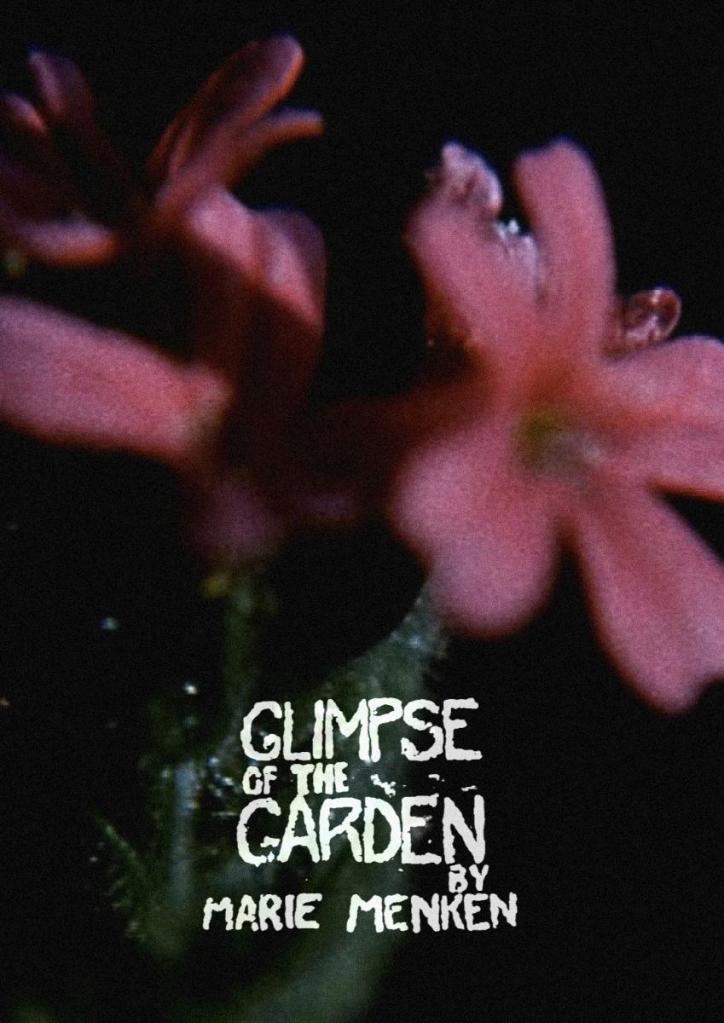
The Plot: “Glimpse of the Garden” lives up to its title as Marie Menken shows off beautiful glimpses of a friend’s garden. As the sounds of birds and insects provide the ambiance, Menken gives us a peek at the various flora the garden has to offer. And because Menken is an experimental filmmaker, we get quick cuts and unconventional angles just to keep things interesting.

Why It Matters: The NFR calls it “beautifully lyrical”, “surprisingly joyful” and “among the more accessible works of avant-garde filmmakers.”

But Does It Really?: Well, I’m lenient with every other experimental filmmaker on this list, might as well be for Marie Menken, especially since she’s one of the earlier experimental types on the NFR, and – as we’ll see – left quite an interesting mark on pop culture. Welcome aboard, Marie!

Everybody Gets One: Originally from New York City, Marie Menken started out as a painter, but her love of playing with light and her desire for a less-static medium led to her transition to filmmaking. Her first film was 1945’s “Visual Variations on Noguchi”, a short montage of sculptures by Isamu Noguchi. Menken was married to fellow filmmaker and poet Willard Maas, and their marriage was a tempestuous one, marked by long bouts of drinking and shouting matches. (Not fun, I know, but trust me, this will come back later)

Seriously, Oscars?: No Oscars for “Garden”, but the film won an award at the Exposition Universelle et Internationale de Bruxelles in 1958. You can see the award on the film’s Wikipedia page, which appears to be either a medal or a commemorative coin of some kind.

Other notes

  • The opening titles thank Dwight Ripley, a botanist and poet who socialized in some of the same New York art circles as Marie Menken in the early ’40s. “Glimpse” is filmed at Ripley’s garden on his farmhouse property near Wappingers Falls, New York.
  • “Glimpse of the Garden” is an off-shoot of the “Staring at Water” movies that permeate this list that I have dubbed “Staring at Plants”. But don’t worry, they never stay on one plant for too long.
  • This movie definitely proves how bad I am at identifying plant types. I felt like I was singing “Little Boxes” while watching this: “There’s a green one, and a pink one, and a blue one, and a yellow one…”
  • As the film progresses, the shots get more artsy, with more quick cuts and extreme close-ups of the plant life. Some close ups are so extreme I’m still not quite sure what part of the plant I was looking at. As with many movies, it’s not what you’re filming, but how you’re filming it.

Legacy

  • Marie Menken would continue making films for another decade after “Glimpse”, most notably 1962’s “Notebook”, which was a collection of outtakes from her previous films. Menkin died on December 29th 1970 of an alcohol-related illness, and Willard Maas died four days later.
  • Among those that Marie Menken influenced with her films were Stan Brakhage and Jonas Mekas, two names that this blog has taught me are a really big deal in the world of experimental film. Also learning at the foot of Menken: Andy Warhol, and I would love to actually see one of his movies someday. Menken even appeared in a few of Andy’s films, though I don’t believe she was ever one of the “Superstars”.
  • Marie Menken is considered one of the earliest filmmakers to highlight the handheld camera effect. Before that, indie filmmakers felt compelled to emulate the smooth effect of a dolly shot, but Menkin’s work changed that. Shaky cam forever!
  • According to Edward Albee, the tumultuous marriage of Marie Menken and Willard Maas was his inspiration for George and Martha in “Who’s Afraid of Virginia Woolf?” Now you understand why I mentioned the drinking and shouting earlier.

Further Viewing: My personal favorite in the “Staring at Plants” subgenre: The ‘70s documentary “The Secret Life of Plants”. Based on the book of the same name, the film delves into the super trippy aspects of plant life, like their ability to remember and feel pain. All this, plus a Stevie Wonder soundtrack!

#581) The Big Trail (1930)

#581) The Big Trail (1930)

OR “Wide Load”

Directed by Raoul Walsh

Written by Hal G. Evarts (and a whole bunch of uncredited writers, including Walsh)

Class of 2006

NOTE: This post is based on my viewing of the widescreen version of “The Big Trail”.

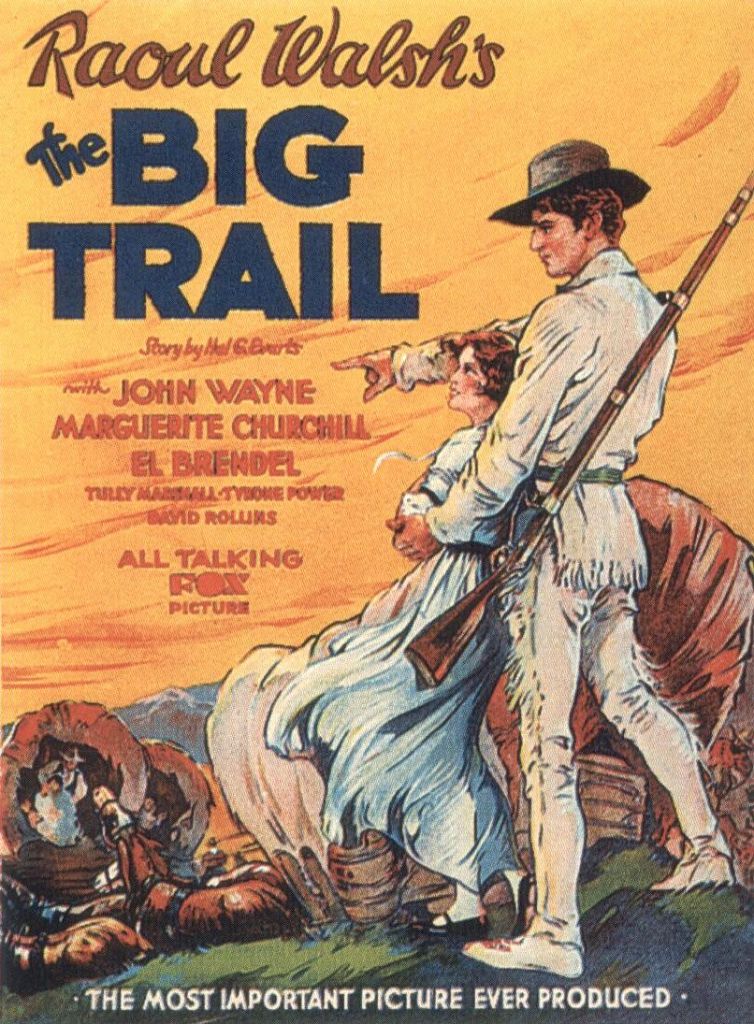
The Plot: Around 1843, a group of settlers begin the dangerous journey from Missouri to Oregon along the famous Oregon Trail. Among those traveling with the settlers is trapper Breck Coleman (John Wayne) out to avenge the death of his friend at the hands of Red Flack (Tyrone Power Sr.). There’s also Ruth Cameron (Marguerite Churchill), a single mother who inevitably becomes this movie’s love interest, and Gus (El Brendel), a Swedish immigrant bossed around by his mother-in-law (Louise Carver). But there’s peril at every stop on this trail, all of it filmed in the widescreen process of Grandeur 70!

Why It Matters: The NFR write-up is mostly a trivia entry about John Wayne’s big break, but they do applaud the film’s “majestic sweep” and “panoramic scenes”. There’s also an essay by Raoul Walsh expert Marilyn Ann Moss.

But Does It Really?: I was completely unaware that there had been any kind of major widescreen release before the 1950s, so Grandeur 70 took me by surprise, and turned what I thought would be a standard John Wayne movie into something quite memorable. Granted, “The Big Trail” is your standard John Wayne movie, but it looks different than any other movie of its time and earns its NFR designation for both its historical and aesthetic significance. “The Big Trail” is a unique enough curio in film history to warrant a spot on the NFR, and at least one viewing for film buffs.

Every Experimental Widescreen Process Gets One: Grandeur 70 (aka Fox Grandeur) was the first major 70mm widescreen film stock in American cinema, conceived by William Fox himself, hoping to create a more grand movie experience to boost ticket sales. Fox collaborated with Theodore Case (the Movietone sound innovator responsible for this odd NFR entry), and by May 1929 the first Grandeur 70 cameras were ready to go. A few experimental shorts were filmed in the process, and “The Big Trail” was the first major film shot in Grandeur 70.

Wow, That’s Dated: While “The Big Trail” is a bit more nuanced in its portrayal of indigenous people (Breck encourages the settlers to make peace with them rather than fight), they sure do say “injuns” a lot, and there’s still an attack sequence in which the tribes are reduced to their “savages” stereotype.

Seriously, Oscars?: No Oscars for “The Big Trail” or its revolutionary cinematography. For the record, Best Cinematography was awarded that year to Floyd Crosby for another NFR film: “Tabu: A Story of the South Seas“.

Other notes

  • “The Big Trail” is a movie that doesn’t have trivia, but rather statistics. According to the aforementioned Moss essay, production took four months (at a time when most movies were shot in a month), and filmed at 15 different locations in seven different states. The creatives included 22 crew members, almost 300 actors, 20,000 extras, 725 indigenous extras from five different tribes, 185 wagons, 1400 horses, 1800 head of cattle, 500 buffalo and 700 various barnyard animals. On top of all this, the crew was shooting the 70mm widescreen version, the 35mm standard version, AND the Spanish, French, Italian, and German language versions simultaneously (a common practice before dubbing technology had improved).
  • Marion Morrison had appeared as an extra or bit player in a few movies during the late 1920s, and was working as a prop handler when Raoul Walsh spotted him moving large furniture pieces with minimal struggle. Walsh trusted his instinct and cast Morrison as the lead in “The Big Trail”. Credited as “Duke Morrison” in an early film, Walsh suggested Morrison change his screen name to “Anthony Wayne”. Fox executives vetoed Anthony (“too Italian”), so Walsh suggested the first name John. And now you know the rest of the story!
  • Shoutout to cinematographer Arthur Edeson (as well as the 35mm version’s cinematographer, Lucien N. Andriot). The widescreen in this movie is gorgeous. As the only ’30s widescreen movie on the list, this film’s aesthetic instantly stands out. Due to technical limitations there aren’t a lot of close-ups in this movie, but if you’re just here for the spectacle, “The Big Trail” does not disappoint. Each frame is packed with big sweeping vistas, wagon trains that extend to the horizon, and background activity that give a real sense of time and place. It almost feels like a documentary, which is funny since this movie is depicting historical events from 90 years prior.
  • As an actor John Wayne is…fine in this. He’s not remarkable, but you do see the beginnings of the all-American hero persona he would embody in his more iconic movies.  Also, John Wayne turned 23 during this production! He’s so young!
  • El Brendel pops up in this movie as the comic relief, playing the same Swedish immigrant stereotype he played in “Wings“. On top of the stereotyping, Brendel’s subplot centers around literal mother-in-law jokes. Also adding some comic relief is Russ Powell as Windy Bill, making more animal noises than the guy from “Police Academy”, and more or less resembling Big Al from the Country Bear Jamboree.
  • Most surprising among the cast to me was Tyrone Power Sr. as Red Flack. Having recently seen his performance as a sophisticated attorney in “Where Are My Children?“, I wasn’t expecting Power to show up as the heavy in a western. This is Power’s only sound film, showing off his rugged baritone.
  • The major trek scenes are an impressive undertaking, and from what I understand filmed as accurately as possible. River crossings, canyon scalings; no wonder the “Oregon Trail” computer game was impossible to beat. I’m surprised no one died of dysentery in this movie.
  • Like many movies of the time, the love story in “The Big Trail” is a variation of “He’s a jerk but she’s okay with it” called “He’s aggressive and she comes around to it eventually”. At least there’s all this natural beauty to look at while this is happening.
  • A major character’s murder is intercut with a marriage ceremony happening on the other side of the wagons. Did Coppola watch this?
  • Tully Marshall is kind of a Walter Huston-lite. He’s not a full-on grizzled prospector caricature, but dagnabbit he’s close.
  • On top of all the natural hazards of wagon trains, there’s also snowfall and thunderstorms during this movie. Allegedly both of them were real occurrences. Even if that’s fabricated, it looks amazing on screen.
  • Ultimately, “Big Trail” is more admirable for its location and backdrop than for its characters. That being said, I did appreciate the final scene of Breck and Ruth reuniting; their two figures dwarfed by a forest of redwoods. 

Legacy

  • “The Big Trail” played at Grauman’s Chinese Theatre in Hollywood and the Roxy Theatre in New York, the only two theaters equipped to show 70mm film. Plans were made to expand the film’s release and equip theaters with Grandeur 70 projectors, but the onset of the Great Depression, mixed with the high costs of widescreen for an industry still adjusting to sound, put an abrupt end to the theatrical exhibition of “The Big Trail”. 
  • Due to the film’s financial setbacks, John Wayne was denied what should have been his breakout role in the movies. Wayne spent the rest of the ’30s in supporting roles and B-movies, and it wasn’t until 1939 that John Ford cast him in “Stagecoach” and jump-started Wayne’s career.
  • Raoul Walsh would join Warner Bros. by the end of the 1930s, where he directed a bevy of movies, including future NFR entry “White Heat“.
  • “The Big Trail” remained a forgotten film for over 50 years, with the 35mm “standard” version making the occasional TV appearance. The original camera negative of the 70mm version was restored by the New York Museum of Modern Art, and this print started making the cable TV rounds in the 1990s. The film started getting a reappraisal from film critics around this time as well.
  • Although Grandeur 70 came and went in 1930, it did presage the abundance of widescreen processes Hollywood studios would crank out in the ’50s to combat television.

#580) The Rocky Horror Picture Show (1975)

#580) The Rocky Horror Picture Show (1975)

OR “The Midnight Special”

Directed by Jim Sharman

Written by Sharman and Richard O’Brien. Based on the stage musical “The Rocky Horror Show” by O’Brien.

Class of 2005

The Plot: On a dark and stormy night [Audience shoots water pistols], engaged couple Brad Majors [ASSHOLE] and Janet Weiss [SLUT] (Barry Bostwick and Susan Sarandon) walk to a nearby castle for assistance when their car breaks down. They soon find themselves in the home of Dr. Frank-N-Furter [audience throws hot dogs] (Tim Curry), a “sweet transvestite” and mad scientist who has created a muscle man named Rocky [BULLWINKLE!] (Peter Hinwood). Assisted by servants Riff Raff and Magenta (Richard O’Brien and Patricia Quinn), the doctor keeps Brad and Janet from leaving, while also helping them discover new facets of their own sexuality. And I am just scratching the surface of the greatest B-movie musical in film history.

Why It Matters: The NFR’s brief paragraph on the film calls it a “low-budget cult classic” and singles out the “catchy songs”.

But Does It Really?: It’s certainly not for everyone, and some of its subject matter would still raise an eyebrow today, but the people who get this movie GET this movie, and in doing so have helped it become a classic. “Rocky Horror” has become so synonymous with its own cult following that it’s nearly impossible to separate the film from the phenomenon. Ultimately, to appreciate “Rocky Horror”, you have to accept this movie for what it is and just go with it, from its campy presentation to its unapologetic sexuality. While not a conventional NFR choice, “The Rocky Horror Picture Show” does what every classic movie should: it has its own instantly identifiable aesthetic, iconic moments, and a legacy that endures year after year.

Shout Outs: Among the movies referenced in “Science Fiction/Double Feature” are NFR entries “The Day the Earth Stood Still“, “Flash Gordon“, “The Invisible Man“, “King Kong” and “Forbidden Planet” (whoa-oh-ah-oh-oooooo-oh). There’s also references to “Frankenstein“, “The Bride of Frankenstein“, “The Night of the Hunter“, and “The Wizard of Oz“. Bonus reference: one of the film’s original posters mentions its main box office competition: “Jaws“.

Everybody Gets One: Passing the time while unemployed, English/New Zealand actor Richard O’Brien wrote a musical that combined his love of B-movies, ’50s rock and roll, and the glam rock scene of the early ’70s. O’Brien showed the musical – then called “They Came from Denton High” – to director Jim Sharman, who agreed to stage the show at the Royal Court’s Theatre Upstairs, a space reserved for experimental pieces. “The Rocky Horror Show” transferred to West End’s King’s Road Theatre in August 1973 and was a runaway hit. American producer Lou Adler saw the show, and quickly bought the US theatrical rights as well as the film rights. After the conclusion of the show’s nine-month run in Los Angeles, the creatives flew back to England to shoot the movie.

Other notes

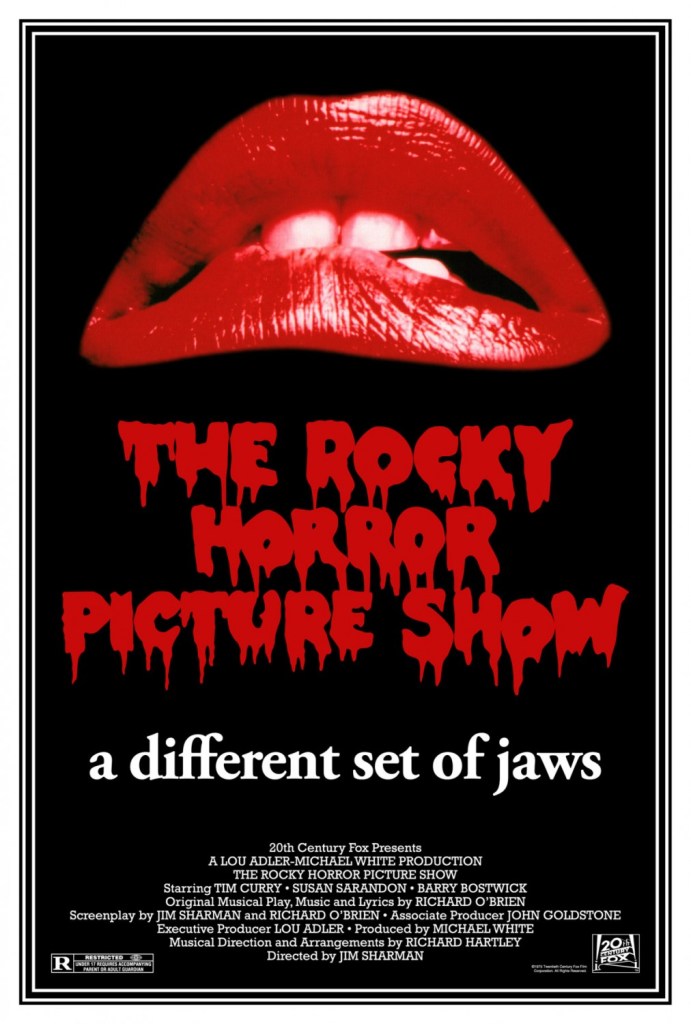
  • Wow, this movie is unsettling from frame one. The first shot is an extreme closeup of Patricia Quinn’s blood-red lips mouthing along to “Science Fiction/Double Feature”. Buckle up, everyone.
  • Barry Bostwick and Susan Sarandon were cast as a sort of compromise. Fox offered the film a larger budget if the cast included big name rock stars (Mick Jagger and Elvis Presley were mentioned). When Sharman and O’Brien declined, opting to stand by the original stage cast, Fox agreed on the condition that Brad and Janet [DAMMIT] were played by American actors.
  • Unlike many musicals that started on the stage, “Rocky Horror” fares well as a film adaptation. This is partly due to the “opening up” of certain scenes, and partly the cinematic influence already baked into the show’s DNA. Also helping things is the film’s limited budget, which forces creativity across all departments
  • Ah, “The Time Warp”. It’s very hard to watch this number solely within the context of the movie, but it’s a lot of fun and so damn catchy. There’s even dance instructions from Charles Gray’s Criminologist. [HE’S GOT NO FUCKING NECK!]
  • Tim Curry was one of the first people to see the potential in “Rocky Horror”, and starred in its original England, Los Angeles, and New York productions. Understandably, Curry walks away with this movie as ruler of all he surveys, in his film debut no less. And he does the whole thing in heels!
  • Pardon my ignorance, but are the terms “transvestite” and “transsexual” still kosher? I’d hate for this movie to become dated in regards to its identity.
  • This movie requires a lot of prior knowledge of old movie stars and bodybuilders. Sure, I got the shoutouts to Fay Wray and Anne Francis, but who remembers Steve Reeves and Charles Atlas? [Audience throws confetti]
  • Because it’s always worth mentioning: NFR movies with Glenn Close: 0, NFR movies with Meat Loaf: 1.
  • “Hot Patootie” is fun, but is immediately followed by a truly disturbing murder. [THAT’S NO WAY TO PICK YOUR FRIENDS!]
  • I was always under the impression that Susan Sarandon had spent most of her career distancing herself from this movie, but I guess she’s warmed up to it in recent years. Not surprising, even Christopher Plummer came around to embracing “The Sound of Music“.
  • Columbia’s donning of mouse ears for most of the film’s second act is a good reminder that “The Rocky Horror Picture Show” is now legally a Disney movie, and is the only Fox property that Disney has kept available to theaters. Even Disney knows better than to mess with “Rocky Horror” fans.
  • Apparently in the L.A. production Meat Loaf also played Dr. Scott? That I would have liked to see; I’m sure he was a great Scott. [Audience throws toilet paper]
  • I’ve seen “Rocky Horror” a few times over the years, and I always forget that it ends up being aliens. Still don’t see it coming. [LIKE EVERYONE IN THIS MOVIE]
  • The Floor Show suite is quite the finale, with the film’s message coming across loud and clear: Don’t Dream It, Be It. The line that stuck with me most comes from “Rose Tint My World”: “Rose tints my world/Keeps me safe from my trouble and pain”
  • [Spoilers] Shoutout to Nell Campbell (billed here as “Little Nell”) as groupie Columbia. The closest this movie gets to an emotional core, I was actually saddened when she’s killed off at the end. [OH SHIT, IT WORKS!]
  • I love me some hand-drawn animated effects. Someone spent hours hunched over a desk drawing those blood credits and laser beams.
  • I’ve said this many times on the blog, but I’ve never meant it as sincerely as I do with “Rocky Horror”: What in God’s name is happening?

Legacy

  • “The Rocky Horror Picture Show” was a critical and commercial disaster upon release, although the UA theater in Los Angeles noted that some moviegoers came back night after night to see the film. On April 1st 1976, “Rocky Horror” was re-released as a midnight movie at New York’s Waverly Theatre. The film finally found its audience, and soon “Rocky Horror” was playing as a midnight movie in hundreds of theaters across the country. Some viewers started bringing props and shouting back at the screen as a way to entertain themselves, which quickly became part of the midnight screening rituals. The film soon developed a following larger than most religions, and “Rocky Horror” is the most successful cult film of all time. 
  • In antici…. [SAY IT!]…pation of the film’s US release in September 1975, Lou Adler also backed the show’s first New York production on Broadway. “Rocky Horror” opened in March 1975…and closed in April 1975. At least the Tony Awards nominated it for Lighting Design. A revival in 2001 fared a little better.
  • Richard O’Brien has tried many times over the years to make a sequel to the stage and/or film version of “Rocky Horror”, with such titles as “Rocky Horror Shows His Heels”, “Revenge of the Old Queen” and “Rocky Horror: The Second Coming”. None of the projects got too far, however, due to a lack of interest from the original cast and creatives. O’Brien and Jim Sharman did reunite in 1981 to make pseudo-sequel “Shock Treatment”, which has a minor cult following of its own.
  • As part of the wave of TV movie musical remakes we got throughout the 2010s, “The Rocky Horror Picture Show: Let’s Do the Time Warp Again” tried to be both a remake of and tribute to the original film, including a framing device of an audience watching a midnight screening of the film. Even the natural charisma of Laverne Cox and stunt casting of Tim Curry couldn’t save this one.
  • “Rocky Horror” doesn’t so much have parodies as it does homages. I’ve always been partial to the tribute to “The Time Warp” on “The Drew Carey Show”, with “Priscilla, Queen of the Desert” thrown in for fun.
  • I’m also amused by the extended sequence in “Fame” where the characters attend a midnight screening. “Fame”: the movie that just gives up and watches another movie instead.
  • Tim Curry and Meat Loaf reunited on “SNL” in a sketch about their “Rocky Horror” shop. Like most of early ’80s “SNL”, [HOW’S YOUR SEX LIFE, BRAD?] it’s negligible.
  • “Rocky Horror” joins the elite list of NFR movies with not one, but TWO video game adaptations.
  • According to the documentary “These Amazing Shadows”, entertainment executive/National Film Preservation Board member John Ptak suggested “The Rocky Horror Picture Show” for NFR consideration, citing its cult following and continued popularity. Then-Librarian of Congress Dr. James H. Billington agreed to the inclusion, stating that the conversation about a “Rocky Horror” induction “certainly broadened [his] horizon” in regards to which films are truly NFR-worthy.