#710) Martha Graham Early Dance Films (1931, 1936, 1943, 1944)

#710) Martha Graham Early Dance Films (1931, 1936, 1943, 1944)

OR “Movers and Shakers”

Choreographed by Martha Graham

Class of 2013

This write-up is another one of my “placeholder posts”. Of the four shorts that comprise the “Martha Graham Early Dance Films”, 2 ½ of them are currently viewable online. To cover the 1 ½ I couldn’t watch, I found later recordings of these same dances, which to the best of my knowledge are faithful recreations of Martha Graham’s original pieces.

The Plot: Hailed as the “Picasso of Dance”, Martha Graham revolutionized the dance world with movements we now refer to as Modern Dance. While Graham’s domain was primarily the stage, a few of her pieces were filmed for teaching purposes, with four films of her early work (all with her as the central dancer) being included in this NFR selection. “Heretic” (1931) is a brief scene of a woman ostracized by a group of Puritans. “Frontier” (1936) showcases a pioneer woman celebrating the exciting promise of a new land. “Lamentation” (1943) is a physical exploration of mourning and grief. “Appalachian Spring” (1944) is a lengthy character study about a newly married couple, a frontier woman, a preacher, and his “flock”.

Why It Matters: The NFR proclaims Martha Graham to be “one of the most important artists of the 20th century” and highlight the films as “four of the artist’s most important early works.” The “lyrical beauty” of “Appalachian Spring” also gets a shoutout.

But Does It Really?: Oh boy, am I out of my element on this one. Modern dance is one of my artistic blind spots, but I appreciated the chance to learn more about it. The Martha Graham films represent an important American artist and her important American art form, but they also acknowledge one of the less recognized perks of the National Film Registry. Yes, the NFR is primarily for preserving classic narrative movies and important historical events, but it can also preserve this country’s other arts. Thanks to the growing use of film in the 20th century, future generations can see artists of all stripes creating their passion projects: paintings, poems, songs (cough Broadway cast recordings cough), and yes, even modern dance. A yes for the inclusion of the “Martha Graham Early Dance Films” and for broadening the definition of what an NFR film can be.

Everybody Gets One: Born in Pennsylvania to a Presbyterian family, Martha Graham grew up in a house that discouraged dancing, and she didn’t see her first dance recital until she was 14. After watching Ruth St. Denis perform in Los Angeles, Graham was hooked, and within a few years was studying at the dance school co-founded by St. Denis. While performing as a dancer in Greenwich Village in the early 1920s, Graham started experimenting with a new, more emotionally driven form of dance, eventually creating what is now known as “Graham technique”. In 1926, she established the Martha Graham Dance Company and began teaching her new method of modern dancing, a style of movement that, among other things, focuses on the correlation between contraction and release of the body. Although Graham believed that live theater should never be filmed, she eventually relented to having some of her own work recorded for posterity.

Other notes

Heretic (1931)

  • Premiering in 1929, “Heretic” was Martha Graham’s first public performance with her concert ensemble (she had previously only performed as a solo dancer). The group is put to excellent use here: 12 members dressed in black and forming an imposing semi-circle around Martha, dressed in white (the symbolism of “Heretic” is hard to miss). “Heretic” is also the first of Graham’s dance pieces to move away from more traditional ballet and apply the Graham method, with was well received upon its premiere.
  • Although all four of the Martha Graham dance films are silent, most uploads include the original music for a more complete viewing experience. The music for “Heretic” is the folk song “Tetus Breton”, providing a perfect tense atmosphere.
  • There are many hallmarks to a Martha Graham dance, but there’s one on display here that no one talks about: flowy dresses. I don’t know what it is, but Martha loves a good flowy dress. They show up in all the pieces covered here.
  • I can see how “Heretic” went over so well at the time; it introduces this new form of dance in a simple, concise presentation. It also meshes well with the other experimental art movements happening at the same time (painting, music, film, etc.). If you’re a member of New York’s cultural elite in the 1930s, something like “Heretic” is easy to engage with.

Frontier (1936)

  • First off, the clip embedded above is NOT, I repeat NOT the original 1936 clip. It is a recreation from 2009 at New York’s 92nd St. Y, performed by Blakeley White-McGuire.
  • Martha Graham’s inspiration for “Frontier” came from her family’s move to California by train, and young Martha seeing the parallel lines of the railroad stretching out into the seemingly infinite horizon. This is the first of many pieces where Graham explores Americana and American archetypes through dance (we’ll see much more of that in “Appalachian Spring”).
  • Of Martha Graham’s solo pieces, “Frontier” is the one most associated with her. Graham even performed it for Eleanor Roosevelt at the White House, the first dancer to be invited to perform there.
  • The music of “Frontier” is an original score by Louis Horst, longtime Graham collaborator and fellow choreographer. Horst also composed a few film scores, though his best-known work is his compositions for Martha Graham.
  • Obviously, I can’t comment too much on the 2009 revival of “Frontier”, so I’ll focus instead on the dance itself. Unsurprising for a Martha Graham piece, I was drawn to the contrast in the movement: boisterous leaps through the air followed by small, feeble movements on the floor (floor work is another key component to Graham technique). The title “Frontier” evokes, of course, our country’s pioneer days as we traveled westward, and I read this dance as the dichotomy that frontier women would have faced; the freedom of a new land, yet still restrained to their position as daughters, wives, and mothers. Probably not what Martha Graham had in mind, but there you go.

Lamentation (1943)

  • Unlike the other three dance films, we have a little bit of information of who actually filmed “Lamentation”; sculptor Simon Moselsio, with his wife taking still photos during the filming. “Lamentation” stands out for being filmed with two cameras (allowing for some cross-cutting), as well as for being filmed in color!
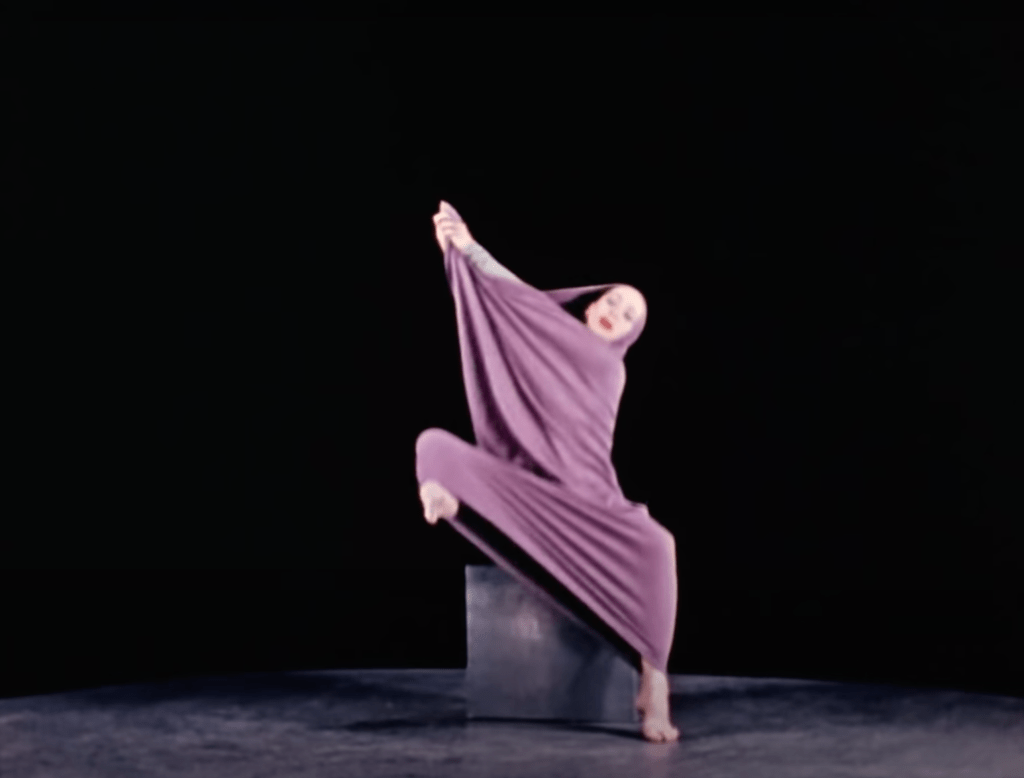
  • We get Martha in her flowiest dress yet: a purple tube-like garb that covers her almost completely. It’s practically a Snuggie. Martha performs the entire piece sitting on a small bench, never standing up but still fully utilizing her body while sitting down. I wonder if she thought the constant leaping in her pieces was getting stale.
  • For “Lamentation”, Graham needle-drops Zoltan Kodaly’s Piano Piece, Op. 3, No. 2. Like Graham, Kodaly also has a method named after him, in his case the Kodaly method of music education.
  • Graham stated at the time that she wasn’t trying to represent any specific sorrow with this piece, but rather “the personification of grief itself”. I gotta say, even while being engaging to watch, “Lamentation” does get a little depressing. So, well done, I guess.

Appalachian Spring (1944)

  • This is the “half” in the 2 ½ films I mentioned upfront. “Appalachian Spring” is a 30-minute piece, and roughly 11 minutes of the 1944 film can be seen online. For the full piece, I also watched a 1959 re-enactment that Martha Graham and her dancers filmed for TV.
  • Of the four, “Appalachian Spring” was the one I understood the least. Perhaps due to its longer runtime I was expecting a full story through dance, and maybe there was one, but I sure couldn’t follow it. There’s lots of tableaus and variations of dance throughout “Appalachian”, but ultimately, I couldn’t fully comprehend what this piece was trying to say. Just when I thought I was beginning to understand modern dance, along comes “Appalachian Spring” to make me doubt everything.
  • The piece’s rustic setting got me to thinking about the dream ballet from “Oklahoma!“, which would have premiered a year before “Appalachian Spring”. While I initially thought that Agnes de Mille’s “Oklahoma!” choreography might have influenced this piece, my research shows that “Appalachian Spring” was a long gestating project for Graham (dating back to 1941), so we can most likely chalk the comparisons up to parallel thinking. For the record, Graham and de Mille were contemporaries, friends, and supporters of each other’s work.
  • The preacher in this piece is most likely a Shaker, a sect of Christianity that was known for its enthusiastic revivals, earning the description “Shaking Quakers”, later shortened to Shaker. The Shaker community stopped accepting new members in the late 1950s, and today only 2 official members survive. I didn’t realize you could shut down a religion. Something to think about. Anyway, where was I…
  • “Appalachian Spring” has an original score by Aaron Copland, who utilizes the traditional song “Simple Gifts”, which I know from somewhere, but I can’t put my finger on where exactly. Side note: Copland won the Pulitzer Prize for Music for his “Appalachian Spring” composition. For those of you keeping track, that’s two films on the NFR with a Pulitzer-winning score.

Legacy

  • Martha Graham continued dancing until the late 1960s (when she was in her mid-70s!) and continued to choreograph new dance pieces until just before her death in 1991 at age 96. Her final decades were also spent receiving every national arts award under the sun, including the Presidential Medal of Freedom and the Kennedy Center Honors.
  • The Martha Graham Dance Company is still going strong almost a century after its founding, now known as the Martha Graham Center of Contemporary Dance with two locations in New York. The Graham technique is still being taught as part of modern dance, though be aware that since the early 2000s the term “Graham technique” is a registered trademark, so please be careful with how you use it.
  • The pieces highlighted in these films have been revived by the Martha Graham Dance Company over the years, some more frequently than others. “Appalachian Spring” has become so popular and so celebrated it is one of the rare Martha Graham pieces to be licensed out for other dance companies to perform.

Bonus Clip: Because I love it so much, here’s that clip from “The Birdcage”. Thanks to “Lamentation”, you now understand why Robin Williams puts his shirt over his head as he shouts “Martha Graham! Martha Graham! Martha Graham!”

#709) Behind Every Good Man (1967)

#709) Behind Every Good Man (1967)

OR “Ursin Major”

Directed by Nikolai Ursin

Class of 2022

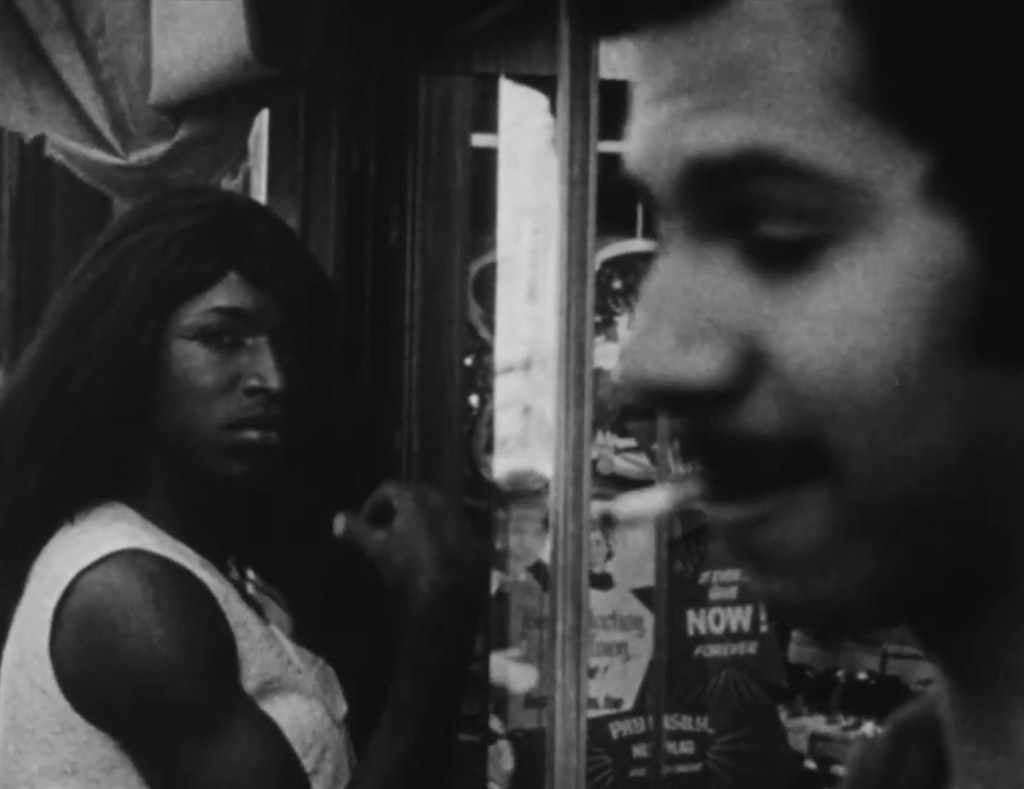
The Plot: This obscure treasure from the UCLA film archive follows an unidentified Black person who we would identify today as transgender, though this film isn’t concerned with labels. We follow our protagonist as she turns a few heads walking down the street, flirts with a man, and gets her apartment ready for a dinner date. Throughout the film, our protagonist narrates their hopes for future relationships, recounts a brief run in with an undercover police officer, and reminds us that behind every good man…there’s a woman.

Why It Matters: The NFR calls the short “stunning”, though skirts around the subject matter, merely stating the film is “pre-Stonewall” and is a portrait of “gender fluidity”.

But Does It Really: This is an interesting one. On the one hand “Behind Every Good Man” is a brief but poignant film shedding a positive light on a topic that was virtually unspoken of at the time. On the other hand, I get the sense that “Behind Every Good Man” was plucked from the obscurity of the UCLA archives for NFR inclusion, removed from its original context to represent a culture that it can only scratch the surface of. To make matters worse, there is little to no information about the film’s production (Nikolai Ursin passed away decades before the film’s NFR induction), so we have no real way of knowing what went into the making of this film or why this particular short has been deemed significant. “Behind Every Good Man” is an interesting time capsule, but I do wish it had delved a little deeper into its subject. I am all for more movies on the NFR about the transgender community, but “Behind Every Good Man” barely justifies its NFR inclusion, and the lack of surrounding context makes for an unfulfilling viewing experience.

Everybody Gets One: The infuriatingly scare information about the film extends to the filmmaker. We know that Nikolai Ursin was a film student at UCLA in the late ’60s and early ’70s. In addition to “Behind Every Good Man”, I found information on one other film Ursin made while at UCLA: 1970’s “Second Campaign”, co-directed by Norman Yonemoto, a documentary short about the People’s Park protest of 1969 in Berkeley. We have zero information about the transgender woman that this film focuses on. Not their name, not what their connection to Nikolai Ursin was, nothing. Whoever they are, I hope they lived (or continue to live) a good life.

Other notes

  • Despite my disappointment in trying to do any research for this movie, I did enjoy “Behind Every Good Man”. Our protagonist is lively and candid, and the scenarios, while most likely staged, paint an engaging if fleeting portrait. I was steeling myself for the inevitable downturn when our hero gets harassed or abused, but thankfully that never came. The closest we get is a story about getting questioned by a police officer which ends anticlimactically, and the final shot of our hero accepting that her date is never showing up. I guess witnessing this woman’s heartbreak is all the pain we need to see them go through. 
  • One other thing I’ll say about this movie: it’s got a good soundtrack. As our hero walks down the street, we get the Dionne Warwick double-header “Reach Out for Me” and “Wishin’ and Hopin’ (the latter of which I’ve had stuck in my head ever sense). The scene in her apartment prominently features The Supremes’ cover of “I’ll Turn to Stone”. For the record, “Behind Every Good Man” is also available for viewing on UCLA’s Internet Archive page, just in case the YouTube upload blocks some of the songs for copyright reasons.

Legacy

  • After completing his MFA in film production at UCLA, Nikolai Ursin seems to have taken a direct turn into the adult film industry. Throughout the ’70s and ’80s, Ursin (under the name Nick Elliot) was the cinematographer, camera operator, and occasional director of such titles as “Inch by Inch”, “Skin Deep”, and “Bi-Coastal”. Nikolai Ursin died in 1990 from AIDS-related lymphoma at the age of 48.

Further Viewing: We’re only one year away from “Tangerine” being eligible for the NFR. Sean Baker’s 2015 film still gets shout outs for its respectful, nuanced portrayal of transgender sex workers, and is that one movie you heard about that was filmed entirely on an iPhone 5S.

#708) Before Stonewall: The Making of a Gay and Lesbian Community (1984)

#708) Before Stonewall: The Making of a Gay and Lesbian Community (1984)

OR “Gay Old Times”

Directed by Greta Schiller. Co-directed by Robert Rosenberg.

Class of 2019

The Plot: On June 28th, 1969, a police raid of the Stonewall Inn, a gay bar in New York’s Greenwich Village, escalated when the bar’s gay clientele fought back, leading to violence and rioting over the next five days. While the Stonewall Riots have been designated the starting point of the modern gay rights movement, Greta Schiller’s documentary focuses on American gay culture within the generations leading up to that historic night. Through archival footage and first-hand accounts, “Before Stonewall” chronicles gay (or what we now call queer) life in America between 1900 and 1969; a history of repression, marginalization, burgeoning communities, and the very beginnings of liberation.

Why It Matters: The NFR write-up isn’t very helpful, describing the documentary’s overall themes without offering any superlatives for the film or its creators. It always surprises me when the NFR doesn’t specify what makes their selections important or unique.

But Does It Really?: “Before Stonewall” is the right movie at the right time. Of course this film’s subject matter is significant, but beyond that, the film is a documentation of the first “out” generations openly discussing their lives and struggles for posterity. “Before Stonewall” is a movie about beginnings: the beginning of gay rights, but more importantly the beginning of the queer activism that continues to this day. Schiller’s oral history approach, candid interview subjects, and overall optimism towards this material make “Before Stonewall” a landmark film in queer history and a compelling watch.

Shout Outs: Brief clips from “Salome” (and its allegedly all-gay cast), plus a snippet of Judy Garland singing “Over the Rainbow“.

Everybody Gets One: A 1977 graduate of The City College of New York with a BA in Film/Video Production, Greta Schiller’s first films were the shorts “Greta’s Girls”, and “Greetings from Washington D.C.”, the latter being about the first National March on Washington for Lesbian and Gay Rights in October 1979. In the early 1980s, Schiller was approached by producer Robert Rosenberg about making a documentary based on the then-unpublished book “Sexual Politics, Sexual Communities: The Making of a Homosexual Minority in the United States” by John D’Emilio. “Before Stonewall” was Greta Schiller’s first feature-length film, and quickly evolved beyond the scope of the gay communities in the book to become, as Schiller later put it, “Gay History 101”.

Seriously, Oscars?: No Oscar love for “Before Stonewall”, though it did win a handful of film festival awards and was a Sundance Grand Jury Prize nominee. Following the film’s PBS airing in 1986, it won two News & Documentary Emmys: Outstanding Information, Cultural or Historical Program and Outstanding Individual Achievement in a Craft: Researchers. You gotta love an award given out for research.

Other notes

  • The film opens with an interesting disclaimer: “Unless otherwise stated, the people who appear in this film should not be presumed to be homosexual…or heterosexual.” This film knows its audience and knows it well.
  • “Before Stonewall” makes heavy usage of archival footage, photos, and audio throughout. Most libraries Schiller contacted for the film claimed not to have any footage of homosexuals, but the film’s archival resource director (and future Emmy winner) Andrea Weiss had success at the Library of Congress by searching under more general terms like “cross-dressing” and “Greenwich Village street life”. Most of the film’s archival materials come from the personal photos and home movies of the film’s interviewees, as well as material sent to Greta Schiller after she printed an ad in Village Voice
  • We begin as all ’80s documentaries were required to: with an ironic in hindsight Ronald Reagan movie clip. In this case, a scene from 1943’s “This Is the Army” where, as a Corporal in charge of an Army revue show, he assigns Alan Hale to dress in drag for the “Ladies of the Chorus” number. Reagan will show up later during the ’60s segment when he’s Governor of California, calling homosexuality “a tragic illness”. No, you’re thinking of the actual tragic illness you ignored for most of your presidency.
  • “Before Stonewall” is narrated by Rita Mae Brown, author, feminist, and gay activist. She’s okay, but as far as gay NFR documentaries go she’s no Harvey Fierstein.
  • The film’s early segments chronicling the 1900s through 1920s lay an excellent foundation of what’s to come, mostly how repressed homosexuality was, and the extreme subtlety involved if you dared to connect with any other gay person. There’s also a brief mention of cowboys hooking up with each other out on the lone prairie. Somewhere Annie Proulx is taking notes.
  • Among the film clips is a scene from the 1932 Clara Bow vehicle “Call Her Savage”, featuring one of the first (if not the first) depictions of openly gay characters, as well as a scene set in a gay cabaret. Ah, the pre-code days, we will miss you when you’re gone.
  • I didn’t realize how pivotal the rise of Nazism and WWII were for gay rights. Obviously, the persecution of homosexuals by the Nazis gets a mention, but America entering the war led to (closeted) gay men and women serving in the military and discovering people just like them from across the country and around the world. This moment of discovery and a possible community was a huge eye-opener for me.
  • I love when NFR documentaries overlap with each other, and “Before Stonewall” may brush up against more NFR docs than any other, a testament to how long our gay community had to stay hidden in the background of society. A segment dedicated to lesbians in the workforce during WWII feels like a lost scene from “The Life and Times of Rosie the Riveter“. This section has one of the film’s most memorable moments: former WAC member Nell “Johnnie” Phelps telling her story of standing up to General Dwight Eisenhower when he requested an investigation into lesbian infiltration within WAC. It’s an exciting tale, until you learn that based on Phelps’ military record it most likely never occurred. Whatever, it makes for good copy, and she tells it very well.
  • Another NFR doc that resurfaces here: “Point of Order” and the McCarthy hearings, specifically the debate between Senator McCarthy and Chief Counsel Welch over the definition of the word “pixie”. It is one of the hearing’s rare lighthearted moments. Also, blink and you’ll miss Roy Cohn in the background of that clip. So…go ahead and blink I say.
  • I was relieved that there are no homophobic slurs thrown about during this film, other than the newspaper headlines referring to outed gay men as “perverts”. We know things were bad for our gay citizens (and still are), we don’t need the slurs to go with it.
  • The film’s late ’50s trip to suburbia is accompanied by “Little Boxes”, the 1962 Malvina Reynolds song that reached a new audience when it became the theme song to the TV show “Weeds”. Its inclusion here made for a fun sing-along during my viewing. Fun Fact: Reynolds wrote “Little Boxes” about the tract housing development in Daly City, California, most of which is still there.
  • Speaking of the Bay Area, I was fascinated by the segment about Black Cat Café, a North Beach bar that served as a meeting spot for San Francisco’s beat and gay communities. Black Cat Café closed in 1964 after losing its liquor license, and is now the restaurant Nico’s, though there is a plaque acknowledging the building’s history. “Before Stonewall” hosts a very touching reunion between the bar’s regulars 20 years later. 
  • My main takeaway from this movie is “a rising tide lifts all boats”. Much like WWII, the Civil Rights and Women’s movements of the 1960s helped fan the flame of the gay rights movements. The gay community, as depicted here, were the marginalized group within these bigger marginalized group, with gay women and gay people of color becoming invigorated by these movements to stand up for their own rights. Side note: We briefly see clips from the 1963 March on Washington and, unlike another NFR documentary, “Before Stonewall” ponies up and plays a snippet of Dr. King’s “I Have a Dream” speech.
  • It must be the late 1960s because I hear Jefferson Airplane’s “Somebody to Love”.
  • The film, of course, concludes with the Stonewall Riots, which are surprisingly glossed over. Heck, my description in “The Plot” is more detailed than this movie’s account. Keep in mind the riots occurred only 15 years before this film was released, so the assumption is if you’re watching this documentary in 1984 the riots are recent history that don’t need any set-up. It’s like if a modern documentary said, “You remember the housing crisis, we don’t need to get into all of that.”

Legacy

  • “Before Stonewall” premiered at the Toronto International Film Festival in 1984 and received a limited theatrical release in June 1985. As part of their funding agreement with the Corporation for Public Broadcasting, “Before Stonewall” aired on PBS in 1986, the first film specifically about lesbianism to be funded and broadcast by the network. When certain PBS affiliates refused to air the documentary, Greta Schiller and Andrea Weiss traveled to those regions and held special screenings for local gay and/or arts organizations.
  • Based on their successful collaboration during “Before Stonewell”, Greta Schiller and Andrea Weiss founded Jezebel Productions, and continue to direct and produce documentaries to this day. Their most well-known collaboration is 1995’s “Paris Was a Woman”, their passion project about lesbians in 1920s Paris. Schiller and Weiss have also been in a personal relationship since shortly after making “Before Stonewall” and have been legally married since 2018.
  • “Before Stonewall” received a restoration and re-release in 2019, commemorating the 50th anniversary of the Stonewall riots as well as the film’s 35th anniversary. The film would be inducted into the NFR later that same year.
  • I was not expecting “Before Stonewall” to have both a sequel and a prequel. “Before Stonewall” co-producer John Scagliotti directed both films: 1999’s “After Stonewall” about the 30 years of gay history following the Stonewall Riots, and 2017’s “Before Homosexuals”, exploring the history of homosexuality preceding the 20th century.
  • Greta Schiller’s most recent film is 2024’s “Love Letters”, a documentary about Catherine Stimpson and Elizabeth Wood, a lesbian couple whose custody battle in the ’70s broke down an important gay rights barrier. You can learn more about Schiller’s filmography on the Jezebel Productions website.

#707) With Car and Camera Around the World (1929)

#707) With Car and Camera Around the World (1929)

OR “Anyway, Here’s Wanderwell”

Directed by Walter & Aloha Wanderwell

Class of 2020

We have another placeholder post on our hands. The full footage of “With Car and Camera” is said to be about 60 minutes in length, but only about four minutes can be found online. I’ll continue to update this post when more footage surfaces.

The Plot: In 1922, Walter Wanderwell, a traveler and promoter, embarked on an endurance race around the world in a Ford Model T. For proof of his world travels, Wanderwell had the expedition filmed for the travelogue series “With Car and Camera Around the World”, with the revenue from those screenings providing funds to continue the multiyear journey. Needing a mechanic and filmmaker, Wanderwell hired 16-year-old Idris Welsh, who took the stage name Aloha Wanderwell for the trip. The film series covers the Wanderwells’ four years of traveling, with such exotic locales as Rome, Prague, Agra, and Hollywood (at least in the footage available online at the time of this writing, more to come hopefully).

Why It Matters: The NFR write-up is a rundown of Aloha Wanderwell, her world travels, and her subsequent filmography. There’s also a link to the Academy archive, where you can request a viewing of their collection of Aloha Wanderwell’s films. That’s very tempting, but do I have to go to Los Angeles?

But Does It Really?: This is one of those NFR entries where the story behind it is infinitely more fascinating than the footage itself, which given its global scope is saying something. I loved seeing all the sights of the Wanderwells’ journey, but the life story of Aloha Wanderwell quickly overshadowed anything on the screen. I was totally unaware of Aloha before this film’s NFR induction, and I hope that its inclusion in the Registry will lead to her story being rediscovered. A pass for the film’s NFR inclusion, and a yes for celebrating Aloha Wanderwell.

Everybody Gets One: As previously mentioned, Aloha Wanderwell was born Idris Welch in Winnipeg, Manitoba, and was a world traveler at a young age as her family moved to Europe when Idris’ stepfather joined the Durham Light Infantry in World War I. At age 16, Idris applied for the mechanic/filmmaker position on Walter Wanderwell’s worldwide expedition (with her mother’s permission). Once accepted, she took her childhood nickname – “Aloha” for her love of hula dancing – and Walter’s last name to become Aloha Wanderwell, and in 1922 set out with Walter and his team, quickly becoming the face of the expedition. In just over four years, Aloha traveled 380,000 miles across 6 continents, documented the entire trip for “With Car and Camera Around the World”, showcased these films during a concurrent lecture tour, married Walter while the two were visiting California, and gave birth to their daughter Valri (with their son Nile being born shortly after the tour). By the end of the trip in 1927, Aloha had become the first woman to circumnavigate the globe.

Other notes

  • Most of the online footage currently available comes courtesy of the Academy Archive and is technically outtakes from “With Car and Camera”. What is it with me and outtakes this week?
  • In keeping with the fashion of the 1920s, Aloha is seen in most of these clips dressed like an Amelia Earhart-type aviatrix. Walter can also be spotted in a few shots donning his military outfit, though how and where exactly he served is still up for debate, as is his seemingly self-appointed title of Captain Wanderwell.
  • The first batch of clips show Aloha and Walter being celebrated upon their arrival in Rome. The shots of Aloha in the Coliseum are lovely, but when are they gonna finish building that thing?
  • Next up, a trip to Prague, which I only know because of the sign in Czech advertising their visit (well, it advertises Captain Wanderwell “s jeho chotí” [with his wife]. So much for being the face of the expedition.)
  • A trip to Hollywood features appearances by Douglas Fairbanks and Mary Pickford on the set of “Little Annie Rooney”! I wasn’t expecting to see actual movie stars in this. A lifelong movie buff, Aloha Wanderwell idolized Mary Pickford, so I’m sure this leg of the trip was especially exciting for her. Given my own lackluster response to Mary’s other NFR entries, this may be her best NFR film by default. 
  • The Aloha Wanderwell YouTube channel has a handful of clips that I assume were also part of “With Car and Camera”, including a stop in Holland in 1924, where apparently everyone did in fact dress like the Dutch stereotypes we associate them with, complete with clogs!
  • Question: If this film footage from literally around the world was filmed by a Canadian woman and her Polish husband, how does it qualify for a list of notable American films? But you know me, I hate to nitpick.
  • My one takeaway from watching these clips and learning about Aloha Wanderwell is “Where is her biopic?” Seriously, this thing writes itself. You can call it “Aloha” or “Wanderwell” and give it some cheesy tagline like “She traveled the world and found herself.” I’m just blue skying here, but I am available to do a pass at this.

Legacy

  • Aloha Wanderwell’s life of traveling didn’t stop with the end of “With Car and Camera Around the World”. The Wanderwells took on a tour of Africa in the late 1920s before settling in California. Sadly, Walter Wanderwell was murdered on their yacht near Long Beach in 1932, a killing that to this day has gone unsolved. Aloha would continue traveling throughout her life (joined by her second husband Walter Baker), and in 1939 published her memoir “Call to Adventure!” (Hey, there’s another great biopic title). Her second memoir – “A Driving Passion” – has gone unpublished, though select passages have been made public through the years. Although Aloha stopped filming her expeditions around 1937, she continued to show the films on her lecture tours well into her 70s.
  • In 1985, Aloha Wanderwell Baker donated her film collection to the Academy of Motion Picture Arts and Sciences, and lived in quiet retirement in her Newport Beach home until her death in 1996 at age 89. Her films have been preserved by the Academy and started undergoing a restoration around 2014 thanks to a donation from the estate of her late son. Hopefully, the film’s NFR induction will lead to more of this footage being readily available.
  • Okay, one more tagline: “Six continents. Four years. One woman.” I’m still workshopping it, there are no bad ideas in this phase.

#706) Fox Movietone News: Jenkins Orphanage Band (1928)

#706) Fox Movietone News: Jenkins Orphanage Band (1928)

OR “Charleston in Charge”

Produced by Fox Movietone News

Class of 2003

The Plot: Fox Movietone News travels to Charleston, South Carolina to record the world-famous Jenkins Orphanage Band. Comprised entirely of African American orphans, the Jenkins Orphanage Band wows us with their hot rendition of “Shoutin’ Eliza”, complete with some of the latest dance moves. And then they do it all over again because these are outtakes from the actual newsreel, comprising take after take of the band performing the same song.

Why It Matters: The NFR write-up is a straightforward description of the film, with a recognition of the Jenkins Orphanage Band being “one of the country’s important jazz ‘incubators’.” An essay by music history professor Julie Hubbert is a detailed history of the band, its origins, and its influences. There’s also a link to the University of South Carolina Moving Image Research Collections, which includes this footage.

But Does It Really?: Sure, but I’m a little confused. The title implies that this is the original Fox newsreel about the Jenkins Orphanage Band, but the only footage available online is 10 minutes of outtakes. While this footage matches the NFR’s description of the film, nothing in the NFR write-up mentions the outtakes. This leaves me with several questions: Does the final newsreel still exist? Did it ever exist? Did I watch the actual NFR inducted film or is this my biggest fake out since “Empire“? As far as I can tell, these outtakes are the film in question, but an official confirmation would be nice. I still support “Jenkins Orphanage Band” making the NFR, I just want to make sure I watched what I was supposed to watch.

Everybody Gets One: Founded in 1891 by the Reverend Daniel Jenkins, the Daniel Jenkins Orphanage was Charleston’s only orphanage established specifically for African American children. Funding for the orphanage was always an issue (their original funding from the Charleston city council was $100 – about $4000 today), and Jenkins, inspired by the African American military bands of the Civil War era, organized a band comprised of his orphans to travel the northern states as a fundraiser. A trip to London around 1896 received major press coverage, and soon the band’s reputation grew. In the first decade of the 1900s alone the Jenkins Orphanage Band played the Pan-American Exposition, the St. Louis World’s Fair, and the inaugurations of both Theodore Roosevelt and William Howard Taft. The band maintained their popularity over the years by incorporating the latest music into their act such as ragtime and jazz. Fox News (not to be confused with the much later cable news channel) first filmed the Jenkins Orphanage Band in 1926 with standard silent film, but with the advent of sound the rebranded Fox Movietone News returned on November 22nd, 1928 to record the only surviving sound footage of the Jenkins Orphanage Band.

Other notes

  • Once again, the song is “Shoutin’ Eliza”, and I hope you like it because you’re going to hear it a lot in the next 10 minutes. Is this the only song they know how to play?
  • For a band comprised of children with little training, they sound great. Though I notice they start to get a little sloppy in the later takes, which is understandable.
  • One interesting bit of trivia: the children in the band were trained on each instrument! This film also shows off another of the band’s traits: having the band’s smallest children conduct.
  • About halfway through we get a few takes of a young boy doing a number of dance moves for the camera, including the Charleston, which may have originated with members of the Jenkins Orphanage Band! This is followed by two little girls dancing in front of the band, and what they lack in skill they more than make up for in adorableness.
  • The last part of the outtakes is the off-camera director trying to get a child to face the camera and say, “Hey hey!”. As these are outtakes, we never find out if this kid ever performed a satisfactory take. The best this cameraman can get is the kid saying “Hey!…Hey!”

Legacy

  • Following the death of Reverend Daniel Jenkins in 1937 (and the orphanage’s relocation after part of the original building was damaged in a fire), the Jenkins Orphanage Band continued performing, until finally being phased out in the 1980s due to financial constraints. The Jenkins Orphanage, however, continues operating to this day, now known as the Jenkins Institute for Children.