
#644) Naughty Marietta (1935)

#644) Naughty Marietta (1935)

OR “The French Maid’s Tale”

Directed by W.S. Van Dyke

Written by John Lee Mahin & Frances Goodrich and Albert Hackett. Based on the operetta by Victor Herbert and Rida Johnson Young.

Class of 2003

The Plot: In 18th century France, the Princess Marie (Jeanette MacDonald) is unhappy with her arranged marriage to Don Carlos (Walter Kingsford). Wanting to find true love, she disguises herself as her servant Marietta (Helen Shipman) and takes her place on a ship bound for New Orleans with casquette girls sent to marry the French colonists. After their ship is overtaken by pirates, the women are rescued by Captain Richard Warrington (Nelson Eddy) and his band of mercenaries. Marie initially is unimpressed by Warrington’s boasting, but eventually the two warm up to each other. Marie’s arrival in New Orleans leads to more romance, mistaken identity, and a whole bunch of songs.

Why It Matters: No real superlatives in the NFR write-up, other than that MacDonald and Eddy are a “sensational singing duo”. The films production and Oscar stats are also mentioned.

But Does It Really?:  The early 2000s was the NFR’s “What haven’t we gotten to yet?” era: checking off major movie series and performers that were so far unrepresented on the NFR (We get Our Gang, the Three Stooges, and Elvis on the list during this period). Among those pieces of movie culture is a Jeanette MacDonald/Nelson Eddy MGM operetta, and “Naughty Marietta” fits the bill. On its own “Naughty Marietta” is a fun, enjoyable musical; not outstanding, but a pleasant enough viewing experience. “Naughty Marietta” is on the list for what it is as much as for what it represents: the kind of escapist romantic movie musicals that delighted Depression-era audiences. An indifferent but understanding pass for its NFR inclusion.

Everybody Gets One: Born into a musical family, Nelson Eddy got his start singing in the church choir, eventually performing with the Philadelphia Civic Opera Company. A last minute booking in Los Angeles earned him acclaim, as well as the attention of several studios. Eddy signed with MGM, and was shortly thereafter assigned the leading role opposite Jeanette MacDonald in “Naughty Marietta” when MacDonald’s first choice Allan Jones was unavailable (he was filming “A Night at the Opera“).

Everybody Almost Gets One: “Naughty Marietta” was originally to be directed by Robert Z. Leonard, known for helming MGM’s more sophisticated fare like “Strange Interlude” and “A Tale of Two Cities”. After one day of filming, Leonard asked to be taken off the project. His reason for leaving remains unknown, as does whether any of his day’s footage is in the final film.

Title Track: Once again we have a Lebowski situation, as the real title role is the minor character Marietta, played by Helen Shipman during her brief tenure at MGM. Sadly we never learn what makes Marietta so naughty.

Seriously, Oscars?: A hit upon release, “Naughty Marietta” received two Oscar nominations. The film lost Best Picture to fellow MGM release “Mutiny on the Bounty”, but prevailed in the category Best Sound Recording, with the statuette going to sound engineer Douglas (older brother of Norma) Shearer.

Other notes 

  • Not a lot of info about the original operetta “Naughty Marietta” or how it became a film, but we know that MGM purchased the film rights originally as a vehicle for Marion Davies. The film follows the overall plot of the musical, omitting a few subplots and streamlining the story.
  • I’m only a few minutes in and I already have no idea what is happening or what anyone is singing. In retrospect the plot doesn’t really get going until about 10 minutes in, and the first numbers are just table dressing reiterating how nice Marie is.
  • Jeanette MacDonald seems to be having a good time playing Marie. There’s a sense of fun in her performance, especially her first few scenes posing as Marietta; a chance to play a “character” rather than her screen persona. Also wow what a voice. If Jeanette sings any higher she’s gonna start setting off car alarms.
  • I assume the boat set and all its colonial aesthetics are holdovers from “Mutiny on the Bounty”, later to be redecorated for “Captains Courageous”. Also, jeez Louise this boat farewell number is so long. Stop singing about leaving and just go already!
  • I appreciate that Marie’s uncle figures out the Marietta switch almost immediately, with only the lengthy voyage to America delaying his pursuit of her. It becomes the movie’s ticking time bomb; we’re always worried for Marie because we know her uncle is on the way.
  • For whatever reason I wasn’t expecting this film to have pirates. The lead pirate Bras Pique (French for “Spade Arm”) had a much more pivotal role in the operetta, trimmed to a minor role in the film for time and possibly censorship (he was a bit effeminate, a “Be Careful” in the Production Code handbook).
  • Nelson Eddy IS Davy Crockett. Much like MacDonald, Eddy seems to be enjoying himself in this film, and has a voice that packs a wallop. The relationship between Warrington and Marie is very much “He’s a jerk but she’s okay with it”.
  • We arrive in New Orleans and are greeted by Governor and Madame d’Annard, played by Frank Morgan and Elsa Lanchester, aka the Wizard and the Bride. Morgan’s performance is about 90% stammering, but his timing is flawless. Lanchester is stuck in the thankless role of nagging wife, but it’s always nice seeing her in a movie, especially one where she has actual dialogue.
  • The whole casquette girl thing is a trip. Good thing we don’t commodify women in any way, shape, or form nowadays, right? ….Right?
  • Question: Are these songs diegetic? I get the sense that everyone in this movie is aware that other characters are singing; the songs are being “performed” for other characters’ amusement. I wonder if ’30s audiences weren’t ready to make that suspension of disbelief just yet.
  • Ah yes, that time in American movies when we conflated the Italians and Romani for the “gypsy” stereotype. That being said, this movie has more Italians in the cast than any movie this side of “The Godfather“. One of the young Italian women is Adrianna Caselotti, making her film debut in a rare on-screen appearance before becoming the voice of Snow White. Sadly, her operatic voice is not on display here.
  • I assume Douglas Shearer’s Oscar win was for the overall recording of the songs, especially those extended high notes. I detect some audio doctoring.
  • The marionette theater number “Ship Ahoy” is truly bizarre. I never expected to see Jeannette MacDonald doing a “Weinerville” style puppet show. Man, remember “Weinerville”? I loved that show.
  • For those of you playing along, this is the second Jeanette MacDonald movie on the NFR in which a description of medical symptoms turns into rhyming couplets and then a song.
  • I assume Walter Kingsford was cast as stuffy betrothed Don Carlos because Edward Everett Horton was unavailable.
  • Oh my god, Frank Morgan is just full on stammering in lieu of actual dialogue. He’s like a proto-Goldblum. Did preview audiences demand more stammering? This all being said, Morgan gives some great double takes throughout, as well as a spit take!
  • After being teased as a leitmotif throughout, “Ah! Sweet Mystery of Life” gets a full number at the film’s climax. It’s the only time MacDonald and Eddy share a duet, and it’s worth the wait. I understand why they held off having these two sing directly at each other. Their voices are so strong I was expecting a tornado to start forming between them.
  • Marie’s uncle after her duet with Warrington: “That’s the most disgusting exhibition I’ve ever seen in my life.” Clearly the man has never seen “Pink Flamingos“.
  • What a cute ending. Of course MacDonald and Eddy get together, and they travel west, the reality of which was do doubt a full one 180 from this rose-colored happy ending. Somebody in that group died of dysentery that’s for sure.

Legacy 

  • “Naughty Marietta” was a surprise hit upon release, earning a healthy profit at the box office and eventually receiving a reissue (the reissue’s trailer is embedded above). From 1936 to 1942, Jeanette MacDonald and Nelson Eddy made seven more films together, three of which were directed by Robert Z. Leonard, who apparently stuck around for the whole shoot this time.
  • Although both of their film careers peaked with their collaborations, both MacDonald and Eddy continued to perform on radio, records, and the stage for the rest of their lives. I remember Eddy best from his performance as every character in “Willie the Operatic Whale”, the best short not on Disney+.
  • The stage version of “Naughty Marietta” has rarely been seen since its original staging in 1910, and the only other major adaptation was as a TV special in 1955 with Alfred Drake and Patrice Munsel.
  • The legacy of both the operetta and film is “Ah! Sweet Mystery of Life”, which gets referenced every so often in pop culture, especially in the decades immediately following the film. I can just imagine nine year old Melvin Kaminsky sitting in the balcony of some Brooklyn movie house watching “Naughty Marietta” and filing away “Ah! Sweet Mystery of Life” for later use.

Further Viewing: Victor Herbert’s other major contribution to pop culture was the 1903 operetta “Babes in Toyland”. There have been several film adaptations over the years, each straying further and further from the source material. Still, you got to love the variety of performers these films have attracted: Laurel & Hardy, Annette Funicello, Drew Barrymore.

Listen to This: Victor Herbert and his “Naughty Marietta” score are on the National Recording Registry by virtue of a 1911 Edison cylinder recording of “Ah! Sweet Mystery of Life”, added to the Registry in 2017. Herbert expert Alyce Mott guest writes an essay about the recording.
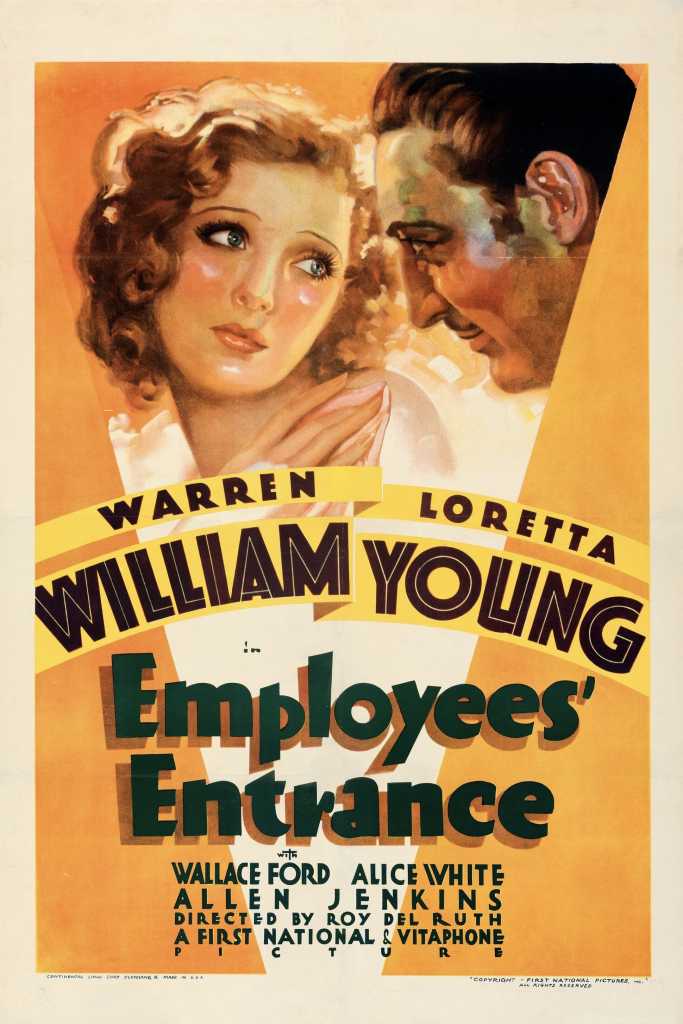
#643) Employees’ Entrance (1933)

#643) Employees’ Entrance (1933)

OR “Not My Department”

Directed by Roy Del Ruth

Written by Robert Presnell Sr. Based on a play by David Boehm.

Class of 2019 

The Plot: New York’s monumental Monroe department store is losing revenue as the Great Depression takes it toll. Kurt Anderson (Warren William) is brought in as the store’s new general manager, and while Monroe makes its biggest profits in years, Anderson’s management style is ruthless; firing anyone who disagrees with him and using his female employees as sex objects. Anderson seduces young Madeline Walters (Loretta Young) and hires her as a dress model in the ladies’ department. Madeline begins a whirlwind romance with Martin West (Wallace Ford), Anderson’s promising young assistant, and the two marry in secret, not wanting Anderson to learn about their relationship for fear it will damage their careers. But of course Anderson finds out, and gets to work trying to break up the couple for his benefit. If you think you can guess the ending, remember this is pre-Code and guess again.

Why It Matters: The NFR calls the film “a superb pre-Production Code film” and “one of the studio’s best” features of the 1930s. Warren William’s “devastating” and “superb” performance is also highlighted.

But Does It Really?: We have a rarity: I don’t think I can justify having “Employees’ Entrance” on the NFR. Don’t get me wrong, I enjoyed the movie, but it lacks the unique standing I’m looking for on a list of culturally significant films. We’ve already got racy pre-Code movies on the list (see “Baby Face“) and plenty of films that encapsulate Depression-era living (see “Wild Boys of the Road“). “Employees’ Entrance” is one of your “TCM at 10am on a Wednesday” kinda movies; an enjoyable watch, but not ready for primetime. I can’t help but think that this slot could have gone to another movie.

Everybody Gets One: Roy Del Ruth started his career as a writer for Mack Sennett before pivoting to directing. He doesn’t have a lot of classics on the resume, but he did direct the first film adaptation of “The Maltese Falcon” a full decade before John Huston took a stab at it. Loretta Young started out in silent movies before successfully making the transition to sound, and was already an established ingenue at Warner Bros. when “Employee’s Entrance” came around. Young was 19 when she filmed this! She’s so…not old!

Wow, That’s Dated: First and foremost: department stores. If Monroe was still around today that building would be a multiplex, two escapes rooms and a Boba tea shop. Also dated, the profession of department store dress model. Had mannequins not been invented yet?

Seriously, Oscars?: No Oscar love for “Employees’ Entrance”. Warner Bros.’ major contenders that year were “42nd Street” and “I Am a Fugitive from a Chain Gang“.

Other notes 

  • Weirdly enough I can’t find anything about the original play “Employees’ Entrance” is based on. It never played Broadway, and there’s no record of it being performed anywhere. Any leads?
  • Warren William may be the most ’30s man who ever lived, with his slicked back hair, pencil mustache, and double-breasted suit. Also he looks and sounds like Christopher Plummer as John Barrymore.
  • I know this movie goes out of its way to make Anderson as unscrupulous as possible, but did you have to name him Kurt? A bit on the nose, don’t you think?
  • Madeline is living in the department store? When did this become “Evening Primrose”?
  • Tops on the list of this movie’s pre-Code insinuations: Anderson, seeing Polly; “Oh it’s you. I didn’t know you with all your clothes on.” Whoa.
  • This apparently was a comeback vehicle of sorts for Alice White, who had found success in the late ’20s as a flapper-type. With her short bob and unapologetic sex appeal, White’s Polly is like a live-action Betty Boop (and no I don’t mean Helen Kane). Sadly, shortly after this film’s release, Alice White was caught up in a public scandal involving her fiancé Sy Bartlett and former lover John Warburton, and her career never recovered.
  • I’m gonna go ahead and assume that Monroe doesn’t have an HR department. Either that or Anderson is the HR department, just moving over to another desk when people want to file a complaint.
  • Say what you will about Anderson, but instead of laying off a bunch of employees, he makes the executives (and himself) take a pay cut. The same could not necessarily be said for other organizations during COVID.
  • According to the characters in this movie, the word “employee” is pronounced “EM-ploy-YAY”, and “brassieres” is pronounced “BRAH-see-ERS”. Have I been saying them wrong this whole time?
  • Wait, Madeline and Martin are getting married? They met like 20 minutes ago. Also, I correctly called that the man playing the priest is a real priest and not an actor. The Rev. Dr. Neal Dodd was an L.A. based priest who played various ministers, reverends, and justices of the peace in dozens of Hollywood movies for over 30 years. He appears in at least three other NFR titles: “It Happened One Night“, “Mr. Smith Goes to Washington“, and “The Killers“.
  • I’m enjoying this movie’s comic interludes on the department floor. “Young lady, where’s the basement?” “On the 12th floor, madam.” Somebody in the Warner Bros. writing pool worked retail. Points deducted, however, for the cutaway involving a stereotypical Jewish customer who refuses to buy a pigskin football. They can’t all be winners.
  • Classic Movie Cliché #18: Drunks in a movie singing “Sweet Adeline” (we will also accept “How Dry I Am” as an alternate).
  • Here’s your big pre-Code moment: When Madeline is passed out at the party, Anderson closes the door, turns off the lights, and a fade to black implies everything that happens next. In case you can’t figure it out, Madeline says later she feels like “someone you pick up off the streets”.
  • [Spoilers] Wow this all escalated quickly. Warren William receives the 1933 Clark Gable prize for best reaction to being shot: “You can’t even shoot straight, can you?”
  • In addition to salacious dialogue throughout the film, “Employees’ Entrance” ends with another pre-Code staple: no punishment for the villain. You think Anderson is about to get his comeuppance and be voted out by the board, but at the last minute he’s saved, and does not grow or change from this experience. Adding insult to injury (or vice versa), the movie ends with him throwing an actual real-life dog into a wastebasket. That’s the worst offense of the whole movie!

Legacy 

  • “Employees’ Entrance” opened in August 1933…and I have no information on how it did. I assume as a B picture (released through the Warner Bros.’ subsidiary First National Pictures) it didn’t set the box office on fire. I know that it started airing on local TV stations in the mid-50s, so at least it has that going for it.
  • Roy Del Ruth continued to direct movies for the next 25 years. Among his later films were “Broadway Melody of 1938” (in which Judy Garland sings “(Dear Mr. Gable) You Made Me Love You”), and “The Babe Ruth Story”, a biopic so bad even Del Ruth didn’t like it.
  • Both this film’s screenwriter and original author would go on to receive Oscar nominations for their later screenplays: Robert Presnell Sr. for “Meet John Doe” and David Boehm for “A Guy Named Joe”.
  • Warren William continued his leading man streak throughout the 1930s (playing opposite Claudette Colbert in both “Imitation of Life” and “Cleopatra”) though he never matched his early ’30s run as “King of Pre-Code”. Fun Fact: William was the first actor to play Perry Mason, portraying the lawyer in four separate films.
  • The actor with the biggest post-“Employees’ Entrance” career was definitely Loretta Young. In the ensuing decades, Young became a big movie star, an Oscar winner for her performance in “The Farmer’s Daughter”, and eventually a TV star with the long-running “Loretta Young Show”.

#642) Scorpio Rising (1963)

#642) Scorpio Rising (1963)

OR “Look Back in Anger”

Directed by Kenneth Anger

Written by Ernest D. Glucksman

Class of 2022 

Ugh, no YouTube clip I embed here will show the thumbnail image (I keep getting the “Video unavailable” screen). You can watch the film on YouTube here.

The Plot: The avant-garde, occult influenced, homoerotic work of Kenneth Anger is on full display in “Scorpio Rising”. Set to an inspired playlist of ’60s hits, the film follows a biker named Scorpio (Bruce Byron) as he prepares for a night of racing and partying. It’s an experimental examination of the different groups society has deemed outsiders throughout history. Or maybe it’s a condemnation of hero worship. Or maybe Kenneth Anger just thought this guy was cute.

Why It Matters: The NFR gives a heap of superlatives to “Scorpio Rising”, calling it “one of the key works in Avant-Garde/Experimental cinema” and “a one-of-kind, rapid-fire exploration and juxtaposition of symbolism”.

But Does It Really?: Oh sure. “Scorpio Rising” is a great representation of the late legend Kenneth Anger. I would go so far as to say that “Scorpio Rising” is a better representation on this list for Anger than his previously inducted film: 1953’s “Eaux d’Artifice“. While “Eaux” has all the markings of an early experimental film (and is one of those “Staring at Water” movies the NFR loves for some reason), it lacks the hallmarks of Anger’s other films; the surreal blend of pop culture and his own sexuality that he is known for. “Scorpio Rising” fits the bill, and is a testament to one of filmdom’s first openly gay creators.

Shout Outs: I’m pretty sure James Dean’s photo on Scorpio’s wall is from “Rebel Without a Cause“. We also get a very brief shot of a Bela Lugosi-looking vampire.

Everybody Gets One: Richard MacAulay was a biker in Greenwich Village who went by the name Bruce Byron (a tribute to James Dean, whose middle name was Byron). A chance encounter with Kenneth Anger in Times Square led to him appearing in “Scorpio Rising”. Much of the character of Scorpio is taken from Byron’s real life: His Greenwich Village apartment was used for filming, and the photos of James Dean on the wall were really his (as is the Dishonorable Discharge from the Marines). The character’s name came from Byron’s astrological sign, as well as the scorpion amulet he always carried with him. When the film was released, Byron would occasionally show up at theaters to greet audiences.

Title Track: The title “Scorpio Rising” is written in metal studs on the back of a leather jacket. That tells you exactly what kind of movie you are in for.

Seriously, Oscars?: What? No Oscar nomination for “Scorpio Rising”? I’m shocked! (Can you sense the sarcasm?) For the record: 1963’s Live Action Short winner was Robert Enrico’s “An Occurrence at Owl Creek Bridge“, which would go on to be re-edited and aired as one of the final episodes of…”The Twilight Zone”.

Other notes 

  • Part One of this film (known as “Boys & Bolts”) feels like the film adaptation of “Zen and the Art of Motorcycle Maintenance”. At one point I though the whole movie was just going to be this guy fixing his bike. What is this, “Andy Warhol’s Garage”?
  • Longtime readers know I’m a sucker for a good soundtrack, and “Scorpio Rising” is no exception, with each track masterfully chosen to either comment on or subvert the film’s imagery. In order for “Scorpio” to compete at film festivals without getting pulled for copyright infringement, Anger paid for the clearance rights of each song, which cost about $8000 (about $80,000 today), roughly the same amount it cost to make the film!
  • At one point we hear Bobby Vinton’s rendition of “Blue Velvet”, which reminds me: When is David Lynch’s “Blue Velvet” gonna make the NFR? I remembered to submit it for consideration this year, so hopefully that helps.
  • In Part Two (“Image Maker”) Scorpio is watching a TV airing of “The Wild One”, another movie I’m surprised isn’t on the NFR yet. It’s always odd when an independent film makes the NFR before the more iconic film it’s referencing does. Apparently, “Wild One” just happened to be playing on TV when Anger was filming in Byron’s apartment, but as with any piece of Kenneth Anger trivia I will take that with a grain of salt.
  • Looks like Scorpio picked the wrong week to keep snorting methamphetamines.
  • Anger starts laying on the symbolism pretty thick with shots of Scorpio juxtaposed with clips of Jesus from the ’50s educational film series “The Living Bible”. These images appear while The Crystals’ “He’s a Rebel” plays on the soundtrack. You know, Jesus was something of a rebel himself. Shoutout to Nelson Leigh, the actor playing Jesus in the clips from “Living Bible”. Leigh plays bit parts in fellow NFR films “Lassie Come Home“, “Imitation of Life“, and the aforementioned “Rebel Without a Cause”.
  • And now the great “Art vs. Porn” debate. During the “Living Bible” clip when a blind man kneels before Jesus, Kenneth Anger interjects a blink-and-you’ll-miss-it shot of someone’s penis. This, combined with some of the more overt physical acts at the party led to the film’s obscenity charges (more about those in “Legacy”). Now I’m no expert (I tend to fall on the “I know it when I see it” side of things), but all of the sexual acts in this movie happen so quickly you’d have to really be paying attention in order to find it titillating. But that’s just me; you do you.
  • Speaking of, I assume the debauchery in Part Three (“Walpurgis Party”) is what hard-core conservatives think happen at all liberal parties. Well we used to party like that, but then COVID hit. Safety first, you know.
  • Of course this kind of homoerotic imagery was ahead of its time in 1963, but I got to wondering if it was even too much for the NFR team of 1993, the year “Eaux d’Artifice” was inducted. I wouldn’t be surprised if there was an agreement among the Film Preservation Board that Kenneth Anger should be on the Registry, but that a film like “Scorpio” was too extreme for a list that included the likes of “An American in Paris“. If there’s any gay subject matter in “Eaux”, it’s so subtle that I definitely missed it.
  • Okay I get it, he’s like Jesus! Stop it! I think Anger’s going for a “Let he without sin cast the first stone” deal. Or maybe “Don’t knock it ’till you’ve tried it.”
  • Wait, are the bikers Hitler now? Anger starts using photos of Hitler as well as Jesus in Part Four (“Rebel Rouser”) when the bikers start racing each other. Is this commentary on the danger of hero worship? Also during this part they cut to a shot of a checkers set with swastikas on all the pieces. I definitely did not have “Nazi Checkers” on my list of things to watch for in an NFR film.
  • Another classic film repurposed by Anger: 1935’s “A Midsummer Night’s Dream”. Mickey Rooney’s Puck makes a quick appearance, a reference to Anger’s production company Puck Film, as well as Anger’s claim that he played the changeling child in the film (a claim repeatedly debunked over the years).
  • The closing shots of a solitary police beacon light flashing in the dark looks like the opening of “Police Squad!” (In Color).
  • That was awesome. Thanks, Kenneth.

Legacy 

  • “Scorpio Rising” premiered in October 1963 at the Gramercy Arts Theater in New York City, and shortly afterwards ran at the legendary Bleecker Street Cinema in Greenwich Village, where it became a popular attraction. The controversy with “Scorpio” began almost immediately when the film was pulled from theaters following a public obscenity charge. Cinema Theater manager Mike Getz was convicted for showing the film, but the case was appealed by the California Supreme Court, creating a precedent for seemingly “pornographic” films containing “redeeming social merit”.
  • Speaking of lawsuits, we have perhaps the funniest bit of trivia I’ve ever read while researching a blog post. In 1964, the American Nazi Party sued Kenneth Anger for defamation because of his use of their flag in “Scorpio Rising”. That story again: The American Nazi Party sued someone for damaging their reputation. Riiiiiight. I can’t find the results of that lawsuit, but I assume the judge’s verdict was several minutes of unbridled laughter.
  • Among the filmmakers who have cited “Scorpio Rising” as an influence are John Waters and Martin Scorsese. You can definitely see the Anger influence on these two: Waters with his subverted look at ’50s pop culture, and Scorsese with his choice needle drops.
  • Kenneth Anger continued making films for the next 45 years, his last being 2010’s “Missoni”. And while he wrote “Hollywood Babylon III” around the same time, the book was never published due to its chapter criticizing the Church of Scientology. Anger passed away earlier this month at the age of 96. And I’m sure wherever he is right now, he’s cursing all of us.

Listen to This: None of the songs in this film have been inducted into the National Recording Registry, though some of their performers have (Elvis, Ray Charles, Martha & the Vandellas, etc.). That means the NRR currently lacks such classics as “Blue Velvet”, “Hit the Road Jack”, “(Love Is Like a) Heat Wave”, “I Will Follow Him”, and “Wipeout”. Now available on two CDs or two cassettes!

#641) Pink Flamingos (1972)

#641) Pink Flamingos (1972)

OR “Divine Intervention”

Directed & Written by John Waters

Class of 2021

The Plot: Divine, alias “Babs Johnson” (Divine), is a criminal living a quiet life in a trailer outside Phoenix, Maryland with her family. She also holds the title of “the filthiest person alive”, which infuriates her rival Connie Marble (Mink Stole), who intends to claim the title for herself. I refuse to go into any further detail of what everyone in this movie does to out-filth each other, suffice it to say that this movie earns its NC-17 rating, and you’ll never look at your dog the same way again.

Why It Matters: The NFR calls the film a “delirious fantasia” and “a landmark in queer cinema”. John Waters is hailed as “Baltimore’s favorite son”.

But Does It Really?: Ah yes, the “Be Careful What You Wish For” movie. For years it surprised me that John Waters wasn’t represented on the National Film Registry, and “Pink Flamingos” seemed the natural choice. So I would nominate “Pink Flamingos”, never once considering that if it made the list I would have to actually watch it. This was – without a doubt – the most difficult viewing experience I’ve ever had for this blog. “Pink Flamingos” is filthy, disturbing, grotesque, obscene…and one of the most culturally significant movies on this list. At a time when American film was just starting to experiment with far how it could push the envelope, John Waters set the envelope on fire, and in the process brought new notoriety to underground filmmaking. In the hands of a lesser director, “Pink Flamingos” would be unwatchable smut, but with Waters’ deft, borderline voyeuristic direction, “Pink Flamingos” is the most entertaining unwatchable smut you’ve ever seen. John Waters is an icon of queer and cult filmdom, and having “Pink Flamingos” on the NFR is overdue and well deserved. Now let us never speak of this again.

Everybody Gets One: John Waters was born and raised in the Baltimore suburb of Lutherville, and among his early cinematic influences were “The Wizard of Oz“, “Lili”, the experimental films of Andy Warhol and Kenneth Anger, and a healthy dose of “tacky” films at his local drive-in. “Pink Flamingos” was Waters’ third feature-length film, shot in and around Baltimore in late 1971. Waters’ parents Patricia and John Sr. funded “Pink Flamingos”, and while they were proud of their son’s achievements, they chose never to watch the final film.

Wow, That’s Dated: There are several references to the Manson Family throughout the film, including in the opening dedication. Waters cited the Manson Family (and the media coverage surrounding their murder trial) as an inspiration for “Pink Flamingos”, though he had intended for these allusions to be “a sarcastic nod”, and ultimately regretted their inclusion.

Title Track: The pink flamingos of the title are the plastic ones outside Divine’s trailer. John Waters named the film “Pink Flamingos” because he wanted a “normal” title to counter the film’s outrageousness.

Seriously, Oscars?: Surprising no one, “Pink Flamingos” received zero Oscar nominations. More surprising, however: John Waters has never been nominated. How about an honorary Oscar, Academy?

As I previously mentioned, “Pink Flamingos” was a tough watch for me, and with all due respect to Mr. Waters, I don’t have the stomach to go more in-depth about the film’s subject matter. In lieu of my typical Other notes section, I’m just going to transcribe verbatim my notes from this film.

  • This is already the weirdest movie.
  • Wow, the C word! Twice!
  • Oh dear god.
  • Oh! Okay then.
  • I don’t know if I can do this.
  • Oh God!
  • Oh Jesus!
  • [Weirded-out noises]
  • Wow.
  • Is he-? Oh he is.
  • Gah!
  • Oh no. Oh nooooo.
  • Aaaaaaaah!
  • Eeeeewwww
  • Good soundtrack though.

Legacy 

  • “Pink Flamingos” premiered at the Baltimore Film Festival in March 1972 before its official New York premiere in February 1973. Critics were mixed about the film, and even the ones who enjoyed it admitted the film is “for the very open-minded.” “Pink Flamingos” found success as one of the first “midnight movies”, playing in New York and Los Angeles for years. By 1980 the film had made more than 500 times its budget at the box office.
  • John Waters’ subsequent filmography includes “Polyester”, “Cry-Baby”, and fellow NFR entry “Hairspray”. My personal favorite is “Serial Mom” with arguably Kathleen Turner’s best film performance.
  • Although Waters hasn’t helmed a film since 2004’s “A Dirty Shame”, he continues to make appearances in documentaries (including “These Amazing Shadows“) and cameos in various movies and TV shows. Like most of my generation, I was introduced to John Waters via his charming performance on “The Simpsons”. “This is a sordid little burg, isn’t it? Makes me sick in a wonderful, wonderful way.”

#640) The Little Mermaid (1989)

Is that the original theatrical poster or are you just happy to see me?

#640) The Little Mermaid (1989)

OR “Fish Outta Water”

Directed & Written by John Musker and Ron Clements. Based on the fairy tale by Hans Christian Andersen. Song score by Howard Ashman and Alan Menken.

Class of 2022

The Plot: Ariel (voice by Jodi Benson) is a teenage mermaid with a fascination for the human world, much to the frustration of her strict father King Triton (voice by Kenneth Mars). When Ariel goes up to the surface, she is immediately smitten with the human Prince Eric (voice by Christopher Daniel Barnes). Desperate to see him again, she makes a deal with the sea witch Ursula (voice by Pat Carroll) to become human temporarily in exchange for her voice. With only three days to get Eric to fall in love with her, will Ariel live happily ever after? Or will she sacrifice her life and turn into sea foam like in the original fairy tale? Seeing as how this is the Disney version, probably not the latter.

Why It Matters: The NFR calls it “an animated film for the ages”, highlighting the score and the “fantastic array of voice artists”. There’s also a quote from Jodi Benson stating that she is “thrilled and honored” that “our very special film” has made the Registry.

But Does It Really?: I’ve nominated “The Little Mermaid” on my NFR ballot several times over the years, so you’ll get no argument from me. “The Little Mermaid” is the end of one era in Disney animation and the beginning of the next. “Beauty and the Beast” is still the grand-slam of Disney Renaissance musicals, but “Little Mermaid” loaded the bases. With its sweet, simple story, great performances, and catchy songs, “The Little Mermaid” brought classic Disney animation to a new generation, and has continued to endure.

Everybody Gets One: John Musker and Ron Clements met while working as animators on “The Fox and the Hound”. Through a series of shuffling following the arrival of Michael Eisner, Frank Wells, and Jeffrey Katzenberg in 1984, Musker and Clements found themselves co-directing “Basil of Baker Street” (later renamed “The Great Mouse Detective”) and a creative partnership was born. During production of “Great Mouse Detective”, Clements pitched an animated “Little Mermaid” after finding a book of Hans Christian Andersen fairy tales in a bookstore. Katzenberg rejected this pitch, citing similarities with “Splash” and its upcoming TV sequel “Splash, Too”, though he changed his mind the next day, with a warning that a “girl’s film” wouldn’t be a box office success.

Seriously, Oscars?: One of Disney’s biggest hits of the decade, “The Little Mermaid” was nominated for three Oscars, winning two. Alan Menken won Best Original Score, and Menken and Ashman picked up Best Song for “Under the Sea” (with “Kiss the Girl” also nominated). “The Little Mermaid” was the first Disney film since 1971’s “Bedknobs and Broomsticks” to win an Oscar (not counting Touchstone films “The Color of Money” and “Who Framed Roger Rabbit“).

Other notes 

  • In the late 1930s, Walt Disney was in talks with Samuel Goldwyn to animate a series of shorts based on Hans Christian Andersen stories – including “The Little Mermaid”- but the project fell through (Goldwyn would eventually produce an all live-action Hans Christian Andersen film in 1952). While Clements and Musker were working on their version of “The Little Mermaid” in the ’80s, they found concept art for the ’30s version by artist Kay Nielsen, who would be posthumously credited in the final film as a Visual Development Artist. They also found transcripts of Walt’s story meetings, where he had coincidentally made the same modifications to the story as Musker and Clements had.
  • “The Little Mermaid” holds the distinction as the final Disney animated film to feature hand-painted characters and backgrounds, and the last one to use xerography to transpose the artists’ drawings directly onto the cels. These techniques were replaced by the computer system CAPS, created by the relatively unknown Pixar company. This traditional hand-painted look is one of the film’s appeals for me. A viewing on an HD screen reveals the animation as not fully polished; character details disappear when they’re in the background, lip movement doesn’t fully match the dialogue, etc., but it gives the whole film a human touch. I also love that the film is still very cartoony. Disney always strives for realism, but it’s nice to see Sebastian and Flounder with bugged-out eyes and jaws dropping to the floor.
  • This film’s other major contribution is the songwriting team of Howard Ashman and Alan Menken. Ashman had been brought on to write a song for “Oliver & Company” and stuck around to work on “Mermaid”, enlisting the help of his “Little Shop of Horrors” co-writer Menken. Previous Disney films had their songs penned either by in-house composers or writers from Tin Pan Alley; Ashman and Menken brought a musical theater sensibility to “Little Mermaid”, imbuing each song with character and story development. This has since become the norm for animated musicals.
  • I feel for Flounder in that opening sequence, I was something of a guppy myself at that age (and for several subsequent ages). Fun Fact: Flounder’s voice actor Jason Marin is also Farmer Peabody’s son in “Back to the Future” (“It’s already mutated into human form! Shoot it!”)
  • Comedian Leonard “Buddy” Hackett gives an endearingly funny performance as Scuttle, the only seagull with a Brooklyn accent. This is Hackett’s second NFR appearance, and as long as I’m still cranking out posts I will lobby to a get a third Buddy Hackett film on this list.
  • This movies loves sea puns: “You give them an inch, they swim all over you.” “Look what the catfish dragged in.” etc. It’s just the right amount without reaching a “Shark Tale”-level of annoyance.
  • Despite Ashman and Menken’s contributions to film musicals, it takes 15 minutes before we get “Part of Your World”, the movie’s first real song (no offense to “Fathoms Below” and “Daughters of Triton”). Like “Over the Rainbow” before it, “Part of Your World” is a quintessential “I Want” song that almost got cut before cooler heads prevailed. Shoutout to Jodi Benson, singing her heart out with the perfect balance of teenage yearning and Broadway belting.
  • As great as “Part of Your World” is, it’s the reprise that features arguably the film’s most iconic shot of the waves splashing against the rock Ariel is leaning on as she hits the climactic final note. Not since “Vertigo” has there been such perfectly timed waves. Plus, it’s a fun nod to the Little Mermaid statue in Copenhagen honoring Hans Christian Andersen.
  • There really isn’t a weak link in this voice cast. In addition to everyone mentioned so far, you got Samuel E. Wright bringing a fun little character arc to Sebastian the crab, and old pros like Kenneth Mars, Ben Wright, and René Auberjonois giving fully committed performances. Plus, this is a reminder that Christopher Daniel Barnes (the voice of Prince Eric) would go on to play Greg Brady in the ’90s “Brady Bunch” movies. Groovy.
  • “Under the Sea” is the most fun number in the movie, with maybe the flimsiest connection to the story (Sebastian sings it to distract Ariel from thinking about Eric? Good luck with that.) While we’re on the subject: Am I allowed to still sing this song? It’s hard not to sing along without emulating Sebastian’s Trinidadian accent, and surely that doesn’t fly nowadays. Side note: Also making their only NFR appearance during this number: The Incredible Mr. Limpet!
  • It was not until researching this post that I learned Ursula’s collection of souls are supposed to be polyps, which longtime readers may remember have quite an interesting sex life.
  • And now the Pat Carroll gush-fest portion of this post. Ms. Carroll only has a handful of films on the resume (she was primarily a TV and theater performer), but boy does she make this one count. Original choices Bea Arthur and Elaine Stritch would have been great, but I suspect their inherent wryness wouldn’t measure up to the glorified camp Carroll brings to the part (she described her performance as a cross between Tallulah Bankhead and Maurice Evans). Shoutout to Ursula’s supervising animator Ruben Aquino, matching Carroll’s vocal performance with some knockout animation, as well as Divine, John Waters’ muse who served as inspiration for Ursula’s look and movement.
  • “Oh, Prince Eric’s very popular, Ed. They think he’s a righteous dude.“
  • “Kiss the Girl” enters the “Summer Lovin’” realm of catchy songs with questionable lyrics. In recent years “Kiss the Girl” has sparked conversations about non-verbal consent (as has the film’s whole storyline about a woman changing herself to attract a man). Sure there’s a part of me that wants to just say “it’s a fairy tale” and shrug it off, but that’s admittedly a privileged opinion for me to have. I don’t have kids, but I recognize the importance of parents talking to their kids about the media they consume and the influence it may have, especially if that media is a nostalgic part of their own childhood that may not hold up as well as they remember it.
  • Wow, Ursula just called Ariel “the little tramp!” and I don’t think she means Chaplin. Yeah, definitely talk to your kids before letting them see this movie.
  • It’s his knee. Moving on.
  • The film’s finale is not without its issues. For starters, I’m always put off by things that become bigger than they should (be it Mega-Ursula or the career of Pete Davidson). But my main beef with the finale is that aside from a brief moment where Ariel saves Eric, Ariel is pretty passive during all of this. It’s Eric that kills the villain and saves the day while Ariel just flops around. No wonder the ride at California Adventure skips through this part.

Legacy 

  • “The Little Mermaid” premiered in November 1989, and was an immediate hit. Critics hailed it as a return to form for Disney, and the film quickly became the highest-grossing animated film of all time. The success of “The Little Mermaid” launched what became known as The Disney Renaissance, and the many Disney animated musicals of the ’90s that still live rent-free in your head.
  • John Musker & Ron Clements’ follow-up film was another hit of the Disney Renaissance: “Aladdin”. Subsequent Musker/Clements collaborations were “Hercules”, “Treasure Planet” (a passion project for Clements), “The Princess and the Frog”, and “Moana”.
  • When you’re as big a hit as “The Little Mermaid”, there’s no escaping the Disney Synergy Machine. In addition to the countless toys and merch spawned by the film, “The Little Mermaid” received a Saturday morning TV series, a direct-to-video sequel, a direct-to-video prequel, a Broadway stage adaptation, and several theme park attractions.
  • Disney’s latest trend of live-action remakes continues with a “Little Mermaid” rehash coming out later this month. Look, we all know it’s not going to be as good as the original (it’s 52 minutes longer for god sake!) but can we all agree here and now to leave Halle Bailey alone? She is clearly a very talented individual, and any problems you may have with the movie aren’t going to be her fault. So do us all a favor: take your dog-whistle racism and fuck off.

Further Viewing: I’m always fascinated by adaptations of fairy tales that predate the Disney version. “The Little Mermaid” has a few that skew closer to the original fairy tale, and I’m partial to two TV adaptations: A 1961 episode of “Shirley Temple’s Storybook” and a 1987 episode of “Faerie Tale Theatre” starring Pam Dawber!