#751) Heroes All (1920)

#751) Heroes All (1920)

OR “A Red Cross to Bear”

Produced by the Red Cross Bureau of Pictures

Class of 2009

Funny story: Thanks to Ken Schenk I learned that “Heroes All” is available for viewing through the National Archives if you email the Archives and request a digital copy. I emailed the Archives, filled out the request form, got the link to download the file, e-signed an agreement that I wouldn’t share the link with anyone, and watched “Heroes All” with no problems. TWO DAYS LATER the film was uploaded for viewing on the National Archives website. Watch it here with significantly less red tape than I did.

The Plot: “Heroes All” is a salute to not only the heroes who fought during World War I, but also the heroes at the American Red Cross who are helping our veterans upon their return home. Our film follows a group of veterans as they are treated at the Walter Reed Hospital in Washington D.C., where Red Cross volunteers help treat their injuries alongside the Walter Reed staff. Many of our veterans stay at the Red Cross Convalescent House at Walter Reed, where they are further rehabilitated through lodging, vocational courses, and outings to various D.C. landmarks. It’s a patriotic, maybe too upbeat look at how we took care of our veterans over a century ago, brought to you by the short-lived film branch of the American Red Cross.

Why It Matters: The NFR calls “Heroes All”, as well as the many other films produced by Red Cross at the time, “invaluable historical and visual records of the era.” An essay by Gerry Veeder, Ph.D. is a recap of both “Heroes All” and the Red Cross Bureau of Pictures.

But Does It Really?: While I have a few qualms with this movie (we’ll get to those later), “Heroes All” does what any good NFR film does; it represents a specific time and place for this country, shining a light on both our war veterans and our Red Cross volunteers. If nothing else, “Heroes All” gave me an excuse to research institutions like the Red Cross and Walter Reed that I’ve heard of all my life but know nothing about. A pass for the NFR induction of “Heroes All”; I’m just glad it’s finally online after all these years.

Everybody Gets One: The first chapter of the American Red Cross opened in 1881 in New York. Co-founder Clara Barton had witnessed the relief aid that the International Red Cross was providing during the Franco-Prussian War and wanted to bring that type of organization stateside. In its first 40 years, the American Red Cross offered aid to such events as the Johnstown flood, the Spanish-American war, the Titanic sinking, the 1918 flu pandemic, and of course World War I. Following America’s entrance into the Great War in 1917, the Red Cross set up their own Bureau of Pictures to create films that could be used as promotional and/or fundraising tools. In the next four years, the Red Cross made over 100 short films, some filmed abroad, and some like “Heroes All” filmed in one of their own chapters.

Wow, That’s Dated: Primarily the evolution of medical practices in the last century, as well as how we treat our veterans. It is interesting, however, to watch something that treats WWI as a singular occurrence; a sort of “Glad that’s over, let’s get back to normal” sort of thing. I can’t quite articulate it, but the advance knowledge of a second world war makes this film seem weirdly tone-deaf in hindsight.

Other notes

  • IMDb lists an Anthony Young as the director and writer of “Heroes All”, but I can’t find anything to back that up (he is not mentioned in either the NFR write-up or the corresponding Veeder essay). More likely he is the director of an unrelated 1931 film also called “Heroes All” that tends to get conflated with the 1920 “Heroes All”. Given the lack of reliable information on either film, we may never know for sure.
  • Shoutout to the real-life Walter Reed, a U.S. Army physician who proved in the early 1900s that yellow fever was spread by a species of mosquito and not, as previously believed, by direct contact. Walter Reed Hospital is one of many posthumous honors Reed has received, including the Walter Reed medal, and the 1938 movie “Yellow Jack” starring Lewis Stone as Reed.
  • Right off the bat this film is giving off an uber-patriotism vibe, with shots of the Capital and reference to “every soldier who follows the American flag” receiving medical treatment. This must be what the US Army was hoping John Huston would give them with “Let There Be Light”. This patriotic approach continues throughout, and honestly, I think the only thing keeping this movie watchable is its lack of sound. If “Heroes All” had a soundtrack with a flag-waving narrator and “My Country, ‘Tis of Thee” in the background I would have gone nuts.
  • Today in old timey phrases that sound dirty but aren’t: “Yankee pluck”. Back then it meant American ingenuity, today it would cost extra.
  • Among the rehabilitation efforts at the Red Cross Convalescent House are shots of our veterans playing with a parrot and a monkey. I’m no doctor, but how do they help with rehabilitation? If you’re going to have animals around for therapeutical services, what about animals that won’t peck your eyes out or fling their poo at you? Just saying. I do love that this is immediately followed by a shot of our veterans sitting around a roaring fireplace, unintentionally implying what became of the animals.
  • Everything being done for these veterans is commendable, but “Heroes All” makes the Red Cross House look like a summer camp. Of course, recreational activities like swimming are a vital part of rehabilitation, but what about their PTSD? Is anyone doing anything about that? Obviously, we know so much more about PTSD now than we did in 1920, but its absence here makes the final film feel…off. 
  • Speaking of summer camp, it’s field trip time! Our veterans visit the Lincoln Memorial, Arlington National Cemetery, and basically everything I didn’t see on my D.C. trip a few years back. Another stop on the tour is B.F. Keith’s Theatre, one of many vaudeville houses that was about a decade away from converting into a movie theater. Fun Fact: B.F. Keith was the K in RKO.
  • Among the vocational courses offered by the Red Cross to veterans who can’t go on the field trips: Woodworking, basket weaving, clay modeling, and yes, even filmmaking! In a brief shot, the veterans are shown the correct speed to hand crank a movie camera, which as I learned from the “Hollywood” documentary series is the same tempo as the “Anvil Chorus” from Verdi’s “il Trovatore”. I know that has nothing to do with anything we’re talking about, but there’s only so much I can say about this film’s rehabilitation practices. And hey, this is a film blog, so that information isn’t entirely off-topic.
  • Another one of the “weekly excursions” is to a baseball game between the Washington Nationals and the Cleveland…sorry I can’t quite make out that team name. They even meet Cleveland’s manager and center fielder Tris Speaker, as well as the Nationals’ manager Clark Griffith (misspelled “Griffiths” in the intertitle). Side note: The present-day Washington Nationals are an unrelated team (they were the Montreal Expos until 2005). The Nationals depicted here moved to Minneapolis in the 1960s and are now the Minnesota Twins.
  • I agree with the Veeder essay that this film’s treatment of paraplegics is uncomfortable. The loss of one or multiple limbs from the war is depicted here as a temporary inconvenience, with prosthetics being used as a catch-all solution. I know we’ve only got 10 minutes and this film is a promotional tool, but this is an infinitely more complex situation that deserves more attention. And while we’re on the subject of paraplegics and amputees, do you have to make them race each other? I just watched these guys compete in both a wheelchair race and a one-legged race! I’m sure it was intended as equitable, but it comes across as cruel and unusual.
  • The film concludes with one of our veterans receiving the Distinguished Service Cross presented by Colonel James D. Glennan, a senior officer in the Medical Corps. And just in case you haven’t figured it out yet, we end with the waving American flag and a brief shot of the Statue of Liberty. Cue “The Star-Spangled Banner” and play ball!

Legacy

  • After WWI ended and public interest in war-related humanitarian efforts waned, so did the Red Cross’s desire to make films, and their Bureau of Pictures was dissolved in 1921.
  • Walter Reed Hospital continued to expand and evolve over the next 90 years until it relocated in 2011 to its current location in Bethesda, Maryland. The former Walter Reed Hospital is now called The Parks at Walter Reed and is part of an ongoing redevelopment of that land by Washington D.C. into commercial and residential areas. I’m not sure of the timeline, but the Red Cross Convalescent Home was demolished at some point; most likely before the 2011 relocation.
  • The American Red Cross is still around and offering countless humanitarian services, including its famous blood donor program which started in 1948. Among the Red Cross’ recent efforts was helping support victims of the L.A. wildfires. Check them out and support their work.

Thank you, Dr. Hayden

Over the last few months I’ve spent a lot of time quietly worrying about the future of the NFR under the Trump administration (among other concerns, the National Film Preservation Act is up for renewal next year). As I’ve struggled to remain optimistic that the NFR would just fly under the radar as it did during the first Trump term, I woke up this morning to some disheartening news. Last night Librarian of Congress Carla Hayden was fired via email from the White House’s Presidential Personnel Office on behalf of Trump. No explanation was given.

As easy as it would be for me to turn this into a catastrophizing post about what this means for the future (or expounding on what a cowardly move it is to fire someone via email on a Thursday night), I am choosing instead to focus on Dr. Hayden’s positive contributions to the Library of Congress. After a 40-plus year run serving libraries in Chicago and Baltimore, Hayden was nominated by Barack Obama to become Librarian of Congress in February 2016. With her official confirmation that July (and subsequent swearing in that September), Carla Hayden became the first woman and first African-American to serve as the Librarian of Congress. During her nine years as Librarian, Dr. Hayden focused on making the Library of Congress’ content more accessible to the public, particularly to underrepresented groups. Part of this accessibility outreach was making more of the Library available online, as well as expanding the Library’s social media presence. It was through the latter that we got that time Lizzo played James Madison’s crystal flute. Remember that? That was awesome.

But of course, I am eternally grateful to Carla Hayden’s input selecting films for the National Film Registry. Her first group of inductees in December 2016 was filled with so many iconic films that it inspired me to start this blog (“The Breakfast Club“! “The Lion King“! “Paris Is Burning!“). Her subsequent selections have been a healthy balance of perennial crowd-pleasers, long-lost actualities, and underrated gems. In addition to all the films I’ve gotten to revisit thanks to Dr. Hayden’s selections, I’ve also had the pleasure of discovering such films as “Eve’s Bayou“, “Pariah“, “Wanda“, “She’s Gotta Have It“, “Time and Dreams“, “Boys Don’t Cry“, “¡Alambrista!“, “Love & Basketball“, and many many more. And thanks to her, we live in a world where “Pink Flamingos” is on a government-sanctioned movie list.

Whatever Carla Hayden plans on doing next, I know it will be in the service of promoting our national heritage, lifelong learning, diverse voices, and so many other things this administration seems determined to purge. I thank Dr. Hayden for giving the Library of Congress what I call “the campsite treatment”; she left it better than how she found it.

The NFR Class of 1999: Livin’ la Vida Loca

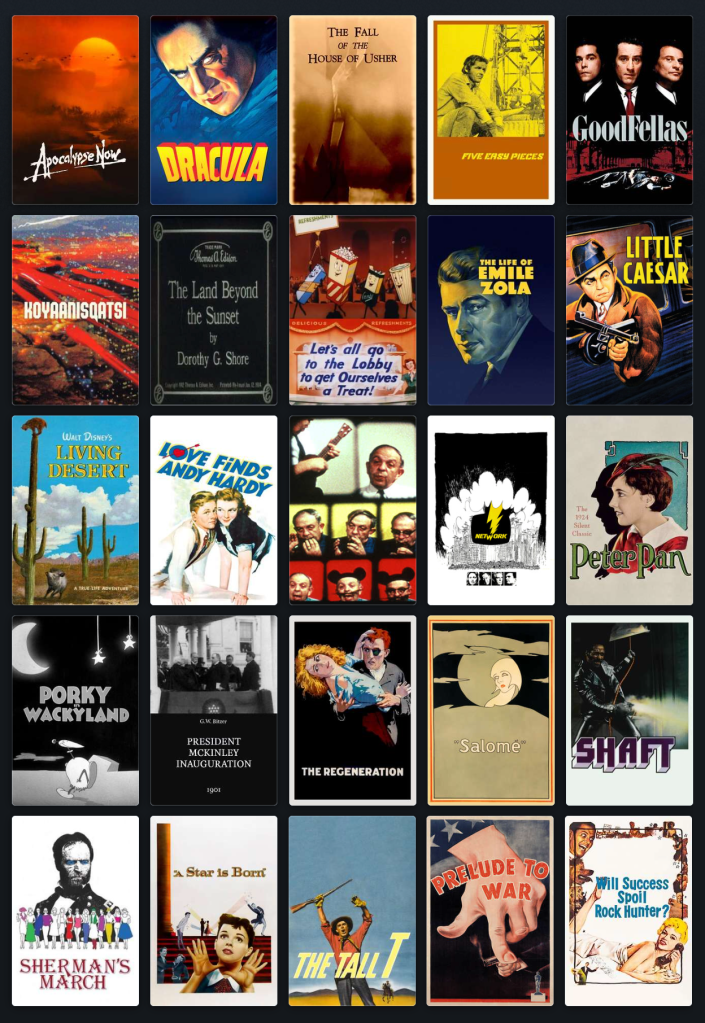
November 16th, 1999: Before everything shuts down for Y2K, it’s time to add more movies to the NFR. Here’s the 1999 roster that brought the National Film Registry to a total of 275 films, plus a pull-quote or two from my write-ups:

Other notes

  • The Class of 1999 is a slight improvement over the Class of 1998; still a lot of second-tier movies on here for what they represent, but also plenty of iconic no-brainers. We also have a continued dedication by the NFR to include non-narrative features, with a variety of documentaries and shorts. And while diversity was never a major factor in the first decade or so of the NFR’s existence, we do get the first Spike Lee film on the list; only the second film to make the NFR immediately upon hitting its 10-year eligibility after “Raging Bull”.
  • Also interesting, many of these 25 films have some sort of major romantic element to them, or at least center around a couple with some tension between them. What does that say about that year’s National Film Preservation Board?
  • One interesting thing mentioned by Dr. James Billington in his 1999 announcement is a “Candidates for the National Film Registry” screening series at the Library of Congress. While I couldn’t find a full list of movies in this series, I found a schedule for Summer 1999, which included future inductees “Raiders of the Lost Ark” and “Do the Right Thing”. Also noteworthy are several titles screened that still haven’t made the NFR over 25 years later, including “The Smiling Lieutenant”,  “Written on the Wind”, and “Paris, Texas”. I know this will never happen, but I would love to find out which NFR-less movies have been in the running over the years, or at the very least which one holds the Peter O’Toole/Glenn Close record for most nominations without induction.
  • When the class of 1999 was announced, the Denzel Washington/Angelina Jolie thriller “The Bone Collector” was number one at the US box office. “Fight Club”, “Being John Malkovich”, and “The Sixth Sense” were also playing in theaters, as were future NFR entries “Boys Don’t Cry” and “Buena Vista Social Club”.
  • Among this year’s double dippers: Actors Judith Anderson, Ruby Dee, Albert Dekker, Charlton Heston, Strother Martin, and Vincent Price, producer/director Joseph L. Mankiewicz, director George Stevens, cinematographer Joseph H. August, visual effects artist John P. Fulton, and Classic Hollywood mainstays Cedric Gibbons and Edith Head.
  • Thematic double-dippers: kisses (both “deadly” and “non-deadly”), exotic locales, “cast of thousands” epics, the year 1936, love interests who initially dislike each other, detectives hooking up with suspects, divine intervention, non-professional filmmakers, watershed moments of violence, Depression-era politics, and the Ten Commandments (think about it…). We also get two entries this year with the Wilhelm scream.
  • Favorites of My Own Subtitles: At Faith Value, I Can’t Believe It’s Not Butler!, Love at First Draft, Veni Vidi Vespa, Moses Proposes, Brains Supreme, The Dirty Half-Dozen, and Long Day’s Heat Wave Into Night.
  • Oh man, now I got “Livin’ la Vida Loca” stuck in my head and I have no one to blame but myself. I’m also having a weird case of déjà vu

And with that, I have watched every film inducted into the NFR in the 20th century. Well…technically the 20th century ended on January 1st, 2001, so I guess I have a few more movies to go. Whatever, I’m celebrating now. Thanks for reading; see you next week!

Happy Viewing,
Tony

#750) The Wild Bunch (1969)

#750) The Wild Bunch (1969)

OR “The Dirty Half-Dozen”

Directed by Sam Peckinpah

Written by Peckinpah and Walon Green. Story by Green and Roy N. Sickner.

Class of 1999

The Plot: On the Tex-Mex border in 1913, a group of aging outlaws led by Pike Bishop (William Holden) pull one last job robbing a railroad payroll office. After a violent showdown, Pike and his surviving men (Ernest Borgnine, Warren Oates, Ben Johnson, Jaime Sánchez) return to their hideout, only to learn the robbery was a set-up and that the “silver” they stole are worthless washers. Needing one more job to retire, the bunch, along with the crotchety Freddie Sykes (Edmond O’Brien) head to Mexico and strike a deal with General Mapache (Emilio Fernandez) to rob a train transporting U.S. Army ammunition so the General can continue his fight against Pancho Villa and the Mexican Revolution. All the while, Pike and his men are being pursued by bounty hunters led by Pike’s former partner Deke Thornton (Robert Ryan). Released just as Old Hollywood was dying out, “The Wild Bunch” showcases a Wild West in its final days, mixed with some of the bloodiest action sequences ever filmed.

Why It Matters: The NFR write up for “The Wild Bunch” is brief but flattering, calling it no less than “a true American classic”, praising Peckinpah, the cast, the cinematography, and the editing. An essay by film critic Michael Wilmington is equally effusive.

But Does It Really?: “The Wild Bunch” is one of the last “established classics” on the Registry that I had never seen before, and I enjoyed it. The film succeeds as the next evolutionary step for the western, with a realism and grittiness that would have been unthinkable just a few years earlier. Yes, the violence is intense, but it’s reserved for a handful of sequences, and the rest of the film is filled out with great performances by the entire ensemble and a script with much to say about loyalty and morality at the end of a lawless era. “The Wild Bunch” isn’t the greatest movie ever made, but it should absolutely be considered among the greats, and its NFR inclusion is a no-brainer.

Everybody Gets One: The original story of “The Wild Bunch” came from Roy N. Sickner, a stuntman who had doubled for the likes of Marlon Brando and Richard Harris. Sickner conceived the role of Pike for his friend Lee Marvin, who agreed to play the part, but bowed out for a bigger paycheck in “Paint Your Wagon”. The initial screenplay was written by documentarian Walon Green before being fleshed out by Sam Peckinpah. “The Wild Bunch” was Green’s first produced screenplay and Sickner’s sole writing credit.

Seriously, Oscars?: Despite its controversy, “The Wild Bunch” received two Oscar nominations: Best Original Screenplay and Best Original Score, losing both to “Butch Cassidy and the Sundance Kid”. Sam Peckinpah’s screenplay nod was the only Oscar nomination of his entire career.

Other notes

  • When we last saw Sam Peckinpah, he had parlayed the success of “Ride the High Country” to direct “Major Dundee”, but that film was recut by the studio, and stories of Peckinpah’s difficult on-set behavior got him fired from his next project, “The Cincinnati Kid”. Desperate for work, Peckinpah returned to TV, receiving critical praise for his adaptation of the short novel “Noon Wine”. This got the attention of Kenneth Hyman and Phil Feldman at Warner Bros., who courted Peckinpah to direct the African adventure film “The Diamond Story”. Peckinpah agreed and proposed “The Wild Bunch” as a backup project. Warner Bros. noticed the similarities between “Wild Bunch” and “Butch Cassidy” (in pre-production at 20th Century Fox) and let Peckinpah go ahead with “Wild Bunch” to have it released before “Butch Cassidy” (“The Diamond Story” was never produced).
  • With “The Wild Bunch”, Peckinpah wanted to make a western with more realistic gun violence in the wake of the Production Code’s dissolution in favor of the MPA rating system. He was inspired by the brief but unflinching violence in “Bonnie and Clyde”, as well as the gruesome imagery of the ongoing Vietnam War being broadcast on the nightly news. Peckinpah more than succeeds at creating the film’s unforgettable violence, aided by the cinematography of Lucien Ballard, who experimented with various frame rates to draw out the bloodshed for maximum impact. Bonus shoutout to editor Lou Lombardo; at a time when the average movie had less than 1000 cuts, “The Wild Bunch” contains anywhere from 1800 to 3600, including some that last a fraction of a second. These quick cuts enhance the overall chaos of the film’s action.
  • This movie hooked me in the opening credits as the bunch make their way to the train office posing as Cavalry men. It’s a lovely display of tension, mixed with Jerry Fielding’s excellent score and some interesting freeze-frame negative images over the credits. It’s all capped by Pike’s order of “If they move, kill ‘em”, followed by Peckinpah’s directing credit.
  • This opening shootout has a lot going for it, and I’m sure in 1969 it was an intense sensory overload. Even amid the bedlam, Peckinpah establishes some key character dynamics and story elements, an incredible feat in and of itself. Also, even though Peckinpah avoided using Warner Bros.’ stock sound effects for this movie, listen closely for a Wilhelm.
  • If you were a classic Hollywood star in the late 1960s as New Hollywood started taking over, your options were A) embrace the change, B) resist and decry the change, or C) retire. The likes of Holden and Borgnine were about 15 years past their movie star prime by 1969, but they clearly went with option A, relishing the chance to play more nuanced characters and mutter things like “son of a bitch” and “you lazy bastard”. As leader of the bunch, Holden is the glue keeping everything together, and can convey all you need to know about Pike with a simple look or a raise of his eyebrow. Holden’s understated work is nicely balanced by Borgnine’s bigger performance as Dutch. He’s not at a “Poseidon Adventure” level of hamminess, but he’s very explosive and emotive by comparison, crucially never crossing the line into overacting.
  • The rest of the bunch is…also there. As the Gorch brothers, Ben Johnson and Warren Oates are fine, but thankfully they have more noteworthy performances in their near future. Jaime Sánchez does okay as the hotheaded young buck Angel, and Edmond O’Brien is having fun as the kind of Walter Brennan-type comic relief these movies are required to have.
  • My viewing of “The Wild Bunch” was of the “Director’s Cut”, which features 10 minutes of sequences cut after the film’s premiere without Peckinpah’s input or approval. Amazingly, it wasn’t the carnage that was initially excised, but rather quieter scenes that served as supplemental character development. Among those cuts: a flashback explaining Pike’s falling out with Deke Thornton. Why would you cut that? We need that!
  • Robert Ryan is playing a much more internal character than his other NFR work, but he’s always a welcomed sight, speaking volumes with his permanent hangdog look. Among the members of Deke’s posse are Peckinpah go-to L. Q. Jones, and Strother Martin in one of his more grating performances.
  • “The Wild Bunch” was filmed entirely in Mexico, which means that at long last we have an NFR movie where the Mexican characters are played by actual Mexicans! The one exception is Puerto Rican Jaime Sánchez, who Peckinpah cast after seeing his performance in “The Pawnbroker”.
  • General Mapache is played by Emilio Fernandez, who longtime readers may remember as the director of “La Perla”. Is it me or does he kinda look like Adolphe Menjou?
  • Yeah, Peckinpah had issues with women. Every woman in this movie is either a literal whore or is treated as such, and several of them have violent on-screen deaths. Men would rather create a watershed revisionist western than go to therapy.
  • The next big action sequence – the bunch’s train robbery – isn’t until the movie’s halfway point, and is another compelling sequence, played out with almost no dialogue. The subsequent chase scene is another reminder of how much easier crossing the US/Mexico border used to be.
  • Thanks to my viewing of “La Venganza de Pancho Villa” for this blog, I had a general idea of where the Mexican Revolution fit into all of this. While Pancho Villa doesn’t make an appearance here, he gets name-dropped a few times, and his troop attacks Aqua Verde in yet another scene cut from the theatrical release.
  • In addition to all the action this movie has, it contains a healthy dose of juicy dialogue, most of it mumbled in a way that, while appropriate for these characters, doesn’t give you the time to fully appreciate it. My favorite exchange (and one of the film’s main theses) is between Dutch and Pike about Deke: “He gave his word to a railroad.” “It’s his word.” “That ain’t what counts! It’s who you give it to!”
  • The film’s most iconic non-violent scene is a shot of Pike, Dutch, and the Gorch brothers, weapons in hand, walking down a street en route to rescue Angel from Mapache. It’s a simple moment that does an excellent job of ramping up the tension in anticipation of the inevitable showdown. Most remarkably, the sequence wasn’t in the script, with Peckinpah creating it on the day.
  • The final shootout is what I assume the ending of “Butch Cassidy” could have been. Most remarkably, it doesn’t last that long. Maybe five minutes? In any other movie it would have been 20 minutes minimum. And no spoilers, but the last line of this movie is Edmond O’Brien’s cackling. Always leave ‘em laughing, I guess.

Legacy

  • “The Wild Bunch” opened in June 1969, three months before “Butch Cassidy and the Sundance Kid”. While “Wild Bunch” ultimately trailed behind “Butch” at the box office, it was still a financial hit, recouping its budget with a profit of about $3 million. Critics at the time were mixed on “Wild Bunch”, with its violence serving as the major dividing line. Since 1969, “The Wild Bunch” has received near-universal acclaim, frequently popping up in lists and polls of the Greatest Movies Ever Made (it is tied at #136 on the 2022 Sight & Sound Greatest Films poll).
  • Sam Peckinpah followed up “The Wild Bunch” with the significantly less violent “The Ballad of Cable Hogue”. Subsequent Peckinpah films include “Straw Dogs”, “The Getaway”, and “Bring Me the Head of Alfredo Garcia”, most if not all of which generated some form of controversy around the film’s content or Peckinpah’s behavior. Sam Peckinpah died in 1984 at age 59 from heart failure.
  • Walon Green has a handful of post-“Wild Bunch” screenplays to his name, including “Sorcerer” and “Eraser”, but his primary writing has been for such TV shows as “NYPD Blue” and “Law & Order”. Green also directed the documentary “The Hellstrom Chronicle”, for which he won an Academy Award. And because I have nowhere else to put this: Walon Green is the man with a millipede crawling over his face during the weird tunnel scene in “Willy Wonka”.
  • “The Wild Bunch” continues to get referenced, or at least alluded to, in practically any movie with a violent standoff. More overt references popped up on “Buffy, the Vampire Slayer”, which featured characters named Angel and Lyle & Tector Gorch. As for direct parodies, it begins and ends with Jim Reardon’s “Bring Me the Head of Charlie Brown”.
  • Hollywood has been threatening us with a remake on-and-off for the last 20 years, at times attaching such names as Tony Scott, Will Smith, and Mel Gibson (!), but thankfully it has stayed in development hell where it belongs.
  • And finally, Peckinpah’s goal with the excessive violence of “The Wild Bunch” was to so overwhelm the audience that they never wanted to see on-screen violence again. Unfortunately, moviegoers loved the violence, and the movies have spent the last 50-plus years out-goring themselves. Not every great movie’s legacy is what the filmmakers intended.

Further Viewing: Even this film’s making-of documentary is good! Consisting of 16 mm footage of the film’s production in Mexico, Paul Seydor’s “The Wild Bunch: An Album in Montage” was released in 1996 and nominated for the Best Documentary Short Oscar.

Wow, 750 movies. How the time flies. Thanks as always to you for reading this. Onward!

The NFR Class of 1998: Gettin’ Jiggy wit It

November 16th, 1998: The National Film Registry celebrates 10 years of adding movies to a list by adding 25 movies to their list, making it an even 250 for the Registry. Here’s the Class of 1998, along with snippets from my write-ups on these films:

Other notes

  • We don’t have any footage of the official NFR announcement (perhaps they learned their lesson from the previous year), but we do have an article from the Library of Congress newsletter telling us that Librarian of Congress Dr. James Billington headed west and made the 1998 announcement at the Academy of Motion Pictures Arts and Sciences library in Los Angeles. Among those in attendance were several National Film Preservation Board members including Alan Bergman, Fay Kanin, and Leonard Maltin, as well as “Twelve O’Clock High” star Gregory Peck. It’s interesting to see the NFR trying to figure out what exactly the announcement is, dipping their toe into a bigger event a la the Oscar nominations. Ultimately, their current practice of a press release and a corresponding video works best.
  • While the Class of 1997 featured plenty of big, iconic movies, the Class of 1998 primarily consists of films that live in the shadow of movies already on the Registry. We have the stepping stone films of directors already on the list, films that represent stars that are important but not essential figures in movie history, plus one that is the sequel to another NFR movie (iconic in its own right, but still a sequel). What this list lacks in heavy hitters, however, it makes up for with its eclecticism: actuality footage, a comedy short, an animated short, amateur disaster footage, New Deal propaganda, several independent productions, an ethnographic film, a concert documentary, and whatever the hell “Powers of Ten” is. We even get one entry produced by and filmed in a U.S. territory, which is still a rarity on the list.
  • There seem to be a disproportionate number of my write-ups on this year’s movies that I tackled in the first year of the blog, before I had settled on the blog’s more informative than irreverent tone. I have dogeared most of these for a re-write in the future. Stay tuned.
  • When the Class of 1998 was announced, the number one movie at the US box office was the Adam Sandler comedy “The Waterboy”. Also in theaters that week was future NFR entry “Saving Private Ryan”, and a re-release of “The Wizard of Oz”. Other notable films in release include “Rush Hour”, “Pleasantville”, and “Practical Magic”; all of which, and I can’t stress this enough, were outgrossed that weekend by “The Waterboy”.
  • Also worth noting that five months earlier “Easy Rider” and “Tootsie” were included on the AFI’s list of 100 greatest American films, along with 66 other NFR entries (with another 29 to come).
  • This year’s creative double dippers: Producers Carl Laemmle Jr. and Darryl F. Zanuck, actors Morris Carnovsky and Frank Conroy, songwriter Bob Dylan, director William A. Wellman, and editor Donn Cambern (though it is debated how much Cambern contributed to the editing of “The Last Picture Show”). This list also gives us three generations of Fondas: Henry, Peter, and a brief appearance by Bridget. Still no Jane anywhere on this list, but that’s another story.
  • Thematic double dippers: Universal monsters, animal abuse (most of it directed at chickens), angry mobs, films shot outside the United States, extra-marital affairs, border crossings, westerns with ineffectual threats, overall disregard for a film’s leading lady, cars/motor vehicles as a primary setting, films that premiered at a World’s Fair, and disputed screenplay credits.
  • Favorites of my own subtitles: Steel This Movie, Savior the Moment, The Land During Time, Why the Lon Face?, Word of Mouse, The Very Model of a Modern Major Capital, and The Robber Bride and Groom.
  • I can admit now that I was high while watching “Easy Rider” for this blog. Nothing crazy, just a brownie. I thought it would help!
  • And of course, it bares repeating that “Steamboat Willie” was inducted into the NFR just a few weeks after Congress had passed the Copyright Term Extension Act, which pushed the film’s copyright expiration from 2003 to 2024. Disney strongly pushed for this extension and similar proposals in the past, to the point that the ’98 act was called the Mickey Mouse Protection Act by critics. Since my initial write-up in 2017, “Steamboat Willie” finally lapsed into the public domain, though it has unfortunately joined the growing list of public domain titles that immediately receive a cheap horror movie.
  • That’s too depressing to end this post on, so let’s revisit a favorite of mine from the “Dont Look Back” post: “Sebastian Cabot, Actor. Bob Dylan, Poet.” Let’s see you pursue that kind of greatness, Timothée Chalamet!

The Class of 1999 recap is coming very soon, as is this blog’s 750th movie! And if you’re following along, you should be able to guess what it is…

Happy Viewing,

Tony