The NFR Class of 2025: My Ballot

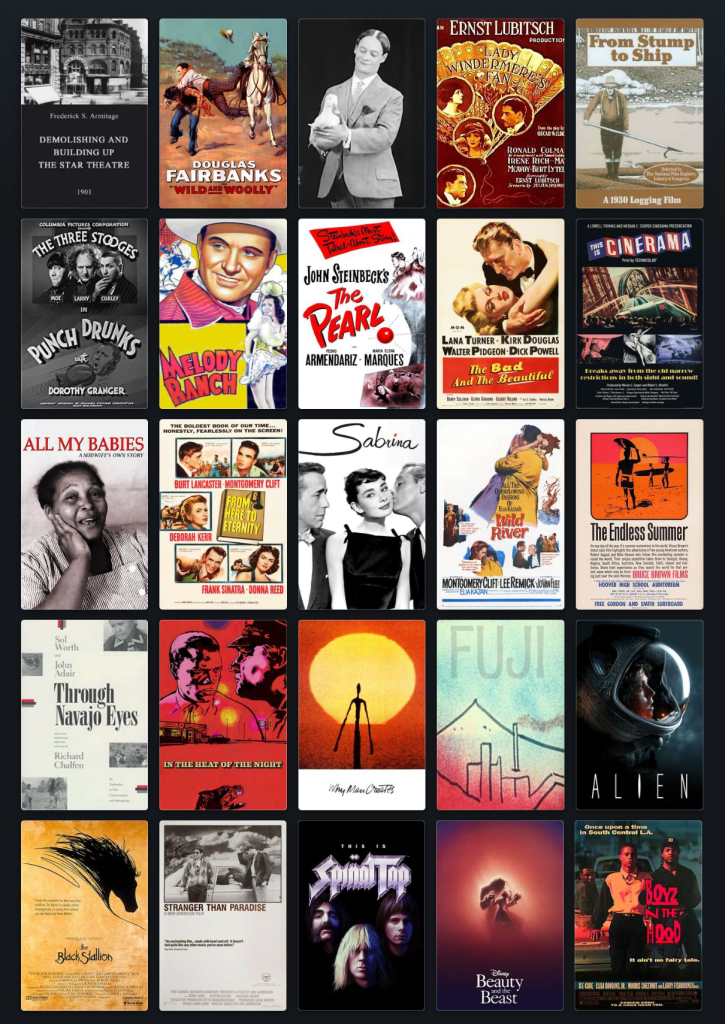
It’s that time of year again, say it with me now: National Film Preservation Board meetings regarding public nominations for the National Film Registry season! Of the thousands of films considered by the board every year for the NFR, here are the 50 I have nominated for the Class of 2025. Films with * next to them indicate films I am nominating for the first time. In arbitrary categorization, they are: 

The Five-Timers Club: Creature from the Black Lagoon (1954), Witness for the Prosecution (1957), The Great Escape (1963), It’s a Mad, Mad, Mad, Mad World (1963), Original Cast Album: Company (1970), Alice Doesn’t Live Here Anymore (1974), 9 to 5 (1980), Clue (1985), The Sixth Sense (1999), Best in Show (2000), Hedwig and the Angry Inch (2001), Finding Nemo (2003)

Favorites: Advise and Consent (1962), F for Fake (1973), Edward Scissorhands (1990), The Player (1992), The Birdcage (1996), The Truman Show (1998), Eternal Sunshine of the Spotless Mind (2004), There Will Be Blood (2007)

Animation: The Jungle Book (1967), Charlotte’s Web (1973)*, Aladdin (1992)*, The Incredibles (2004)*

Classic Hollywood: Three Ages (1923)*, Animal Crackers (1930)*, Mr. Deeds Goes to Town (1936)*, The Little Foxes (1941)*, The Picture of Dorian Gray (1945), The Ghost and Mrs. Muir (1947)*, Royal Wedding (1951)

The David Lynch Memorial Double Feature: The Elephant Man (1980), Blue Velvet (1986)

The Peter Bogdanovich Memorial Double Feature: What’s Up, Doc? (1972)*, Paper Moon (1973)*

How Have I Gone Almost Nine Years Without Ever Nominating These?: Dial M for Murder (1954)*, Barry Lyndon (1975)*, Footloose (1984)*, Glengarry Glen Ross (1992)*, Dazed and Confused (1993)*, Se7en (1995)*, Inception (2010)*

Grab Bag: Richard Burton’s Hamlet (1964)*, Duel (1971)*, Wall Street (1987)*, Rudy (1993)*, American Psycho (2000)*, Bowling for Columbine (2002)*

And finally, New for 2025: Carol (2015)*, Tangerine (2015)*

How many of my 50 will make the final list of 25? Five? Ten? All 50? Okay, maybe not all 50, but my record is still five in one year, and it’s a record I’d love to break if the NFPB is willing.

Happy Viewing, Happy Nominating, and pleeeeease keep taking care of each other,

Tony

#772) The Memphis Belle: A Story of a Flying Fortress (1944)

#772) The Memphis Belle: A Story of a Flying Fortress (1944)

Directed by William Wyler

Written by Wyler, Jerome Chodorov, and Lester Koenig

Class of 2001

The Plot: After flying 24 missions over France and Germany in World War II, an American B-17F bomber plane nicknamed Memphis Belle is assigned its 25th and final mission: bombing the Nazi forces in Wilhelmshaven, Germany. Knowing that this mission will conclude their tour of duty and send them home, the Belle crew, led by Captain Robert K. Morgan, is determined to succeed. But as the plane (and the rest of the 324th Bomb Squadron) flies over enemy territory, the prospect of victory takes an uncertain turn. From the director of “Mrs. Miniver” comes another bit of wartime rabble-rousing, this time documenting real-life pilots and a (mostly) true story.

Why It Matters: The NFR writeup is primarily a rehash of the film’s production, with praise going to Wyler’s directing and Koenig’s script. There’s also a link to view the film via the Library of Congress online screening room.

But Does It Really?: We are in the thick of this blog’s WWII era, and while I am definitely experiencing some wartime propaganda fatigue, I found “Memphis Belle” to be an intriguing watch. It’s still very much another bit of military propaganda, but “Memphis Belle” has a few things going for it. For starters, it’s in color; and with William Wyler at the helm, the narrative is more dramatic than the standard “good vs. evil” storyline (not by much, but it’s something). Also, by 1944, Allied victory seemed in reach, so “Memphis Belle” is more upbeat with the prospect of an end in sight, and therefore more watchable after the preceding uncertainties of titles like “Siege” and “Why We Fight”. A pass for “Memphis Belle”, Wyler’s key contribution to the war effort, and the film that gets me that much closer to being done with the NFR’s WWII entries.

Shout Outs: I’m pretty sure that is Flower, the effeminate skunk from “Bambi”, painted on the nose of a B-17 nicknamed “In Der Fuehrer’s Face”, featured briefly in the film’s opening. Makes sense, the plane’s nickname is also a Disney reference.

Title Track: The plane Memphis Belle got its name from its pilot, Captain Robert K. Morgan, as a tribute to his fiancée Margaret Polk. Originally to be named Little One (Morgan’s pet name for Polk), the name was changed after Morgan and copilot Captain James A. Verinis saw the Joan Blondell/John Wayne film “Lady for a Night”, which featured a steamboat named Memphis Belle (Polk hailed from Memphis, Tennessee). Side note: Morgan and Polk called off their engagement shortly after Morgan’s return to the U.S. in 1944, but the two remained friends, and Polk was among those who actively campaigned for the plane’s preservation following the war.

Seriously, Oscars?: Although “Memphis Belle” played a theatrical run, it did not receive an Oscar nomination. For the record: 1944’s Best Documentary Short went to a film from the U.S. Marine Corps: “With the Marines at Tarawa”.

Other notes 

  • Following the successful release of “Mrs. Miniver” in summer 1942, director William Wyler volunteered with the U.S. Air Force, serving as a major and directing two documentaries, the first of which was “Memphis Belle”. Wyler originally planned to chronicle the bomber Invasion 2nd with the 401st Bomb Squadron, but sadly it was shot down over Germany in April 1943. Wyler selected the Memphis Belle because he liked the name, and given the successful track record of Morgan and his men, Wyler felt the plane had “a pretty good chance of coming back.” Even then, Wyler had another film crew discreetly working with the 303rd Bombardment Group and their Hell’s Angels bomber just in case something happened to the Belle.
  • The Memphis Belle was one of 12,000 B-17F bomber planes manufactured by Boeing in 1942 alone, completing construction that July and arriving at an RAF base in Cambridgeshire, England that October. The “Flying Fortress” of the title was coined by Seattle Times reporter Richard Williams who, upon seeing the first B-17 in 1935, described it as a “15-ton flying fortress”, a phrase quickly copyrighted by Boeing.
  • While the Memphis Belle did fly a mission over Wilhelmshaven in May 1943, not all of the footage in “Memphis Belle” was from that mission. Some of the footage was shot during an earlier mission over Wilhelmshaven done by the Jersey Bounce the previous February, with additional footage taken from the Belle’s other missions over France around the same time. Tragically, it was during one of these France missions in April 1943 when one of the Belle’s fellow bombers – nicknamed Daisy Mae – was shot down, killing among others this film’s co-cinematographer Harold J. Tannenbaum.
  • All this background out of the way, the film proper is quite engaging. The stakes are set up well without hitting you over the head with anything, and the footage, especially the aerial shots of the planes, is breathtaking. Wyler succeeds at making you feel as if you’re in the middle of the action, and I was on the edge of my seat during the second half wondering what will happen to everyone. 
  • The narrator of “Memphis Belle” is Eugene Kern, best known as…the narrator of “Memphis Belle”. Seriously, this is his only film credit; I have no idea who this guy is. There’s also a point where another narrator slips in, and that appears to be Art Gilmore, previously mentioned on this blog for lending his voice to fake FDR in “Yankee Doodle Dandy”.
  • This film doesn’t shy away from the casualties of war, showing us that while the Memphis Belle made it back, its crew was badly injured, with at least one member killed in action. The drama of this moment is undercut a hair by one surviving crew member receiving a life-saving blood transfusion while smoking a cigarette.
  • Surprise guest stars: The King and Queen of England! King George VI and consort Queen Elizabeth (better known later on as The Queen Mother) travel to the base to congratulate the Belle’s surviving crew members. For those of you keeping track on the King George VI historical drama timeline, this would be four years after he was Colin Firth in “The King’s Speech” and about three years before he was Jared Harris in “The Crown”.
  • This all begs the question: Will the NFR ever run out of WWII footage? I mean, there has to be a finite amount, right?

Legacy 

  • A final cut of “Memphis Belle” was screened for President Franklin Roosevelt, who enthusiastically urged that the film receive nationwide distribution. Paramount Pictures picked up the distribution rights, and “Memphis Belle” held its premiere in Memphis on April 4th, 1944, with a national release nine days later.
  • William Wyler made one more military-sanctioned film during the war: “Thunderbolt”, a documentation of the Twelfth Air Force stationed in Italy. “Thunderbolt” was filmed in 1944, but due to a variety of technical and legal issues didn’t get released until 1947. Upon his return home from the war, Wyler’s first studio feature was “The Best Years of Our Lives”, a film whose influences can definitely be traced back to Wyler’s experience with Memphis Belle. Look no further than Dana Andrews’ performance as a traumatized former bombardier pilot.
  • The Memphis Belle got the dramatic film treatment once again in the 1990 film “Memphis Belle”. Directed by Michael Caton-Jones and co-produced by William’s daughter Catherine Wyler, “Memphis Belle” is a fictionalized version of the Belle’s final mission. Upon its release, the film received mixed reviews from critics, who agreed that the film was good, but also felt it was bogged down by a generous helping of war movie cliches.
  • As for the plane itself: After its final mission, the Memphis Belle returned to America for a six month, 31-city war bond tour. The Belle eventually ended up on display in Memphis, Tennessee near the city’s fairgrounds. Decades of neglect led to the plane’s deterioration, with practically every instrument picked off by tourists over the years. Since 2018, a fully restored Memphis Belle has been on display at the National Museum of the United States Air Force in Dayton, Ohio, where it was unveiled on the 75th anniversary of its final mission.

Further Viewing: While working on a film restoration of “Memphis Belle”, filmmaker Erik Nelson discovered 90 hours of outtake footage Wyler shot of the Belle and her crew in the US National Archives. Nelson turned these outtakes into the 2018 documentary “The Cold Blue”.

#771) Cicero March (1966)

#771) Cicero March (1966)

Filmed by Mike Shea and Mike Gray

Class of 2013

In the summer of 1965, Civl Rights leader Martin Luther King Jr., activist James Bevel, and Chicago teacher Al Raby joined forces to create the Chicago Freedom Movement (CFM) in an effort to end racial discrimination practices in Chicago’s housing, education, and employment systems. The CFM’s non-violent marches were met with extreme hostility from Chicago’s predominantly White population, with Dr. King calling the attacks on these marches worse than similar altercations he had experienced in the south. Following a particularly violent march in July 1966, Dr. King met with Chicago city leaders the following month and reached an agreement for the city to enforce desegregation and open-housing laws, on the condition that King not attend a planned march in the all-White suburb of Cicero that September. Although the CFM withdrew their plans for the Cicero march, the Chicago branch of the Congress on Racial Equality (CORE), unhappy with King’s agreement with the city, didn’t back down. On Sunday September 4th, 1966, CORE Chicago chapter leader Robert Lucas led 250 protesters on a march through Cicero, where they were met by escalating jeers from the White citizens. Among the protestors were filmmakers Mike Shea and Mike Gray of The Film Group, capturing the chaos of the day cinema verité style with a single camera. “Cicero March” is the only known footage documenting what happened that day, an event that inched America closer to the Civil Rights Act of 1968 (aka the Fair Housing Act).

In a brief eight minutes, “Cicero March” puts you in the middle of the proceedings, watching the seething racism of the White citizens, the struggles of the Black marchers to keep the peace, and the presence of countless police officers reach their natural boiling point. “Cicero March” is an unflinching account of an oft-overlooked chapter in Civil Rights history, giving you a true sense of what it must have been like to be there. As unsettling as it is watching this racist vitriol spewed in real time (and recognizing how little has changed in 60 years), I’m glad the NFR has found a place for “Cicero March” and the Cicero marchers among its ranks.

Why It Matters: The NFR write-up is a recap of the events leading to the march, and includes an essay by Chicago Film Archives founder Nancy Watrous.

Everybody Gets One: Founded by Mike Gray and Jim Dennett in 1964, The Film Group spent most of its decade-long existence specializing in local TV commercials and industrial shorts. There was the occasional dabble with something more experimental or au courant, and the Cicero march of 1966 was seen by the Film Group as an opportunity to get more documentary experience between gigs. Gray brought along The Film Group’s recently-hired photographer Mike Shea to the march, where Shea handled the film camera while Gray recorded sound.

Seriously, Oscars?: No Oscar nod for “Cicero March”. For the record, the 1966 Oscar for Best Documentary Short went to the more high-profile “A Year Toward Tomorrow”, narrated by Paul Newman and championing the recently founded Volunteers in Service to America (now known as AmeriCorps VISTA).

Legacy 

  • Immediately after the march, Shea and Gray returned to The Film Group and gave the footage to their intern/editor Jay Litvin. Though initially shelved, “Cicero March”, was later incorporated into a seven part educational series by the Film Group called “The Urban Crisis and the New Militants”, consisting primarily of footage shot during the 1968 Democratic Convention riots. Following the Film Group’s closure in 1973, “Cicero March” (and most of The Film Group’s library) was donated to the Chicago Public Library’s film collection. 
  • In 2005, a print of “Cicero March” was donated to the Chicago Film Archives by Film Group member William Cottle, and was preserved by the Archives with grants from the National Film Preservation Foundation. After being nominated for NFR consideration by the Archives in 2006 and 2008, third time was the charm for “Cicero March” in 2013, shortly after the death of Mike Gray that April.
  • Of the Film Group group, Mike Gray seems to have had the most prolific career, most notably co-writing the screenplay for 1979’s “The China Syndrome”. We’ll see more of Mike Gray and The Film Group went I get around to covering their other NFR entry: “The Murder of Fred Hampton”.

#770) Chicana (1979)

#770) Chicana (1979)

OR “Days of Bread and Roses”

Directed by Sylvia Morales

Written by Anna Nieto-Gómez

Class of 2021

As of this writing, you can watch “Chicana” on the Internet Archive.

The Plot: As the first organized Chicana movement gives way to a new generation, Sylvia Morales takes a look back on centuries of Latinas and their struggles in “Chicana”. Narrated by actor Carmen Zapata, “Chicana” is a celebration and examination of Latina women throughout history. Among them: the Great Mother of pre-Aztec culture, La Malinche’s intermediary work with the Spanish conquistadors, Josefa Ortiz de Domínguez’s support for the Mexican War of Independence, Emma Tenayuca leading the 1938 San Antonio pecan shellers strike, and many many more. Through paintings and poems, sights and sounds, “Chicana” highlights the hardships, the successes, and the ongoing legacy of these important women, as well as the modern-era women who follow in their footsteps.

Why It Matters: The NFR’s lengthy write-up on “Chicana” calls the film “a brilliant and pioneering feminist Latina critique”, chronicling the film’s production and subsequent restoration at UCLA.

But Does It Really?: As an NFR entry, “Chicana” ticks off a lot of boxes: a documentary short about a historically marginalized group made by a person of color with a UCLA connection; that’s a bingo. On its own merits, “Chicana” is an engaging history lesson, shining a light on women I’m embarrassed to admit I knew nothing about. While there is a bit of homework that needs to be done to fully appreciate this film, it’s a worthwhile viewing experience worthy of its NFR status. Plus, anyone who can effectively streamline 2000 years of Chicana history into 22 minutes deserves all the recognition they can get.

Everybody Gets One: While studying film at UCLA, Sylvia Morales got a job as a camera operator at KABC, which parlayed into work producing a series of documentary specials for the station. Around the same time, Morales took a Chicano Studies course taught by Anna Nieto-Gómez, which included a historical slide show of Mexican women. Surprised by how many of these women she had never heard of, Morales started doing additional research on her own film about Mexican women which became “Chicana” (with narration written by Nieto-Gómez).

Seriously, Oscars?: No Oscar nod for “Chicana”, though Sylvia Morales would receive an Emmy nomination in the 1990s for the documentary series “A Century of Women”. For the record: the 1979 Oscar for Documentary Short Subject was won by a film that wouldn’t be too out of place in the NFR: Saul J. Turell’s “Paul Robeson: Tribute to an Artist”.

Other notes 

  • Our narrator is Carmen Zapata, one of those actors who never became a big-name star, but worked steadily in film, TV and theater for 50 years. Zapata also collaborated with a number of Hispanic actor organizations, including co-founding the Screen Actors Guild Ethnic Minority Committee. Even without seeing her, you can sense how seriously Zapata is taking her narrating duties, treating each subject with compassion and reverence. Currently, Ms. Zapata has one other NFR appearance: a brief cameo as the mother of the bride in “Boulevard Nights”. 
  • Shout out to Carmen Moreno, who composed the film’s score and plays the guitar throughout. Thanks to her upbeat score during the opening credits, I love this movie already, and we’re only two minutes in!
  • “Chicana” begins with the “nurturing woman” stereotype that generations of Mexican women have been expected to follow. This explanation is spoken during a shot of a woman toilet-training a child, which tells you what this movie thinks of that patriarchal nonsense.
  • My main takeaway from this movie was the dichotomy of how women are treated not just in Mexican culture, but across endless eras and societies. We simultaneously deify and condemn women for their mere existence. Heavy stuff, but it’s important to contemplate these big ideas, and I appreciate a film like “Chicana” for illustrating all this through a historical lens.
  • This whole post could be me talking about the various research rabbit holes I went down learning about the women highlighted in the film. As you can imagine, “Chicana” can only touch upon each of its subjects for a few fleeting moments, but I encourage you to look up any of these women whose stories pique your interest. One that definitely got my attention was La Malinche, the Nahua woman who, in addition to her aforementioned work as intermediary to Hernán Cortés, was enslaved by the Spanish conquistadors and bore Cortés a son, one of the first Mesitzos. While this film paints La Malinche in a positive light, she’s a bit controversial in Mexican history, with the argument that she “betrayed” the indigenous people of Mexico. That is some thin ice we’re skating on, but pivotal in the history of Mexican culture.
  • Catholics. Why is it always Catholics? The Spanish conquistadors of the 1500s brought Catholicism with them to the new world, and the religion continues to be a major factor in Mexican culture (according to their 2020 census, 78% of Mexico’s population identify as Catholic). Among the many unsung heroes depicted in this film is Juana Inés de la Cruz, a nun who wrote in the late 1600s advocating for women’s rights. Although this film implies that Sor Juana’s writings were burnt by a repressive church, that is most likely apocryphal. 
  • Since the film’s release almost 50 years ago, new information about many of these women have come to light. For example, labor organizer Lucia Gonzalez Parsons (aka Lucy Parsons) may not have been of Mexican descent. Information about her early years is spotty, and there are contradicting reports regarding her ethnic heritage (she was most likely African-American). Still, it’s nice to see her included in this historical line-up of important women.
  • Another figure I found interesting was Valentina Ramirez, who disguised herself as a man to fight in the Mexican Revolution, with modern historians giving her the nickname “The Mexican Mulan”. And yes, the hot sauce is named after her.
  • Our film ends by bringing us to the present (1979) with Morales’ brief interviews with activists Dolores Huerta, Alicia Escalante, and Francisca Flores, all of whom stress that the struggle and the fight for women’s rights continue. The film is bookended by a quote from poet James Oppenheim regarding the 1910s women’s suffrage movement: “Hearts starve as well as bodies, give us bread but give us roses.”

Legacy 

  • Sylvia Morales continues to write and direct for film and TV, has penned several books about filmmaking and Mexican history, and has taught film classes at USC. Morales’ most recent film is “A Crushing Love”, a sequel to “Chicana” focusing on the work-life balance of five Chicana activists (including Dolores Huerta and Alicia Escalante from this film).

#769) Chelsea Girls (1966)

“…Timmonsville…Whitmire…Winnsboro…Woodruff…York.”

Jesus, that took forever. Okay, what’s next?

#769) Chelsea Girls (1966)

OR “One Film, Two Film, Red Film, Blue Film”

Directed by Andy Warhol and Paul Morrissey

Written by Warhol and Ronald Tavel

Class of 2024

The Plot: Filmed at the iconic bohemian hotel in Manhattan’s Chelsea neighborhood, “Chelsea Girls” is twelve segments, each presented in one uncut 30 minute take, showcasing life in the Hotel Chelsea as depicted by a cast of Andy Warhol’s “Superstars”. Adding to Warhol’s trademark experimentation, the segments are projected side-by-side, with sequences overlapping each other in an attempt to capture the spontaneity and volatility of an artist community. But if you really want to know what this film is about, I would describe it as 194 minutes of my life I’m never getting back. Strap in kids, this one’s a doozy.

Why It Matters: The NFR claims that the film (which they call “The Chelsea Girls”) “encapsulates everything that makes a Warhol a ‘Warhol’”, praising it as “a time capsule of a downtown New York art scene that is long gone but not forgotten.”

But Does It Really?: Given the size of his pop culture footprint, I like that Andy Warhol has two films on the Registry…in theory. In practice, watching “Chelsea Girls” was one of the most irritating, unpleasant viewing experiences I’ve had for this blog. Nothing about this film worked for me: not the acting, not the scenarios, even the experimental juxtaposition wore thin on me, ultimately coming across as more “gimmicky” than anything else. In my previous Warhol post, I distilled his art down to the phrase “look closer”. If we apply this mantra to “Chelsea Girls”, I have looked closer at Warhol’s scene in its prime, and I hate it with a burning passion. I will allow “Chelsea Girls” on the NFR, but unless you’re really into Warhol and that era of pop art, you can skip this one.

Everybody Gets One: Co-director Paul Morrissey had already made a name for himself as a filmmaker and operator of the Exit Gallery cinematheque in the East Village when he met Andy Warhol in 1965. Impressed with his work, Warhol invited Morrissey  to collaborate with him on his film “Space”, the first of 11 films Morrissey made with Warhol at The Factory. Morrissey continued making low-budget films on his own in the ‘70s and ‘80s, and in his later years resented how much credit Warhol took for their collaborations. Less is known about this film’s co-writer Ronald Tavel, who spent most of his career as an Off-Broadway playwright specializing in what became known as “Theatre of the Ridiculous”.

Title Track: Since the film has no opening or closing credits, it is alternatively known in different write-ups and reviews as “Chelsea Girls” and “The Chelsea Girls”. Much like my “20/Twenty Feet from Stardom” conundrum, I’ve made my choice, ditched the “The” and gone with “Chelsea Girls”. It’s cleaner.

Other notes 

  • The Hotel Chelsea opened as a co-op in 1884, and from the onset attracted artists as tenants due to its proximity to several theaters in the Chelsea neighborhood. By the early 1960s, the building had been converted into an apartment hotel (with its initial 100 rooms broken up into almost 400), and like its surrounding neighborhood, had fallen on hard times. It was around this time that the hotel started renting rooms to several artists associated with Warhol’s Factory, as well as rock stars not allowed to stay at other hotels. In 1966, a few months before “Chelsea Girls” started filming, the Hotel Chelsea was named a historic New York landmark.
  • Andy Warhol conceived of what became “Chelsea Girls” in the summer of 1966. Warhol’s initial idea was a film split down the middle, with “all black on one side and all white on the other.” This concept would evolve into a more figurative interpretation in the final film, with the tone of each segment alternating between “lighter” and “darker”. Although Warhol had a specific order the segments would play in, projectionists were allowed to switch the audio from one to another at will, making each viewing of “Chelsea Girls” a unique experience.
  • In an attempt to streamline these notes, we are pairing up the film segments that spent most of their screen time in my viewing side by side. Titles are listed as they appeared on the screen from left to right.

Father Ondine and Ingrid/Nico in Kitchen

  • On your left is actor Ondine claiming to be a priest while having an inappropriate conversation with Ingrid Superstar. On your right is German supermodel Nico fixing her hair in her kitchen while spending time with her son Gerard. We are off and running with what to expect from this film, with your initial choices being either grating, amateur improv or mundane minutiae with no sound. Is there a third choice?
  • The sound in this film is terrible. I doubt that anyone is miked, which means unless you project, you sound like Charlie Brown’s teacher.
  • How long does it take to clip your bangs and brush your hair? Is she Marcia Brady?
  • I didn’t realize going in that each segment runs about 30 minutes, so you can imagine my frustration as both segments prattled on long after I had lost interest. Surely, these reels will run out of film, right? I found the Ondine & Ingrid sequence particularly annoying, and was relieved when it finally ended.

Boys in Bed/Brigid Holds Court

  • Things get slightly more interesting as Ed Hood and Rene Ricard lie in a presumed post-coital position in bed on the left, while Warhol favorite Brigid Berlin shoots up and makes phone calls on the right.
  • If nothing else, “Boys in Bed” gives us some light bondage and male nudity courtesy of Rene Ricard. Apparently Ricard was one of the few actors in the movie who actually lived in the Hotel Chelsea at the time of filming.
  • Brigid Berlin looks like a cross between Shelley Winters, Sandy Toksvig, and Large Marge. Yeah, that’s probably mean-spirited, but I have to take out my frustrations on this movie somehow. 
  • I suspect I would hate everyone in this movie. No, I will not elaborate.

Hanoi Hannah and Guests/Hanoi Hannah

  • At this point in the film, I started pretending that each of these segments was happening in real time at different parts of the hotel, like an experimental episode of “24”. This theory was immediately squashed with the joint appearances of Hanoi Hannah (Mary Woronov). Both the left and the right segments involve Hannah in her room with fellow superstar International Velvet; smoking, talking, fighting, dictating fake bulletins to American soldiers in Vietnam. Ya know, girl stuff.
  • I don’t know what the pecking order was among Warhol’s superstars, but Mary Woronov was clearly a favorite. Not only does she appear in at least four of these segments, she gets several extended close-ups as the camera stays tight on her face. I get it: with her stern eyebrows and striking features, Woronov always looks like she’s calculating or plotting, which is fun to project onto as an audience member. 
  • Of the actors in this movie, Mary Woronov would have the most prominent post-Warhol acting career, appearing in many a B picture and indie movie, most notably the 1982 black comedy “Eating Raoul”. She also shows up in an episode of “Faerie Tale Theatre”, which is where I know her from.

Marie Mencken [sic]/Mario Sings Two Songs

  • After the film takes a breather with an organic halfway point, we are back up and running with filmmaker Marie Menken holding court on the left and a return for the Boys in Bed on the right.
  • The Marie Menken episode is interesting because it’s the first of four segments filmed in color! And if the name Marie Menken sounds familiar, she is a fellow NFR filmmaker (see “Glimpse of the Garden”). My one question about her: Why is she so angry in this? Every time I look at the left side I see her yelling at someone in the room and brandishing a whip. Is this what life was like for her and her husband?
  • The Boys in Bed get a visit from drag performer Mario Montez, who as promised sings two songs from the Irving Berlin musical “Annie Get Your Gun”:  “They Say It’s Wonderful” and “I Got the Sun in the Morning”. As Montez finished the second number, I assumed that meant the segment would end. 20 minutes later my assumption turned into a desperate prayer.

Color Lights on Cast/Eric Says All

  • It’s easy to understand how these two got paired together: they’re both color film of lighting tests conducted in, I presume, Andy Warhol’s studio. An assemblage of superstars make up the tests on the left while Eric Emerson gives a weird, extended monologue on the right. 
  • Most of the lighting involves the very patriotic combination of red, white, and blue. There are a few moments when all three colors are flashed in quick succession, making it look like the cops have pulled this film over.
  • With his abundant hair and intense performance, mixed with the lighting effects, Eric looks like he’s about to start Willy Wonka’s “There’s no earthly way of knowing” monologue. What is this, a freakout?
  • The sad thing is, before watching “Chelsea Girls”, I had a favorable opinion of Andy Warhol. I wish someone had convinced him to play all 12 of these at once so that I could get this over with in 30 minutes.

Nico Crying/Pope Ondine

  • We end with the weirdest bookend ever. Nico and Ondine return, only now they’ve switched places: Nico on the left (and in color) quietly crying while light effects project on her face, and Ondine on the right giving an extended monologue about how he has become the new Pope.
  • This combination was even worse the second time around, because this time I knew what to expect. Nico just stands there without saying anything, while Ondine rages on about whatever the hell he’s talking about. This led to me becoming increasingly hostile towards the movie as there seemed to be no end in sight.
  • For the curious/masochistic, you can view the muted or partially muted sections of the film online: Nico in Kitchen, Brigid Holds Court, Hanoi Hannah and Guests, Hanoi Hannah, Marie Mencken, Mario Sings Two Songs, and Nico Crying.
  • One final thing worth noting: As soon as this film ended (abruptly, with no credits), I did something I don’t think I’ve ever done while watching a movie for this blog: I booed. I booed this move loud and long and clear. I hated “Chelsea Girls” more than I can describe in 2000 words, but no matter what I write about it here, I know that I can never hurt it as much as it hurt me.

Legacy 

  • After a successful run at the Film-Makers’ Cinematheque in late 1966, “Chelsea Girls” became the first “underground” movie to play a wide release (though primarily through smaller arthouses across the country). Despite mixed critical reception and being banned in Boston and Chicago, “Chelsea Girls” was Andy Warhol’s first financial success as a filmmaker. 
  • “Chelsea Girls” helped propel the popularity of the Hotel Chelsea, as did the presence of one of the hotel’s most famous residents: Bob Dylan. The freeform lifestyle depicted in this movie came to an end in the 1970s following a series of negative incidents in the hotel, including the tragic murder of musician Nancy Spungen by her boyfriend Sid Vicious in 1978. Throughout the decades the Hotel Chelsea has changed owners, and in 2022 completed its conversion to a luxury hotel, mirroring the gentrification of the Chelsea neighborhood.
  • I know I mentioned this in my “Empire” post, but it’s worth repeating: Andy Warhol made a guest appearance on a 1985 episode of “The Love Boat” where he reunites with a former Superstar played by Marion “Happy Days” Ross. God help me if “White Giraffe” ever makes the NFR.